
On August 26, 2026, the Second World Humanoid Robot Games completed its final competition day, and the closing ceremony brought a technology-and-sport gathering to a successful end. Across track and field, tennis, combat, and real-world scenario events, humanoid robots demonstrated rapid running, sharp turns, high-frequency rallies with human athletes, coordinated fighting moves, and long-sequence tasks in gardens, hotels, and family settings. The event did more than produce dramatic moments. It offered a clear lens through which the progress of humanoid robots could be observed as they move from specialized laboratories toward high-intensity athletic performance and complex, real-world environments.
The significance of the Second World Humanoid Robot Games lies in the range of tests it placed before humanoid robots. Some events measured speed and endurance. Others measured perception, prediction, balance, recovery after a fall, autonomous decision-making, and cooperation among multiple machines. In gardens, hotels, libraries, family rooms, and emergency-response settings, humanoid robots were asked to handle tasks that unfold over time and demand continuous interaction with unpredictable surroundings. The result was a portrait of a field that is no longer defined only by laboratory demonstrations. Humanoid robots are now being pushed through athletic extremes and practical workflows in the same competitive framework.
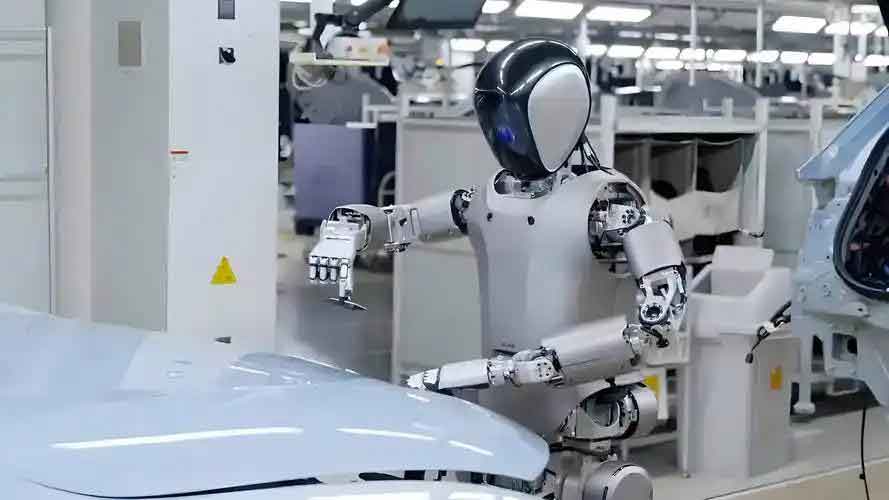
For humanoid robots, the arena became more than a stage. It became a proving ground where hardware, motion control, embodied intelligence, sensing, state estimation, and multi-machine coordination had to work together under pressure. The public could see humanoid robots sprint, turn, rally, fight, coordinate, and perform daily chores. Behind each visible action was a stack of technologies that must remain stable when conditions change. The Second World Humanoid Robot Games therefore served as both a showcase and a stress test for humanoid robots.
-
Closing Ceremony Caps a Technology-and-Sport Gathering
The closing ceremony marked the end of the final competition day and drew a complete arc around an event that combined elite technology with public spectacle. The schedule included athletics, tennis, combat, team performances, and scenario-based challenges. Humanoid robots ran like arrows released from a bow, turned with agility, exchanged tennis shots with human athletes, executed connected combat movements, and navigated complex environments in gardens, hotels, and homes. These images made the closing ceremony not merely a formal ending but a summary of how far humanoid robots have traveled.
The event also revealed a shift in how humanoid robots are evaluated. A single impressive movement is no longer enough. Humanoid robots must sustain performance, recover from errors, adapt to interruptions, and complete tasks without constant human intervention. The Second World Humanoid Robot Games placed these demands at the center of competition. In doing so, it reflected a broader transition in the field: humanoid robots are moving from isolated demonstrations toward integrated capability tests.
That transition matters because humanoid robots are expected to operate in environments built for people. Stairs, uneven pavement, moving obstacles, spoken instructions, safety rules, and social norms all shape real-world tasks. A humanoid robot that can run quickly in a controlled lane must also know when to slow down, how to avoid a collision, and how to respond to a person nearby. The games brought these concerns into public view, even as they celebrated record-breaking performances.
-
Track and Field: Humanoid Robots Rewrite Athletic Limits
The track and field events delivered some of the most visible breakthroughs. In the 100-meter sprint, a Tiangong robot from the Beijing Humanoid Robot Innovation Center recorded a time of 8.85 seconds, breaking the human record set by Usain Bolt. In the 1500-meter final, the Tianzhuo team won with a remarkable time of 2 minutes 21.63 seconds, more than one minute faster than the human men’s 1500-meter world record of 3 minutes 26.00 seconds. In standing high jump, 100-meter, and 400-meter events, humanoid robots also delivered performances that surpassed human bests, refreshing public understanding of motion control and physical limits.
These results should not be read as simple comparisons between machines and people. They are better understood as indicators of how rapidly humanoid robots are improving in balance, propulsion, energy management, and whole-body coordination. A running humanoid robot must manage impact forces, maintain stability, coordinate multiple joints, and regulate heat. When a humanoid robot completes a race at high speed, it demonstrates that these subsystems can operate together in a tightly timed sequence.
The track and field results also underlined the importance of simulation and learning. Humanoid robots do not learn to run by following a single fixed instruction. Their gaits are developed through repeated trials, often in virtual environments, where policies are optimized before being transferred to physical machines. The ability to generate stable motion across different speeds and surfaces is central to the future usefulness of humanoid robots.
Event Reported Result Stated Human Comparison Capability Demonstrated 100-meter sprint Tiangong robot from the Beijing Humanoid Robot Innovation Center recorded 8.85 seconds Broke the human record set by Usain Bolt High-speed locomotion, balance, joint coordination, motion control 1500-meter final Tianzhuo team recorded 2 minutes 21.63 seconds More than one minute faster than the human men’s 1500-meter world record of 3 minutes 26.00 seconds Endurance, gait stability, thermal management, energy efficiency Standing high jump, 100-meter, and 400-meter events Humanoid robots surpassed human bests, according to the event account Human bests surpassed Explosive power, dynamic balance, physical limit testing For humanoid robots, such results are not only athletic achievements. They are evidence that motion control systems can push machines into regimes once considered difficult for legged platforms. The track and field arena showed that humanoid robots can be fast, stable, and repeatable under competitive conditions. That combination is essential for future applications in logistics, inspection, emergency response, and service work.
-
The Algorithmic Engine Behind Humanoid Robots’ Running
Han Gang, a motion control algorithm expert at the Beijing Humanoid Robot Innovation Center, analyzed the improvement in athletic performance as a result of deep integration between motion control large models and reinforcement learning algorithms. This explanation places the achievements of humanoid robots in a broader technical context. The visible running style is not manually scripted joint by joint. Instead, it is generated through learning processes that explore many possible movements and select those that best meet the task.
According to Han Gang, the running posture displayed by humanoid robots during competition was an optimal solution autonomously evolved by algorithms after millions of iterations in a virtual physical world. That posture effectively reduced joint torque and heat loss, achieving maximum energy conversion efficiency. In other words, the way humanoid robots run is not merely aesthetic. It is a functional outcome of optimization, shaped by the need to move quickly while managing stress, temperature, and power consumption.
This insight is important for the future of humanoid robots. Real-world tasks rarely allow unlimited energy or perfect cooling. A humanoid robot that can move efficiently is more likely to operate for longer periods, carry useful payloads, and work safely near people. The algorithms behind running may also support walking, climbing, carrying, and recovering from disturbances. What appeared in the 100-meter and 1500-meter events therefore has implications far beyond the track.
The combination of large models and reinforcement learning also suggests that humanoid robots will continue to improve as data and simulation scale. The challenge is not only to discover a successful motion once, but to make that motion robust across changing terrain, payloads, and task demands. The Second World Humanoid Robot Games provided a public benchmark for that ongoing effort. Humanoid robots are learning not just to move, but to move well.
-
Tennis: Perception, Anticipation, and Dynamic Gameplay
In the world’s first public human-robot tennis match, humanoid robots achieved serves, returns, saves, and even rapid recovery after falling. The match produced a world record of more than one hundred consecutive rallies. For humanoid robots, tennis is a difficult test because the ball arrives quickly, bounces unpredictably, and requires continuous adjustment. A player must perceive the ball, predict its path, move into position, time the swing, and recover for the next shot. Each of these steps must happen within a fraction of a second.
Wang He, founder and chief technology officer of Galaxy General Robot, said that complex, high-dynamic sports such as tennis place extremely high demands on the perception, anticipation, and dynamic game abilities of humanoid robots. The tennis event therefore represented more than entertainment. It was a live examination of how well humanoid robots can integrate sensing, decision-making, and whole-body control in an adversarial setting.
Wang He also noted that safely and sustainably completing high-intensity competition and scenario tasks will become an inevitable trend for humanoid robot events and technology development. This view connects the tennis court to the factory floor, the hospital corridor, and the home. The same abilities that allow a humanoid robot to return a ball may allow it to catch a falling object, avoid a moving person, or adjust its grip when a task changes.
The tennis match also highlighted recovery. A humanoid robot that falls and then stands up quickly demonstrates resilience and control. In real environments, falls and near-falls are risks that must be managed. The ability to recover without human assistance is a practical milestone for humanoid robots. The public match showed that this milestone is now part of competitive performance.
-
Team Events and Swarm Coordination
Team events added another dimension. Xu Zhiyuan, head of motion control at the Beijing Humanoid Robot Innovation Center, pointed to cheerleading as an example of how humanoid robots have achieved a closed loop of three major capabilities. These capabilities move beyond the performance of a single machine and into the coordination of multiple humanoid robots.
- Autonomous odometry and state estimation without an external base station
- Multi-machine swarm cooperative control unified by a platform central scheduler
- Stable reproduction of high-difficulty movements such as jumping and turning
According to Xu Zhiyuan, the competition validated the base-station-free swarm performance of humanoid robots and laid a technical foundation for applications in event activities, cultural tourism, and commercial scenarios. This is significant because many real-world deployments will involve more than one robot. A group of humanoid robots may need to move together, avoid collisions, share space with people, and synchronize actions without relying on fixed infrastructure.
Swarm coordination for humanoid robots is more complex than for simple mobile platforms. Each humanoid robot has a tall, articulated body with many degrees of freedom. Coordination must account for balance, foot placement, arm movement, and timing. When several humanoid robots perform together, small errors can compound. The fact that the games included such performances shows that coordination algorithms are maturing.
The team events also suggest a path toward commercial entertainment and public experiences. Humanoid robots that can perform synchronized routines may appear in theme parks, exhibitions, cultural venues, and live shows. But the same coordination stack could also support warehouse teams, inspection crews, and emergency-response units. The Second World Humanoid Robot Games gave these possibilities a visible form.
-
Scenario Competitions: From Athletic Limits to Real Work
If the athletic events tested the physical limits of humanoid robots, the scenario competitions tested their ability to enter real production and daily-life environments. These events were designed around tasks that people perform in gardens, families, libraries, hotels, and emergency situations. The challenges were not limited to one action. Humanoid robots had to understand a scene, make decisions, and complete long sequences of steps.
In the outdoor garden scenario, the environment included trees and uneven paths, creating a serious test for humanoid robots. During the competition, a humanoid robot was able to scan and identify a camping cart carrying prohibited items such as a portable gas stove, and then issue a voice reminder. It could also automatically recognize uncivilized behavior, such as lying on a seat, and offer a civil persuasion. These tasks required perception, classification, speech interaction, and socially appropriate response.
Liu Rujie, a relevant person in charge at Fujitsu Research and Development (China), told reporters that the garden scenario is a good technology testbed. It allows comparison between laboratory simulation and real environments, helps identify shortcomings during actual operation, and accumulates valuable measured data for subsequent algorithm iteration. For humanoid robots, this kind of feedback loop is essential. Simulation can generate scale, but reality provides the noise, variation, and unexpected events that shape robust systems.
In the family scenario, humanoid robots demonstrated the ability to complete high-complexity, long-process tasks such as folding clothes and organizing items, drawing attention and praise from the audience. The games also included library, hotel, and emergency firefighting work scenarios. Each setting imposed different constraints. A library may require quiet movement and careful object handling. A hotel may require navigation among guests and luggage. Emergency firefighting may require rapid response under uncertainty. Humanoid robots must adapt their behavior accordingly.
These scenario competitions revealed that the value of humanoid robots is not limited to athletic display. The ability to fold clothes, organize a room, identify a hazard, or guide a person is closer to the daily usefulness that will determine adoption. Humanoid robots are being asked to become helpers, not just performers. That shift places new demands on reliability, safety, and human-robot interaction.
-
Autonomy Rules Reward Independence
The rules of the scenario competitions placed special emphasis on autonomy and practicality. The event stipulated that the score weight for fully autonomous methods was 1.0, while the weight for teleoperation was only 0.5. The coefficient difference was therefore double. This rule was not a minor technical detail. It signaled a clear direction for the development of humanoid robots.
Gong Xiao, a member of the event organizing committee and deputy director of the China Software Testing Center, pointed out that this rule was set precisely to guide humanoid robots away from dependence on manual intervention. The goal is for humanoid robots to possess genuine autonomous perception and decision-making capabilities and to become good helpers for humans. In other words, a humanoid robot that completes a task only because a person controls it remotely has not yet solved the core problem.
Autonomy is difficult because real environments are open-ended. A humanoid robot may encounter an object it has never seen, a person who behaves unexpectedly, or a path that is blocked. It must decide what to do, when to stop, and how to ask for help if necessary. The weighting of autonomous performance in the games reflected the understanding that humanoid robots must eventually operate with limited supervision.
For humanoid robots, autonomy also has safety implications. A machine that acts independently near people must understand boundaries, avoid harm, and respond to commands. The scenario events tested these capabilities in a controlled but realistic way. By rewarding autonomy, the Second World Humanoid Robot Games encouraged teams to move beyond remote-controlled demonstrations and toward deployable systems.
-
Embodied Large Models and the Path to Generalization
Wang He analyzed that the leap in scenario difficulty powerfully tested the true capability boundary of embodied large models. Humanoid robots have the ability of “one brain, many uses.” This phrase captures an important ambition: a single embodied intelligence system should be able to support many tasks, rather than requiring a separate program for every action. A humanoid robot that can fold clothes, identify hazards, and coordinate with others may share underlying perception and decision-making models across those tasks.
At present, however, humanoid robots still face bottlenecks in data collection and cost-performance when operating in unfamiliar scenarios. Collecting enough real-world data is expensive and time-consuming. Building a robot that is both capable and affordable remains a challenge. These bottlenecks explain why scenario competitions are so valuable. They expose the gap between controlled demonstrations and open environments.
Wang He added that as the generalization ability of models improves, the cost of training new tasks will decline quickly. Generalization means that a humanoid robot can draw inferences from what it has learned and apply that knowledge to new situations. Instead of training from zero for every new object or room, the robot can transfer skills and adapt. This is a central goal for humanoid robots because no company can pre-program every possible real-world scenario.
Humanoid robots are therefore accelerating away from preset scripts and moving from the competition test field toward broad real application scenarios. The Second World Humanoid Robot Games provided a structured environment for measuring that transition. The events did not solve every problem, but they made the direction visible. Humanoid robots are becoming more general, more autonomous, and more capable of learning from experience.
-
From Arena to Future: What the Second Games Signaled
The cheers of the arena have temporarily stopped, but the pace of development in the humanoid robot industry has not stopped. From the刷新 of athletic limits to breakthroughs in diverse scenarios, the Second World Humanoid Robot Games witnessed an astonishing transformation in technology and outlined a future blueprint of human-machine symbiosis and intelligent empowerment. The event showed that humanoid robots are not only objects of research. They are becoming participants in sport, service, and daily life.
For humanoid robots, the next stage will be defined by deployment. Can a humanoid robot work reliably for hours? Can it handle a task when the lighting changes, the floor is uneven, or a person interrupts? Can it recover from mistakes without causing harm? These questions will determine whether the achievements seen in competition can be translated into everyday value. The games offered early answers, but they also made clear that much work remains.
The integration of motion control, embodied large models, perception, autonomy, and multi-robot coordination will continue. Humanoid robots will need better energy systems, safer physical interaction, more efficient learning, and stronger evaluation standards. The Second World Humanoid Robot Games contributed to this process by creating a public arena where capabilities could be compared and tested. It also helped the public see humanoid robots as more than distant laboratory prototypes.
The future of humanoid robots will not be built by a single breakthrough. It will emerge from many improvements that reinforce one another. A faster gait may support better balance. Better perception may support safer autonomy. Better autonomy may support longer task sequences. Longer task sequences may generate more data. More data may improve generalization. The games accelerated this cycle by concentrating attention, talent, and competition into a few days of intense performance.
-
At a Glance: Event Categories and Demonstrated Capabilities
The Second World Humanoid Robot Games covered a wide spectrum of abilities. The table below summarizes the major categories and the capabilities they highlighted for humanoid robots.
Category Examples Capabilities Shown Direction for Humanoid Robots Track and field 100-meter sprint, 1500-meter final, standing high jump, 400-meter events Speed, endurance, explosive power, balance, whole-body motion control Pushing physical limits and improving robust locomotion Tennis Public human-robot rallies, serves, returns, saves, recovery after falls Perception, prediction, dynamic interaction, rapid recovery Safe high-intensity interaction with people and moving objects Combat Connected and fluid fighting movements Control, coordination, stability under dynamic contact Dynamic whole-body control and resilience Team events Cheerleading and synchronized performances Base-station-free odometry, state estimation, multi-robot cooperation, difficult movement reproduction Swarm performance, cultural tourism, commercial events Scenario competitions Garden, family, library, hotel, emergency firefighting Autonomous perception, decision-making, long-sequence task completion Real-world service, assistance, and work Autonomy rules Fully autonomous score weight of 1.0 versus teleoperation weight of 0.5 Independence, practicality, reduced human intervention Deployable humanoid robots that can act on their own This overview shows why the Second World Humanoid Robot Games mattered for humanoid robots. The event was not a single contest but a multidimensional examination. It joined athletics with service tasks, individual performance with team coordination, and remote control with autonomy. For humanoid robots, the combination is more important than any single result.
The closing of the Second World Humanoid Robot Games marks a moment of transition. Humanoid robots have shown that they can sprint beyond human records, rally with human athletes, recover from falls, coordinate in groups, and perform long tasks in complex settings. They have also shown where challenges remain: generalization, data collection, cost-performance, safety, and true autonomy. The event did not claim that all problems are solved. Instead, it demonstrated that humanoid robots are advancing on many fronts at once.
For the industry, the message is clear. Humanoid robots are moving from isolated laboratory achievements toward integrated systems that must function in the real world. The arena provided a rare public measure of that progress. The next phase will be judged not only by how fast humanoid robots can run or how spectacular their performances appear, but by how reliably, safely, and usefully they can work alongside people. The Second World Humanoid Robot Games offered a vivid preview of that future, and it showed that humanoid robots are closer to it than many observers might have expected.