
The relentless innovation and breakthroughs in artificial intelligence are catalyzing a profound shift: the transition of embodied intelligence from theoretical constructs and laboratory prototypes to practical, real-world applications. This evolution stands as a pivotal force poised to reshape the future paradigms of social production and daily life. Within this transformative wave, the humanoid robot emerges as a quintessential and critical embodiment of this intelligent physical form. Recognized globally as a flagship product of future industries, the development of humanoid robots represents a convergence point for national strategic focus, technological ambition, and commercial potential.
My analysis of the global landscape indicates a particularly vigorous and structured push in one major economy, where comprehensive policy frameworks are being deployed. From national-level strategic directives to local implementation guidelines, specialized policies for humanoid robots are providing multi-faceted support encompassing R&D, scenario application, data standardization, and financial incentives. This concerted effort aims to accelerate the industrial layout for humanoid robots. As a strategic emerging industry, the maturation of this sector, fueled by continuous technological breakthroughs and an improving industrial ecosystem, is expected to become a cornerstone in the construction of a modernized industrial system. A key indicator of this maturation is the accelerating pace of commercial deployment. Since a recent benchmark year, the journey towards viable commercialization has gained significant momentum, with the industrial sector experiencing frequent catalytic events. Empowered by this dual engine of policy support and technological advancement, the humanoid robot is demonstrating immense application potential across a diverse spectrum, including domestic service, industrial manufacturing, healthcare and rehabilitation, and educational entertainment.
The potential economic footprint of this technology is substantial. According to a seminal industry report released during a major national humanoid robot conference, the market scale is projected to follow a steep growth trajectory. The estimates can be summarized as follows:
| Year | Projected Market Size (CNY Billion) | Key Growth Characteristic |
|---|---|---|
| 2024 | ~26.5 (Base) | Establishment year for projection |
| 2025 | ~53 | Approximate 100% Year-on-Year Growth |
| 2029 | ~750 | High-growth phase |
| 2035 | ~3000 | Long-term maturation scale |
This anticipated explosive growth, captured by the compound annual growth rate (CAGR), can be conceptually modeled. If we consider the period from the base (B) to a future year (F), the CAGR can be expressed as:
$$ CAGR = \left( \frac{V_F}{V_B} \right)^{\frac{1}{n}} – 1 $$
where \( V_B \) is the base value, \( V_F \) is the future value, and \( n \) is the number of years. The projected figures suggest a very high CAGR in the initial decades, reflecting intense market optimism. This optimism is also mirrored in capital markets, where growing attention on humanoid robot concepts has spurred significant investor interest.
The technological foundation of a humanoid robot is immensely complex, representing a synthesis of advancements in informatics, advanced manufacturing, new materials, energy systems, and even biotechnology. Its innovation cycle unleashes vast productive potential. The core value proposition of a humanoid robot lies in its ability to operate effectively in environments built for humans. This requires a seamless integration of perception, cognition, decision-making, and actuation. A simplified conceptual model for a single joint’s motion control, fundamental to bipedal locomotion and manipulation, often involves a Proportional-Integral-Derivative (PID) controller:
$$ u(t) = K_p e(t) + K_i \int_0^t e(\tau) \,d\tau + K_d \frac{de(t)}{dt} $$
where \( u(t) \) is the control signal (e.g., torque), \( e(t) \) is the error between desired and actual position, and \( K_p, K_i, K_d \) are tuning constants. However, modern humanoid robot control heavily relies on more advanced model-based and learning-based algorithms for dynamic stability.
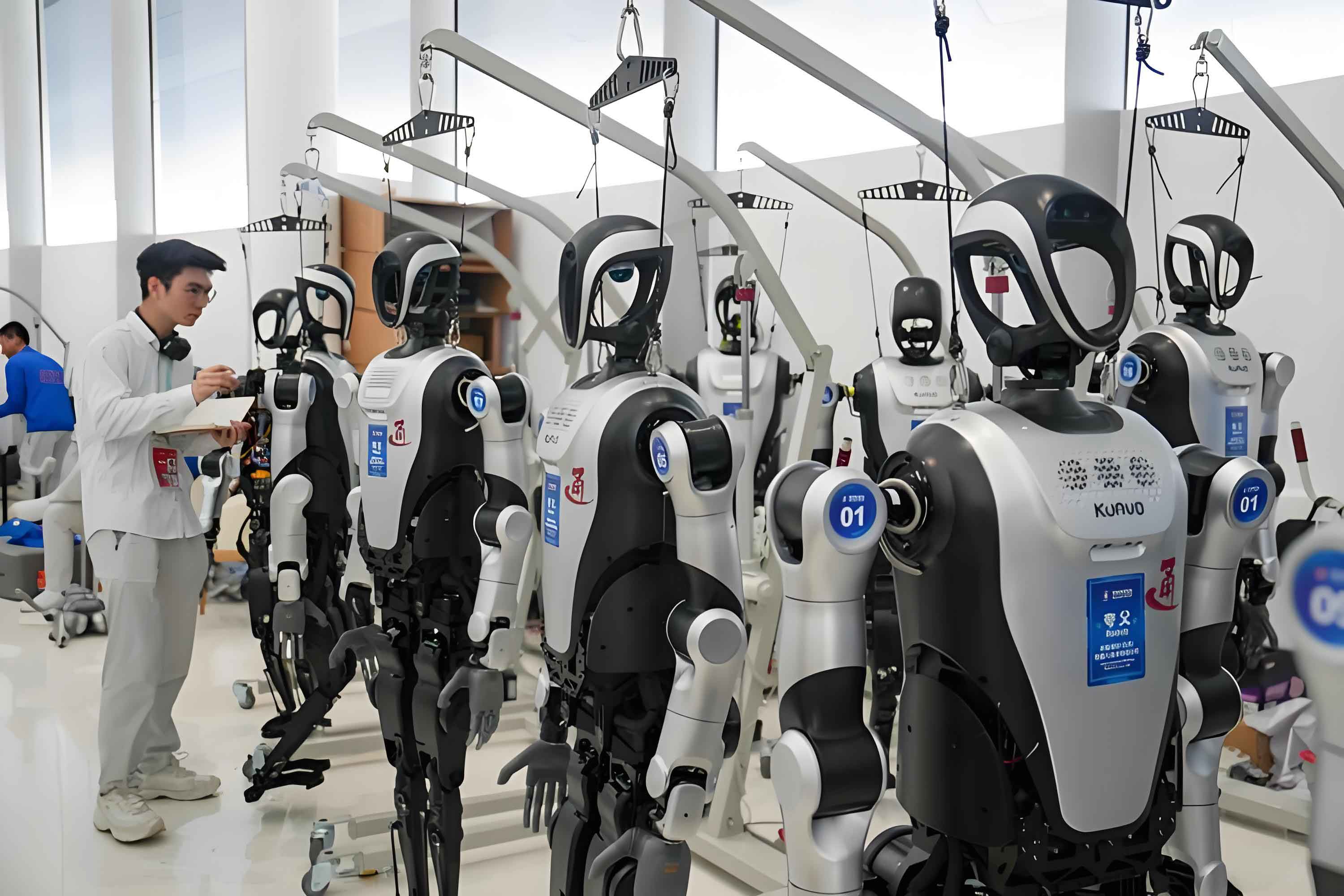
The path to perfecting this integration is layered with challenges across the entire technology stack. The table below outlines key components and associated hurdles.
| System Layer | Key Components | Primary Technical Challenges |
|---|---|---|
| Perception & Cognition | Vision (2D/3D), LiDAR, Tactile Sensors, Inertial Measurement Units (IMUs), AI Chips | Multi-sensor fusion in dynamic environments, real-time scene understanding, low-power high-performance computing. |
| Decision & Control | Motion Planning Algorithms, Whole-Body Control, Sim-to-Real Transfer Learning | Balancing dynamic locomotion on uneven terrain, dexterous manipulation of unknown objects, safe human-robot interaction. |
| Actuation & Power | Electric/ Hydraulic Actuators, Harmonic Drives, Torque Sensors, Battery Packs | High power-density actuators, energy efficiency for extended operation, thermal management, compliant control. |
| Structure & Materials | Lightweight Alloys, Carbon Fiber Composites, Synthetic Skins | Optimizing strength-to-weight ratio, durability under cyclic loading, cost-effective manufacturing. |
One promising and rapidly evolving application domain is security and surveillance. The inherent mobility, situational awareness, and potential for dexterous intervention of a humanoid robot allow it to transcend the limitations of fixed cameras and wheeled or tracked robots. In security contexts, the humanoid robot can patrol complex multi-level environments, navigate staircases, open doors, and perform basic inspection tasks that require a human-like form factor. The application potential extends beyond simple patrols to areas like emergency response in hazardous sites, where a humanoid robot could initially assess a situation. The market readiness and requirements for different security sub-fields vary, as analyzed below:
| Security Application | Current Maturity | Key Value Proposition of Humanoid Form | Primary Technical Hurdles |
|---|---|---|---|
| Facility Patrol & Inspection | Medium (Prototype/Initial Deployment) | Navigation in human-built environments (stairs, doors), standardized interfaces for manual overrides. | Long-duration autonomy, cost-effectiveness vs. simpler robots. |
| Emergency First Response | Low (R&D) | Access confined spaces, operate valves or tools designed for human hands, provide initial visual/audio assessment. | Extreme environment robustness, advanced manipulation under uncertainty. |
| Crowd Monitoring & Guidance | Low (Concept) | Non-threatening, approachable interface for public interaction, ability to move dynamically through crowds. | Advanced social AI, flawless safety protocols in dense human spaces. |
The economic rationale for deploying a humanoid robot in such roles can be framed by considering the total cost of ownership (TCO) and return on investment (ROI). A basic model for ROI over a period of N years is:
$$ ROI = \frac{\sum_{t=1}^{N} \frac{B_t – C_t}{(1 + r)^t}}{I_0} $$
where \( I_0 \) is the initial investment in the humanoid robot system, \( B_t \) are the annual benefits (e.g., reduced labor costs, prevented losses), \( C_t \) are the annual operating costs (maintenance, power, updates), and \( r \) is the discount rate. The benefits \( B_t \) are challenging to quantify but include 24/7 availability, consistency, and access to hazardous areas.
Looking at the broader industrial ecosystem, the value chain for humanoid robots is extensive. It ranges from core components like precision reducers and servo motors to middle-layer operating systems and AI algorithms, and finally to integrators and end-users. The competition is fostering a dynamic landscape with technology giants, specialized startups, and automotive companies all vying for position. The development cycle for a new humanoid robot platform is governed by iterative design, testing, and refinement. The learning curve, which often leads to cost reduction, can be modeled by Wright’s Law or a simple experience curve:
$$ C_n = C_1 \cdot n^{-b} $$
where \( C_n \) is the cost of the \( n \)-th unit produced, \( C_1 \) is the cost of the first unit, \( n \) is the cumulative number of units produced, and \( b \) is the learning elasticity (a constant representing the rate of cost reduction).
As we project into the future, the trajectory for humanoid robots appears deeply intertwined with the broader proliferation of AI. Under this wave of AI democratization, embodied intelligent products, spearheaded by the humanoid robot, are expected to accelerate their entry into countless industries. This is particularly relevant for enterprises undergoing digital and intelligent transformation, where the humanoid robot could serve as a versatile automation platform on the factory floor, in warehouses, or for customer service. The ultimate, albeit longer-term, vision includes integration into domestic settings for complex assistance tasks.
However, the road to ubiquitous adoption is not merely technical. Significant challenges in cost reduction, safety certification, ethical governance, and public acceptance remain. The reliability of a complex system like a humanoid robot is a function of its component reliabilities. For a series system where failure of any key component fails the whole, system reliability \( R_s \) is:
$$ R_s = \prod_{i=1}^{n} R_i $$
where \( R_i \) is the reliability of component \( i \). This multiplicative relationship underscores the need for exceptional reliability in every subsystem, from actuators to control software, to ensure safe operation alongside humans.
In conclusion, the humanoid robot stands at a fascinating inflection point. It is transitioning from a symbol of advanced research to a tangible, policy-backed, and commercially pursued technological entity. While the near-term applications in controlled industrial and specific professional service domains like security are leading the charge for commercialization, the long-term vision remains profoundly transformative. The continued convergence of AI, robotics, and materials science will determine the pace at which the humanoid robot evolves from a sophisticated tool in enterprise and public service applications to a truly integrated part of our social and economic fabric. The journey of the humanoid robot is, in essence, the journey of giving physical form to artificial intelligence, and its progression will be a key narrative in the story of 21st-century technological evolution.