
As a representative of new quality productive forces, humanoid robots demonstrate immense application potential across various fields, including home services, industrial manufacturing, healthcare, education, entertainment, and security. Among these, the security sector is poised to become a significant market for humanoid robot deployment. In this article, I will analyze the application prospects, advantages, challenges, technological breakthroughs, and industrial synergies of humanoid robots in security from a first-person perspective, drawing on industry insights and trends.
The integration of humanoid robots into security systems marks a transformative shift toward automation and intelligence. These robots, with their human-like morphology, offer unique capabilities that can complement traditional security measures. I believe that as technology advances, humanoid robots will play an increasingly critical role in enhancing public safety and operational efficiency.
Current Application Stages and Estimated Output Scale
Currently, the deployment of humanoid robots in security is in the early exploration and pilot stages. While some companies have introduced security-focused humanoid robot products and tested them in specific scenarios, large-scale commercial adoption remains limited, with efforts primarily centered on demonstration and promotion. However, with rapid technological progress and accumulating case studies, the humanoid robot is on the verge of accelerated development in this field. Concurrently, as applications deepen, the output scale is expected to grow substantially. For instance, one automotive group’s third-generation embodied intelligent humanoid robot, GoMate, has undergone training in security contexts and plans small-batch trial production and sales this year, projecting an output value of around 10 million yuan. With more enterprises entering the market and rising demand, I estimate that within the next 5 to 10 years, the output scale for humanoid robots in security could reach tens of billions of yuan, emerging as a new growth driver for the intelligent security industry.
To summarize the stages, I present the following table:
| Stage | Characteristics | Examples | Estimated Timeframe |
|---|---|---|---|
| Exploration | Prototype development, limited trials | Pilot projects in controlled environments | Present – 2025 |
| Pilot Expansion | Small-batch production, scenario testing | GoMate and similar robots in training | 2025 – 2027 |
| Commercialization | Mass adoption, diversified applications | Widespread use in parks, airports, etc. | 2027 onwards |
The output scale can be modeled using a growth formula: $$ S(t) = S_0 \cdot e^{kt} $$ where \( S(t) \) is the output scale at time \( t \), \( S_0 \) is the initial scale (e.g., 10 million yuan), and \( k \) is the growth rate dependent on technological and market factors. Assuming \( k = 0.5 \) per year, the scale could exceed 100 billion yuan within a decade, underscoring the humanoid robot’s economic potential.
Exploration of Application Scenarios in Security
Humanoid robots, leveraging their unique advantages, are set to bring innovative changes to security. Many domestic robotics companies are accelerating exploration in this domain, with pilots showing promising results in various scenarios. Below, I detail key application areas where the humanoid robot excels.
First, in patrol and surveillance scenarios, humanoid robots can autonomously navigate preset routes in places like parks, transportation hubs, industrial zones, schools, and commercial centers. Equipped with cameras, sensors, and other devices, they collect real-time video, audio, and environmental data for comprehensive monitoring. Their bipedal locomotion allows them to traverse stairs, narrow passages, and other human-designed terrains, unlike wheeled robots. For example, a humanoid robot patrolling a campus can identify unauthorized access or suspicious behavior using computer vision algorithms.
Second, in public service and security coordination scenarios, humanoid robots can assist in libraries, museums, airports, and stations by providing咨询 and guidance while monitoring crowd flow, detecting suspicious individuals, and preventing incidents like stampedes. This dual role enhances both user experience and safety. The humanoid robot’s anthropomorphic design facilitates natural interaction with the public, making it an ideal interface for security-related tasks.
Third, in emergency response scenarios, humanoid robots can swiftly engage during fires, natural disasters, or other crises. They can guide trapped individuals to safety via autonomous navigation systems, conduct post-disaster reconnaissance in hazardous areas, and deliver救援物资. For instance, in earthquake zones, a humanoid robot could enter collapsed structures to assess damage and locate survivors, reducing risks to human responders.
Fourth, in hazardous area operations, humanoid robots can operate in易燃易爆 environments, mines, or other dangerous settings where human presence is risky. Their resilience to high temperatures and hazards enables them to perform tasks like patrols, equipment inspections, and safety checks. This not only protects human workers but also ensures continuous monitoring in extreme conditions.
As technology improves and costs decline, I foresee the humanoid robot expanding into additional security domains, such as counter-terrorism, border control, and critical infrastructure protection. The following table categorizes these scenarios:
| Scenario | Key Tasks | Humanoid Robot Advantages | Potential Impact |
|---|---|---|---|
| Patrol and Surveillance | Autonomous巡逻, real-time monitoring | Adaptability to complex terrains, 24/7 operation | Reduced manpower needs, enhanced coverage |
| Public Service Coordination | Guidance, crowd monitoring, anomaly detection | Human-like interaction, multi-tasking ability | Improved safety and user satisfaction |
| Emergency Response | Disaster reconnaissance, evacuation assistance | Risk tolerance, mobility in debris | Faster response, minimized human danger |
| Hazardous Operations | Inspections in dangerous zones | Durability, precision in extreme conditions | Enhanced safety compliance |
To quantify performance in these scenarios, we can use metrics like detection accuracy \( A_d \) and response time \( T_r \), modeled as: $$ A_d = \frac{TP + TN}{TP + TN + FP + FN} $$ where \( TP \), \( TN \), \( FP \), and \( FN \) are true positives, true negatives, false positives, and false negatives, respectively. For a humanoid robot, improving \( A_d \) through advanced sensors is crucial.
Advantages and Significance of Deployment
The deployment of humanoid robots in security offers several distinct advantages. First, their高度仿生 design enables adaptation to complex environments. Unlike specialized robots, the humanoid robot can navigate human-centric infrastructures like stairs and doors, making it versatile for urban and indoor settings. Second, they possess strong perception and decision-making capabilities. With sensors such as cameras, microphones, and LiDAR, coupled with AI algorithms, humanoid robots can analyze multi-dimensional data in real-time, enabling precise actions. For example, using deep learning, a humanoid robot can identify a trespasser amidst clutter with high accuracy. Third, they enhance human-robot collaboration efficiency. The humanoid form fosters intuitive interaction, allowing seamless teamwork with security personnel—for instance, in coordinated patrols where the robot handles routine scans while humans focus on complex interventions.
The significance of deploying humanoid robots in security is multifaceted. It elevates security efficiency and quality by automating tasks, enabling 24/7 surveillance, and reducing incident probabilities. Mathematically, if \( \lambda \) represents the incident rate, deployment can lower it as: $$ \lambda_{\text{new}} = \lambda_{\text{old}} \cdot (1 – \eta) $$ where \( \eta \) is the efficiency gain from humanoid robots, often ranging from 0.2 to 0.5 based on pilot data. Moreover, it expands security application scenarios, covering areas previously inaccessible to traditional methods. Finally, it drives industry transformation from “human + physical” defense to intelligent, automated systems, fostering technological升级.
I have compiled the advantages into a comparative table:
| Advantage | Description | Impact on Security |
|---|---|---|
| Environmental Adaptation | Bipedal locomotion for human-built spaces | Wider deployment in diverse settings |
| Perception and Decision-Making | Multi-sensor fusion, AI-driven analysis | Accurate threat detection and response |
| Human-Robot Collaboration | Natural interaction, task分工 | Enhanced operational synergy |
The humanoid robot’s role in security is not just incremental; it represents a paradigm shift toward proactive, intelligent protection.
Difficulties and Challenges in Deployment
Despite the promise, deploying humanoid robots in security faces hurdles in safety, technology, cost, and regulations. From my perspective, addressing these is critical for widespread adoption.
First, safety concerns are paramount. Physically, a humanoid robot might cause harm due to motion control errors or malfunctions—for example, losing balance and colliding with people. This risk necessitates robust fail-safe mechanisms. Digitally, the vast data collected, including video and personal information, poses privacy and security threats if breached. Ensuring data encryption and access controls is essential to prevent misuse.
Second, technological研发 requires breakthroughs. Motion control remains complex; achieving stable, natural walking involves intricate dynamics. The equation of motion for a humanoid robot can be expressed as: $$ M(q)\ddot{q} + C(q,\dot{q})\dot{q} + G(q) = \tau $$ where \( q \) is the joint angle vector, \( M \) is the mass matrix, \( C \) represents Coriolis forces, \( G \) is gravity, and \( \tau \) is the torque. Solving this in real-time for diverse terrains is challenging. Additionally, AI algorithms have limitations in low-light or crowded environments, leading to误判. Improving target recognition accuracy, currently around 85-90% in trials, to over 95% is a key goal.
Third, high研发 and production costs hinder scalability. Humanoid robots integrate advanced hardware (e.g., high-precision actuators, sensors) and software (AI, control algorithms), each环节 adding expense. Core components like motors and drives remain costly, and without mass production, economies of scale are unrealized. A cost breakdown can be shown as: $$ C_{\text{total}} = C_{\text{R&D}} + C_{\text{materials}} + C_{\text{manufacturing}} $$ where \( C_{\text{R&D}} \) dominates early stages, often exceeding millions per unit.
Fourth, regulatory and ethical issues loom. Legal frameworks for humanoid robot usage in security are lagging, lacking standards on permissions, liability, and data protection. Ethically, the humanoid robot’s likeness raises concerns about privacy invasion and over-reliance on machines. The following table summarizes these challenges:
| Challenge Category | Specific Issues | Potential Solutions |
|---|---|---|
| Safety | Physical injuries, data breaches | Redundant controls, encryption protocols |
| Technology | Motion stability, AI accuracy in complex scenes | Advanced control algorithms, multimodal fusion |
| Cost | High R&D and component costs, limited scale | Material innovation, supply chain optimization |
| Regulatory & Ethical | Lack of laws, privacy concerns, ethical dilemmas | Standard development, public engagement |
I estimate that overcoming these challenges will require concerted efforts across industry and academia, with the humanoid robot’s success hinging on holistic innovation.
Technological Breakthroughs and Innovation Directions
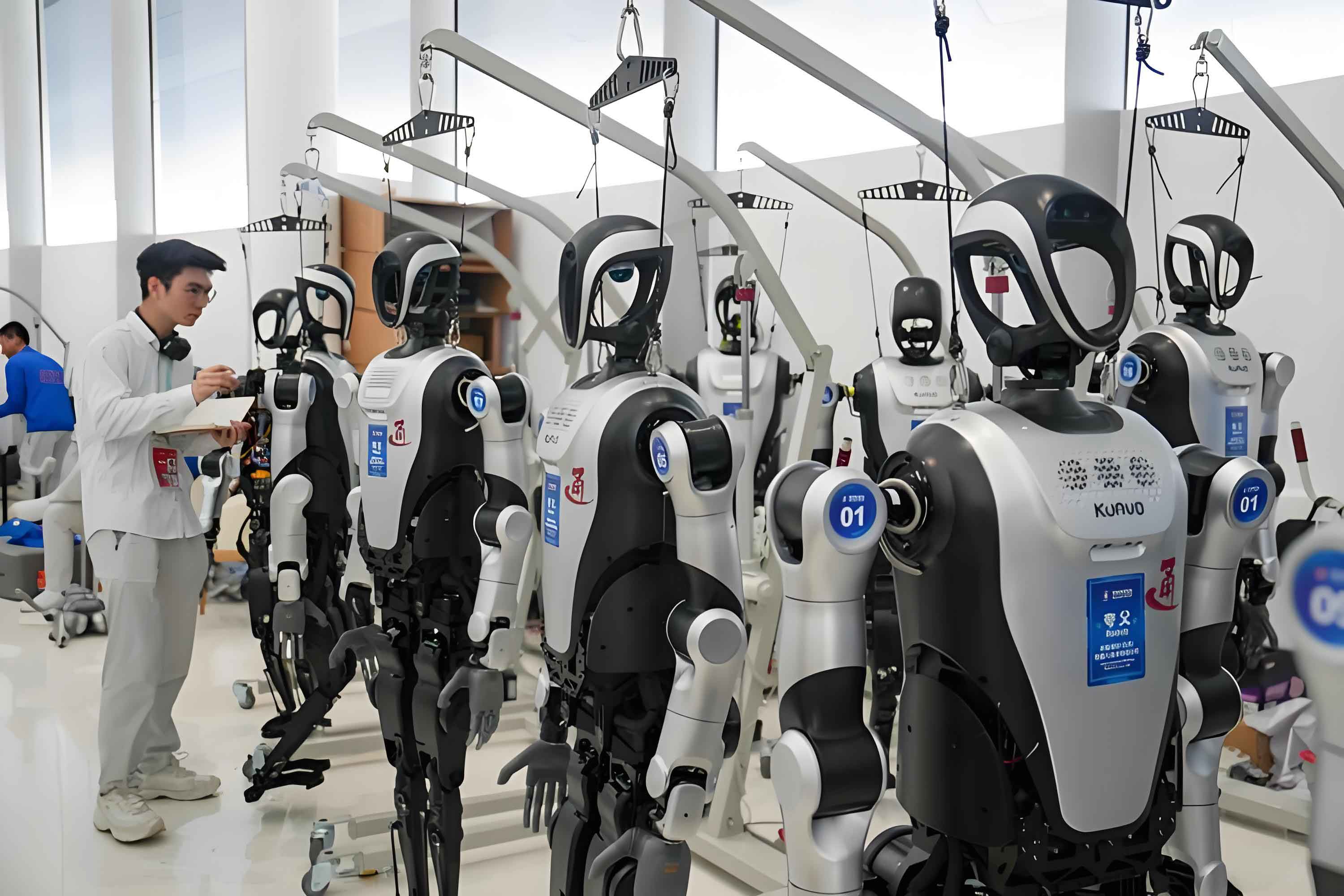
To accelerate deployment, I propose focusing on several technological攻关 areas for the humanoid robot. These include materials, energy, navigation, anomaly handling, human-robot interaction, motion control, AI, and cybersecurity.
First, lightweight and high-strength materials are crucial. Using composites or alloys can reduce weight \( m \) while maintaining strength \( \sigma \), optimizing the power-to-weight ratio: $$ PWR = \frac{F}{m} $$ where \( F \) is force output. This enhances agility and续航. Second, energy management and endurance breakthroughs are needed. Developing high-efficiency batteries and energy回收 systems can extend operational time \( T_{\text{op}} \), modeled as: $$ T_{\text{op}} = \frac{E_{\text{battery}}}{\eta_{\text{system}} \cdot P_{\text{avg}}} $$ where \( E_{\text{battery}} \) is battery capacity, \( \eta_{\text{system}} \) is system efficiency, and \( P_{\text{avg}} \) is average power consumption. Targeting \( T_{\text{op}} > 8 \) hours is essential for all-day security tasks.
Third, navigation, obstacle avoidance, and environmental perception require advancement. Techniques like BEV (Bird’s Eye View) and Transformer models can improve environmental modeling, while multi-sensor fusion (LiDAR, depth cameras) enhances perception accuracy. A fusion formula is: $$ P_{\text{fused}} = \alpha P_{\text{vision}} + \beta P_{\text{Lidar}} + \gamma P_{\text{audio}} $$ with weights \( \alpha, \beta, \gamma \) optimized via learning. Fourth, anomaly recognition and action处置 need refinement. Multimodal data fusion and deep learning can boost识别率, with systems autonomously storing event data for risk assessment.
Fifth, human-robot collaboration technology should foster natural interaction. Developing intuitive interfaces and协作 algorithms can improve teamwork efficiency \( \eta_{\text{collab}} \), defined as: $$ \eta_{\text{collab}} = \frac{T_{\text{task, human-robot}}}{T_{\text{task, human-only}}} $$ where values < 1 indicate time savings. Sixth, motion control and stability demand research on dynamics and control algorithms, as shown in the earlier equation, to ensure reliable performance on uneven surfaces.
Seventh, AI algorithms must be optimized for security contexts. Employing迁移学习 and reinforcement learning can enhance adaptability. For instance, a humanoid robot can learn from simulation to real-world transfer using: $$ \mathcal{L}_{\text{transfer}} = \mathcal{L}_{\text{sim}} + \lambda \mathcal{L}_{\text{real}} $$ where \( \mathcal{L} \) denotes loss functions. Eighth, cybersecurity防护 is vital; encryption and access control mechanisms must safeguard data integrity.
I summarize these directions in a table with key metrics:
| Innovation Area | Key Technologies | Target Metrics | Formulas/Models |
|---|---|---|---|
| Materials | Composites, lightweight designs | Weight reduction by 20%, strength maintained | $$ \sigma_{\text{new}} \geq \sigma_{\text{old}}, m_{\text{new}} \leq 0.8m_{\text{old}} $$ |
| Energy Management | High-density batteries, energy回收 | Operational time > 8 hours | $$ T_{\text{op}} = E / (P \cdot \eta) $$ |
| Navigation & Perception | BEV, sensor fusion, reinforcement learning | Obstacle avoidance accuracy > 98% | $$ P_{\text{fused}} = \sum w_i P_i $$ |
| Anomaly Recognition | Multimodal fusion, deep learning | Detection accuracy > 95% | $$ A_d = \frac{TP+TN}{Total} $$ |
| Human-Robot Collaboration | Natural interfaces, collaborative algorithms | Task efficiency improvement by 30% | $$ \eta_{\text{collab}} = 0.7 $$ |
| Motion Control | Dynamic models, control algorithms | Stability on slopes up to 30° | $$ \tau = M\ddot{q} + C\dot{q} + G $$ |
| AI Algorithms | Transfer learning, reinforcement learning | Adaptation time reduction by 50% | $$ \mathcal{L}_{\text{total}} = \mathcal{L}_{\text{base}} + \lambda \mathcal{L}_{\text{adapt}} $$ |
| Cybersecurity | Encryption, access control | Data breach probability < 0.1% | $$ P_{\text{breach}} = 1 – e^{-\lambda t} $$ |
Beyond technology, safety standards, ecosystem building, and supply chain development are critical. For the humanoid robot to thrive, we must establish规范和产业联盟, fostering collaboration among manufacturers, security firms, and researchers.
Ecosystem Collaboration and Industrial Chain Construction
The successful integration of humanoid robots into security hinges on robust ecosystem collaboration and industrial chain construction. From my experience, this involves standard-setting, partnership building, and supply chain optimization.
First, safety standards and regulations must be formulated. I advocate for尽快制定 guidelines covering design, manufacturing, and usage of humanoid robots in security. This includes technical specifications for motion control precision, fault protection, and data security, ensuring safe operation. For example, a standard could mandate that a humanoid robot’s emergency stop响应时间 be under 0.5 seconds, mathematically: $$ t_{\text{stop}} \leq 0.5 \text{ s} $$
Second, strengthening生态合作建设 is essential. This entails forming产学研 alliances among robotics companies, universities, and research institutions to drive innovation. Additionally, establishing industry consortia with stakeholders like chip makers and software developers can accelerate development. The synergy can be quantified as: $$ I_{\text{innovation}} = \alpha I_{\text{industry}} + \beta I_{\text{academia}} + \gamma I_{\text{government}} $$ where coefficients reflect contribution levels.
Third,加快构建产业链 requires nurturing domestic suppliers for key components, such as actuators and sensors, to enhance supply chain resilience. Policy incentives and market mechanisms can promote industrial clustering, achieving economies of scale. Building mass production bases will lower costs through规模效应, modeled as: $$ C_{\text{unit}} = C_{\text{fixed}} + \frac{C_{\text{variable}}}{N} $$ where \( N \) is production volume, showing cost reduction with scale.
I emphasize that the humanoid robot’s future in security depends not only on technological prowess but also on this holistic ecosystem approach, ensuring sustainable growth and adoption.
Conclusion
In conclusion, the humanoid robot presents a vast application前景 in security, with potential to reshape the industry from intelligent patrols to立体化应急响应. Despite challenges in safety, technology, cost, and regulations, ongoing breakthroughs in materials, energy, AI, and other areas promise to overcome these hurdles. As an advocate in this field, I believe that with concerted efforts in standardization, collaboration, and supply chain development, the humanoid robot will transition from an辅助力量 to a核心战力, injecting robust momentum into safer, more efficient societal security frameworks. The economic and social value it can unlock is immense, and I am committed to contributing to this transformation through continuous innovation and empowerment of security-focused applications. Ultimately, the humanoid robot stands as a beacon of progress in the evolving landscape of security technology.