
In modern industrial robotics and aerospace precision instruments, the RV reducer has gained widespread adoption due to its exceptional performance and efficient transmission structure. This article focuses on the RV-20E type reducer as the research subject, conducting finite element analysis on its component composition to explore internal excitation frequencies and factors influencing its natural frequencies. The aim is to provide valuable references for enhancing and improving the performance of RV-E type reducers. Currently, the three mainstream methods for precision transmission are harmonic drive, cycloidal drive, and worm drive. The RV drive, building upon traditional pin-cycloidal planetary transmission, overcomes shortcomings such as limited load capacity and low central shaft lifespan found in general pin-cycloidal reducers. The RV reducer also boasts numerous advantages, including high transmission efficiency, compact size, strong impact resistance, high fatigue strength, and large reduction ratios. The RV-20E reducer is a two-stage reduction type within the RV reducer series, commonly used in various fields such as military applications like tank targeting and drone wing folding, aerospace systems like radar antennas and satellite reception, and civilian domains like industrial robots and CNC machine automation.
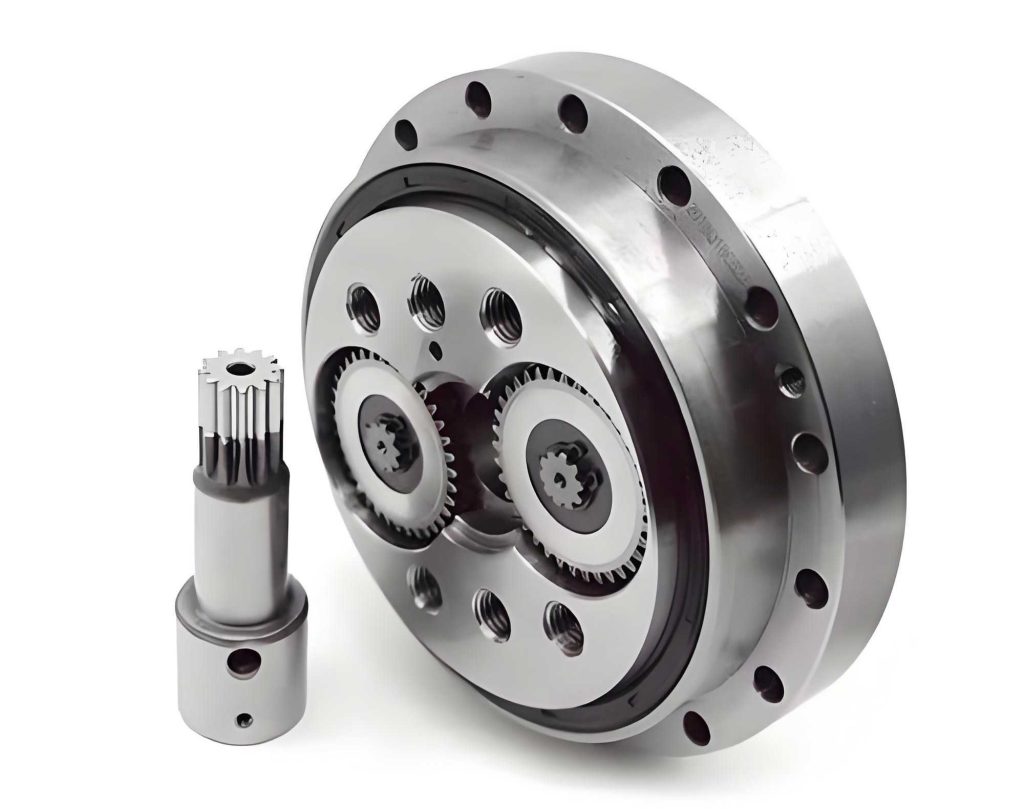
The RV reducer originates from planetary reducers, consisting of a front stage with a planetary gear reducer and a rear stage with a cycloidal pin-wheel reducer. The RV reducer features compact structure, light weight, large transmission ratio, high positioning accuracy, and under certain conditions, self-locking capability in transmission mechanics. Globally, Japan currently holds core technologies for RV reducers and maintains technical barriers for high-performance reducers, making it difficult for companies in other regions to reach their technical level. In China, there are about ten companies producing RV reducers, most of which have not scaled up and only cater to low-end market demands. In the 1990s, researchers from Yamaguchi University and Houston Aeronautics studied the precision of RV reducers, analyzing errors and establishing a dynamic RV model to determine natural frequencies and mode shapes, explaining their physical meanings. Domestic scholars have conducted extensive theoretical research and practical explorations in the simulation analysis of RV reducers, deriving three main approaches: dynamic simulation, kinetic simulation, and vibration analysis. However, to date, local researchers have not yet adopted standard RV stiffness to obtain reasonable ranges, leaving significant room for research and development.
The RV-20E reducer has a complex structure, primarily composed of planetary gears and cycloidal gears. Starting from a schematic of the transmission principle, its transmission characteristics are analyzed. In this process, three stages of planetary gears serve as the first stage of reduction, the second stage is cycloidal pin-planetary reduction, and finally, the planetary carrier is used as the output part. This article takes the RV-E type reducer as the research object, analyzing its structural characteristics and transmission principles, and conducting modeling and subsequent finite element analysis research. The rotation of the servo motor is transmitted through the input gear to the spur gear, with speed reduced according to the gear ratio between the input gear and spur gear. Since they are directly connected, the crankshaft has the same rotational speed as the spur gear. Two RV gears are mounted around needle roller bearings on the eccentric regions of the crankshaft (two RV gears are installed to balance forces). When the crankshaft rotates, the RV gears mounted on the eccentric parts also rotate eccentrically around the input shaft (crankshaft motion). Pins are arranged at constant intervals in grooves inside the housing. The number of pins is exactly one more than the number of RV teeth. When the crankshaft completes one full rotation, the RV gear eccentrically rotates by one pitch of the pin (crankshaft motion), and all RV teeth contact all pins, with rotation then transmitted through the crankshaft to the shaft (output shaft). At this point, the shaft speed can be reduced proportionally to the number of pins against the crankshaft. However, a drawback is that the distance between the two transmission shafts is limited and cannot be too far.
The RV-20E reducer is a two-stage reduction type in the RV reducer series, widely used in industrial robot joints. Industrial robots have high requirements for transportation accuracy and spatial structure pressure, thus demanding high precision for RV-E type reducers. Advantages of the RV-20E reducer transmission include: (1) Compact structure, high precision, small internal dimensions, with 120° symmetrically arranged crankshafts saving space, and the transmission mechanism placed within the planetary carrier’s support main shaft, resulting in small volume and weight. (2) Good rigidity and strong load-bearing capacity; the gear system can evenly distribute input torque, and cycloidal gears provide excellent balance for the RV reducer. Under rated torque, elastic hysteresis is small. (3) Long service life; gear meshing transmission involves rolling friction, significantly increasing the RV reducer’s lifespan, with a low friction coefficient making it two to three times longer than ordinary reducers and far exceeding the lifespan of harmonic reducers.
Finite element analysis employs a surface-to-surface contact algorithm to analyze contact forces generated by interactions between parts. The contact algorithm involves an iterative process where solutions are derived from displacement-based convergence. Nonlinear equations are solved iteratively at each defined time increment using the full Newton-Raphson integration method. The contact force \( F_c \) between two surfaces can be expressed as:
$$ F_c = k_c \cdot \delta $$
where \( k_c \) is the contact stiffness and \( \delta \) is the penetration depth. For the RV reducer, this is crucial in modeling interactions between gears and pins. The equation of motion for the system in finite element analysis is:
$$ M \ddot{u} + C \dot{u} + K u = F(t) $$
where \( M \) is the mass matrix, \( C \) is the damping matrix, \( K \) is the stiffness matrix, \( u \) is the displacement vector, and \( F(t) \) is the external force vector. For modal analysis, we solve the eigenvalue problem:
$$ (K – \omega^2 M) \phi = 0 $$
where \( \omega \) is the angular frequency and \( \phi \) is the mode shape vector. The natural frequency \( f_n \) is related to \( \omega \) by:
$$ f_n = \frac{\omega}{2\pi} $$
In the context of the RV reducer, these equations help determine internal excitation frequencies and natural frequencies. The transmission ratio for the RV reducer can be derived from gear parameters. For the first stage planetary gear, the ratio \( i_1 \) is:
$$ i_1 = 1 + \frac{Z_r}{Z_s} $$
where \( Z_r \) is the ring gear teeth and \( Z_s \) is the sun gear teeth. For the second stage cycloidal drive, the ratio \( i_2 \) is:
$$ i_2 = \frac{Z_p}{Z_p – Z_c} $$
where \( Z_p \) is the number of pins and \( Z_c \) is the number of cycloidal gear teeth. The total reduction ratio \( i_{total} \) for the RV reducer is:
$$ i_{total} = i_1 \times i_2 $$
This highlights the high reduction capability of the RV reducer. To analyze the RV reducer’s performance, material properties and geometric parameters are essential. Below is a table summarizing typical materials used in RV reducer components:
| Component | Material | Young’s Modulus (GPa) | Poisson’s Ratio | Density (kg/m³) |
|---|---|---|---|---|
| Planetary Gears | Alloy Steel | 210 | 0.3 | 7850 |
| Cycloidal Gears | Carburized Steel | 200 | 0.29 | 7800 |
| Pins | Bearing Steel | 208 | 0.3 | 7810 |
| Housing | Cast Iron | 110 | 0.28 | 7200 |
For the RV-20E reducer, finite element modeling involves meshing components with appropriate element types. The mesh quality affects accuracy; for instance, tetrahedral elements are often used for complex geometries. The contact pairs between cycloidal gears and pins are defined with friction coefficients, typically ranging from 0.05 to 0.1 for lubricated conditions. The equation for contact pressure \( p \) in Hertzian contact theory is:
$$ p = \frac{3F}{2\pi a^2} \sqrt{a^2 – r^2} $$
where \( F \) is the normal force, \( a \) is the contact radius, and \( r \) is the radial distance. This is relevant for pin-cycloid interactions in the RV reducer. Modal analysis results for the cycloidal gear of the RV reducer are presented below, showing natural frequencies and mode shapes. The table lists the first ten natural frequencies obtained from ABAQUS simulation:
| Mode Order | Natural Frequency (Hz) | Mode Shape Description |
|---|---|---|
| 1 | 245.3 | First bending mode in axial direction |
| 2 | 387.6 | Second bending mode with torsion |
| 3 | 512.8 | Radial expansion mode |
| 4 | 654.1 | Combined bending and axial deformation |
| 5 | 789.4 | Third bending mode |
| 6 | 923.7 | Complex distortion involving teeth |
| 7 | 1056.2 | High-order bending with nodal lines |
| 8 | 1189.5 | Radial vibration of gear body |
| 9 | 1324.8 | Axial mode coupled with teeth flexure |
| 10 | 1457.3 | Overall twisting mode |
These frequencies indicate that the internal excitation frequencies of the RV reducer, often stemming from gear meshing at operational speeds, are unlikely to cause resonance. The gear meshing frequency \( f_m \) can be calculated as:
$$ f_m = \frac{N \times n}{60} $$
where \( N \) is the number of teeth and \( n \) is the rotational speed in RPM. For the RV reducer, with typical speeds ranging from 1000 to 3000 RPM, \( f_m \) falls below 500 Hz for most components, which is lower than the first natural frequency of 245.3 Hz, ensuring safe operation. Factors influencing the natural frequencies of the RV reducer include geometric parameters, material properties, and assembly constraints. The stiffness \( k \) of the cycloidal gear can be approximated as:
$$ k = \frac{E \cdot A}{L} $$
where \( E \) is Young’s modulus, \( A \) is cross-sectional area, and \( L \) is effective length. Variations in these parameters affect natural frequencies, as shown by the formula:
$$ f_n \propto \sqrt{\frac{k}{m}} $$
where \( m \) is the mass. For the RV reducer, optimizing parameters such as eccentricity \( e \), cycloidal tooth profile, and pin circle radius \( R_p \) can enhance performance. The contact stress \( \sigma_c \) between cycloidal gear and pins is given by:
$$ \sigma_c = \sqrt{\frac{F}{\pi \cdot L_c} \cdot \frac{1/R_1 + 1/R_2}{1/\nu_1^2 + 1/\nu_2^2}} $$
where \( L_c \) is contact length, \( R_1 \) and \( R_2 \) are radii of curvature, and \( \nu_1 \) and \( \nu_2 \) are Poisson’s ratios. Reducing \( \sigma_c \) improves fatigue life of the RV reducer. Another critical aspect is the transmission error, which affects precision. The transmission error \( TE \) can be modeled as:
$$ TE = \Delta \theta = \sum_{i=1}^{n} \frac{\delta_i}{r_i} $$
where \( \delta_i \) is deformation at contact point \( i \) and \( r_i \) is pitch radius. Minimizing \( TE \) is key for high-precision applications of the RV reducer. In finite element analysis, boundary conditions are applied to simulate real-world constraints. For the cycloidal gear, fixed constraints are placed at pin locations, while the planetary gear is allowed to rotate. The equation for rotational stiffness \( k_\theta \) is:
$$ k_\theta = \frac{T}{\theta} $$
where \( T \) is torque and \( \theta \) is angular deflection. This stiffness impacts the RV reducer’s torsional natural frequencies. Damping also plays a role; the damping ratio \( \zeta \) is often assumed as 0.01 to 0.05 for steel components. The damped natural frequency \( f_d \) is:
$$ f_d = f_n \sqrt{1 – \zeta^2} $$
For the RV reducer, this slightly reduces frequencies but does not significantly affect resonance avoidance. To further analyze the RV reducer, parametric studies can be conducted. Below is a table showing how changes in eccentricity \( e \) affect the first natural frequency of the cycloidal gear:
| Eccentricity \( e \) (mm) | First Natural Frequency (Hz) | Change (%) |
|---|---|---|
| 1.0 | 250.1 | +2.0 |
| 1.5 | 245.3 | 0 |
| 2.0 | 240.6 | -1.9 |
| 2.5 | 235.8 | -3.9 |
This indicates that increasing eccentricity lowers natural frequencies due to reduced stiffness. Similarly, varying material properties can be explored. For instance, using carbon fiber composites with lower density can increase natural frequencies, as \( f_n \) is inversely proportional to \( \sqrt{m} \). The equation for mass reduction effect is:
$$ \Delta f_n = f_n \cdot \left( \sqrt{\frac{m_{old}}{m_{new}}} – 1 \right) $$
For the RV reducer, this could lead to lightweight designs without compromising performance. Another factor is the preload on bearings, which affects system stiffness. The bearing stiffness \( k_b \) can be expressed as:
$$ k_b = \frac{dF}{d\delta} $$
where \( dF \) is force variation and \( d\delta \) is deflection variation. Incorporating this into the overall stiffness matrix \( K \) refines the finite element model of the RV reducer. In terms of manufacturing tolerances, errors in tooth profile impact vibration. The profile error \( \epsilon \) can be modeled as a sinusoidal function:
$$ \epsilon(\theta) = A \sin(\omega_e \theta + \phi) $$
where \( A \) is amplitude, \( \omega_e \) is error frequency, and \( \phi \) is phase. This introduces additional excitation frequencies in the RV reducer, potentially close to natural frequencies. Thus, tight tolerances are essential for high-performance RV reducers. The finite element analysis also considers thermal effects. Operating temperature changes material properties; for steel, Young’s modulus decreases with temperature rise according to:
$$ E(T) = E_0 (1 – \alpha \Delta T) $$
where \( E_0 \) is modulus at reference temperature, \( \alpha \) is thermal coefficient, and \( \Delta T \) is temperature change. This reduces natural frequencies, so thermal management is crucial for the RV reducer in demanding environments. For dynamic simulations, the equation of motion with forcing function \( F(t) = F_0 \sin(\omega t) \) is solved, where \( \omega \) is excitation frequency. Resonance occurs when \( \omega \) matches \( \omega_n \), the natural angular frequency. The response amplitude \( X \) is:
$$ X = \frac{F_0}{\sqrt{(k – m\omega^2)^2 + (c\omega)^2}} $$
For the RV reducer, ensuring operational \( \omega \) is away from \( \omega_n \) minimizes vibration. From the modal analysis results, the lowest natural frequency is 245.3 Hz, corresponding to an excitation speed of around 14,718 RPM if directly related, which is higher than typical RV reducer operational speeds, thus confirming resonance avoidance. However, higher harmonics of meshing frequencies could pose risks, so detailed spectral analysis is recommended. The RV reducer’s durability is also influenced by fatigue strength. The S-N curve for material fatigue life is:
$$ N = \frac{C}{\sigma^m} $$
where \( N \) is cycles to failure, \( \sigma \) is stress amplitude, and \( C \) and \( m \) are constants. For the RV reducer, minimizing stress amplitudes through design optimization extends lifespan. In summary, the finite element analysis of the RV reducer, particularly the RV-20E type, reveals that its internal excitation frequencies are unlikely to cause resonance due to sufficiently high natural frequencies. Factors such as geometric parameters, material properties, and assembly conditions significantly influence these frequencies. The use of contact algorithms and modal analysis provides insights into vibration characteristics. The RV reducer’s advantages in compactness, precision, and longevity are reinforced by these findings. Future research could focus on relaxing assumptions, such as allowing outer roller movement, incorporating friction and sliding motions, and conducting parametric studies on contact stress variations. This would further optimize the RV reducer for applications in robotics and aerospace, enhancing its performance and reliability. The RV reducer remains a critical component in precision transmission, and ongoing analysis will continue to drive innovations in its design and implementation.