
Moving boxes, tightening screws, loading and unloading machine tools — the robotics hall at the 26th China International Industry Fair looked less like an exhibition and more like a temporary factory. ABB Robotics, Fanuc and Yaskawa Electric, three of the world’s largest industrial robot makers, all set up booths there, standing face to face with domestic forces including AgiBot, JAKA, SIASUN, ESTUN and Inovance Technology. The theme of the contest was singular: whose robot — and, increasingly, whose humanoid robot — can actually do the work.
Public statements on the floor pointed in the same direction. The next era of industrial automation will be defined by how quickly a robot learns rather than by how well it has been programmed, ABB Robotics global president Ma Sikang told visitors at the fair, and that view is fast becoming an industry consensus. The year 2026 is being treated by many in the sector as the delivery year for embodied intelligence, a moment when the industry puts conceptual exploration behind it and moves into a phase of scenario-based, practical and large-scale development. For the humanoid robot, the change is concrete: the machines are walking off the stage and through the factory gate.
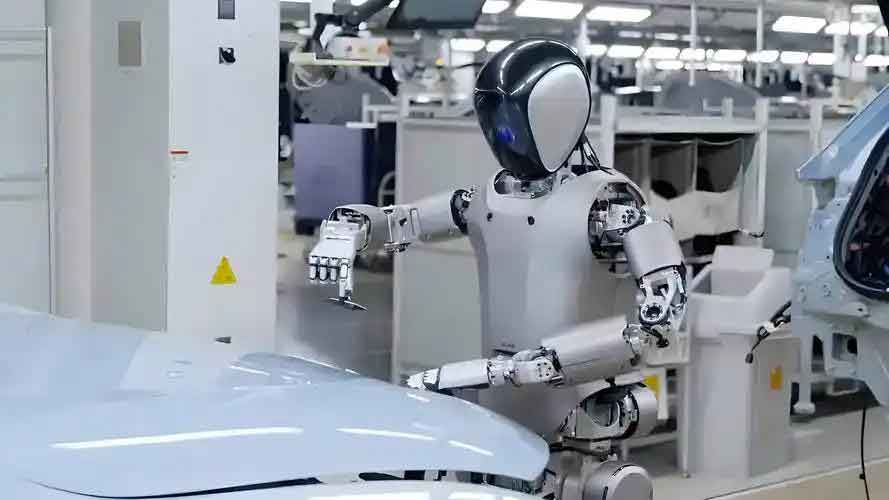
- The Factory Floor Becomes the Arena for the Humanoid Robot
At this year’s fair, the international industrial robot giants converged on the same message almost by accident: get the robot into the plant and let it work. ABB Robotics used its booth to present, end to end, how industrial-grade physical AI travels from a technical concept to an industrial deployment, and it gave two compact high-performance industrial robots their global debut at the event. The display was built around the idea that a humanoid robot or a conventional industrial arm is only as valuable as the production line it can be integrated into.
Yaskawa, for its part, stuck to a pragmatic route for industrial AI. The company showed two technical directions at the fair. The first embeds AI deeply inside the automation equipment itself: its new Motoman NEXT controller can run AI models natively, covering vision-based insertion and removal tasks and bin-picking from unstructured piles. The second direction uses the company’s motion control hardware foundation to empower AI applications, and the newly released GP35 robot was aimed squarely at handling large-format PCB panels.
Domestic companies moved toward the plant floor at a pace that was at least as fast. Inside a precision loading and unloading workstation for chip packaging and die-bonding equipment built by SIASUN, a full-body wheeled humanoid robot, the BR-MR73A, was kept busy feeding and removing material. The exhibit demonstrated the application capability of a humanoid robot in a semiconductor equipment loading and unloading scenario, a setting where repeatability and positional accuracy leave very little room for error.
The AgiBot G2 series, marketed under the company’s Spirit line, has also become a generalist on the factory floor. At the AgiBot booth, G2 series robots moved through precision manufacturing, flexible assembly, automotive component feeding and warehouse logistics scenarios. The machine handled delicate work such as plugging and unplugging optical modules, and it also carried and palletized goods. For an industry still searching for proof that a humanoid robot can be genuinely multi-skilled, the display was a deliberate argument.
Yan Yixing, vice president of embodied business at AgiBot, told reporters that the G2 has already produced quantifiable indicators on customer production lines. At Longcheer Technology’s Nanchang plant, the machine was integrated into a parallel tablet mass-production line for precision loading and unloading. Scenario calibration was completed in as little as 15 minutes, integration and line connection took 36 hours, and equipment reuse reached 95 percent. During a six-day continuous live line-connection task, the success rate reached 99.99 percent. At Joyson Electronics, the same humanoid robot took on a demanding three-pin positioning flexible assembly task, achieving a cycle time of as little as 12.97 seconds and a success rate of 99.9 percent, with up to 1,000 workstations already adapted within the company’s system.
JAKA brought the complex operating conditions of a real factory into the exhibition hall, presenting its large-scale deployment capability in a way that visitors could watch rather than imagine. According to staff at the booth, the company’s Kargo10 wheeled humanoid robot entered a smart headlamp factory operated by a globally known automotive components company in July, where the single-box cycle time was compressed from 105 seconds to 28 seconds and the deployment period for a new scenario was shortened to 57 days. At the fair, JAKA also gave a global debut to the Kargo50, a 50-kilogram heavy-load upgraded version of the platform.
At the Inovance Technology booth, an automotive welding demonstration line showed a humanoid robot working alongside a vision system and an arc welding robot. The machine completed workpiece loading, unloading and resetting operations and cooperated in arc welding work, illustrating how physical AI and robotics technology can be explored inside a specific production scenario rather than in isolation.
- Measured Results Replace Stage Performances
The most striking feature of this year’s exhibits was not the number of joints or the elegance of a gait, but the presence of cycle times, success rates and integration timelines. A humanoid robot that once drew crowds by walking across a stage is now being judged by the seconds it saves on a line and by the number of shifts it can run without intervention. Vendors brought those numbers with them, and they invited comparison.
| Company | Centerpiece at the Fair | Reported Deployment Indicators |
|---|---|---|
| ABB Robotics | Full-chain presentation of industrial-grade physical AI; global debut of two compact high-performance industrial robots | No production metrics disclosed at the fair |
| Yaskawa Electric | Motoman NEXT controller running AI models natively for vision insertion and unstructured bin picking; new GP35 robot for large-format PCB handling | No production metrics disclosed at the fair |
| SIASUN | BR-MR73A full-body wheeled humanoid robot inside a chip packaging and die-bonding loading and unloading workstation | No production metrics disclosed at the fair |
| AgiBot | G2 series humanoid robot across precision manufacturing, flexible assembly, automotive feeding and warehouse logistics | Longcheer Technology Nanchang plant: calibration in as little as 15 minutes, integration in 36 hours, 95 percent equipment reuse, 99.99 percent success over six continuous days; Joyson Electronics: three-pin positioning assembly at 12.97 seconds and 99.9 percent success, up to 1,000 adapted workstations |
| JAKA | Kargo10 wheeled humanoid robot in a real production display; global debut of the 50-kilogram payload Kargo50 | Smart headlamp plant of a global automotive components company: single-box cycle time cut from 105 seconds to 28 seconds, new scenario deployment shortened to 57 days |
| Inovance Technology | Automotive welding demonstration line pairing a humanoid robot, a vision system and an arc welding robot | No production metrics disclosed at the fair |
The table tells its own story. The humanoid robot is no longer presented as a research artifact but as a line item with a payback period. Each figure in the right-hand column represents a claim that a customer can verify, and each one raises the bar for the next vendor. When cycle times are quoted to two decimal places, the conversation has moved from capability to reliability.
- Industrial Giants Anchor Physical AI in Hardware
The international players approached the same destination from a different starting point. Their advantage lies in decades of motion control, drives, controllers and safety engineering, and they are using that base to carry AI into the plant rather than building a humanoid robot from scratch. The logic is straightforward: an AI model that cannot be executed with repeatable precision at production speed is of limited value on a line that runs around the clock.
ABB’s presentation framed the industrial-grade physical AI chain as a continuous path from simulation and skill learning to commissioning and long-term operation, with the two new compact high-performance robots positioned as the mechanical backbone of that path. The company’s message was that a humanoid robot and a conventional industrial robot share the same requirement — they must be predictable, safe and easy to redeploy.
Yaskawa’s Motoman NEXT controller illustrates a complementary bet. By allowing AI models to run natively on the controller, the company reduces the latency and integration burden that come from bolting an external computing box onto a robot cell. Vision-based insertion and unstructured bin picking are exactly the tasks where rigid programming struggles and where learning-based approaches can pay off. The GP35, aimed at large-format PCB handling, addresses a materials-handling problem that is growing as electronics manufacturing scales.
For the humanoid robot, this hardware-first approach matters. A humanoid robot deployed in a factory must coexist with PLCs, safety fences, vision systems and existing material flow. The industrial incumbents are effectively arguing that the humanoid robot will be adopted through the same channels, with the same reliability expectations, as the articulated arm it stands beside.
- Domestic Challengers Compress the Deployment Cycle
The domestic response has been to compress time. Where an international integrator might spend months on a new cell, Chinese vendors are reporting integration windows measured in hours and deployment cycles measured in weeks. That speed is itself a competitive weapon, because it allows a humanoid robot to be tried in many scenarios at once and allows failures to be corrected before they become expensive.
AgiBot’s numbers from the Longcheer Technology plant are the clearest expression of this approach. A calibration time of 15 minutes and an integration time of 36 hours suggest a deployment model built around standard interfaces and reusable skill libraries. An equipment reuse rate of 95 percent implies that the same humanoid robot can be moved between tasks without a rebuild. A success rate of 99.99 percent across six days of continuous operation is the kind of figure that plant managers use when deciding whether to commit a second shift to a machine.
The Joyson Electronics deployment adds a second dimension. Three-pin positioning flexible assembly is a task where tolerances are tight and where parts can arrive in slightly different orientations. A cycle time of 12.97 seconds and a success rate of 99.9 percent, combined with up to 1,000 adapted workstations across the company’s system, point to a humanoid robot being treated as standard equipment rather than as a pilot project.
JAKA’s Kargo10 story follows the same arc. Entering a smart headlamp factory in July and cutting a single-box cycle time from 105 seconds to 28 seconds is a gain that shows up directly in throughput. Shortening the deployment period for a new scenario to 57 days addresses the hidden cost that has historically slowed automation: the engineering effort required to adapt a robot to a new line. The global debut of the 50-kilogram payload Kargo50 extends the same platform into heavier material handling, where the physical demands on a humanoid robot are greater and the case for automation is often stronger.
SIASUN’s choice of a semiconductor application is equally telling. Chip packaging and die-bonding equipment demands clean handling, precise placement and minimal downtime. Placing a full-body wheeled humanoid robot at the loading and unloading station of such equipment is a statement that the humanoid robot can meet the discipline of a semiconductor fab’s material flow, not merely the looser requirements of a warehouse.
Inovance’s welding demonstration line shows a third pattern: the humanoid robot as a member of a team. By linking the machine with a vision system and an arc welding robot, the company illustrated a division of labor in which the humanoid robot handles loading, unloading and resetting while the dedicated welding robot performs the joining work. This hybrid configuration may prove more practical in the near term than expecting a single humanoid robot to perform every step of a complex process.
- The ChatGPT Moment and the Limits of Optimism
Optimism about the pace of progress was on open display. Wang Xingxing, founder of Unitree Robotics, said during a roundtable at the opening ceremony that the ChatGPT moment for embodied intelligence is arriving faster than many expect, possibly within one or two years. The remark captured the mood of a sector that has spent years promising general-purpose machines and now believes it can see the finish line.
Yet the busy rush into factories also exposed how far the humanoid robot still is from being reliably useful. Behind the staged demonstrations and the quoted success rates, the gap between a working prototype and a dependable production asset remains wide. A humanoid robot that performs well for six days must still perform well for six months, across shift changes, seasonal temperature swings, incoming part variation and the inevitable rough handling that a real plant delivers.
The first barrier standing in front of large-scale deployment is data. Training a humanoid robot to handle the long tail of factory tasks requires large volumes of real manipulation data, and that data is expensive to collect, difficult to label and rarely shared between companies. Every vendor at the fair acknowledged the problem in one form or another, and several arrived with an answer.
- Data Infrastructure Emerges as the Bottleneck and the Business
Mifeng Technology used the fair to present a full-chain technical system that runs from real operation data collection to data governance, together with the service capability to organize scenario tasks. The company brought its MEgo series body-less data collection terminals, the MEgo Engine data governance engine and a physical AI data crowdsourcing service platform. The pitch was aimed at providing data infrastructure for the training and evaluation of embodied intelligence models.
The phrase body-less is significant. Collecting data through a humanoid robot itself is slow and costly, because the machine must be present at every collection site. Collection terminals that decouple the sensing and manipulation capture from the robot body allow data to be gathered at many locations in parallel, and they allow a humanoid robot to be trained on data that was never generated by a robot at all. For an industry trying to scale, this is a practical route around a physical constraint.
Data governance matters just as much as collection. Raw sensor streams from a factory are noisy, redundant and inconsistent in format. A governance engine that standardizes, deduplicates and annotates that material turns it into something a model can actually learn from. A crowdsourcing platform extends the same logic to task organization, allowing scenario work to be distributed across many contributors rather than concentrated inside a single laboratory.
For the humanoid robot, the implication is that the competitive advantage may shift from hardware design to data access and data quality. Two vendors with similar mechanical platforms could diverge sharply depending on the breadth of scenarios their models have seen. The company that can field a humanoid robot trained on thousands of real industrial tasks will have an advantage that is difficult to replicate with hardware alone.
- A Call to Open Industrial Data
The most pointed comment on the subject came from Wang Jian, an academician of the Chinese Academy of Engineering and founder of Alibaba Cloud, who used the fair to demand data on behalf of the robotics industry. He called on the industrial sector to release its data and argued that industrial data should become the primary data for AI, alongside language and code. Without that release, he warned, the embrace between AI and industry will face considerable challenges.
The argument is easy to follow. Language models advanced rapidly because text was abundant and already digitized. Code models advanced because open repositories provided vast amounts of structured examples. Industrial data, by contrast, sits inside factories, locked behind competitive concerns, proprietary protocols and the simple fact that it was never captured in a usable form. A humanoid robot that must learn to handle a specific component on a specific machine needs exactly that kind of data, and it cannot be scraped from the public internet.
Wang’s intervention also implied a division of responsibilities. Robotics companies can build the collection hardware, the governance pipelines and the models, but they cannot manufacture the raw material of factory experience on their own. Industrial firms hold that material, and the pace at which the humanoid robot becomes genuinely useful will depend in part on how willing those firms are to share it, whether through industry consortia, data trusts or commercially structured exchanges.
- What the Fair Revealed About the Road Ahead
Several conclusions can be drawn from the show floor. The first is that the humanoid robot has entered the same competitive arena as the industrial robot. The question is no longer whether a humanoid robot belongs in a factory but which tasks justify its flexibility premium over a fixed automation cell. Loading and unloading, flexible assembly, material transport and machine tending are the current answers, and they are being tested at production scale rather than in laboratories.
The second is that integration speed has become a product feature. Calibration in minutes, integration in hours and deployment in weeks are the metrics that determine whether a humanoid robot can be economically justified across a large number of low-volume, high-mix stations. A machine that takes months to commission will remain confined to a handful of showcase lines, no matter how capable its manipulation skills.
The third is that reliability figures are now public claims subject to verification. Success rates of 99.9 percent and above, sustained over continuous multi-day operation, set an expectation that the entire industry must meet. A humanoid robot that performs flawlessly for a camera but falters on the second shift will not survive the procurement process at a serious manufacturer.
The fourth is that data has become the binding constraint. Hardware platforms are converging, controllers are becoming capable of running models natively, and vision systems are increasingly commoditized. What separates one humanoid robot from another is the breadth and quality of the experience encoded in its models, and that experience depends on access to real industrial data at scale. The companies building collection terminals, governance engines and crowdsourcing platforms are therefore building the foundation on which the next generation of humanoid robot capability will rest.
The fifth is that the hybrid model may dominate the near term. Inovance’s welding line, in which a humanoid robot feeds and resets workpieces while a dedicated arc welding robot performs the join, is a reminder that flexibility and specialization can coexist. A factory of the near future is likely to combine conventional industrial robots, mobile manipulators and humanoid robots, each assigned to the tasks where its economics are strongest.
- The Humanoid Robot as a Standard Line Item
The language used at the fair has shifted accordingly. Executives spoke about cycle time, reuse rate, integration hours and adapted workstations rather than about dexterity or general intelligence. That vocabulary belongs to procurement and production engineering, and its adoption signals that the humanoid robot is being evaluated as capital equipment.
That shift carries risks as well as opportunities. Capital equipment is judged against alternatives, and a conventional articulated robot or a fixed automation cell will often be cheaper for a single, stable task. The humanoid robot’s case rests on variability: the ability to be redeployed when a product line changes, to handle parts that arrive in unpredictable orientations, and to fill gaps in a process that is too varied to automate with dedicated machinery. The vendors that can demonstrate those advantages with verifiable numbers will win the orders.
The year 2026 may therefore be remembered less for a single breakthrough than for a change in how the industry measures itself. The delivery year for embodied intelligence is not a date on a calendar but a threshold: the point at which a humanoid robot can be installed, measured, paid for and relied upon. On the evidence presented at the fair, some machines have crossed that threshold in selected scenarios, and many more are close behind.
The road from here runs through data. Collection terminals, governance engines and crowdsourcing platforms will determine how quickly a humanoid robot learns the long tail of industrial work. Factories will determine how much of their operating experience they are willing to share. And the machines themselves will be judged by the least glamorous metric of all: whether they show up, shift after shift, and do the job at rate.
- Key Takeaways From the Robotics Hall
- The humanoid robot has moved from staged demonstrations to production-line deployments across automotive components, consumer electronics, semiconductors and warehouse logistics.
- International industrial robot makers are anchoring physical AI in mature motion control hardware, while domestic challengers are competing on integration speed and deployment flexibility.
- Published indicators now include cycle times, success rates, equipment reuse and integration hours, giving buyers a basis for comparison that did not exist in previous years.
- Data collection and governance have emerged as the primary bottleneck for scaling the humanoid robot, with new platforms built specifically to supply training and evaluation material.
- Industry figures have publicly called for industrial data to be opened up, arguing that AI and manufacturing cannot fully converge without it.
- Hybrid production lines that combine a humanoid robot with dedicated industrial robots appear to be the most practical near-term configuration.
The fair closed with the same question it opened with, now framed in operational terms: which humanoid robot can be trusted with the next shift? The answers will be written on production lines rather than in exhibition halls, and the companies that brought verifiable numbers to the show floor intend to be the ones doing the writing.