
As the fourth quarter opens a new window for capital market布局, investor focus is shifting from valuation repair to industrial sectors with clear growth logic. Among these, humanoid robots are advancing from laboratories to practical applications, alongside breakthroughs in deep-sea wind power and rebounding photovoltaic prices. These three sectors are progressing in parallel, with the potential to grasp structural opportunities in technological breakthroughs and energy transformation, which may become key to navigating market fluctuations.
-
Humanoid Robots Accelerate from Labs to Real-World Applications
Humanoid robots have never been as prominent in the spotlight as they are today. Integrating advanced technologies such as artificial intelligence, high-end manufacturing, and new materials, humanoid robots are poised to become disruptive products following computers, smartphones, and new energy vehicles. They are expected to profoundly transform human production and lifestyles and reshape the global industrial development landscape.
From humanoid robots performing traditional dances on the 2025 Spring Festival Gala stage to marathon events in Beijing’s Yizhuang and robot combat competitions in Hangzhou, Zhejiang, humanoid robots are gradually breaking into the mainstream, moving from “laboratories” to various “application fields.” This not only serves as a “pressure test” for technology but also demonstrates a critical leap from炫技performances to practical scenario breakthroughs.
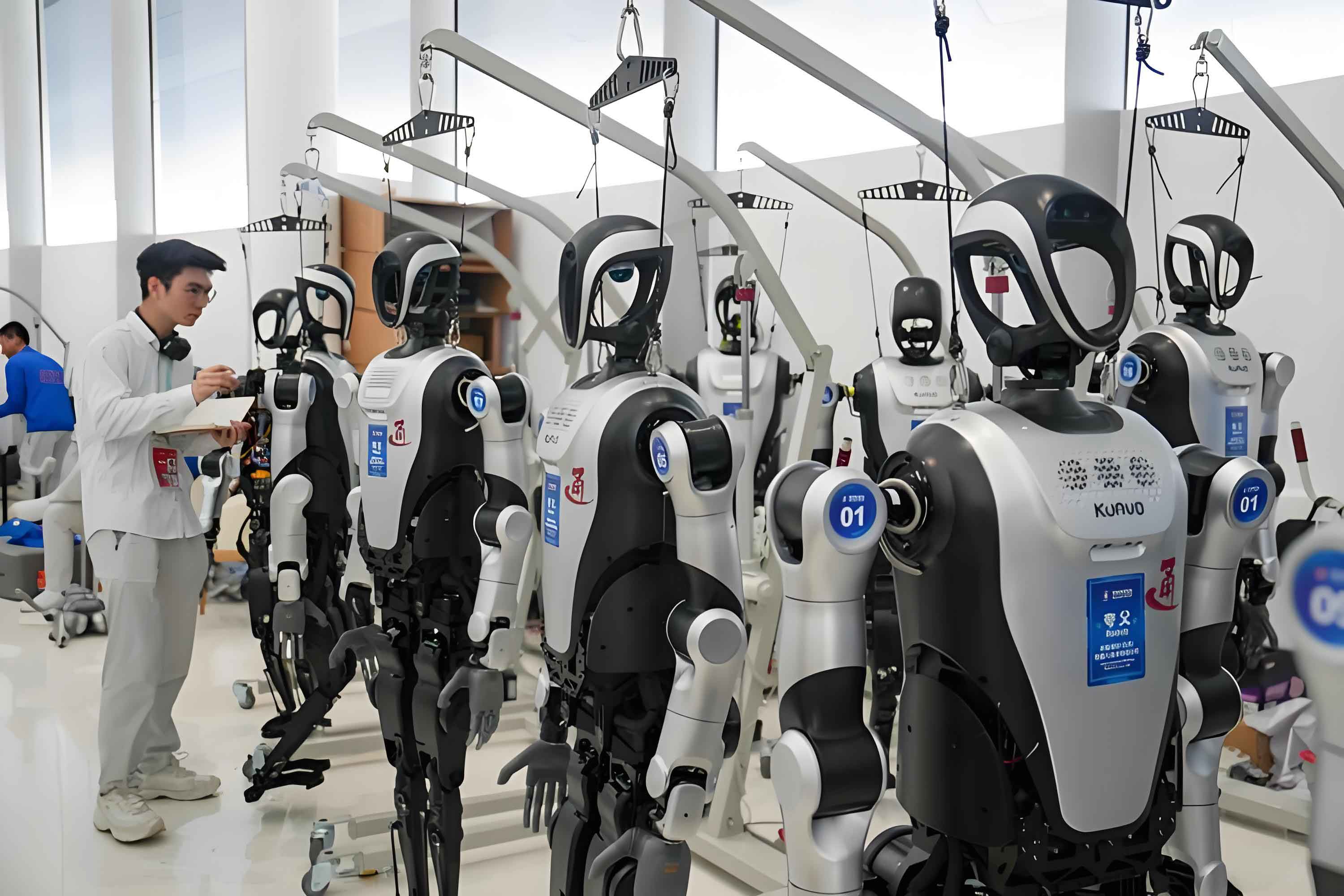
Recently, a wave of corporate activities has emerged. Internationally, on September 30, Tesla announced via its official social media that it is working to scale up humanoid robots, with plans to launch the third generation by the end of 2025 and begin mass production in 2026. Tesla CEO Elon Musk predicts annual production of 1 million units by 2030.
Domestically, on September 30, Zhipu Dynamics announced that its full-size humanoid robot, Oli, has achieved fully autonomous tasks including tennis ball recognition, tracking, picking up, and placement, as well as walking, bending, and squatting. Oli’s whole-body mobile operations based on active perception are completed entirely autonomously, without motion capture data or remote control.
At the Fourth Global Digital Trade Expo, Wang Xingxing, founder and CEO of Yushu Technology, stated that the company’s robot algorithms have undergone several iterations this year and are expected to release a 1.8-meter-tall humanoid robot in the second half of the year.
Previously, Fourier introduced its third-generation humanoid robot, GR-3C, at the 2025 Shanghai Industrial Expo, marking its debut. Kepler Robot officially released a video announcing the start of mass production for the K2 Hornet, declaring the commencement of commercial orders for the world’s first commercially available hybrid-architecture humanoid robot.
-
Expansive Future Growth Prospects for the Humanoid Robot Industry
Driven by both policy support and market forces, the future development space for China’s humanoid robot industry is vast. According to a report released by the China Academy of Information and Communications Technology, titled “Humanoid Robot Industry Development Research Report (2024)”, it is estimated that after 2045, the number of humanoid robots in use in China will exceed 100 million units, penetrating various industry sectors, with the整机market scale reaching approximately 10 trillion yuan.
An Oriental Securities research report indicates that, driven by leading domestic and international humanoid robot companies, the industry is expected to enter the mass production phase next year. Looking ahead from the perspective of future mass production, component companies with excellent manufacturing and management capabilities are poised to benefit more.
-
Strong Performance of Humanoid Robot Concept Stocks
In recent years, the humanoid robot sector has accelerated its升温, with capital market attention significantly increasing. In the secondary market, related concept stocks involved in the humanoid robot industry have delivered impressive performances.
According to statistics from Securities Times · Data宝, as of September 30, the average increase for humanoid robot concept stocks this year has reached 83.6%, outperforming the Shanghai Composite Index over the same period. Twenty-five concept stocks have seen their prices more than double year-to-date. The top five gainers include Shangwei New Materials, Shenghong Technology, Zhenyu Technology, Wolong Electric Drive, and Anpei Long. Shangwei New Materials, which gained attention due to the entry of Zhiyuan Robot, has surged by 1891.6% year-to-date, becoming the top performer in the A-share market this year.
Regarding future growth potential, many humanoid robot concept stocks are favored by institutions. According to Data宝 statistics, based on consensus forecasts from five or more institutions, 27 stocks are expected to achieve net profit growth rates exceeding 20% both this year and next. Four龙头stocks with market capitalizations exceeding 100 billion yuan are included, namely Shenghong Technology, Inovance Technology, Lingyi Intelligent Manufacturing, and Huaqin Technology.
The top five stocks with the highest average institutional forecast for net profit growth are Orbbec-UW, Shenghong Technology, Estun, Fulin Precision, and JL Mag. Orbbec-UW leads with an average forecasted net profit growth rate of 207.24%.
A Ping An Securities research report states that Orbbec-UW is a leading domestic 3D vision enterprise, having built a full-stack technology system including structured light, iToF, dToF, binocular, Lidar, and industrial 3D measurement, with product performance comparable to international giants. Robotics and 3D scanning are expected to become important落地scenarios for the company’s 3D vision technology, following biometric recognition, and are key areas for expansion, potentially becoming significant drivers of future performance growth.
Among the 27 humanoid robot concept stocks with high expected growth, as of September 30, those with lower rolling price-to-earnings ratios include Zoomlion, Huaqin Technology, Jihong Shares, Shiyun Circuit, and Yiheda.
Zoomlion has the lowest rolling price-to-earnings ratio at 17.33 times. According to Zoomlion’s 2025 interim report, the company has newly developed three models of humanoid robots, including one wheeled humanoid robot and two bipedal humanoid robots, with dozens already deployed in factory operations, conducting pilots in areas such as mechanical processing, logistics, assembly, and quality inspection to accelerate industrial落地.
| Stock Name | Year-to-Date Increase (%) |
|---|---|
| Shangwei New Materials | 1891.6 |
| Shenghong Technology | To be filled based on data |
| Zhenyu Technology | To be filled based on data |
| Wolong Electric Drive | To be filled based on data |
| Anpei Long | To be filled based on data |
The rapid advancement of humanoid robots is not just a technological marvel but a testament to the growing integration of AI and robotics in everyday life. As humanoid robots become more prevalent, their impact on various industries is expected to be profound, driving efficiency and innovation. The convergence of policy support, corporate innovation, and market demand is creating a fertile ground for the expansion of humanoid robots, making them a key area for investment and development in the coming years.
| Stock Name | Average Forecasted Net Profit Growth Rate (%) |
|---|---|
| Orbbec-UW | 207.24 |
| Shenghong Technology | To be filled based on data |
| Estun | To be filled based on data |
| Fulin Precision | To be filled based on data |
| JL Mag | To be filled based on data |
In summary, the humanoid robot sector is experiencing unprecedented growth, with concept stocks showing remarkable performance. The industry’s future looks bright, supported by technological advancements and favorable market conditions. As humanoid robots continue to evolve from experimental projects to practical tools, they are set to revolutionize multiple sectors, offering substantial opportunities for investors and companies alike. The emphasis on humanoid robots in capital markets underscores their potential to become a cornerstone of future technological and economic landscapes.
The development of humanoid robots is not limited to entertainment or niche applications; they are increasingly being adopted in manufacturing, healthcare, and logistics. For instance, humanoid robots can perform repetitive tasks with precision, reducing human error and increasing productivity. In healthcare, humanoid robots are being explored for patient care and surgical assistance, while in logistics, they can streamline warehouse operations. The versatility of humanoid robots makes them a valuable asset across industries, and as technology improves, their capabilities will expand further.
Moreover, the global race for dominance in the humanoid robot market is intensifying. Companies like Tesla are pushing the boundaries with ambitious production targets, while Chinese firms are making significant strides in innovation and deployment. This competition is driving rapid advancements, benefiting consumers and businesses through improved products and services. The collaboration between academia, industry, and government is crucial for sustaining this momentum, as it fosters research, development, and commercialization of humanoid robot technologies.
Investors are closely monitoring the progress of humanoid robot companies, as evidenced by the soaring stock prices. The average increase of over 80% for concept stocks highlights the market’s optimism about the sector’s prospects. However, it is essential to consider the risks, such as technological hurdles, regulatory challenges, and market saturation. Despite these, the long-term outlook for humanoid robots remains positive, with projections indicating substantial growth in adoption and revenue.
In conclusion, humanoid robots represent a transformative force in the modern economy. Their integration into various aspects of life and industry will likely accelerate, driven by continuous innovation and supportive policies. For investors, focusing on companies with strong technological foundations and growth potential in the humanoid robot space could yield significant returns. As the world moves towards greater automation and intelligence, humanoid robots will play a pivotal role in shaping the future.
The journey of humanoid robots from concept to reality is a fascinating example of human ingenuity and technological progress. With each passing day, new developments emerge, bringing us closer to a world where humanoid robots are commonplace. Whether in factories, homes, or public spaces, these machines are set to enhance our capabilities and improve our quality of life. The excitement surrounding humanoid robots is well-founded, and their impact will be felt for generations to come.
As we look ahead, it is clear that humanoid robots will continue to be a hot topic in both technological and financial circles. Their potential to disrupt existing industries and create new ones is immense, making them a key area for strategic investment. Companies that successfully leverage humanoid robot technology will likely gain a competitive edge, while societies that embrace these innovations will benefit from increased efficiency and new opportunities. The era of humanoid robots is just beginning, and its full implications are yet to be realized.
In the context of global trends, humanoid robots align with the broader movement towards digitalization and automation. Governments worldwide are investing in robotics and AI as part of their industrial strategies, recognizing the economic and social benefits. For example, initiatives like “Made in China 2025” and similar programs in other countries emphasize the importance of advanced manufacturing, where humanoid robots are a critical component. This global push ensures that the development of humanoid robots will remain a priority, driving further innovation and adoption.
Additionally, the environmental impact of humanoid robots should not be overlooked. By optimizing resource use and reducing waste through precise operations, humanoid robots can contribute to sustainability goals. In energy sectors, they can assist in maintenance and monitoring, improving efficiency and safety. As the world grapples with climate change, the role of technology like humanoid robots in promoting green practices becomes increasingly important.
Overall, the narrative around humanoid robots is one of promise and potential. While challenges exist, the collective efforts of researchers, entrepreneurs, and policymakers are paving the way for a future where humanoid robots are integral to our daily lives. The financial markets’ response, as seen in the performance of concept stocks, reflects this optimism. As we continue to witness the evolution of humanoid robots, it is an exciting time to be involved in this dynamic field.