
In the final week of February, Marc Raibert, founder of the Intelligent Robot Research Institute and creator of Boston Dynamics, revealed to Chinese media that his laboratory had purchased humanoid robots from Unitree Robotics along with several smaller robotic units. The pioneer renowned for developing BigDog – the world’s first load-carrying quadruped robot capable of off-road mobility – has now drawn significant attention through procuring products from this Chinese newcomer. This move carries particular weight following Unitree’s humanoid robots achieving mainstream visibility through a performance on China’s CCTV Spring Festival Gala.
According to Goldman Sachs projections, the global humanoid robot market is anticipated to reach approximately $38 billion by 2035. This century-long pursuit, originating from Leonardo da Vinci’s mechanical knight sketches, is experiencing transformative momentum toward mass production – accelerated by advancements in AI large language models, mechanical engineering breakthroughs, and intense capital investment. Yet behind this manufacturing evolution, fundamental questions persist: Is this enthusiasm truly unlocking humanity’s future? How should businesses approach the commercial realities of humanoid robots?
-
Morphological Debate: A Battle of Efficiency
It’s time to demystify the discourse surrounding humanoid robots. The mid-20th century discovery of da Vinci’s “Mechanical Knight” drawings – featuring wind and hydro-powered human-like structures capable of sitting, gesturing, and speaking – represented early conceptualizations of humanoid machinery. Entering the 21st century, these blueprints have materialized at an unprecedented pace. Recent demonstrations include Unitree’s G1 humanoid robot performing martial arts sequences, Zhong Qing Tech’s PM01 executing forward flips, and the “Tian Gong” humanoid robot climbing hundreds of outdoor steps consecutively. With Tesla’s Optimus humanoid robot targeting small-batch production in 2025, multiple institutions predict 2025 will mark the critical inflection point for scaled manufacturing of humanoid robots.
The developmental trajectory since WABOT-1 – the first humanoid robot in 1973 – has evolved from physical resemblance toward functional sophistication. The period 2010-2020 focused on dynamic control for complex movements, while 2020-2025 marks the AI-empowerment phase, where cognitive advancements make humanoid robots increasingly human-like in capability. Yet amid intensifying hype, industry veteran Li Qing (pseudonym) cautions: “Enterprises shouldn’t be hijacked by fleeting attention. Audiences must stay rational; companies need steadfast vision.”
Defining humanoid robots remains contentious. “Mere physical resemblance doesn’t qualify as humanoid robotics,” argues Li. “True humanoid robots must navigate human environments and perform human tasks.” This sparks the pivotal question: How critical is morphology? Pan Helin, member of the Ministry of Industry and Information Technology’s Expert Committee, observes: “Currently, non-humanoid robots like industrial robotic arms demonstrate greater maturity. While humanoid robots aim to undertake human-exclusive work, significant capability gaps persist.”
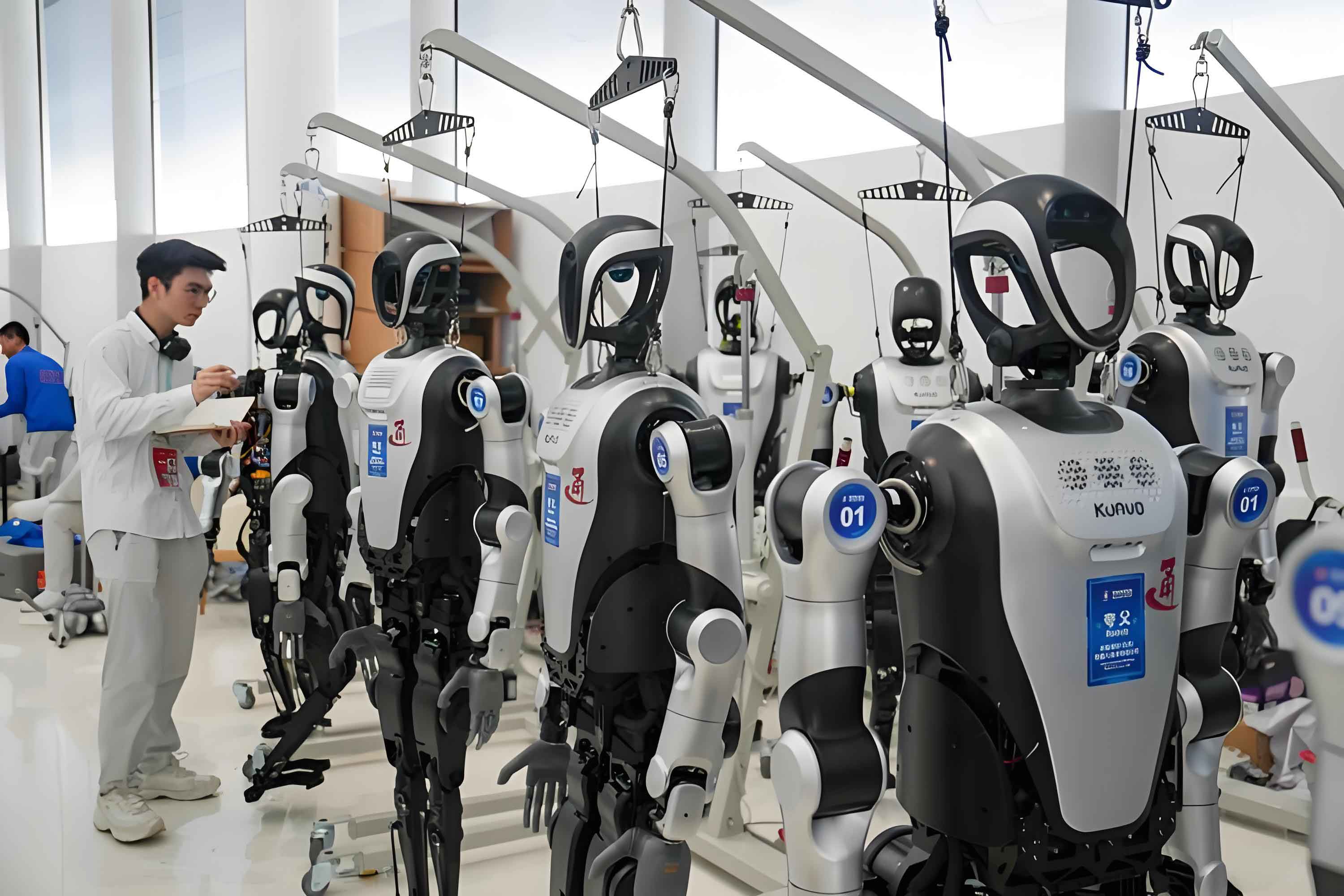
When questioned about developing humanoid robots, Fu Sheng, Chairman and CEO of Cheetah Mobile and Chairman of Orion Star, responded: “We prioritize labor-oriented robots with mounted mechanical arms, not purely humanoid bipedal forms.” Illustrating functional pragmatism, he noted: “Why deploy humanoid robots for transport when forklifts with mechanical arms move 100kg payloads? Humanoid robots have inferior load capacity, impact resistance, and prohibitive costs.” This divergence highlights competing industrial philosophies: Universalists champion humanoid designs for seamless integration into human-centric environments, targeting general-purpose applications. Conversely, efficiency advocates prioritize function-specific morphology over anthropomorphic replication.
-
Unclear Turning Point
Notably, companies categorized within the humanoid robot sector don’t exclusively focus on humanoid products or objectives. Industry pioneer UBTech exemplifies this complexity. Their latest financial reports reveal 35.8% of H1 2024 revenue came from consumer robots and hardware, while educational robots contributed 33.1%. The segment including Walker-series humanoid robots generated ¥90.879 million, representing 18.7% of revenue – though UBTech disclosed neither sales volume nor dedicated revenue figures for humanoid robots specifically.
Similarly, Zhu Ji Dong Li, developer of the CL-2 humanoid robot and creator of the VideoGenMotion embodied operation algorithm, positions itself primarily as an embodied intelligence toolchain company. Founder Zhang Wei explains: “Long-term, our products will encompass robot hardware alongside software toolchains for data processing and deployment. Currently, we’re starting with scarce bipedal/humanoid platforms during our R&D phase.” This reflects the embryonic state of humanoid robot commercialization, despite bullish industry forecasts.
Analysts from Guojin Securities project 2024 as the global prototype-release year for humanoid robots, with 2025 becoming the mass-production inflection point and 2026 triggering commercial application explosions. However, Pan Helin counters: “Humanoid robot technology remains bottlenecked, lacking breakthrough momentum. Humanoid systems comprise perception, decision-making, and control-execution modules – all currently trained via neural networks – yet none approach basic human competency. Machine vision can’t match human object recognition; decision-making relies on rule-based systems indistinguishable from industrial robots.”
Supporting this caution, Goldman Sachs recently noted “the technological inflection point for humanoid robots remains unclear,” revising projected global shipments downward to 76,000 units by 2027 and 1.502 million by 2032. Their report emphasizes current investment opportunities lie primarily within supply chain component manufacturers, citing “a comprehensive ecosystem under formation.”
Yao Lu Chuan Technology exemplifies this supply-chain positioning. Founder Zheng Daoqin details their role: “Our 3D multi-vision and structured-light depth perception technologies manifest in core visual hardware for humanoid robots.” Regarding robotic hands/end-effectors, Zheng explains their systems enable dynamic obstacle avoidance and precision manipulation like micro-part grasping. On pricing, he reveals: “Certain 3D structured-light cameras for humanoid robots range from tens to millions of yuan per unit.”
-
The Other Side of Capital Market Frenzy
Multiple consecutive price-limit surges, stocks doubling within sessions – the speculative frenzy surrounding humanoid robot concept stocks reveals intense market euphoria. This investment mania primarily targeted Unitree’s suppliers, R&D partners, and shareholders, propelling companies like Changsheng Bearing, Zhongda Lide, Shenglan Stock into investor spotlight. Particularly notable was Changsheng Bearing – experiencing stagnant valuations since its 2017 IPO – unexpectedly becoming a market darling through its association with Unitree Robotics.
The company’s stock trajectory illustrates this phenomenon vividly: From late December 2024 through February 2025, Changsheng shares skyrocketed nearly 400% over 40 trading days, dramatically boosting founder Sun Zhihua’s wealth and investor returns. Despite recent corrections, valuations remain elevated. Changsheng specializes in self-lubricating bearings – including critical joint components for humanoid robots – while R&D partner Lingyun Guang, collaborator Baotong Technology, and suppliers like Boke Automation and Shenglan Stock similarly rode the speculative wave.
Zhi Peiyuan, Vice Chairman of China Investment Association’s Listed Companies Committee, analyzes: “The humanoid robot concept’s explosive growth stems from converging factors. Technologically, humanoid robots integrate AI, advanced manufacturing, and represent future innovation vectors with vast application potential. Psychologically, investors chase emerging trends, creating concentrated capital inflows upon concept emergence.”
Contrasting this market exuberance is the modest commercial reality for these companies. Beyond Changsheng Bearing, Boke Automation and Shenglan Stock similarly produce essential humanoid robot components. Investor relations disclosures reveal that despite increased downstream-driven demand, humanoid-related revenue remains minimal relative to corporate valuations. Boke Automation – whose frameless torque motors serve humanoid joint systems – recently entered triple-digit share price territory but confirmed: “Client demand hasn’t significantly amplified despite market excitement.”
Shenglan Stock produces connectors for humanoid robots, acknowledging: “Orders are growing but remain small-batch currently.” Changsheng Bearing explicitly stated via investor platforms that humanoid robot applications contribute “below 1%” to primary revenue. Shareholder companies like Snow Dragon Group also witnessed soaring valuations despite minimal stakes. Snow Dragon clarified in risk disclosures: “Our shareholding in Shenzhen Capital Group’s SME Fund is minuscule, which itself holds only 1.3546% of Unitree Robotics.”
Zhi predicts increasing market differentiation: “Firms possessing core technologies, sustained R&D, and strategic supply-chain positioning may thrive alongside industry maturation. Purely concept-driven stocks lacking substantive progress face severe corrections upon market rationalization.” Notably, Lingyun Guang – Unitree’s R&D collaborator – maintains optimistic long-term projections despite current uncertainties: “We develop integrated solutions combining our respective technologies. We regard humanoid robots as major future scenarios, though mass production and application ecosystems remain emergent.”
-
The Distance to Common Households
Marc Raibert, despite recently purchasing Unitree products, identifies three barriers for household humanoid robot adoption: “First, diverse home environments create unpredictable complexity. Second, safety concerns regarding domestic operation. Third, accessibility – current humanoid robots remain prohibitively expensive for families.” Echoing this assessment, Liu Yonghao, Chairman of New Hope Group, recounted discussions with Unitree CEO Wang Xingxing: “Wang believes household humanoid robot penetration is inevitable but requires time.”
Today, humanoid robots represent embryonic sparks rather than mature solutions. Whether they ignite widespread adoption as Wang envisions – catalyzing transformative application waves – remains dependent upon overcoming persistent technical, economic, and safety challenges. The journey from laboratory prototypes to ubiquitous household assistants continues unfolding, with time as the ultimate arbiter of this technological trajectory.
The global race toward viable humanoid robotics embodies both extraordinary promise and sobering constraints. While morphological debates, supply-chain developments, and investment surges dominate contemporary discourse, the path to truly functional, accessible humanoid robots remains a complex multidimensional challenge. As research institutions, manufacturers, and investors navigate this landscape, the convergence of technological readiness, market demand, and economic viability will ultimately determine whether humanoid robots transition from captivating spectacles into indispensable societal assets.