
I have followed the trajectory of industrial robots in the domestic and global markets long enough to recognize when a threshold is crossed. The latest market data I reviewed points to a decisive moment: the leading domestic manufacturer of industrial robots has again secured the top position in all-brand shipment volume in the first half of 2026. More importantly, it became the first independent brand to exceed ten thousand units shipped in a single quarter. This is not a narrow statistical victory. I see it as evidence that industrial robots produced by an independent brand can now compete at scale, across payload classes, across sectors, and across geographies.
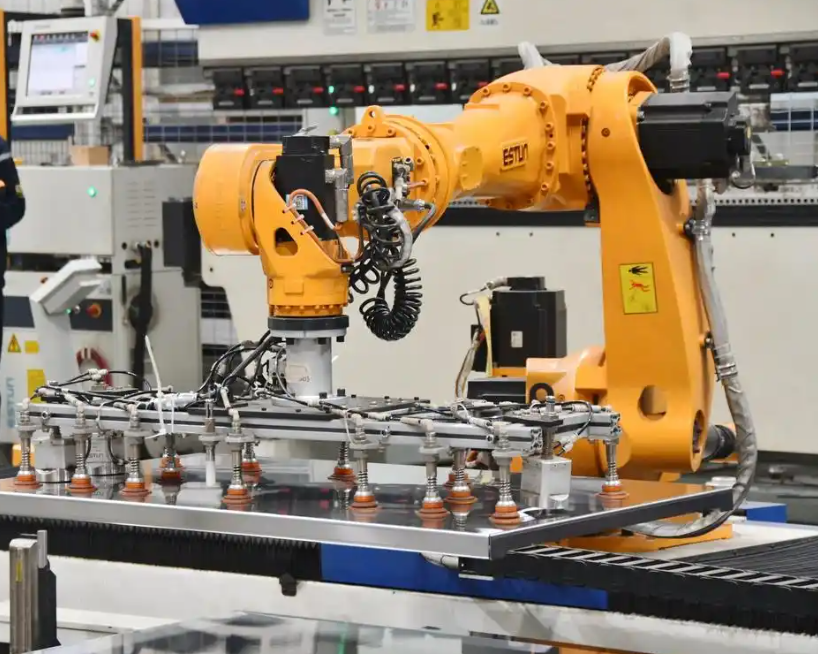
From my perspective, the significance of this milestone rests on several reinforcing facts. The manufacturer has held the leading position for six consecutive quarters since first reaching the top. It has also remained the highest-volume domestic brand for eight consecutive years. That combination suggests something deeper than a single product cycle. It suggests that industrial robots from this source have moved from being challengers to being reference platforms for automation in multiple high-demand industries.
I use the term industrial robots deliberately. These machines are not consumer gadgets. They are capital goods that sit at the center of production systems. Their value is realized through uptime, cycle time, repeatability, payload, reach, integration cost, programming effort, maintenance, and total cost of ownership. When I evaluate industrial robots, I therefore look beyond headline unit sales. I examine whether the underlying platform can support heavy payloads, whether core components are autonomous, whether software can reduce commissioning time, whether cloud systems can manage fleets, and whether global service networks can keep factories running.
I begin with a simple market-position snapshot. The table below summarizes the key observations I extract from the available data.
| Observed metric | Value I record | What it means for industrial robots |
|---|---|---|
| All-brand shipment rank in the first half of 2026 | First | Scale leadership across competing industrial robots brands |
| Single-quarter shipment milestone | More than ten thousand units | First independent brand to cross this volume threshold |
| Consecutive quarters at the top | Six | Consistency in supply, demand, and delivery |
| Consecutive years as top domestic brand | Eight | Long-term platform strength in industrial robots |
| Heavy payload capability | 1,200 kg | Entry into demanding high-load industrial robots applications |
| Core component autonomy in heavy payload systems | 100 percent | Reduced dependency in critical industrial robots subsystems |
| Global service nodes | 75 | Support infrastructure for industrial robots fleets |
| Automation rate in a core automotive components plant | 90 percent | Deep integration of industrial robots into core processes |
| Robots commissioned within sixty days | More than 200 | Rapid deployment capability for industrial robots |
| Cleanroom robots deployed in electronics manufacturing | More than 1,000 | Precision and cleanliness capability for industrial robots |
I interpret these numbers through several quantitative lenses. The first is market share. If I denote the shipment volume of brand \(i\) in period \(t\) as \(Q_{i,t}\), then its share among all \(n\) brands is:
$$ S_{i,t} = \frac{Q_{i,t}}{\sum_{j=1}^{n} Q_{j,t}} \times 100\% $$
I then examine growth. The period-over-period growth rate of industrial robots shipments is:
$$ g_t = \frac{Q_t – Q_{t-1}}{Q_{t-1}} \times 100\% $$
For longer horizons, I use the compound annual growth rate:
$$ CAGR = \left( \frac{Q_T}{Q_0} \right)^{\frac{1}{T}} – 1 $$
These formulas matter because leadership in industrial robots is not a static achievement. A brand can lead for one quarter because of a large order, a channel fill, or a temporary supply advantage. Sustained leadership requires positive growth, reliable delivery, and repeat demand. I therefore treat six consecutive quarters at the top as a signal of operational endurance rather than a one-time event.
I also track robot density, because it connects industrial robots to the broader productive base. If \(R\) is the number of industrial robots in operation and \(E\) is the number of manufacturing employees, then robot density per ten thousand employees is:
$$ \rho = \frac{R}{E} \times 10{,}000 $$
When I see a domestic brand leading in industrial robots shipments, I do not assume that density has reached its ceiling. Rather, I infer that the cost and integration barriers are falling. That inference is supported by automation rates. If \(T_{automated}\) is automated task time and \(T_{total}\) is total task time, then the automation rate is:
$$ A = \frac{T_{automated}}{T_{total}} \times 100\% $$
A core automotive components plant reaching 90 percent automation is a strong indicator. It tells me that industrial robots are no longer confined to isolated cells. They are being woven into the main process flow. That kind of integration demands more than arms. It requires controllers, software, sensors, safety systems, digital scheduling, and service response. In my assessment, the leading position in industrial robots reflects an entire system of production and delivery, not only mechanical assembly.
The next layer I examine is upstream research and development. I see a clear pattern: the manufacturer has focused on the upper reaches of the industrial robots value chain. In heavy payload industrial robots, the company reports a 1,200 kg payload capability and 100 percent autonomous core components. I take this to mean that critical subsystems such as motors, drives, reducers, and controllers are increasingly developed and produced within its own ecosystem. That matters because heavy payload industrial robots are often limited by component performance, thermal behavior, synchronization, and structural stiffness.
I also note the reported breakthroughs in dual-motor synchronous control and dual-reducer hard synchronization. These are not marketing phrases to me. They are engineering requirements for high-load industrial robots that must move large masses with precision. If two motors or two reducers are not synchronized, the result is vibration, wear, positioning error, or premature failure. I express the synchronization error as:
$$ e_{sync}(t) = \theta_1(t) – \theta_2(t) $$
For acceptable performance, I want the absolute synchronization error to remain below a tolerance \(\epsilon\):
$$ |e_{sync}(t)| \le \epsilon $$
When that condition holds across the motion profile, heavy payload industrial robots can achieve stable acceleration, deceleration, and positioning. This is exactly the kind of capability that expands industrial robots into new sectors such as large structural parts, heavy machinery, and high-load handling.
I summarize the technology stack I observe in the following table.
| Stack layer | Core capability | Effect on industrial robots |
|---|---|---|
| Perception | Vision, force, and multimodal sensing | Allows industrial robots to adapt to variation |
| Computation | Real-time control and edge processing | Reduces latency in industrial robots motion |
| Decision | AI planning and task reasoning | Enables industrial robots in non-structured scenes |
| Execution | Precision motion and force control | Improves repeatability and quality |
| Cloud | Fleet management and digital twins | Scales industrial robots operations |
| Developer ecosystem | Open APIs and application software | Shortens integration for industrial robots |
| AI management | Data-driven optimization | Raises utilization of industrial robots |
I see the control system as the foundation. A unified control platform can coordinate perception, calculation, decision, and execution. When those links are connected, industrial robots can move beyond fixed repetitive tasks. They can handle complex non-structured scenarios with a degree of autonomy. I define an embodied intelligence index for industrial robots as a weighted combination of perception, computation, decision, and execution capabilities:
$$ EII = w_p P + w_c C + w_d D + w_e X $$
where \(P\), \(C\), \(D\), and \(X\) represent normalized scores for perception, computation, decision, and execution, and the weights sum to one:
$$ w_p + w_c + w_d + w_e = 1 $$
I use this index because it helps me compare industrial robots beyond payload and speed. Two industrial robots may have the same reach and payload, but one may require extensive manual teaching while the other can adapt through vision, force feedback, and AI planning. The latter reduces engineering time and increases flexibility. That is a competitive advantage in sectors with high product variety.
I also examine the open platform approach. I understand that an open industrial embodied intelligence platform can connect sensing, computation, decision, and execution. Such a platform gives industrial robots the ability to adapt to complex non-structured scenes. I view openness as important because no single vendor can develop every application. If third-party developers, system integrators, and end users can build on the platform, the installed base of industrial robots becomes more valuable. The platform effect can be described as:
$$ V = k N^2 $$
where \(V\) is ecosystem value, \(N\) is the number of active participants, and \(k\) is a coefficient that depends on interoperability. For industrial robots, this formula explains why software ecosystems matter. More developers create more applications; more applications attract more users; more users generate more data; more data improves AI models; better AI models make industrial robots more capable.
The cloud layer reinforces this loop. A next-generation AI industrial cloud platform can support system developers, application software, and AI digital management. I summarize this three-in-one structure in a table.
| Cloud layer | Primary function | Value for industrial robots |
|---|---|---|
| System developer ecosystem | Tools, interfaces, and simulation | Expands the capabilities of industrial robots |
| Application software ecosystem | Ready-made process modules | Reduces programming effort for industrial robots |
| AI digital management platform | Monitoring, analytics, and optimization | Improves uptime and productivity of industrial robots |
I now turn to the application layer. I see industrial robots being deployed in flexible sheet metal processing, intelligent grinding, AI teaching-free welding, intelligent high-speed flying inspection, and 3D laser cutting. These are not simple pick-and-place tasks. They require vision, force control, path planning, and real-time adaptation. The following table maps sectors to solutions and operational outcomes.
| Industry sector | Industrial robots solution | Operational outcome I infer |
|---|---|---|
| Automotive components | Core process automation with more than 200 robots commissioned in sixty days | 90 percent automation rate and faster ramp-up |
| Lithium battery | Cell manufacturing, module assembly, and full-chain solutions | Flexible high-efficiency production lines |
| Electronics manufacturing | More than 1,000 lightweight cleanroom robots and custom solutions | High precision and stable operation in clean environments |
| AIDC | Intelligent automation and data-driven process control | Higher consistency and traceability |
| Flexible sheet metal processing | Adaptive handling and forming support | Reduced changeover time |
| Intelligent grinding | Force-controlled grinding and polishing | Better surface consistency |
| AI teaching-free welding | Vision-based seam finding and parameter adaptation | Lower programming burden |
| High-speed flying inspection | High-speed visual inspection on moving lines | Higher throughput and fewer defects |
| 3D laser cutting | Precision cutting with robotic motion | Complex geometry capability |
I pay attention to the phrase AI plus industrial robots because it describes a shift from programmed automation to adaptive automation. In traditional industrial robots, the programmer defines every path. In AI-enhanced industrial robots, the system can use vision and force feedback to adjust. I model the benefit as a reduction in programming time. Let \(T_{manual}\) be manual teaching time and \(T_{AI}\) be AI-assisted setup time. The programming time reduction is:
$$ \Delta T = T_{manual} – T_{AI} $$
The relative reduction is:
$$ R_T = \frac{T_{manual} – T_{AI}}{T_{manual}} \times 100\% $$
When \(R_T\) is large, industrial robots become economical for smaller batch sizes. That expands the addressable market. It also improves return on investment. If \(C_{initial}\) is the initial cost of an industrial robots cell and \(S_{annual}\) is annual savings, the simple payback period is:
$$ PBP = \frac{C_{initial}}{S_{annual}} $$
I see AI reducing both \(C_{initial}\) through faster setup and increasing \(S_{annual}\) through higher uptime and quality. Both effects shorten payback. This is why I view AI integration as central to the next wave of industrial robots adoption.
The collaboration with a research institute on industrial embodied intelligence, intelligent welding processes, and cloud-edge-end collaboration reinforces my view. I interpret such joint work as an effort to close the gap between laboratory AI and factory-floor industrial robots. The key challenges are reliability, latency, safety, and data quality. A cloud-edge-end architecture can distribute computation. If \(L_{cloud}\) is cloud latency and \(L_{edge}\) is edge latency, then total response time can be approximated as:
$$ L_{total} = L_{sensor} + L_{edge} + L_{cloud} + L_{actuator} $$
For real-time control, I want \(L_{total}\) to remain below a critical threshold \(L_{max}\):
$$ L_{total} \le L_{max} $$
Industrial robots that depend on AI must respect this constraint. Vision and force control cannot wait for distant servers. Edge computing therefore becomes essential. The cloud handles fleet learning, model training, and long-term optimization; the edge handles immediate decisions. This division of labor makes industrial robots both adaptive and responsive.
I next examine the production and delivery system. The company reports a unified modular product platform that enables flexible mixed-line production across multiple models. I see this as a manufacturing advantage. If \(N_{models}\) is the number of models produced on one line and \(T_{change}\) is changeover time, then mixed-line flexibility can be expressed as:
$$ F = \frac{N_{models}}{T_{change}} $$
A higher \(F\) means the factory can respond to varied demand without long interruptions. For industrial robots, this is important because customers need different payloads, reaches, mounting options, and software configurations. A modular platform allows the manufacturer to shorten new product introduction cycles and improve iteration speed. I summarize the delivery system in the following table.
| Delivery element | Mechanism | Key performance indicator |
|---|---|---|
| Modular product platform | Shared subsystems and interfaces | Shorter new product introduction cycle |
| Flexible mixed-line production | Multiple models on one line | Higher model mix flexibility |
| Global supply chain control | Coordinated sourcing and logistics | Lower shortage risk |
| Digital scheduling | Real-time capacity monitoring | Better on-time delivery |
| Intelligent dispatch | Dynamic order allocation | Higher throughput |
| Batch delivery | Standardized commissioning | More than ten thousand units per quarter |
I consider delivery reliability to be as important as technical capability. If \(Q_{on-time}\) is the number of industrial robots delivered on time and \(Q_{ordered}\) is the number ordered, then:
$$ R_{delivery} = \frac{Q_{on-time}}{Q_{ordered}} \times 100\% $$
When \(R_{delivery}\) is high, customers can plan production with confidence. This is especially important in automotive, lithium battery, and electronics sectors, where industrial robots are part of large capital projects. A delayed robot can delay an entire line. I therefore see the ability to commission more than 200 robots in sixty days as a strong operational signal. It shows that the manufacturer can not only build industrial robots but also integrate them at project speed.
I also analyze overall equipment effectiveness because it connects industrial robots performance to factory economics:
$$ OEE = Availability \times Performance \times Quality $$
Availability measures uptime, performance measures speed, and quality measures yield. If industrial robots have high OEE, the payback period shortens and the customer’s competitive position improves. AI and cloud platforms can improve OEE by predicting maintenance, reducing unplanned downtime, optimizing motion, and detecting defects early. I see this as a virtuous cycle: better industrial robots generate more data; more data improves algorithms; better algorithms improve industrial robots; improved industrial robots win more orders.
I now move to global expansion. I observe that the manufacturer is accelerating its global business layout. It has seventy-five service nodes worldwide and is expanding in Europe, North America, and Southeast Asia. In Europe, a Swiss headquarters coordinates regional business, and local operations have been established in several countries across Western, Central, and Southern Europe. In Asia, Malaysia serves as a starting point for building a local service provider and partner ecosystem. This localization strategy is important for industrial robots because service proximity affects uptime and customer confidence.
I summarize the global footprint in a table.
| Region | Coordination model | Local capabilities | Market effect for industrial robots |
|---|---|---|---|
| Europe | Swiss headquarters coordination | Research, sales, service, and manufacturing | Coverage of major Western, Central, and Southern European markets |
| Asia | Malaysia as regional starting point | Service partners and ecosystem building | Support for ASEAN and outbound brands |
| North America | Global service network | Sales and service support | Closer support for global accounts |
| Global | Seventy-five service nodes | Local response and spare parts | Higher uptime for industrial robots fleets |
I define a localization index for industrial robots operations as a weighted sum of local research, sales, service, and manufacturing presence:
$$ L = w_r R + w_s S + w_v V + w_m M $$
where \(R\), \(S\), \(V\), and \(M\) are normalized scores for research, sales, service, and manufacturing, and the weights sum to one:
$$ w_r + w_s + w_v + w_m = 1 $$
I use this index because global success in industrial robots is not only about exporting machines. It is about being close to the customer. Local service engineers can reduce downtime. Local application engineers can adapt industrial robots to local process requirements. Local partners can integrate industrial robots into existing lines. A high localization index therefore supports higher market share and stronger customer retention.
I also consider the role of the home market. The domestic market provides a large installed base, diverse applications, and intense competition. That competition forces rapid iteration. I see the home market as a testing ground for industrial robots before global deployment. The learning curve can be represented as:
$$ C_n = C_1 n^{-\alpha} $$
where \(C_n\) is the unit cost of the \(n\)-th cumulative production unit, \(C_1\) is the first unit cost, and \(\alpha\) is the learning rate exponent. As cumulative production increases, unit cost falls. For industrial robots, learning applies not only to manufacturing but also to engineering, commissioning, and service. The more industrial robots a company deploys, the more it learns about reliability, integration, and application requirements. That learning becomes a barrier to entry.
I note that the manufacturer is described as the first in its industry to have a dual listing. I do not focus on the listing itself. I focus on what it enables: access to capital, global visibility, and governance discipline. Capital is important for industrial robots because research and development, global service networks, and manufacturing capacity all require long-term investment. I express the investment requirement as:
$$ I_{total} = I_{R\&D} + I_{capacity} + I_{service} + I_{digital} $$
Each component matters. Research and development produces better industrial robots. Capacity produces more industrial robots. Service supports installed industrial robots. Digital infrastructure connects industrial robots to cloud and AI systems. I see balanced investment across all four as a prerequisite for sustained leadership.
I now turn to the competitive landscape. I do not assume that leadership is permanent. Industrial robots is a global industry with strong competitors. The challenges I identify include supply chain volatility, currency movements, trade policy, talent shortages, cybersecurity, and rapid technology shifts. I summarize these risks and my assessment in a table.
| Risk area | Potential impact on industrial robots | Mitigation I would emphasize |
|---|---|---|
| Supply chain volatility | Delays in critical components | Deeper vertical integration and dual sourcing |
| Currency movements | Margin pressure in export markets | Local production and financial hedging |
| Trade policy | Higher tariffs and market access barriers | Regional manufacturing and localization |
| Talent shortage | Slower integration and service growth | Training ecosystems and partner certification |
| Cybersecurity | Risk to connected industrial robots | Secure edge and cloud architecture |
| Technology shifts | Obsolescence of current platforms | Open architecture and continuous AI investment |
I see vertical integration as a double-edged strategy. On one hand, it reduces dependency and improves cost control. On the other hand, it requires broad expertise and capital. For industrial robots, the benefit is clear in heavy payload systems, where component performance is critical. If a company controls motors, drives, reducers, controllers, and software, it can optimize the whole system rather than compromise between parts. I express system-level performance as a function of subsystem performance:
$$ P_{system} = f(P_{motor}, P_{drive}, P_{reducer}, P_{controller}, P_{software}) $$
When all subsystems are co-designed, the system can achieve better synchronization, thermal behavior, and motion control. That is a durable advantage for industrial robots that compete on precision and reliability.
I also consider the economic value of data. Industrial robots generate data on position, velocity, torque, temperature, vibration, power consumption, and cycle time. If I denote the data vector at time \(t\) as \(x_t\), then the condition monitoring function can be written as:
$$ y_t = h(x_t) $$
where \(y_t\) is a health or performance indicator. When \(y_t\) crosses a threshold, maintenance can be scheduled. This reduces unplanned downtime. For a fleet of industrial robots, the aggregate benefit is:
$$ B_{fleet} = \sum_{i=1}^{N} \left( C_{downtime,i} – C_{maintenance,i} \right) $$
I see cloud platforms as the mechanism that turns individual industrial robots data into fleet-level intelligence. This is why the AI cloud platform matters. It is not only a dashboard. It is a learning system that improves the performance of every connected industrial robot.
I now summarize the strategic logic in a compact formula. Let \(M\) be market share, \(T\) be technology capability, \(D\) be delivery reliability, \(G\) be global service coverage, and \(E\) be ecosystem strength. I model competitive position as:
$$ CP = \alpha M + \beta T + \gamma D + \delta G + \epsilon E $$
where the coefficients reflect the relative importance of each factor. In my assessment, \(T\), \(D\), and \(E\) are becoming more important over time. Market share \(M\) is an outcome, not a cause. It follows from technology, delivery, service, and ecosystem. That is why I interpret the six-quarter leadership and eight-year domestic top position as evidence of a deeper competitive system.
I also quantify the effect of AI on industrial robots adoption. Let \(U\) be the utility of adopting an industrial robots solution, \(Q\) be quality improvement, \(P\) be productivity improvement, \(C\) be integration cost, and \(R\) be risk. Then:
$$ U = Q + P – C – R $$
AI can increase \(Q\) and \(P\) while reducing \(C\) through easier programming and reducing \(R\) through better monitoring. When \(U\) rises, adoption accelerates. I see this dynamic in welding, grinding, inspection, and cutting. These processes traditionally require skilled programmers and long setup times. AI teaching-free welding and intelligent path planning reduce that burden. As a result, more factories can justify industrial robots.
I want to emphasize that the milestone of more than ten thousand units in a single quarter is not only about volume. It is about repeatability. To deliver ten thousand industrial robots in a quarter, a company must manage thousands of components, hundreds of suppliers, complex production scheduling, quality control, logistics, commissioning, and after-sales support. I express the delivery challenge as a constraint:
$$ \sum_{k=1}^{K} C_k \le Cap_{total} $$
where \(C_k\) is the capacity required for component \(k\) and \(Cap_{total}\) is the total coordinated capacity. If any component becomes a bottleneck, the entire delivery plan is at risk. Therefore, high-volume delivery demonstrates supply chain coordination. I see this as a major reason why the manufacturer has been able to maintain leadership for six consecutive quarters.
I also consider the customer-side value. For a factory, an industrial robots cell is justified when the net present value is positive:
$$ NPV = \sum_{t=1}^{T} \frac{CF_t}{(1+r)^t} – C_0 $$
where \(CF_t\) is cash flow in period \(t\), \(r\) is the discount rate, and \(C_0\) is initial investment. AI, cloud monitoring, and rapid commissioning increase \(CF_t\) and reduce \(C_0\). That improves NPV. When NPV is positive across more applications, the market for industrial robots expands. I see this as the economic engine behind the shipment milestone.
I now turn to the future. I expect industrial robots to evolve along four axes: payload, precision, intelligence, and connectivity. Payload determines what can be moved. Precision determines what can be manufactured. Intelligence determines what can be adapted. Connectivity determines how industrial robots cooperate with other machines and systems. I summarize these axes in a table.
| Axis | Current direction I observe | Future implication for industrial robots |
|---|---|---|
| Payload | Heavy payload capability reaching 1,200 kg | More industrial robots in heavy manufacturing |
| Precision | Cleanroom and high-speed inspection deployments | More industrial robots in electronics and medical production |
| Intelligence | Embodied intelligence and AI teaching-free processes | More industrial robots in high-mix low-volume production |
| Connectivity | Cloud platforms and edge collaboration | More industrial robots as part of connected factories |
I believe the combination of these axes creates a new competitive frontier. A company that leads only in payload may lose to a company that leads in intelligence. A company that leads only in intelligence may lose to a company that leads in service. The strongest position comes from integrating all four. That is why I view the reported investments in heavy payload, core components, open platforms, cloud AI, and global service as mutually reinforcing.
I also examine the role of standards and interoperability. For industrial robots to scale in connected factories, they must communicate with programmable logic controllers, manufacturing execution systems, enterprise resource planning systems, and cloud analytics. If standards are fragmented, integration costs rise. I model integration cost as:
$$ C_{int} = C_{hardware} + C_{software} + C_{engineering} + C_{downtime} $$
Open platforms can reduce \(C_{software}\) and \(C_{engineering}\). Standardized interfaces can reduce \(C_{downtime}\). When integration cost falls, more factories adopt industrial robots. I therefore see openness as a strategic choice, not merely a technical feature.
I consider the labor market as well. Industrial robots are often discussed as replacements for labor, but I see them differently. They automate dangerous, repetitive, and precision-critical tasks. They also create demand for robot engineers, data analysts, maintenance technicians, and system integrators. The net effect depends on the balance between displacement and productivity growth. If \(L_d\) is displaced labor and \(L_c\) is created labor, then net employment effect is:
$$ \Delta L = L_c – L_d $$
I do not assume that \(\Delta L\) is always positive or negative. It varies by sector and time horizon. However, I do observe that industrial robots increase output and quality, which can expand markets and create new jobs. The key is to invest in training and education so that workers can move into higher-value roles.
I also reflect on energy and sustainability. Industrial robots can reduce waste, improve material utilization, and optimize energy consumption. If \(E_{baseline}\) is energy use without industrial robots and \(E_{robot}\) is energy use with industrial robots, then energy savings are:
$$ \Delta E = E_{baseline} – E_{robot} $$
AI-driven scheduling can shift energy-intensive tasks to off-peak periods. Cloud analytics can identify inefficiencies. I see sustainability as an emerging driver for industrial robots adoption, especially in large manufacturing enterprises that have carbon reduction targets.
I now bring the analysis together in a summary table of strategic conclusions.
| Conclusion area | Evidence I observe | Implication for industrial robots |
|---|---|---|
| Scale leadership | First in all-brand shipments and more than ten thousand units in one quarter | Independent brands can compete at high volume |
| Technology depth | Heavy payload capability and autonomous core components | High-end industrial robots are increasingly feasible |
| Software differentiation | Open embodied intelligence and cloud platforms | Industrial robots become more adaptable and connected |
| Application breadth | Automotive, lithium battery, electronics, sheet metal, welding, grinding, inspection, cutting | Industrial robots penetrate diverse manufacturing processes |
| Delivery capability | Modular platform, digital scheduling, rapid commissioning | Large orders can be fulfilled on time |
| Global expansion | Seventy-five service nodes and regional localization | Industrial robots support global customers |
| Future potential | AI plus embodied intelligence and research collaboration | Next-generation industrial robots will be more autonomous |
I conclude that the current milestone is more than a shipment record. It is a signal that industrial robots from an independent brand have reached the scale, reliability, and technological depth required for sustained leadership. I base this conclusion on the combination of six consecutive quarters at the top, eight consecutive years as the leading domestic brand, more than ten thousand units in a single quarter, heavy payload capability, core component autonomy, open software platforms, cloud AI, and a growing global service network.
I also recognize that the next phase will be more demanding. Competition will intensify. Customers will expect faster integration, higher uptime, lower energy consumption, and greater flexibility. AI will become table stakes. Service will become a differentiator. Data will become a strategic asset. Companies that can combine hardware, software, and service will lead. Companies that treat industrial robots as isolated machines will fall behind.
From my perspective, the most important lesson is that leadership in industrial robots depends on a system. The system includes research and development, component autonomy, motion control, AI perception, cloud computing, application software, modular manufacturing, digital scheduling, supply chain management, and global service. No single element is sufficient. The interaction among them creates the advantage. I express this interaction as a multiplicative rather than additive function:
$$ CP = T^{\alpha} D^{\beta} G^{\gamma} E^{\delta} $$
where \(CP\) is competitive position, \(T\) is technology, \(D\) is delivery, \(G\) is global service, and \(E\) is ecosystem. The exponents reflect diminishing or increasing returns. In my assessment, \(E\) and \(T\) have the strongest long-term effects. They determine whether industrial robots can adapt to new tasks and whether the installed base grows in value over time.
I close with a forward-looking view. I expect the next milestones to include higher payloads, faster commissioning, deeper AI integration, broader cleanroom deployment, more autonomous welding and grinding, and stronger cloud-edge collaboration. I also expect industrial robots to become more energy-aware, more secure, and more interoperable. The manufacturer that reaches these milestones first will shape the next decade of industrial robots. The current shipment leadership provides a platform, but it does not guarantee the future. Execution will decide.
I remain convinced that the rise of industrial robots is one of the most important productivity stories in modern manufacturing. The data I have reviewed shows that independent brands can now lead in industrial robots volume while investing in high-end capabilities. That combination is rare and valuable. It suggests that the industrial robots market is entering a new phase: one in which scale, intelligence, and global service are integrated into a single competitive strategy. I will continue to track shipments, technology launches, application deployments, and service expansion. For now, I interpret the latest data as a clear sign that industrial robots from an independent brand have crossed a new threshold.