
As an essential component in precision mechanical systems, the harmonic drive gear has garnered significant attention due to its high transmission ratio, compact size, and minimal backlash. These characteristics make it indispensable in aerospace, robotics, and other high-performance applications. However, the failure of harmonic drive gear systems often stems from inadequate lubrication in the tooth contact regions, leading to wear, pitting, and thermal issues. In this article, I explore the tribological performance of a double circular arc tooth profile in harmonic drive gear, focusing on how the convex tooth radius of the flexspline influences lubrication behavior. By developing a mixed lubrication model that accounts for real surface roughness, load distribution, and kinematic conditions, I aim to provide insights into optimizing tooth profile parameters for enhanced durability and efficiency in harmonic drive gear applications.
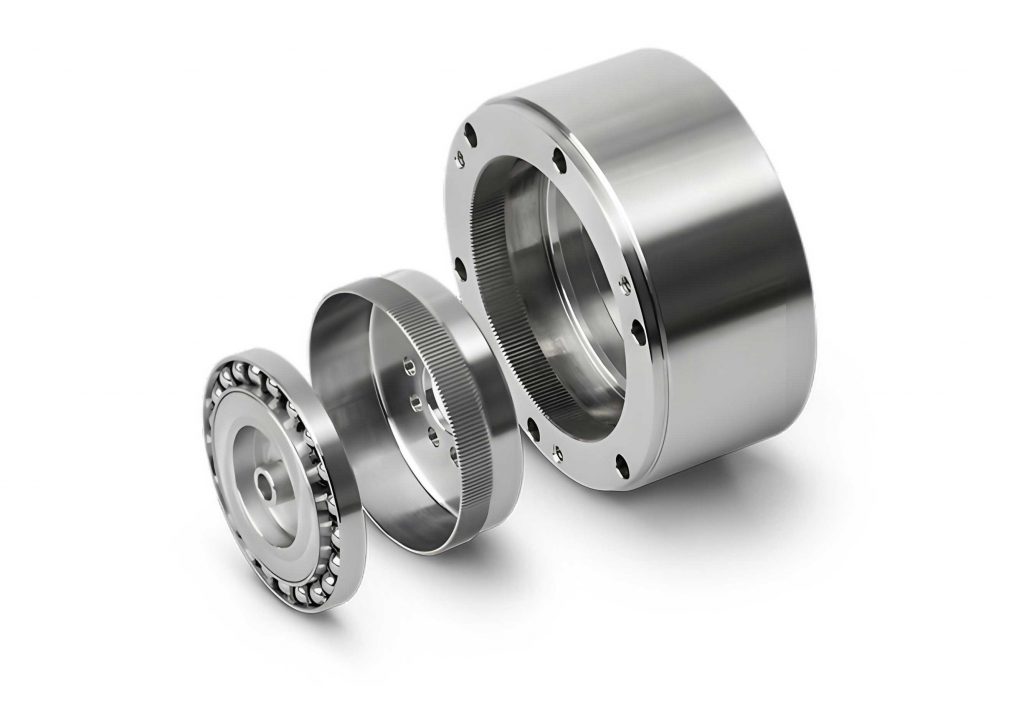
The harmonic drive gear operates on the principle of elastic deformation, where a wave generator induces a flexible spline (flexspline) to mesh with a rigid spline (circular spline). This interaction involves complex contact mechanics, and the tooth profile plays a critical role in determining the lubrication state. The double circular arc tooth profile, characterized by convex and concave arcs connected by a tangent line, is widely used for its improved load distribution and reduced stress concentrations. In my analysis, I consider a public tangent double circular arc profile, where the flexspline tooth consists of a convex arc at the tip, a straight line segment, and a concave arc at the root. The geometric parameters, such as the convex arc radius (\( \rho_a \)), concave arc radius (\( \rho_f \)), and tangent line angle (\( \gamma \)), define the tooth shape and directly impact the conjugate meshing behavior in the harmonic drive gear.
To model the tooth profile, I derive parametric equations for the flexspline segments. For the convex arc segment (AB), the coordinates are expressed as:
$$ \mathbf{r}_1 = \begin{bmatrix} x \\ y \end{bmatrix} = \begin{bmatrix} \rho_a \cos\left( \frac{u_1}{\rho_a} – \theta_a \right) + x_{oa} \\ \rho_a \sin\left( \frac{u_1}{\rho_a} – \theta_a \right) + y_{oa} \end{bmatrix} $$
where \( u_1 \) is the arc length parameter, \( \theta_a = \arcsin\left( \frac{h_a + X_a}{\rho_a} \right) \), and \( x_{oa} = -l_a \), \( y_{oa} = h_f + t – X_a \). For the straight line segment (BC):
$$ \mathbf{r}_2 = \begin{bmatrix} x \\ y \end{bmatrix} = \begin{bmatrix} x_B + (u_2 – l_1) \sin \gamma \\ y_B – (u_2 – l_1) \cos \gamma \end{bmatrix} $$
with \( x_B = x_{oa} + \rho_a \cos \gamma \), \( y_B = y_{oa} + \rho_a \sin \gamma \), and \( l_2 = l_1 + \frac{h_l}{\cos \gamma} \). For the concave arc segment (CD):
$$ \mathbf{r}_3 = \begin{bmatrix} x \\ y \end{bmatrix} = \begin{bmatrix} -\rho_f \cos\left( \frac{u_3}{\rho_f} – \gamma \right) + x_{of} \\ -\rho_f \sin\left( \frac{u_3}{\rho_f} – \gamma \right) + y_{of} \end{bmatrix} $$
where \( x_{of} = \rho_a + h_l \tan \gamma – \rho_f \cos \gamma \), \( y_{of} = h_f + t + X_f \), and \( l_3 = l_2 + \rho_f \left( \arcsin\left( \frac{X_f + h_f}{\rho_f} \right) – \gamma \right) \). These equations form the basis for analyzing the conjugate meshing in the harmonic drive gear.
The conjugate tooth profile of the circular spline is derived using an improved kinematic method. By establishing a meshing invariant matrix \( \mathbf{B} \), I relate the flexspline and circular spline motions. The matrix is defined as:
$$ \mathbf{B} = \begin{bmatrix} 0 & -\dot{\beta} & \omega \sin(\varphi + \mu) + \dot{\varphi} \Delta \cos(\varphi + \mu) \\ \dot{\beta} & 0 & -\omega \cos(\varphi + \mu) + \dot{\varphi} \Delta \sin(\varphi + \mu) \\ 0 & 0 & 0 \end{bmatrix} $$
where \( \omega \) is the input angular velocity, \( \varphi \) is the rotation angle, \( \mu \) is the deformation function, and \( \Delta \) is the radial displacement. The meshing equations are:
$$ \begin{cases} \mathbf{n}_i^T \mathbf{B} \mathbf{r}_i = 0, & i = 1,2,3 \\ \mathbf{r}^{(2)}_i = \mathbf{M}_{21} \mathbf{r}^{(1)}_i, & i = 1,2,3 \end{cases} $$
Solving these yields the theoretical conjugate profiles for the circular spline. In practice, the harmonic drive gear exhibits two conjugate contact regions: convex-convex contact (flexspline convex arc with circular spline convex arc) and convex-concave contact (flexspline convex arc with circular spline concave arc). I optimize the tooth profile parameters to minimize differences between conjugate curves, achieving a “double conjugate” condition that enhances meshing performance in the harmonic drive gear.
For the mixed lubrication analysis, I model the tooth contact as a finite line contact between two cylindrical surfaces with radii \( r_1 \) and \( r_2 \). The contact half-width \( a \) and length \( d \) are derived from Hertzian theory. The load distribution is calculated based on deformation compatibility and torque balance equations. The tangential and radial forces at a meshing point are given by:
$$ f_t = \frac{T}{d_g} \int_{\varphi_1}^{\varphi_2} \frac{\pi}{4} – \frac{\pi}{2} \cos(\varphi) \, d\varphi $$
and \( f_r = f_t \tan \alpha \), where \( T \) is the output torque, \( d_g \) is the pitch diameter, and \( \alpha \) is the pressure angle. These forces influence the lubrication state in the harmonic drive gear contact zones.
The mixed lubrication model integrates the Reynolds equation, film thickness equation, and elastic deformation. The Reynolds equation for transient conditions is:
$$ \frac{\partial}{\partial x} \left( \frac{\rho h^3}{12 \eta} \frac{\partial p}{\partial x} \right) + \frac{\partial}{\partial y} \left( \frac{\rho h^3}{12 \eta} \frac{\partial p}{\partial y} \right) = \frac{u_1 + u_2}{2} \frac{\partial (\rho h)}{\partial x} + \frac{\partial (\rho h)}{\partial t} $$
where \( p \) is pressure, \( h \) is film thickness, \( \rho \) is density, \( \eta \) is viscosity, and \( u_1, u_2 \) are surface velocities. The film thickness equation accounts for real surface roughness:
$$ h = h_0 + \frac{x^2}{2R_x} + \frac{y^2}{2R_y} + \delta_1(x,y,t) + \delta_2(x,y,t) + V_e(x,y,t) $$
Here, \( h_0 \) is the central film thickness, \( R_x, R_y \) are effective radii, \( \delta_1, \delta_2 \) are roughness amplitudes, and \( V_e \) is the elastic deformation computed as:
$$ V_e = \frac{2}{\pi E’} \iint \frac{p(\xi, \zeta)}{(x – \xi)^2 + (y – \zeta)^2} \, d\xi \, d\zeta $$
with \( E’ \) as the effective elastic modulus. The viscosity-pressure relationship uses the Barus equation: \( \eta = \eta_0 e^{\alpha p} \), and the density-pressure equation is:
$$ \rho = \rho_0 \left( 1 + \frac{0.6 \times 10^{-9} p}{1 + 1.7 \times 10^{-9} p} \right) $$
The load balance equation ensures that the integrated pressure supports the applied load: \( w(t) = \iint p(x,y,t) \, dx \, dy \). I solve these equations numerically using a coupled iterative method with fast Fourier transform for elastic deformation and Gauss-Seidel iteration for pressure convergence, achieving an error tolerance of \( 10^{-5} \) in the harmonic drive gear contact simulation.
To analyze the influence of convex tooth radius, I vary \( \rho_a \) while keeping other parameters constant, based on standard GOST 15023-69. The flexspline module is 0.396 mm, and key parameters are summarized in Table 1.
| Parameter | Value | Parameter | Value | Parameter | Value |
|---|---|---|---|---|---|
| \( h_a \) (mm) | 0.2400 | \( t \) (mm) | 0.5228 | \( \gamma \) (°) | 12 |
| \( h \) (mm) | 0.6110 | \( h_l \) (mm) | 0.0644 | \( Z_r \) | 160 |
| \( X_a \) (mm) | 0.1271 | \( \rho_a \) (mm) | Variable | \( Z_g \) | 162 |
| \( l_a \) (mm) | 0.5203 | \( \rho_f \) (mm) | 0.8200 |
I consider four cases with different convex arc radii, as shown in Table 2, where \( \rho_1 \) and \( \rho_2 \) are the fitted circular spline convex and concave arc radii, respectively. These define the contact geometry in the harmonic drive gear.
| Case | Flexspline Convex Radius \( \rho_a \) (mm) | Circular Spline Convex Radius \( \rho_1 \) (mm) | Circular Spline Concave Radius \( \rho_2 \) (mm) |
|---|---|---|---|
| 1 | 0.5 | 0.590683 | 0.765108 |
| 2 | 0.6 | 0.652248 | 0.662512 |
| 3 | 0.7 | 0.677232 | 0.626742 |
| 4 | 0.8 | 0.690683 | 0.609836 |
The simulation assumes an input speed range from 200 to 3000 r/min, an output torque of 90 N·m, and a tooth width of 9 mm. The material properties for the harmonic drive gear components are: density 7.85 g/cm³, elastic modulus 206 GPa, and Poisson’s ratio 0.29 for flexspline (40CrMoSiA) and 0.28 for circular spline (40CrMo). The lubricant has an initial viscosity of 0.093 Pa·s and a pressure-viscosity coefficient of 1.82 GPa⁻¹.
I evaluate lubrication performance using film thickness ratio \( \lambda \) (ratio of central film thickness to composite roughness), contact load ratio (percentage of load carried by asperity contact), and friction coefficient. The results for the convex-convex contact zone (Zone a) and convex-concave contact zone (Zone b) are presented below. For Zone a, the film thickness ratio increases with input speed, as shown in Figure 1 (represented descriptively here, since images are not referenced by number). At low speeds (e.g., 200 r/min), \( \lambda \) is low (0.011 for Case 1), indicating boundary lubrication. Increasing \( \rho_a \) improves \( \lambda \); for instance, at 3000 r/min, \( \lambda \) rises from 0.15 for Case 1 to 0.21 for Case 3. However, the enhancement diminishes as \( \rho_a \) approaches \( \rho_f \); Cases 3 and 4 show similar \( \lambda \) at high speeds. This trend highlights the importance of convex tooth radius optimization in harmonic drive gear design.
In Zone b, similar behavior is observed. The film thickness ratio improves with speed and larger \( \rho_a \), but the effect plateaus. For example, at 1200 r/min, increasing \( \rho_a \) from 0.5 mm to 0.7 mm boosts \( \lambda \) by 0.04, whereas from 0.7 mm to 0.8 mm, the increase is only 0.01. This suggests that moderate increases in convex radius benefit lubrication, but excessive changes yield marginal gains in harmonic drive gear systems.
The contact load ratio, representing the proportion of load supported by direct asperity contact, decreases with speed and larger \( \rho_a \). In Zone a, at 1600 r/min, the ratio drops from 10.94% for Case 1 to 6.68% for Case 3. This reduction signifies a shift toward full-film lubrication, reducing wear risk in the harmonic drive gear. Table 3 summarizes the contact load ratio for different cases at selected speeds.
| Speed (r/min) | Case 1 (\( \rho_a = 0.5 \) mm) | Case 2 (\( \rho_a = 0.6 \) mm) | Case 3 (\( \rho_a = 0.7 \) mm) | Case 4 (\( \rho_a = 0.8 \) mm) |
|---|---|---|---|---|
| 200 | 25.6 | 23.1 | 21.4 | 20.8 |
| 800 | 18.3 | 15.2 | 12.9 | 12.1 |
| 1600 | 10.9 | 8.5 | 6.7 | 6.0 |
| 3000 | 5.2 | 4.8 | 4.4 | 4.3 |
The friction coefficient also declines with speed and larger \( \rho_a \), particularly in the mid-speed range (800–2000 r/min). For Zone a, at 1200 r/min, the friction coefficient decreases from 0.085 for Case 1 to 0.072 for Case 3, reflecting better lubrication conditions. This reduction is crucial for improving efficiency and reducing heat generation in harmonic drive gear transmissions. The relationship can be expressed empirically as:
$$ \mu = \mu_0 e^{-k \omega} + C \left( \frac{\rho_a}{\rho_f} \right)^{-m} $$
where \( \mu_0 \), \( k \), \( C \), and \( m \) are constants derived from the data. This formula underscores the synergistic effect of speed and tooth geometry on friction in harmonic drive gear contacts.
To further elucidate the trends, I derive analytical expressions for central film thickness using Hamrock-Dowson type equations adapted for harmonic drive gear contact. The dimensionless film thickness is:
$$ H_c = 2.69 U^{0.67} G^{0.53} W^{-0.067} (1 – 0.61 e^{-0.73k}) $$
where \( U \) is the speed parameter, \( G \) is the material parameter, \( W \) is the load parameter, and \( k \) is the ellipticity ratio influenced by \( \rho_a \). For the convex-convex contact, the effective radius \( R \) is:
$$ \frac{1}{R} = \frac{1}{r_1} + \frac{1}{r_2} = \frac{1}{\rho_a} + \frac{1}{\rho_1} $$
Substituting the fitted values from Table 2, I compute \( R \) for each case. As \( \rho_a \) increases, \( R \) increases, leading to a larger film thickness according to the equation \( h_c \propto R^{0.43} \). This correlation explains why larger convex radii enhance lubrication in harmonic drive gear systems, especially at higher speeds where hydrodynamic effects dominate.
In discussion, the results emphasize that optimizing the convex tooth radius in harmonic drive gear design can significantly improve tribological performance. At low speeds, lubrication is primarily boundary-dominated, and speed is the critical factor. However, at medium to high speeds, increasing \( \rho_a \) effectively boosts film thickness, reduces asperity contact, and lowers friction. The “double conjugate” condition ensures smooth meshing, but the convex radius should be chosen judiciously; values too close to the concave radius offer diminishing returns. For the studied harmonic drive gear, a convex radius around 0.7 mm (approximately 85% of the concave radius) appears optimal, balancing lubrication enhancement and geometric constraints.
Moreover, the mixed lubrication model validates that real surface roughness, often overlooked in ideal analyses, plays a key role. The measured roughness amplitudes (0.3535 μm for flexspline, 0.3627 μm for circular spline) contribute to the contact load ratio, particularly at low film thickness ratios. Future work could explore surface texture modifications to further improve harmonic drive gear longevity.
In conclusion, I have demonstrated through comprehensive modeling that the convex tooth radius of the flexspline profoundly affects the tribology of double circular arc harmonic drive gear. By increasing this radius within practical limits, engineers can achieve thicker lubricant films, reduced direct contact, and lower friction, especially in mid-to-high-speed operations. This insight aids in designing more reliable and efficient harmonic drive gear systems for demanding applications. The methodologies and results presented here provide a framework for continued optimization of tooth profiles in advanced harmonic drive gear transmissions.