
In the era of Industry 4.0, the advancement towards intelligent manufacturing has propelled the development of robotics, where precision and reliability are paramount. At the heart of many robotic systems lies the RV reducer, a critical component known for its compact design, high torque capacity, and exceptional transmission accuracy. The RV reducer employs a two-stage reduction mechanism: the first stage involves planetary gear transmission, while the second stage utilizes a cycloidal pin wheel drive, which is the primary focus of this analysis. This cycloidal drive, characterized by multi-tooth engagement, plays a pivotal role in determining the overall performance and stiffness of the RV reducer. Understanding the meshing stiffness of this drive is essential for dynamic analysis, load distribution, and structural optimization. In this article, I explore the impact of key tooth profile parameters, such as pin tooth radius and eccentricity, on the meshing stiffness of the cycloidal pin wheel in RV reducers, using a combination of Hertz theory-based modeling and finite element analysis (FEA).
The RV reducer, short for Rotary Vector reducer, is a type of precision reducer widely used in industrial robots, aerospace, and other high-precision applications. Its structure typically includes an input shaft, planetary gears, crankshafts, cycloidal wheels, pin teeth, and a pin gear housing. The unique design allows for high reduction ratios in a small footprint, making it ideal for space-constrained environments. The second-stage cycloidal drive is particularly complex due to its multi-tooth contact and high重合度, which necessitates detailed analysis of meshing forces and stiffness. The meshing stiffness of the cycloidal pin wheel directly influences the RV reducer’s torsional rigidity, vibration characteristics, and service life. Therefore, investigating how tooth profile parameters affect this stiffness is crucial for enhancing the performance and durability of RV reducers.
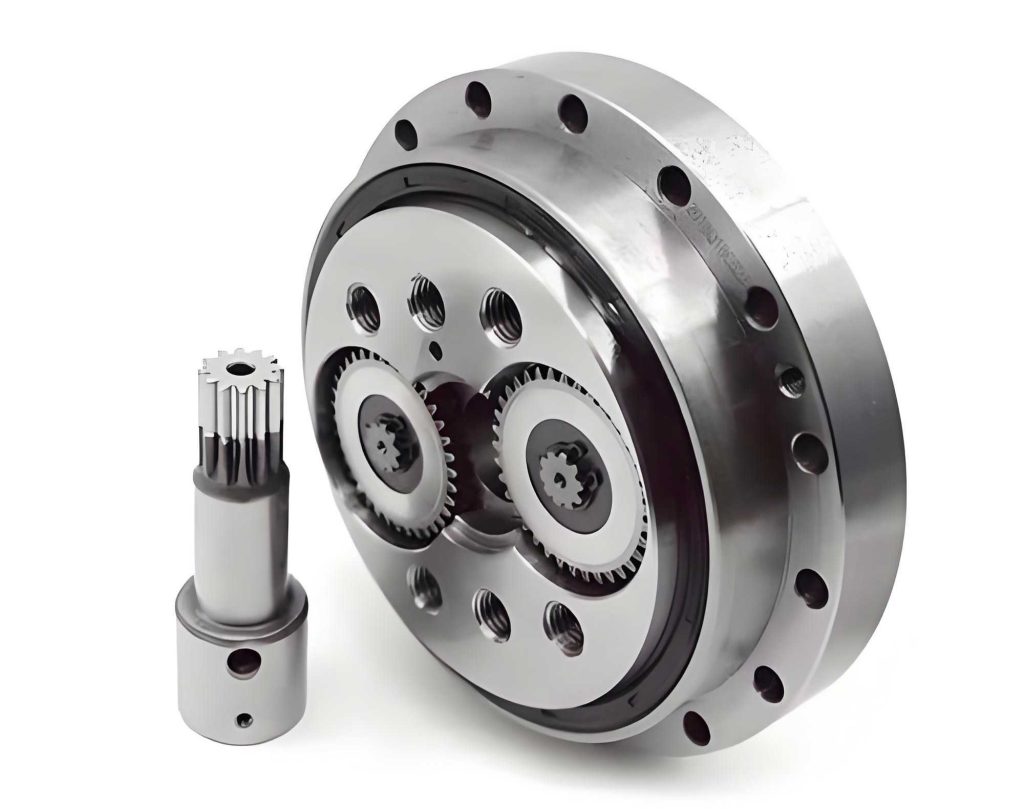
To delve into the mechanics, let’s first consider the tooth profile generation of the cycloidal wheel. The standard tooth profile of a cycloidal wheel, which conjugates with pin teeth without backlash, can be derived from parametric equations. Assuming the geometric center of the cycloidal wheel as the origin, the standard tooth profile equations are given by:
$$x_e = \left[ r_p – r_{rp} \phi^{-1}(K_1, \phi) \right] \cos((1 – i_H)\phi) – \left[ e – K_1 r_{rp} \phi^{-1}(K_1, \phi) \right] \cos(i_H \phi)$$
$$y_e = \left[ r_p – r_{rp} \phi^{-1}(K_1, \phi) \right] \sin((1 – i_H)\phi) + \left[ e – K_1 r_{rp} \phi^{-1}(K_1, \phi) \right] \sin(i_H \phi)$$
where \( r_p \) is the radius of the pin tooth distribution circle, \( r_{rp} \) is the pin tooth radius, \( i_H \) is the transmission ratio between the cycloidal wheel and pin gear (\( i_H = z_p / z_c \)), with \( z_p \) and \( z_c \) being the number of pin teeth and cycloidal teeth, respectively. \( \phi \) is the meshing phase angle, \( e \) is the eccentricity, and \( K_1 \) is the shortening coefficient defined as \( K_1 = e z_p / r_p \). However, in practical RV reducer applications, to accommodate manufacturing errors, assembly tolerances, and lubrication needs, the cycloidal wheel undergoes profile modifications. Common methods include equidistant modification and offset modification, which introduce controlled backlash. The modified tooth profile equations incorporate these adjustments:
$$x_e = \left[ r_p + \Delta r_p – (r_{rp} + \Delta r_{rp}) \phi^{-1}(K’_1, \phi) \right] \cos[(1 – i_H)\phi – \delta] – \frac{a}{r_p + \Delta r_p} \left[ r_p + \Delta r_p – z_p (r_{rp} + \Delta r_{rp}) \phi^{-1}(K’_1, \phi) \right] \cos(i_H \phi + \delta)$$
$$y_e = \left[ r_p + \Delta r_p – (r_{rp} + \Delta r_{rp}) \phi^{-1}(K’_1, \phi) \right] \sin[(1 – i_H)\phi – \delta] – \frac{a}{r_p + \Delta r_p} \left[ r_p + \Delta r_p – z_p (r_{rp} + \Delta r_{rp}) \phi^{-1}(K’_1, \phi) \right] \sin(i_H \phi + \delta)$$
Here, \( \Delta r_p \) and \( \Delta r_{rp} \) represent the modification amounts for the pin tooth distribution circle and pin tooth radius, respectively, and \( K’_1 \) is the modified shortening coefficient. These modifications ensure proper meshing with minimal backlash, which is critical for the smooth operation of the RV reducer.
The meshing stiffness of the cycloidal pin wheel drive is a key parameter that affects the load distribution among multiple engaging teeth. Due to the high重合度, the meshing stiffness varies with time and depends on the number of teeth in contact simultaneously. To model this, I base the analysis on Hertz contact theory, which approximates the elastic deformation at the contact points between the cycloidal wheel and pin teeth. For a single tooth pair, the contact stiffness can be derived from the Hertz formula. Consider two elastic bodies in line contact; the radial deformation of the pin tooth \( t_{zi} \) and the cycloidal tooth \( t_{bi} \) at the \( i \)-th contact point are given by:
$$t_{zi} = \frac{4 F_i a_i (1 – \mu^2)}{\pi b E r_z}$$
$$t_{bi} = \frac{4 F_i a_i (1 – \mu^2)}{\pi b E a_{bi}}$$
where \( F_i \) is the force at the \( i \)-th contact point, \( a_i \) is the comprehensive curvature radius, \( \mu \) is Poisson’s ratio (assumed as 0.3 for both components), \( E \) is the elastic modulus (206 GPa for typical materials like 20CrMnTi), \( b \) is the tooth width, \( r_z \) is the pin tooth radius, and \( a_{bi} \) is the equivalent curvature radius at the cycloidal tooth. The individual stiffness values for the pin tooth and cycloidal tooth are:
$$k_1 = \frac{F_i}{t_{zi}} = \frac{\pi b E r_z}{4 a_i (1 – \mu^2)}$$
$$k_2 = \frac{F_i}{t_{bi}} = \frac{\pi b E a_{bi}}{4 a_i (1 – \mu^2)}$$
For a single tooth pair, the combined meshing stiffness \( k \) is the series combination of \( k_1 \) and \( k_2 \):
$$k = \frac{k_1 k_2}{k_1 + k_2} = \frac{\pi b E R_z S^{3/2}}{4(1 – \mu^2)(R_z S^{3/2} + 2 r_z T)}$$
where \( R_z \) is related to the pin tooth distribution circle, \( S = 1 + K_1^2 – 2K_1 \cos \phi_i \), and \( T \) is a function of the meshing phase. However, for the entire cycloidal drive in an RV reducer, the total meshing stiffness must account for all simultaneously engaging teeth. The initial backlash due to modifications affects the number of teeth in contact. The backlash \( \Delta(\phi) \) is expressed as:
$$\Delta(\phi) = \Delta r_{rp} \left(1 – \frac{\sin \phi_i}{\sqrt{1 + K^2 – 2K \cos \phi_i}}\right) – \frac{\Delta r_p (1 – K \cos \phi_i – \sqrt{1 – K^2} \sin \phi_i)}{\sqrt{1 + K^2 – 2K \cos \phi_i}}$$
Under torque, the deformation curve intersects with the initial backlash distribution, defining the range of engaged teeth. The number of simultaneously meshing teeth \( z \) is calculated as:
$$z = \text{int}\left(\frac{\Delta \phi}{2\pi / z_p}\right)$$
where \( \Delta \phi = \phi_b – \phi_a \) is the phase angle range. Considering factors like manufacturing errors, a coefficient \( \lambda \) (typically 0.7) is introduced. Thus, the equivalent torsional stiffness \( K \) of the cycloidal pin wheel drive in the RV reducer is:
$$K = \lambda \sum_{i=a}^{b} k l_i^2$$
where \( l_i \) is the force arm length at the \( i \)-th contact point, derived from geometric relations. This model forms the basis for evaluating how tooth profile parameters influence meshing stiffness.
To validate the theoretical model and investigate parameter effects, I conducted finite element analysis (FEA) using ANSYS Workbench. A 3D model of the cycloidal pin wheel drive was created in SolidWorks based on the parametric equations, with key parameters summarized in Table 1. The model includes two cycloidal wheels, 40 pin teeth, a pin gear housing, and eccentric shafts, omitting minor features like fillets to simplify meshing. The material properties are listed in Table 2.
| Parameter | Symbol | Value | Unit |
|---|---|---|---|
| Number of pin teeth | \( z_p \) | 40 | – |
| Pin tooth radius | \( r_{rp} \) | 3 | mm |
| Number of cycloidal teeth | \( z_c \) | 39 | – |
| Eccentricity | \( e \) | 2.2 | mm |
| Tooth width | \( b \) | 16 | mm |
| Shortening coefficient | \( K_1 \) | 0.675 | – |
| Pin distribution circle radius | \( r_p \) | Based on design | mm |
| Component | Material | Elastic Modulus (MPa) | Poisson’s Ratio |
|---|---|---|---|
| Cycloidal wheel | 20CrMnTi | 2.12 × 10⁵ | 0.3 |
| Pin teeth | 20CrMnTi | 2.12 × 10⁵ | 0.3 |
| Pin gear housing | QT450 | 1.73 × 10⁵ | 0.3 |
The model was imported into ANSYS Workbench for transient dynamic analysis. Meshing was performed using hex-dominant elements, with refined grids at the tooth contacts to ensure accuracy. The input shaft was treated as a rigid body, and a torque of 3 N·m was applied to the pin gear housing, converted into equivalent nodal forces. Constraints included axial and radial fixes for the pin gear housing and axial constraints for the cycloidal wheels. The simulation yielded stress distributions and contact forces over time, which were then exported to MATLAB for stiffness calculation.
The FEA results confirmed the theoretical predictions. The meshing stiffness curve derived from simulation closely matched the Hertz-based model, with minor deviations due to numerical approximations. This validates the approach for analyzing the RV reducer’s cycloidal drive. Next, I varied key tooth profile parameters—specifically, the pin tooth radius \( r_{rp} \) and the eccentricity \( e \)—to study their impact on meshing stiffness. For each parameter set, transient simulations were run, and the equivalent torsional stiffness was computed using the formula above. The findings are summarized in Table 3 and illustrated through curves.
| Parameter Variation | Range | Meshing Stiffness Trend | Key Observation |
|---|---|---|---|
| Pin tooth radius \( r_{rp} \) | 2.5 mm to 3.5 mm | Slight increase | Minimal impact on overall stiffness |
| Eccentricity \( e \) | 1.8 mm to 2.6 mm | Significant non-linear change | Major influence; optimal at 2.2 mm |
| Shortening coefficient \( K_1 \) | 0.6 to 0.75 | Moderate variation | Linked to eccentricity and distribution radius |
The relationship between pin tooth radius and meshing stiffness can be expressed mathematically. From the stiffness formula, as \( r_{rp} \) increases, the term \( a_{bi} \) changes, but the effect is buffered by other factors. Approximating, the stiffness \( k \) for a single pair shows:
$$k \propto \frac{r_z S^{3/2}}{R_z S^{3/2} + 2 r_z T}$$
Since \( r_z \) (pin tooth radius) appears in both numerator and denominator, the net effect is small, as observed in simulations. For the eccentricity \( e \), the impact is more pronounced because it directly affects the force arm length \( l_i \) and the meshing phase. The force arm is given by:
$$l_i = \frac{O_p P \cdot \sin \phi_i}{\sqrt{1 + K_1^2 – 2K_1 \cos \phi_i}}$$
where \( O_p P \) is related to \( e \). As \( e \) increases, \( l_i \) generally increases, altering the torsional stiffness \( K = \lambda \sum k l_i^2 \). This leads to a non-linear relationship, where stiffness peaks at an optimal eccentricity value—in this case, around 2.2 mm for the given RV reducer design. This underscores the importance of precise eccentricity control in manufacturing RV reducers.
To further quantify these effects, I derived analytical expressions for stiffness sensitivity. For small changes in pin tooth radius \( \Delta r_{rp} \), the stiffness change \( \Delta k \) is approximately:
$$\Delta k \approx \frac{\partial k}{\partial r_{rp}} \Delta r_{rp} = \frac{\pi b E S^{3/2} (R_z T – r_z S^{3/2})}{4(1 – \mu^2)(R_z S^{3/2} + 2 r_z T)^2} \Delta r_{rp}$$
Given typical values, this derivative is small, confirming the minor influence. For eccentricity \( e \), the sensitivity is higher due to its role in \( K_1 \) and \( l_i \). Using chain rule:
$$\frac{\partial K}{\partial e} = \lambda \sum \left( \frac{\partial k}{\partial e} l_i^2 + 2k l_i \frac{\partial l_i}{\partial e} \right)$$
where \( \frac{\partial k}{\partial e} \) involves terms like \( \frac{\partial S}{\partial e} = \frac{2z_p e}{r_p} – 2z_p \cos \phi_i \), leading to substantial variations. This analysis highlights why eccentricity is a critical design parameter for optimizing meshing stiffness in RV reducers.
In practical terms, these findings have direct implications for RV reducer design and manufacturing. For instance, when tuning the performance of an RV reducer, engineers should prioritize controlling the eccentricity within tight tolerances to achieve desired stiffness characteristics. The pin tooth radius, while less influential, can be adjusted for other considerations like stress reduction or wear resistance. Additionally, the profile modifications—equidistant and offset—must be carefully calibrated to balance backlash and stiffness, ensuring smooth operation without compromising load capacity.
Moreover, the meshing stiffness affects the dynamic behavior of the RV reducer, including vibration and noise levels. A higher stiffness generally leads to lower vibration but may increase stress concentrations. Therefore, optimizing tooth profile parameters is a multi-objective task that requires trade-offs. The methods presented here—combining Hertz theory with FEA—provide a robust framework for such optimization, enabling designers to simulate various scenarios and predict stiffness outcomes accurately.
In conclusion, through theoretical modeling and finite element analysis, I have demonstrated that tooth profile parameters significantly influence the meshing stiffness of the cycloidal pin wheel drive in RV reducers. While pin tooth radius has a minimal effect, eccentricity plays a major role, with optimal values enhancing torsional rigidity. These insights are vital for advancing RV reducer technology, contributing to more reliable and efficient robotic systems. Future work could explore additional factors, such as temperature effects or advanced materials, to further refine the performance of RV reducers in demanding applications.
To summarize key formulas and relationships, here is a consolidated list of equations used in this analysis for the RV reducer cycloidal drive:
$$ \text{Standard tooth profile: } x_e, y_e \text{ as defined above} $$
$$ \text{Modified tooth profile: } x_e, y_e \text{ with } \Delta r_p, \Delta r_{rp} $$
$$ \text{Single tooth pair stiffness: } k = \frac{\pi b E R_z S^{3/2}}{4(1 – \mu^2)(R_z S^{3/2} + 2 r_z T)} $$
$$ \text{Total torsional stiffness: } K = \lambda \sum_{i=a}^{b} k l_i^2 $$
$$ \text{Backlash: } \Delta(\phi) = \Delta r_{rp} \left(1 – \frac{\sin \phi_i}{\sqrt{1 + K^2 – 2K \cos \phi_i}}\right) – \frac{\Delta r_p (1 – K \cos \phi_i – \sqrt{1 – K^2} \sin \phi_i)}{\sqrt{1 + K^2 – 2K \cos \phi_i}} $$
These equations, coupled with parametric studies, offer a comprehensive approach to understanding and improving the meshing stiffness in RV reducers, ensuring they meet the stringent requirements of modern industrial applications.