
As a researcher in the field of assistive robotics, I have witnessed the rapid evolution of artificial intelligence and its profound impact on daily life. The integration of IoT technology into robotic systems presents a transformative opportunity, particularly for addressing the challenges posed by an aging global population. In this article, I explore the current state and future potential of the intelligent robot dog designed for elderly care, leveraging IoT frameworks to enhance safety, companionship, and independence for seniors living alone.
The aging demographic crisis is intensifying worldwide, with many countries experiencing a significant increase in the proportion of elderly citizens. This trend often results in seniors residing in isolation, as family members are occupied with work or live afar. Traditional care solutions, such as human caregivers or nursing homes, face limitations in scalability, cost, and emotional connection. Here, the robot dog emerges as a promising alternative—a compact, versatile companion that integrates seamlessly into home environments. By combining IoT capabilities with advanced robotics, this robot dog can monitor health, provide assistance, and offer social interaction, thereby bridging the gap between technological innovation and humane care.
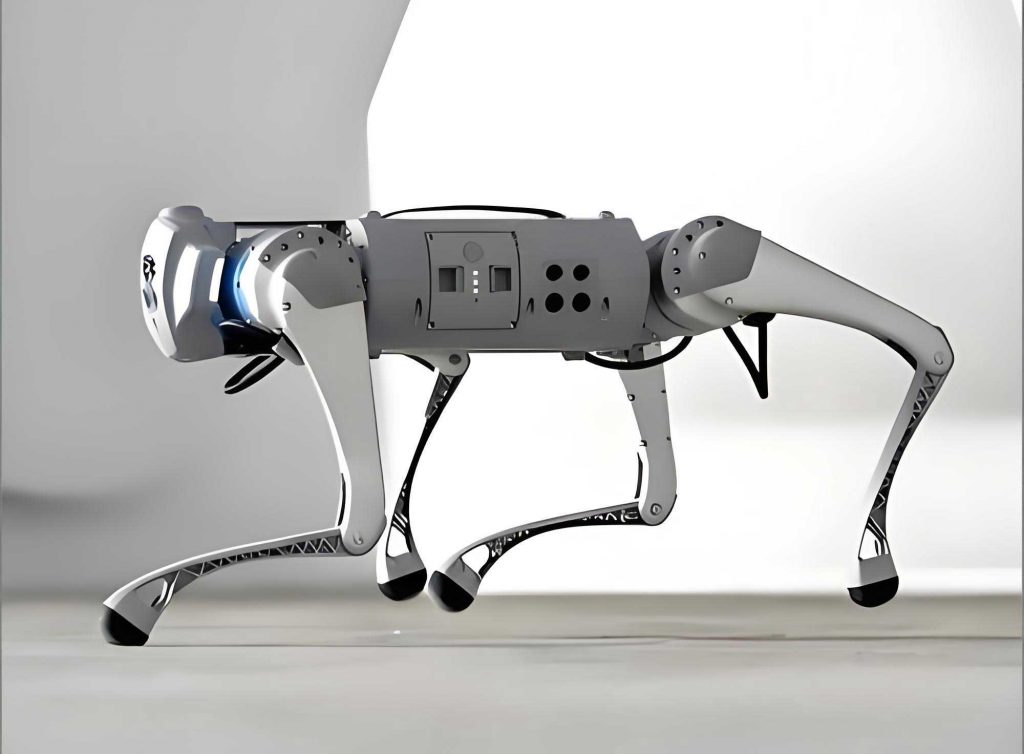
The core of this intelligent robot dog lies in its IoT architecture, which consists of three layers: the perception layer, network layer, and application layer. Each layer contributes to the robot dog’s functionality, enabling real-time data processing and responsive actions. The perception layer employs various sensors to collect environmental and physiological data. For instance, health metrics like heart rate and blood pressure are captured using biomedical sensors, while motion sensors detect falls or irregularities in movement. The data acquisition process can be modeled mathematically to represent the integration of sensor inputs over time. Let $$ S(t) $$ denote the sensor data vector at time $$ t $$, comprising values from $$ n $$ sensors: $$ S(t) = [s_1(t), s_2(t), \ldots, s_n(t)] $$. The perception layer aggregates this data, filtering noise through algorithms such as a Kalman filter, represented as: $$ \hat{x}_t = F_t \hat{x}_{t-1} + K_t (z_t – H_t \hat{x}_{t-1}) $$, where $$ \hat{x}_t $$ is the estimated state, $$ F_t $$ is the state transition model, $$ z_t $$ is the measurement, and $$ K_t $$ is the Kalman gain. This ensures accurate information extraction for the robot dog’s decision-making.
The network layer facilitates data transmission between the robot dog and external systems, such as cloud servers or emergency contacts. Using wireless protocols like Wi-Fi or 5G, the robot dog sends processed data to the application layer, where user interactions occur. The data flow rate $$ R $$ can be expressed as: $$ R = \frac{D}{T} $$, where $$ D $$ is the data size and $$ T $$ is the transmission time. This layer ensures seamless connectivity, allowing the robot dog to alert caregivers or medical services promptly. The application layer interfaces with users through voice commands, mobile apps, or automated responses, making the robot dog an intuitive companion. For example, when a senior speaks a command, the robot dog’s natural language processing module interprets it using probability models: $$ P(\text{intent} | \text{speech}) = \frac{P(\text{speech} | \text{intent}) P(\text{intent})}{P(\text{speech})} $$, enabling effective communication.
The functionalities of the intelligent robot dog are diverse, tailored to meet the holistic needs of elderly individuals. Below is a comprehensive table summarizing these key features, which highlight the robot dog’s multifaceted role in daily care.
| Function Category | Description | IoT Integration |
|---|---|---|
| Voice Interaction | Provides voice播报 for weather, time, news, and music; enables smart聊天 through AI algorithms. | Uses microphones and speakers in the perception layer; processes data in the application layer. |
| Health Monitoring | Continuously tracks vital signs (e.g.,心率,血压,血氧); sends alerts for anomalies via SMS. | Biomedical sensors in the perception layer; network layer transmits data to emergency contacts. |
| Physical Assistance | Carries items like medicine or money; acts as a mobile seat for rest; assists in standing after falls. | Load sensors and actuators in the perception layer; application layer controls mechanical responses. |
| Safety and Navigation | Follows the elderly closely; uses定位 and navigation to prevent走失; detects falls and triggers alarms. | GPS and motion sensors in the perception layer; network layer connects to emergency services. |
| Environmental Sensing | Monitors air quality via tail sensors; provides照明 and video监控 through eye components. | Environmental sensors in the perception layer; data visualized in the application layer. |
| Stability and Autonomy | Maintains balance on rough terrain; self-rights if tipped over; operates quietly to avoid noise. | Inertial measurement units (IMUs) in the perception layer; control algorithms in the application layer. |
These functions are enabled by sophisticated algorithms that optimize the robot dog’s performance. For instance, the path-following mechanism can be described using a proportional-integral-derivative (PID) controller: $$ u(t) = K_p e(t) + K_i \int_0^t e(\tau) d\tau + K_d \frac{de(t)}{dt} $$, where $$ u(t) $$ is the control output, $$ e(t) $$ is the error between the robot dog’s position and the target path, and $$ K_p, K_i, K_d $$ are tuning parameters. This ensures smooth and accurate movement alongside the elderly user. Additionally, the health monitoring system employs anomaly detection models, such as threshold-based alerts where a vital sign $$ V $$ triggers an alarm if: $$ |V – V_{\text{normal}}| > \delta $$, with $$ \delta $$ being a predefined tolerance. The robot dog’s ability to process such data in real-time underscores its reliability as a caregiving tool.
The advantages of this robot dog over traditional care solutions are significant, contributing to its potential for widespread adoption. A comparative analysis reveals key benefits, as shown in the table below, which contrasts the robot dog with conventional methods like human caregivers or basic monitoring devices.
| Aspect | Robot Dog | Traditional Care |
|---|---|---|
| Cost | Relatively low造价 due to small size and scalable production; suitable for various income levels. | High expenses for human护工 or nursing homes; ongoing costs for labor and facilities. |
| Safety | Real-time monitoring and immediate response to emergencies; reduces risks of falls or health crises. | 依赖 on human attention, which may be delayed or inconsistent; limited by caregiver availability. |
| Companionship | Offers emotional support through互动 and entertainment; mimics pet-like behavior to reduce loneliness. | Human interaction is valuable but not always constant; pets require additional care and may pose hazards. |
| Convenience | Portable and adaptable to home environments; follows the elderly autonomously without disrupting daily life. | May involve intrusive installations or rigid schedules; less flexible in dynamic situations. |
| Technological Integration | Leverages IoT for smart connectivity; updates and improves via software enhancements. | Often relies on manual methods or standalone devices with limited connectivity. |
From a market perspective, the demand for such a robot dog is driven by demographic shifts. Global aging statistics indicate a rising need for innovative care solutions. For example, the elderly population growth can be modeled using logistic functions: $$ P(t) = \frac{K}{1 + e^{-r(t-t_0)}} $$, where $$ P(t) $$ is the population at time $$ t $$, $$ K $$ is the carrying capacity, $$ r $$ is the growth rate, and $$ t_0 $$ is the inflection point. In many regions, the proportion of seniors is projected to exceed 20% by 2040, creating a substantial market for assistive robots. Specifically, the robot dog addresses gaps left by existing products like smart手环, which lack physical assistance capabilities. The market potential $$ M $$ for the robot dog can be estimated as: $$ M = N \times \alpha \times \beta $$, where $$ N $$ is the number of elderly living alone, $$ \alpha $$ is the adoption rate, and $$ \beta $$ is the average revenue per unit. With millions of seniors worldwide, the robot dog could capture a significant share of the elderly care market.
Internationally, research and development in quadruped robots have advanced, with entities like Boston Dynamics creating models for military or industrial use. However, the focus on elderly care remains underexplored, presenting an opportunity for specialization. The intelligent robot dog discussed here distinguishes itself through its IoT integration and affordability. Current technologies, such as machine learning for gesture recognition, enhance the robot dog’s interactivity. For instance, the probability of correctly interpreting a gesture $$ G $$ given sensor data $$ X $$ can be expressed as: $$ P(G | X) = \frac{P(X | G) P(G)}{\sum_{g} P(X | g) P(g)} $$, using Bayesian inference. This allows the robot dog to respond to commands like “come” or “go” intuitively, fostering a natural bond with the user.
Looking ahead, the evolution of the robot dog will likely involve enhanced AI capabilities, such as predictive analytics for health deterioration. By employing time-series forecasting models like ARIMA: $$ \phi(B) \nabla^d y_t = \theta(B) \epsilon_t $$, where $$ \phi $$ and $$ \theta $$ are polynomials, $$ B $$ is the backshift operator, and $$ \epsilon_t $$ is white noise, the robot dog could anticipate issues before they become critical. Moreover, swarm robotics might enable multiple robot dogs to collaborate in larger care facilities, optimizing resource分配. The cost-effectiveness of the robot dog can be further improved through mass production, with unit cost $$ C $$ decreasing as production volume $$ Q $$ increases, following a learning curve model: $$ C(Q) = C_0 Q^{-b} $$, where $$ C_0 $$ is the initial cost and $$ b $$ is the learning rate. This scalability ensures accessibility across diverse socioeconomic groups.
In conclusion, the intelligent robot dog represents a convergence of IoT, robotics, and empathetic design, offering a viable solution to the challenges of elderly care. As I reflect on its potential, I am convinced that this robot dog will not only enhance safety and independence for seniors but also alleviate the burdens on families and healthcare systems. By continuously refining its algorithms and expanding its functionalities, the robot dog can evolve into an indispensable companion, embodying the promise of technology to enrich human life. The journey from concept to widespread adoption will require collaboration across disciplines, but the vision of a future where no elderly person feels alone or unsafe is within reach, thanks to innovations like the robot dog.