
The advancement of robotic manipulation hinges on the development of sophisticated end-effectors capable of emulating the adaptability and precision of the human hand. The dexterous robotic hand, characterized by its multi-fingered, multi-degree-of-freedom (DOF) architecture, represents the pinnacle of this pursuit. This article presents a comprehensive kinematic analysis and introduces a novel interactive simulation methodology for a multi-DOF anthropomorphic dexterous robotic hand. We begin by detailing the mechanical design and DOF distribution. Subsequently, the forward kinematics are rigorously derived using the Denavit-Hartenberg (D-H) convention. Finally, we propose and demonstrate an interactive simulation framework that allows for real-time, user-in-the-loop adjustment of joint parameters, significantly enhancing the efficiency of motion planning and grasp synthesis for the dexterous robotic hand.
The mechanical architecture of a dexterous robotic hand is fundamental to its performance. Our design philosophy prioritizes anthropomorphism and modularity to achieve a wide range of stable grasps and fine manipulations. The hand comprises five independent fingers and a palm, offering a total of 20 actively driven degrees of freedom. This high level of actuation provides the necessary redundancy for executing complex tasks.
The index, middle, ring, and little fingers share a modular design. Each of these fingers possesses four active DOFs, distributed across three kinematic joints mimicking their biological counterparts: the Metacarpophalangeal (MCP) joint, the Proximal Interphalangeal (PIP) joint, and the Distal Interphalangeal (DIP) joint. The MCP joint is realized using a cross-axis mechanism, providing two independent DOFs for flexion/extension and abduction/adduction motions. The PIP and DIP joints each provide one DOF for flexion/extension.
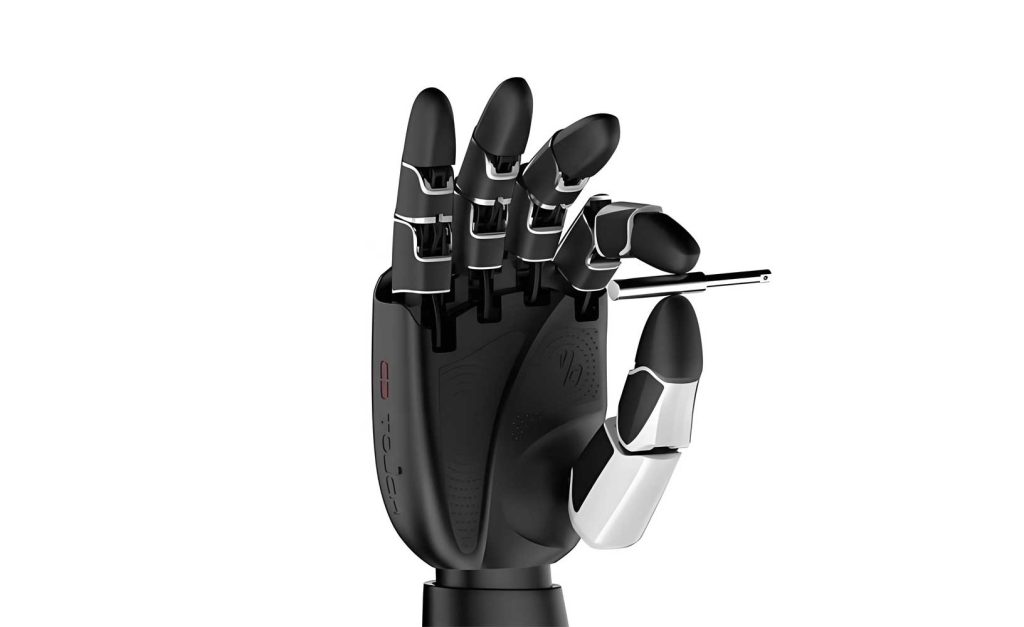
The thumb’s design is distinct, featuring enhanced configurability to oppose the other fingers effectively. It is mounted within a slotted track on the palm, allowing for translation to adjust its base position relative to the palm. Furthermore, the thumb’s orientation can be rotated along an arc-shaped groove, enabling optimal opposition for various grasp types. This adjustable installation significantly enlarges the effective workspace and improves grasp stability of the dexterous robotic hand.
A precise kinematic model is essential for controlling and simulating a dexterous robotic hand. We employ the standard D-H method to establish coordinate frames for each link in the finger’s serial chain. For the modular four fingers (excluding the thumb), the coordinate frames are assigned as shown in the referenced figure, with the base frame {0} located at the MCP joint. The associated D-H parameters are summarized in Table 1, where $a_i$ represents the link length, $d_i$ the link offset, $\alpha_i$ the link twist, and $\theta_i$ the joint angle.
| Joint $i$ | $\theta_i$ | $\alpha_i$ | $a_i$ | $d_i$ |
|---|---|---|---|---|
| 1 | $\theta_1$ | $-90^\circ$ | $a_1$ | 0 |
| 2 | $\theta_2$ | $90^\circ$ | $a_2$ | 0 |
| 3 | $\theta_3$ | $0^\circ$ | $a_3$ | 0 |
| 4 | $\theta_4$ | $0^\circ$ | $a_4$ | 0 |
The transformation matrix from the fingertip frame {4} to the base frame {0} is obtained by the consecutive product of individual joint transformation matrices:
$$
^0_4\mathbf{T} = ^0_1\mathbf{T} \ ^1_2\mathbf{T} \ ^2_3\mathbf{T} \ ^3_4\mathbf{T}
$$
where each homogeneous transformation matrix $^{i-1}_i\mathbf{T}$ is defined by its D-H parameters $(\theta_i, \alpha_i, a_i, d_i)$. The complete forward kinematics equation for the fingertip position and orientation is:
$$
^0_4\mathbf{T} = \begin{bmatrix}
c_1 c_2 c_{34} – s_1 s_{34} & -c_1 c_2 s_{34} – s_1 c_{34} & c_1 s_2 & a_4(c_1 c_2 c_{34} – s_1 s_{34}) + a_3(c_1 c_2 c_3 – s_1 s_3) + a_2 c_1 c_2 + a_1 c_1 \\
s_1 c_2 c_{34} + c_1 s_{34} & -s_1 c_2 s_{34} + c_1 c_{34} & s_1 s_2 & a_4(s_1 c_2 c_{34} + c_1 s_{34}) + a_3(s_1 c_2 c_3 + c_1 s_3) + a_2 s_1 c_2 + a_1 s_1 \\
-s_2 c_{34} & s_2 s_{34} & c_2 & -a_4 s_2 c_{34} – a_3 s_2 c_3 – a_2 s_2 \\
0 & 0 & 0 & 1
\end{bmatrix}
$$
where $c_i = \cos\theta_i$, $s_i = \sin\theta_i$, $c_{ij} = \cos(\theta_i + \theta_j)$, and $s_{ij} = \sin(\theta_i + \theta_j)$. Therefore, the position of the fingertip $\mathbf{p} = [x, y, z]^T$ in the base frame is given by the last column of $^0_4\mathbf{T}$:
$$
\begin{aligned}
x &= a_4(c_1 c_2 c_{34} – s_1 s_{34}) + a_3(c_1 c_2 c_3 – s_1 s_3) + a_2 c_1 c_2 + a_1 c_1 \\
y &= a_4(s_1 c_2 c_{34} + c_1 s_{34}) + a_3(s_1 c_2 c_3 + c_1 s_3) + a_2 s_1 c_2 + a_1 s_1 \\
z &= -a_4 s_2 c_{34} – a_3 s_2 c_3 – a_2 s_2
\end{aligned}
$$
The kinematic model for the thumb must account for its additional base degrees of freedom. The transformation from the thumb’s palm base frame {P} to the global hand base frame {0} includes parameters for its adjustable orientation ($\theta_{-1}$) and translation ($d_{-2}$). The combined transformation from the thumb tip frame {4} to the global base {0} is:
$$
^0_4\mathbf{T}_{\text{thumb}} = ^0_P\mathbf{T}(\theta_{-1}, d_{-2}) \ ^P_4\mathbf{T}(\theta_1, \theta_2, \theta_3, \theta_4)
$$
The resulting position equations are more complex but follow the same D-H formulation, confirming that the pose of any fingertip on this dexterous robotic hand is uniquely determined by its joint angles and fixed link lengths.
Traditional kinematic simulation for a dexterous robotic hand often involves pre-computing trajectories or using offline optimization to determine joint angles for specific poses or grasps. This process is non-interactive, irreversible, and inefficient for exploratory design or rapid prototyping of manipulation strategies. To overcome these limitations, we propose an interactive simulation paradigm. This method allows a user to control the virtual dexterous robotic hand in real-time, adjusting the rotation direction and angle of each joint during the simulation via an intuitive interface. This capability enables immediate visual feedback and iterative refinement of motions without the need to re-solve or re-specify complex kinematic parameters from scratch.
The simulation environment is built using a virtual prototyping platform. The 3D model of the dexterous robotic hand, with its articulated joints, is imported and kinematic constraints are applied based on the derived D-H models. Interactive sliders or direct manipulation widgets are linked to each joint variable ($\theta_i$). As the user adjusts these controls, the forward kinematics equations are solved in real-time to update the posture of the entire hand, enabling direct manipulation of the dexterous robotic hand‘s configuration.
To validate the interactive approach, we simulate the formation of a “V-for-Victory” gesture, a non-trivial pose requiring independent finger abduction and specific flexion sequences. The simulation proceeds interactively: first, flexion of the ring and little fingers is applied; then, the thumb is flexed towards them; finally, the index and middle fingers are abducted in opposite directions. The key advantage of interactivity is demonstrated when the initial abduction angles appear asymmetric. The user can immediately adjust the index finger’s abduction angle by a few degrees in the opposite direction and observe the correction in real-time, converging on a symmetric pose efficiently. The final joint angles for this gesture, captured directly from the simulation interface, are shown in Table 2.
| Joint | Thumb | Index | Middle | Ring | Little |
|---|---|---|---|---|---|
| $\theta_1$ | $36^\circ$ | $0^\circ$ | $0^\circ$ | $79^\circ$ | $80^\circ$ |
| $\theta_2$ | $41^\circ$ | $15^\circ$ | $15^\circ$ | $0^\circ$ | $0^\circ$ |
| $\theta_3$ | $0^\circ$ | $0^\circ$ | $0^\circ$ | $88^\circ$ | $89^\circ$ |
| $\theta_4$ | $29^\circ$ | $0^\circ$ | $0^\circ$ | $31^\circ$ | $30^\circ$ |
A more complex task is the interactive simulation of grasping a handled cup. This process is naturally broken into a coarse phase followed by a fine-adjustment phase. During coarse positioning, the user translates the entire dexterous robotic hand towards the cup handle while curling the ring and little fingers. Then, the hand is moved so the index and middle fingers pass through the handle. In the fine-adjustment phase, the user interactively微调s the flexion of the index and middle finger joints to ensure they snugly contact the handle contour, simultaneously adjusting the thumb’s position to firmly oppose the grip on the other side of the handle. This blend of coarse and fine interactive control mirrors human dexterity and rapidly yields a stable grasp configuration. The joint angles upon achieving a stable grasp are recorded in Table 3.
| Joint | Thumb | Index | Middle | Ring | Little |
|---|---|---|---|---|---|
| $\theta_1$ | $89^\circ$ | $0^\circ$ | $0^\circ$ | $83^\circ$ | $82^\circ$ |
| $\theta_2$ | $0^\circ$ | $0^\circ$ | $0^\circ$ | $0^\circ$ | $0^\circ$ |
| $\theta_3$ | $0^\circ$ | $84^\circ$ | $82^\circ$ | $88^\circ$ | $88^\circ$ |
| $\theta_4$ | $32^\circ$ | $77^\circ$ | $78^\circ$ | $55^\circ$ | $50^\circ$ |
The interactive simulation of the dexterous robotic hand provides profound benefits across multiple domains. For mechanical designers, it serves as a powerful tool for workspace visualization and validation of joint range-of-motion limits early in the design phase, potentially reducing costly physical prototyping iterations. For control engineers, it facilitates rapid prototyping and testing of grasp hypotheses and finger gait sequences. The real-time recording of joint angles during successful interactive maneuvers, as shown in the tables above, provides immediate and valuable datasets for training machine learning models or for deriving reference trajectories for subsequent autonomous control of the dexterous robotic hand.
In conclusion, the development and control of a highly articulated dexterous robotic hand necessitate robust kinematic models and efficient methods for motion exploration. This article detailed the mechanical design and forward kinematics analysis of a 20-DOF anthropomorphic hand. More significantly, it introduced and demonstrated an interactive simulation framework that transcends traditional, pre-scripted kinematic simulation. By enabling real-time, user-driven adjustment of joint parameters, this interactive approach makes the simulation process reversible, controllable, and highly intuitive. It accelerates the analysis of the dexterous robotic hand‘s kinematic performance, the optimization of grasp strategies, and the generation of control data, thereby contributing substantially to the streamlined development and effective deployment of advanced dexterous robotic hand systems. The fusion of precise kinematic modeling with interactive simulation represents a significant step towards more intuitive and efficient tools for robotic hand design and programming.