
The pursuit of efficiency and precision in modern manufacturing, particularly in fields like industrial robotics and CNC machine tools, has placed stringent demands on core transmission components. Among these, the RV reducer stands out due to its exceptional combination of a large reduction ratio, high torsional stiffness, compact structure, and minimal backlash. However, the inherent complexity of the RV reducer, encompassing nearly twenty interconnected parts, presents a significant challenge in its design and assembly phase. Traditional, manual 3D modeling and assembly processes within CAD software are not only time-consuming but also prone to human error, leading to extended development cycles. This article details a comprehensive methodology and system implementation aimed at achieving full-process automation for RV reducer design. By leveraging secondary development within the SolidWorks environment using Visual Basic for Applications (VBA), we integrate parametric modeling of all components with a feature-based, modular automated assembly strategy. This integration culminates in a unified parametric design platform, significantly enhancing design reliability, consistency, and speed.
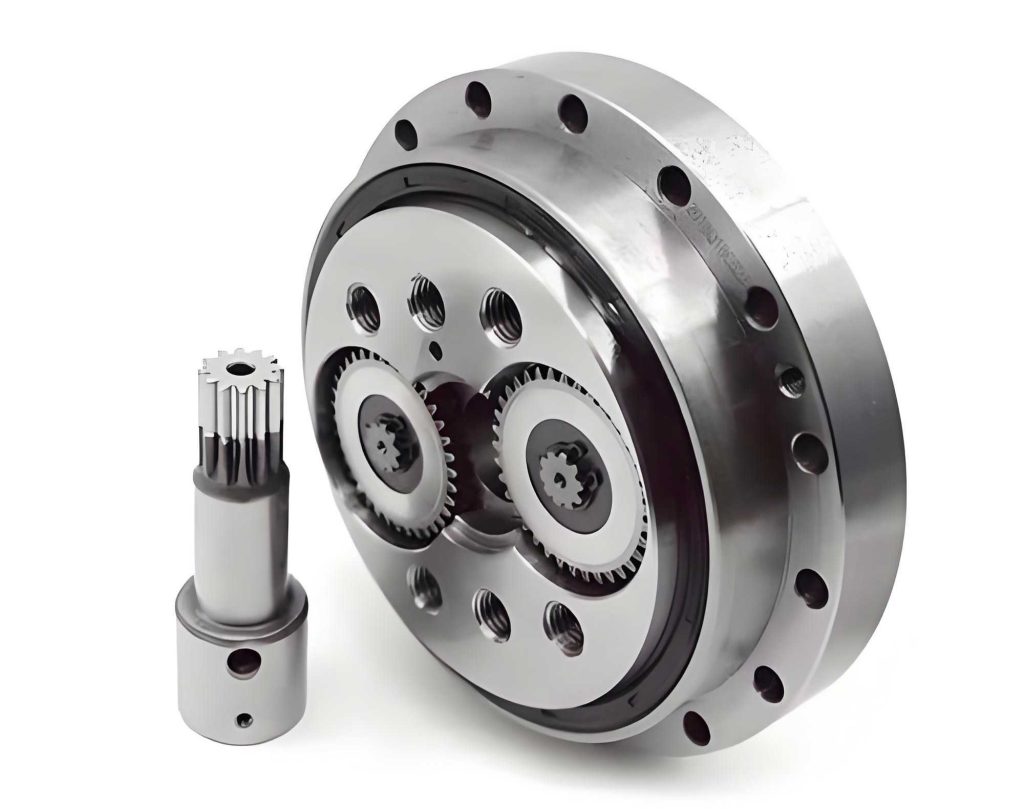
The operational principle of the RV reducer is fundamental to understanding its automated assembly constraints. It is essentially a two-stage hybrid gear system. The first stage is a planetary gear train, and the second stage is a cycloidal pin-wheel mechanism. The input power is delivered to the input gear shaft (sun gear). This shaft meshes with two or three planetary gears, constituting the first-stage reduction. The planetary gears are connected to crankshafts, which serve as the input to the second stage. The eccentric motion of the crankshafts drives the cycloidal discs. These discs mesh with stationary pinwheels housed in the pinwheel housing. The unique motion of the cycloidal discs—a combination of eccentric revolution and opposite rotation—is converted into concentric output rotation via the crankshafts and the output mechanism (typically an output flange connected to a planet carrier). This dual-stage process results in the RV reducer’s characteristically high reduction ratio, which can be expressed by the following formula combining both stages:
$$ i_{total} = i_{stage1} \times i_{stage2} = \left(1 + \frac{Z_{pinion}}{Z_{sun}}\right) \times \left(\frac{Z_{pin}}{Z_{pin} – Z_{cycloid}}\right) $$
Where:
- $Z_{sun}$ is the number of teeth on the input sun gear.
- $Z_{pinion}$ is the number of teeth on the planetary gear.
- $Z_{pin}$ is the number of pinwheels in the housing.
- $Z_{cycloid}$ is the number of lobes on the cycloidal disc.
The foundation of automated assembly lies in the complete parametric modeling of every constituent part of the RV reducer. Each component, from the complex cycloidal disc to the simple spacer, is generated from a master model where key dimensions are defined as variables. These variables are linked to a central parameter table or an input form. For instance, the geometry of the cycloidal disc, defined by the equidistant curve of a curtate epicycloid, is governed by parameters like the pinwheel radius $r_{rp}$, the eccentricity $e$, and the number of lobes $Z_c$. The parametric equation for the cycloidal profile can be summarized as:
$$ \begin{aligned}
x &= (R_p – \Delta R) \sin(\theta) – e \sin(Z_c \theta) – r_r \sin(\theta – \phi) \\
y &= (R_p – \Delta R) \cos(\theta) – e \cos(Z_c \theta) – r_r \cos(\theta – \phi)
\end{aligned} $$
Where $R_p$ is the pinwheel distribution circle radius, $\Delta R$ is the equidistant modification, $r_r$ is the roller (needle) radius, and $\phi$ is the pressure angle. Similarly, gears, shafts, and housings are modeled parametrically. This ensures that a change in a fundamental design parameter, such as the reduction ratio or center distance, automatically propagates through all related components, maintaining geometric consistency and assembly feasibility.
Core Technology for Automated Assembly: Feature-Based Mating
Automated assembly within SolidWorks is achieved through its Application Programming Interface (API). We utilize Visual Basic for Applications to write macros or standalone executables that control SolidWorks programmatically. The key to reliable and robust automation, as opposed to simple coordinate-based placement, is feature-based mating. This method replicates the logical constraints a design engineer would apply manually. Instead of calculating absolute spatial coordinates, the code identifies specific geometric features (faces, edges, axes, planes) on components and applies standard mates (coincident, concentric, distance, gear) between them.
The assembly sequence is scripted. First, a new assembly document is created. Components are inserted into this assembly from their saved parametric model files. The first component is typically fixed. Subsequent parts are added and then programmatically mated to existing ones. For example, to assemble the planetary gear onto the input shaft, the code performs these steps:
- Select the cylindrical face or the central axis of the input shaft.
- Select the corresponding central axis of the planetary gear bore.
- Apply a ‘Concentric’ mate between these two axes, ensuring they share the same centerline.
- Select a reference plane on the input shaft (e.g., a plane through a tooth space) and a corresponding reference plane on the planetary gear (e.g., a plane through a tooth thickness).
- Apply a temporary ‘Coincident’ mate to phase the gears correctly for meshing.
- Apply a ‘Gear’ mate between the two axes, defining the gear ratio based on their pitch diameters. The kinematic relation for the gear mate is defined by the API.
- Finally, suppress or delete the temporary coincident mate, leaving the gear mate to control the angular relationship.
This process is encapsulated in VBA code. Key API functions include `AddComponent` to insert a part, `SelectByID2` to pick a specific feature, and `AddMate5` to apply constraints. The gear mate, crucial for the **RV reducer**’s first stage, is implemented with a specific mate type constant and the ratio parameter.
| Mate Type (VBA Constant) | Geometric Features Used | Purpose in RV Reducer Assembly |
|---|---|---|
| Concentric (swMateCONCENTRIC) | Cylindrical faces, central axes | Aligning shafts with bearing bores, gears on shafts, pins in holes. |
| Coincident (swMateCOINCIDENT) | Planar faces, reference planes | Mounting flanges against housing faces, phasing cycloidal discs, aligning keyways. |
| Distance (swMateDISTANCE) | Planar faces | Setting precise gaps for pre-load in bearings or between spacers. |
| Gear (swMateGEAR) | Component axes (with ratio) | Defining the kinematic relationship between the input gear and planetary gears. |
| Parallel (swMatePARALLEL) | Planar faces, axes | Ensuring components like crankshafts remain parallel. |
Modular Assembly Strategy for the RV Reducer
Given the part count and complexity of the **RV reducer**, a monolithic assembly script would be cumbersome and difficult to debug. Therefore, a modular assembly strategy is employed. The complete reducer is decomposed into logical sub-assemblies, which are built independently and then combined into the final product. This mirrors best practices in manufacturing and design.
The primary modules are:
- Pinwheel Housing Module: This involves assembling the pinwheels (or needle bearings) into the pinwheel housing. The parametric model often generates the pinwheels as a patterned feature or a single part. This module is assembled first and serves as the fixed ground for the rest of the assembly.
- Output & Bearing Module: This sub-assembly includes the main bearings, the support flange, and the output flange. These components are mated together based on concentric and coincident constraints. This pre-assembled module is then inserted as a single unit into the pinwheel housing.
- Cycloidal & Crankshaft Module: This is the most complex module. It involves assembling the crankshafts with their eccentric sections, needle bearings, spacers, and the two cycloidal discs. A critical step here is the correct phasing of the two cycloidal discs at 180 degrees to balance radial forces. The formula for ensuring proper phase involves the number of lobes $Z_c$ and the eccentricity orientation. The entire module is then inserted into the central cavity.
- Planetary Gear Stage Module: As previously described, this module assembles the input shaft with the planetary gears, including gear mates for correct meshing. This module is attached to the crankshaft inputs.
Standard components like screws, retaining rings, and dowel pins are fetched from the SolidWorks Toolbox library or from parametrically generated models and added last. This modular approach makes the automation code more manageable, reusable, and reliable. It also allows for partial assembly validation at the module level.
| Parameter Category | Symbol | Description | Typical Relation/Formula |
|---|---|---|---|
| Input/First Stage | $Z_{sun}$, $Z_p$ | Teeth on input (sun) gear and planetary gear | $i_1 = 1 + Z_p / Z_{sun}$ |
| Cycloidal/Second Stage | $Z_c$ | Number of lobes on cycloidal disc | $i_2 = Z_{pin} / (Z_{pin} – Z_c)$, $Z_{pin} = Z_c + 1$ |
| $Z_{pin}$ | Number of pinwheels/needles | ||
| $e$ | Eccentricity of crankshaft | ||
| Geometry | $R_p$, $r_{rp}$ | Pinwheel distribution radius, Pinwheel radius | $R_p = m \cdot Z_{pin} / 2$ (conceptual) |
| Output | – | Total Reduction Ratio | $i_{total} = i_1 \times i_2$ |
Model Verification and Validation
Automation must be paired with verification to ensure design integrity. After the automated parametric modeling and assembly scripts generate the complete **RV reducer** model, two critical checks are performed programmatically or manually via the CAD interface:
- Dimensional Verification: The API allows for the extraction of geometric dimensions from the assembled model. Critical distances, diameters, and clearances are measured and compared against the theoretical input parameters. Discrepancies indicate an error in the parametric relations or the assembly constraints.
- Interference Detection: This is perhaps the most crucial check. SolidWorks’ interference detection tool is invoked to scan the entire assembly for any overlapping volumes between components. A successful automated assembly must result in zero hard interferences. The presence of interferences would signal incorrect mating conditions, inappropriate parametric dimensions, or a flaw in the assembly sequence. Clearances for bearings and lubricant flow are also verified.
These verification steps are essential for validating the entire automated design pipeline. They ensure that the output is not just a 3D model, but a geometrically consistent and manufacturable digital prototype of the **RV reducer**.
Integrated Parametric Design Platform
The ultimate goal is to encapsulate the entire capability into a user-friendly system. A dedicated parametric design platform is developed, typically as a standalone application or an integrated SolidWorks add-in. This platform presents a unified graphical user interface (GUI) that guides the user through the design process.
The platform integrates two core functions:
- Parametric Modeling Module: The GUI contains input fields for all key **RV reducer** design parameters (e.g., reduction ratio, torque, center distance). Upon user input, this module drives the individual part templates in the background, regenerating all components with the new dimensions.
- Automated Assembly Module: With a single button click (e.g., “Assemble RV Reducer”), this module executes the sequence of VBA scripts. It opens the newly generated parts, creates a new assembly file, and runs the feature-based, modular assembly routines in the correct order, culminating in a fully mated, interference-free 3D model of the **RV reducer**.
The platform hides the complexity of the underlying CAD operations and scripting. The user only interacts with high-level design parameters and assembly commands. This significantly lowers the barrier for designing custom **RV reducer** variants, accelerates iteration, and enforces design rule consistency.
Conclusion and Outlook
This framework demonstrates a complete solution for the full-process automation of **RV reducer** design. By synergizing parametric modeling, feature-based automated assembly via SolidWorks API and VBA, a modular build strategy, and rigorous model verification, the methodology drastically reduces manual effort and potential for error. The development of an integrated parametric design platform provides a practical tool that consolidates these capabilities, enabling rapid customization and virtual prototyping of the complex **RV reducer**.
Future enhancements can focus on several areas. The integration of finite element analysis (FEA) for stress and deformation evaluation directly from the platform would create a true design-analysis loop. Furthermore, incorporating tolerance analysis into the automated assembly process could predict performance variations and optimize fits. Extending the platform to automatically generate detailed manufacturing drawings, bill of materials (BOM), and even instructions for robotic assembly would push the automation frontier further, closing the gap between digital design and physical production for the high-precision **RV reducer**.