
In recent years, the rapid advancement of artificial intelligence, robotics, and materials science has propelled humanoid robots into the spotlight as a transformative technology. As a key component of future-oriented industries, humanoid robots represent a new frontier in global technological competition and economic growth. They are often regarded as the next disruptive product after computers, smartphones, and electric vehicles, with the potential to revolutionize production methods, daily life, and societal structures. From my perspective, analyzing the development strategies of leading nations and regions provides valuable insights for localizing policies. In this article, I will explore the current state of humanoid robot industries worldwide, compare international approaches, and offer tailored recommendations for Guangzhou to foster innovation and cultivate new quality productive forces.
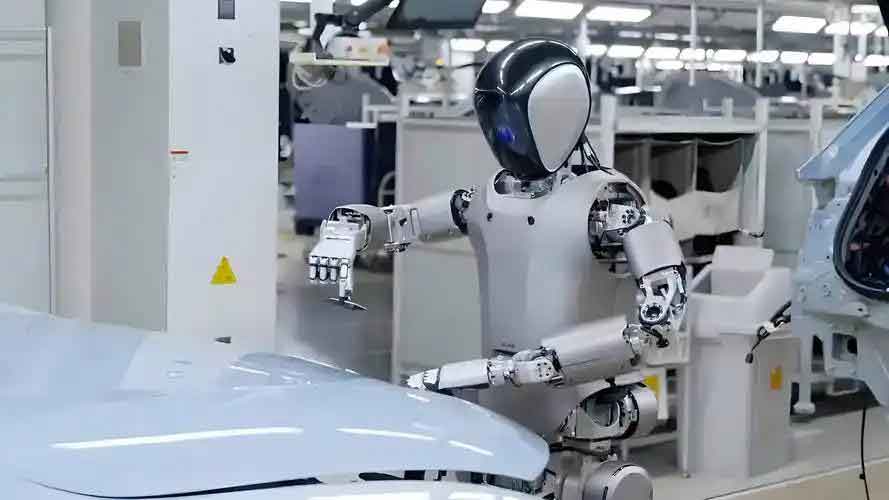
The concept of humanoid robots, also known as anthropomorphic or bipedal robots, involves integrating AI, robotics, biomimetics, and other cutting-edge technologies to create machines that mimic human form and capabilities. These robots are expected to address challenges such as labor shortages due to aging populations and low birth rates, while enhancing productivity across sectors. According to market forecasts, the global humanoid robot market could reach trillions of dollars by 2035, with a compound annual growth rate exceeding 90%. This growth is driven by technological breakthroughs and increasing adoption in diverse fields. However, the path to widespread commercialization faces significant hurdles, including technical barriers, high costs, and limited application scenarios. I believe that a systematic analysis of these factors is crucial for formulating effective development strategies.
To understand the evolution of humanoid robots, it is essential to consider their intelligence levels. Based on classification standards, robots can be categorized into five levels, from L1 (basic) to L5 (adaptive), depending on their感知 (perception), 执行 (execution), 决策 (decision-making), and 认知 (cognitive) capabilities. This progression can be modeled mathematically. Let $$ L $$ represent the intelligence level, which is a function of key parameters: $$ L = f(P, E, D, C) $$, where $$ P $$ denotes perception, $$ E $$ execution, $$ D $$ decision-making, and $$ C $$ cognition. For instance, a humanoid robot at level L3 might have partial decision-making abilities, while L5 implies full autonomy and learning. The transition from L3 to L4 is a critical milestone for humanoid robot industrialization, as it enables more complex interactions in unstructured environments.
| Level | Intelligence Type | Perception | Execution | Decision-making | Cognition | Definition |
|---|---|---|---|---|---|---|
| L1 | Basic | Yes | Partial | No | No | Has perception and partial execution functions |
| L2 | Semi-interactive | Yes | Yes | No | No | Has perception and execution functions |
| L3 | Interactive | Yes | Yes | Partial | No | Has perception, execution, and partial decision-making functions |
| L4 | Autonomous | Yes | Yes | Yes | No | Has perception, execution, and decision-making functions |
| L5 | Adaptive | Yes | Yes | Yes | Yes | Has perception, execution, decision-making, and cognitive functions |
The humanoid robot industry encompasses upstream components (e.g., sensors, actuators, control systems), midstream manufacturing (robot本体 integration), and downstream applications (e.g., industrial manufacturing, healthcare, domestic services). Currently, the industry is transitioning from laboratory research to commercialization, with 2025 anticipated as the first year of mass production. Key challenges include mastering core technologies, reducing production costs, and expanding application scenarios. I estimate that overcoming these barriers requires coordinated efforts in research, policy, and ecosystem development. For example, the cost of a humanoid robot can be expressed as $$ C_{total} = C_{components} + C_{integration} + C_{software} $$, where $$ C_{components} $$ depends on the supply chain maturity, and $$ C_{software} $$ involves AI model development. Reducing $$ C_{total} $$ through innovation is vital for market penetration.
From an international perspective, major科技 powers have implemented various strategies to advance humanoid robot technologies. The United States, for instance, has a long history of research in this field, with initiatives like the National Robotics Initiative (NRI) and the Artemis program fostering collaboration between academia and industry. The NRI has funded over 300 projects since 2011, focusing on collaborative robots that can work alongside humans. Europe, through the EU Framework Programs, has allocated substantial funds to robotics research, emphasizing digital transformation and human-robot collaboration. Germany’s Robotics Research Action Plan and France’s “France 2030” investment plan highlight targeted support for AI-driven robotics. Japan, a pioneer in humanoid robots, has pursued consistent policies under its New Robot Strategy, aiming for symbiotic robots by 2050. South Korea, through its Intelligent Robot Basic Plans, has focused on localizing key components and expanding industrial scale.
| Economy | Policy/Initiative | Key Focus Areas | Funding/Investments |
|---|---|---|---|
| United States | National Robotics Initiative (NRI) | Collaborative robots, human-robot共生,基础研发 | Over $250 million across phases |
| European Union | EU Framework Programs (FP7, FP8, FP9) | Perception, cognition, AI integration, market transfer | Billions of euros allocated |
| Germany | Robotics Research Action Plan | AI-based algorithms, sensors,救援 robots, talent cultivation | Over €40 million annually |
| France | France 2030 Investment Plan | AI-driven robotics, startup support | €800 million for robotics |
| Japan | New Robot Strategy | Manufacturing, services, healthcare, standardization | Ongoing public-private investments |
| South Korea | Intelligent Robot Basic Plans (4th edition) | Component localization, eight core technologies | Planned ₩3 trillion by 2030 |
In China, the humanoid robot sector has seen rapid growth, supported by top-level policies like the “Guidelines for Innovative Development of Humanoid Robots.” Patent analysis reveals that China leads globally in both patent applications and valid patents for humanoid robot technologies, indicating a strong innovation momentum. Provinces such as Beijing, Shanghai, Guangdong, Jiangsu, Shandong, and Anhui have introduced specific action plans to nurture humanoid robot industries. These plans typically emphasize核心技术攻关, enterprise cultivation, application场景拓展, and生态营造. For example, Shandong’s implementation scheme targets breakthroughs in key components and large-scale applications by 2027. I have summarized some regional approaches in the table below to highlight comparative strategies.
| Region | Policy Document | Main Objectives | Notable Measures |
|---|---|---|---|
| Beijing | Robot Industry Innovation Development Action Plan | Develop原型机, tackle key technologies, create innovation centers | Support through “揭榜挂帅” mechanisms, focus on 3C and新能源汽车 |
| Shanghai | Action Plan for High-Quality Development of Intelligent Robots | Build manufacturing innovation centers, advance通用人形机器人 | Integrate brain-inspired AI, promote open-source platforms |
| Shandong | Implementation Scheme for Promoting Humanoid Robot Industry Innovation | Achieve technological breakthroughs, foster leading enterprises | Comprehensive support across R&D, applications, and ecosystem |
| Anhui | Humanoid Robot Industry Development Action Plan (draft) | Enhance industrial scale, improve innovation capacity | Focus on core components,典型场景推广 |
| Guangdong | Cluster Development Plan for Future Intelligent Equipment | Establish global innovation高地, form领军企业 | Emphasize humanoid robots as future industry,承担 national projects |
Turning to Guangzhou, the city possesses a solid foundation in intelligent equipment and robotics. In 2023, the智能装备与机器人产业 generated an added value of over ¥53 billion, with industrial robot production increasing by 47%. The local ecosystem includes upstream component manufacturers (e.g., for reducers, controllers, servo motors), midstream integrators, and downstream applicators. Companies are actively exploring humanoid robot development, such as those involved in bipedal机器人 prototypes for automotive testing. Research institutions like the Super Robot研究院, jointly established by local authorities and universities, aim to tackle key technological challenges and incubate startups. However, compared to leading global clusters, Guangzhou faces gaps in core technology mastery, high-cost barriers, and limited pilot applications. I argue that addressing these issues requires a tailored strategy based on international best practices.
To propel the humanoid robot industry forward, I propose several recommendations for Guangzhou. First, prioritize organized research to攻克关键技术. This involves focusing on the “brain” (AI large models), “小脑” (motion control), and “肢体” (actuation systems) of humanoid robots. A dedicated R&D plan could be formulated, with funding allocated through competitive grants. Collaboration platforms that link enterprises, universities, and research institutes should be established to accelerate innovation. For instance, a humanoid robot innovation center could serve as a hub for testing and standardization. The performance of a humanoid robot can be evaluated using metrics like $$ \text{Performance Index} = \alpha \cdot \text{Stability} + \beta \cdot \text{Precision} + \gamma \cdot \text{Learning Rate} $$, where $$ \alpha, \beta, \gamma $$ are weights assigned to different capabilities. By optimizing this index through iterative testing, Guangzhou can enhance product reliability.
Second, promote pilot demonstrations to explore应用场景. Guangzhou should leverage its manufacturing strengths to deploy humanoid robots in sectors like automotive, electronics, and logistics. Government-led initiatives can release demand lists for典型场景, facilitating matchmaking between solution providers and users. Hosting innovation challenges can stimulate creativity and identify promising applications. The economic impact of deploying humanoid robots can be modeled as $$ \Delta GDP = \sum_{i} ( \text{Productivity Gain}_i \times \text{Adoption Rate}_i ) $$, where $$ i $$ represents different industries. Early pilots in special environments (e.g., hazardous tasks) can build confidence and drive broader adoption.
Third, cultivate a robust industrial生态 through multi-faceted measures. This includes compiling a list of key humanoid robot enterprises for targeted support, offering tax incentives for R&D and sales, and attracting global talent and investment. Open-source data platforms for training humanoid robot AI models can lower development costs and foster collaboration. The growth of the ecosystem can be described by a logistic function: $$ N(t) = \frac{K}{1 + e^{-r(t – t_0)}} $$, where $$ N(t) $$ is the number of active firms, $$ K $$ is the carrying capacity, $$ r $$ is the growth rate, and $$ t_0 $$ is the inflection point. Policies aimed at increasing $$ K $$ and $$ r $$ can accelerate cluster formation.
Fourth, strengthen支撑服务能力 to sustain development. Guangzhou should engage in standardization efforts, aligning with international norms for humanoid robot safety, interoperability, and performance. Establishing industry standards can reduce market fragmentation and boost competitiveness. Financial support through state-guided funds can de-risk early-stage ventures, while talent programs can address skill gaps. The relationship between investment and innovation output can be expressed as $$ I(t) = \delta \cdot R(t) + \epsilon $$, where $$ I(t) $$ is innovation (e.g., patents), $$ R(t) $$ is R&D expenditure, and $$ \delta, \epsilon $$ are parameters. By increasing $$ R(t) $$ strategically, Guangzhou can enhance its innovation trajectory.
In conclusion, the development of humanoid robots represents a significant opportunity for Guangzhou to advance its technological prowess and economic resilience. By learning from international examples and adapting strategies to local contexts, the city can overcome existing challenges and position itself as a leader in this emerging field. I recommend a holistic approach that balances technical攻关, application exploration, ecosystem nurturing, and policy support. As humanoid robots evolve from L3 to L4 intelligence, their integration into society will deepen, potentially transforming industries and daily life. Guangzhou’s proactive efforts today can pave the way for a future where humanoid robots contribute substantially to new quality productive forces and sustainable development.
Looking ahead, I anticipate that advancements in AI, materials, and energy storage will further accelerate the capabilities of humanoid robots. Continuous monitoring of global trends and adaptive policy-making will be essential. Through collaborative efforts across sectors, Guangzhou can not only catch up with global leaders but also carve out a unique niche in the humanoid robot landscape, driving innovation and prosperity for years to come.