
JIAXING, China, August 31, 2026 — Jiaxing intelligent manufacturing has achieved a historic breakthrough in its global expansion. On August 29 local time, Europe’s first mass-production base for humanoid robots, invested and built by Jiaxing-based Minth Group, began production in Sabac, Serbia. Serbian President Aleksandar Vucic attended the production launch ceremony and issued a certification plaque for the first robot to roll off the line, known as Robot 001. The base is scheduled to complete delivery of 500 mass-produced units this year. The first batch of products will be used at Expo 2027. Once fully operational, the base will have an annual production capacity of up to 20,000 units, with an expected annual output value exceeding EUR 100 million. It is also expected to create 280 high-end manufacturing and technology research and development positions for the local area, enabling Serbia to step directly into the frontier industry track of the 21st century.
The launch of Europe’s first mass-production base for humanoid robots is more than a single corporate milestone. It represents a new stage in the global expansion of Jiaxing’s high-end intelligent manufacturing, a new chapter in the internationalization of Chinese advanced manufacturing, and a significant development for the global humanoid robots industry. The project places Jiaxing, a manufacturing powerhouse in the core area of the Yangtze River Delta, at the center of one of the most closely watched technology and industrial races in the world. It also demonstrates how Chinese supply chain strength, local operational experience, and European market access can be combined to create a replicable model for overseas intelligent manufacturing.
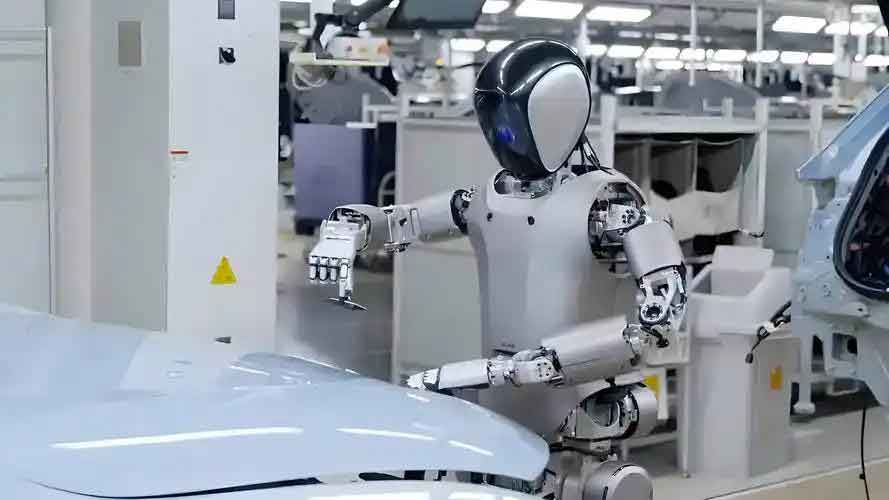
1. A Historic Breakthrough for Jiaxing Intelligent Manufacturing in Europe
The production launch in Sabac marks the first time a Jiaxing enterprise has built a mass-production base for humanoid robots in Europe. The project is led by Minth Group, a company rooted in Jiaxing and active in the global automotive and advanced manufacturing supply chain. Its decision to invest in Serbia reflects both the growing capabilities of Jiaxing’s manufacturing sector and the increasing confidence of Chinese companies in pursuing high-value opportunities in Europe.
The presence of Serbian President Aleksandar Vucic at the ceremony underscored the strategic importance of the project. The certification plaque issued for Robot 001 symbolized not only the start of production but also the beginning of a new industrial relationship. For Serbia, the base offers an opportunity to participate in a frontier industry that is expected to shape the future of manufacturing, logistics, services, and human-machine collaboration. For Jiaxing, it offers a platform to demonstrate that its intelligent manufacturing capabilities can meet European standards and compete in one of the world’s most demanding markets.
The initial production target of 500 units this year is modest compared with the base’s eventual full capacity, but it is significant as a first step. Mass production is a critical test for any emerging technology. Humanoid robots must move from laboratories, exhibitions, and pilot projects into reliable, scalable, and commercially viable production. The Sabac base is designed to support that transition. Its first products are expected to be used at Expo 2027, providing an international stage for both the technology and the manufacturing system behind it.
At full capacity, the base is expected to produce up to 20,000 humanoid robots annually and generate more than EUR 100 million in annual output value. The project is also expected to create 280 high-end manufacturing and technology research and development jobs. These positions are not limited to assembly. They include engineering, quality control, supply chain management, software integration, testing, maintenance, and research and development. This mix of roles reflects the complexity of humanoid robots, which combine mechanical engineering, electronics, artificial intelligence, sensors, control systems, and advanced software.
The phrase “Europe’s first mass-production base for humanoid robots” carries substantial weight. It signals that Jiaxing intelligent manufacturing has moved beyond traditional exports and low-cost production. It has entered a field defined by advanced technology, complex integration, and long-term industrial potential. The base is therefore not merely a factory. It is a statement about the position of Jiaxing companies in the global value chain and their ability to build industrial capacity in Europe.
2. Breaking the Established Global Robot Market Pattern
Humanoid robots are widely regarded as a new high ground in global technological competition, a new track for future industries, and a new engine for economic growth. They have the potential to transform manufacturing, healthcare, logistics, education, hospitality, disaster response, and many other sectors. Because of this potential, governments, technology companies, research institutions, and manufacturers around the world are investing heavily in the field.
According to data from China’s National Development and Reform Commission, for every 10 humanoid and quadruped intelligent robots sold globally, 8 come from China. This figure highlights China’s growing strength in the production and supply of advanced robots. It also shows that Chinese companies have built significant capabilities in components, software, integration, and manufacturing. However, the global high-end robot market has long been dominated by companies from Europe, the United States, Japan, and South Korea. These companies have held advantages in brand recognition, core technology, customer relationships, and industrial standards.
The new base in Sabac breaks that established pattern. By building Europe’s first mass-production base for humanoid robots, Jiaxing intelligent manufacturing has challenged the product and technology monopoly previously held by overseas enterprises. It has shown that a Chinese company from Jiaxing can establish a presence in the heart of Europe and produce humanoid robots at scale. This is not only a commercial achievement but also a demonstration of industrial capability.
For the global humanoid robots industry, the entry of a new production base in Europe is significant. It adds capacity, increases competition, and encourages further innovation. It also provides European customers with more options and strengthens the connection between Chinese supply chains and European markets. In a field where humanoid robots are still developing rapidly, the ability to produce at scale and adapt to local needs will be a major source of competitive advantage.
The achievement also carries symbolic value. Serbia is often described as the crossroads of Europe. Placing a mass-production base for humanoid robots there connects Chinese advanced manufacturing with European industrial networks. It shows that Chinese high-end intelligent manufacturing can take root in Europe, not only through trade but also through investment, localization, and long-term cooperation. For Jiaxing, this is proof that its intelligent manufacturing is recognized by the European market. For China, it opens a new path for high-end technology products to expand overseas.
3. A New Approach for Chinese High-End Intelligent Manufacturing Going Global
In recent years, Jiaxing companies have accelerated their pace of going global. Their investments in Europe have become increasingly high-end, moving from traditional trade and low-cost production to advanced manufacturing, research and development, brand building, and service networks. However, before this project, there was still a lack of a flagship project capable of radiating across the entire Balkan region. The humanoid robots base in Sabac fills that gap.
Minth Group has operated in Serbia for many years and has built a mature local operating system. That experience was essential to the success of the project. Building a mass-production base for humanoid robots requires more than capital and technology. It requires an understanding of local regulations, labor practices, logistics, supplier networks, and customer expectations. It also requires the ability to integrate with the local community and build trust with government and industry partners.
The project’s most important feature is that it does not simply export a final product that is already controlled by monopolies. Instead, it exports an entire industrial system. That system includes technology, supply chain management, talent cultivation, production processes, quality standards, and after-sales support. This approach is deeper and more sustainable than traditional product export. It creates local capacity, transfers knowledge, and builds long-term relationships.
By moving away from traditional path dependence and expanding the depth of cooperation, the base combines China’s supply chain integration advantages with Serbia’s location advantages. China has strong capabilities in manufacturing, components, engineering, and cost efficiency. Serbia offers access to European markets, a strategic geographic position, and a growing industrial base. Together, these strengths can be used to explore the European high-end intelligent manufacturing market and create a replicable overseas intelligent manufacturing model.
This model is important for humanoid robots because the industry is still young. Standards are evolving, supply chains are forming, and customer needs are changing. A flexible and integrated approach can help companies respond quickly to new opportunities. It can also help local partners participate in the value chain rather than remain passive recipients of imported goods. The Sabac base therefore represents a new way for Chinese high-end intelligent manufacturing to go global: not only selling products, but building ecosystems.
4. Combining China’s Supply Chain Strength with Serbia’s Location Advantage
Serbia’s position as a crossroads of Europe gives the project a unique advantage. From Sabac, the base can serve markets in the Balkans and beyond. It can connect with European customers, participate in regional supply chains, and respond to demand for humanoid robots in manufacturing, logistics, services, and public applications. The location also supports cooperation with European research institutions, technology partners, and industrial users.
China’s supply chain integration advantage is equally important. The production of humanoid robots requires a wide range of components, including sensors, actuators, motors, controllers, batteries, communication modules, and advanced software. China has developed a deep and competitive supply chain for many of these technologies. By combining that supply chain strength with local production in Serbia, the project can achieve efficiency, quality, and responsiveness.
The base is expected to become a platform for cooperation rather than a simple production site. It can support local suppliers, train local engineers, and collaborate with universities and research centers. It can also help European customers understand and adopt humanoid robots more quickly. As the industry grows, the base can expand its capabilities in research and development, customization, maintenance, and software services.
This combination of Chinese supply chain strength and Serbian location advantage creates a foundation for a replicable overseas intelligent manufacturing model. Other Jiaxing companies can learn from the experience. They can see how to build local partnerships, how to integrate with European standards, and how to move from product export to industrial system export. The model is not limited to humanoid robots. It can be applied to other advanced manufacturing fields where China has supply chain advantages and Europe has market demand.
The project also reflects a broader trend in global manufacturing. Companies are increasingly seeking to localize production close to customers while maintaining access to global supply chains. Humanoid robots are complex products, and their production requires close coordination between design, engineering, manufacturing, and service. A base in Europe allows Jiaxing intelligent manufacturing to shorten response times, improve customization, and build stronger relationships with European customers.
5. A Microcosm of Jiaxing’s High-End Intelligent Manufacturing Going Global
Jiaxing is a major city for the private economy, a strong manufacturing city, and an open city in the core area of the Yangtze River Delta. Its companies have long participated in global industrial division of labor. Over the years, they have moved from exporting goods to investing overseas, building factories, establishing research and development centers, and creating international brands. The humanoid robots base in Serbia is a microcosm of this broader transformation.
By the end of last year, 398 local enterprises from Jiaxing had invested and developed in 48 countries and regions worldwide. The filed amount of outbound investment reached USD 13.993 billion. These figures show the scale and reach of Jiaxing’s global economic engagement. They also show that Jiaxing companies are not limited to one market or one industry. They are active in manufacturing, resources, technology, logistics, and many other fields.
Examples include Zhenshi Group and Huayou Cobalt, which have built the Zhenshi Huabao Industrial Park and the Huayou Pomalaa Industrial Park in Indonesia. These projects demonstrate Jiaxing companies’ ability to undertake large-scale overseas investment and industrial park development. The new humanoid robots base in Serbia adds a new dimension. It shows that Jiaxing companies can also build advanced technology production bases in Europe and participate in frontier industries.
As Jiaxing enterprises extend their global footprint, their competitiveness in international markets grows stronger. Their position in global industrial and value chains rises higher. The humanoid robots base is a clear example. It places Jiaxing at the intersection of advanced manufacturing, artificial intelligence, robotics, and international cooperation. It also strengthens the city’s reputation as a source of high-end intelligent manufacturing.
For Jiaxing, the project is not only about one company or one product. It is about the city’s industrial ecosystem. It reflects the accumulated experience of local suppliers, engineers, managers, and workers. It reflects the support of an open business environment and the ability to connect with global markets. It also reflects the courage of Jiaxing companies to take risks, explore new markets, and invest in future industries.
6. Beyond Production Transfer: City Capability and Image
Going global is not merely a transfer of manufacturing locations. It is a comprehensive export of city capability and image. When a Jiaxing company builds a mass-production base for humanoid robots in Serbia, it brings more than machines and capital. It brings management systems, technical standards, training methods, quality culture, and international cooperation experience. It also brings a reputation for reliability, efficiency, and innovation.
The successful production launch of Europe’s first mass-production base for humanoid robots is expected to encourage more Jiaxing companies to go global. It shows that ambitious projects in advanced fields are possible. It shows that European markets are open to Chinese high-end intelligent manufacturing. It also shows that local governments, communities, and industry partners can benefit from such investment.
The base is expected to inspire more Jiaxing companies to go out, to go well, and to go farther. It can become a reference point for companies that are considering overseas investment but are uncertain about technology, talent, or market conditions. By demonstrating a successful model, it can reduce perceived risks and encourage more high-value international projects.
On the world stage, Jiaxing is writing a Jiaxing-style model of the “sweet potato economy.” This model emphasizes rooting local development in a home base while extending vines globally. The humanoid robots base in Serbia is one such vine. It connects Jiaxing’s industrial roots with European opportunities. It also shows how local capabilities can be used to create global value.
The project can become a vanguard force for Jiaxing intelligent manufacturing as it integrates into global industrial chains. It can help attract talent, technology, and partners to Jiaxing. It can also help local companies learn from international markets and improve their own standards. In this way, the benefits flow in both directions: Jiaxing companies gain global experience, and international partners gain access to Chinese manufacturing strength.
7. Key Facts and Figures at a Glance
| Item | Details |
|---|---|
| Project | Europe’s first mass-production base for humanoid robots |
| Investor | Minth Group, based in Jiaxing, China |
| Location | Sabac, Serbia |
| Production launch | August 29 local time |
| Ceremony | Serbian President Aleksandar Vucic attended and issued a certification plaque for Robot 001 |
| Delivery target for this year | 500 mass-produced humanoid robots |
| First application | Expo 2027 |
| Full-capacity annual production | Up to 20,000 humanoid robots |
| Expected annual output value | More than EUR 100 million |
| Local jobs | 280 high-end manufacturing and technology research and development positions |
| Global market data | For every 10 humanoid and quadruped intelligent robots sold globally, 8 come from China, according to China’s National Development and Reform Commission |
| Jiaxing overseas footprint | By the end of last year, 398 local enterprises had invested in 48 countries and regions, with filed outbound investment of USD 13.993 billion |
8. Why Europe’s First Mass-Production Base for Humanoid Robots Matters
The significance of the Sabac base can be understood from several perspectives. For Serbia, it brings high-end manufacturing and research and development jobs. It also brings participation in a frontier industry that is expected to grow in importance over the coming years. The production of humanoid robots requires advanced skills in engineering, software, electronics, and quality management. These skills can spill over into other industries and help strengthen the local innovation ecosystem.
For Jiaxing, the base is proof that its high-end intelligent manufacturing can compete in Europe. It shows that Jiaxing companies are capable of building complex production systems, managing international operations, and meeting rigorous quality standards. It also strengthens Jiaxing’s position as a source of advanced manufacturing and a gateway for Chinese companies seeking global opportunities.
For China, the project opens a new path for high-end technology products to expand overseas. It shows that Chinese companies can move beyond exporting goods and build integrated industrial systems in foreign markets. It also shows that China’s supply chain advantages can be combined with local strengths to create mutual benefits. The humanoid robots base is a concrete example of how high-end intelligent manufacturing can go global in a sustainable and cooperative way.
For the global humanoid robots industry, the project adds production capacity in Europe and increases competition. It also encourages further innovation and localization. As humanoid robots move from concept to commercial deployment, the ability to produce them at scale will be crucial. The Sabac base is one of the first dedicated mass-production facilities for humanoid robots in Europe, and its progress will be watched closely by industry participants around the world.
The project also has symbolic importance. It demonstrates that Chinese and European partners can cooperate in advanced technology fields. It shows that Serbia can play a role in the global humanoid robots supply chain. It also shows that Jiaxing, a city in the Yangtze River Delta, can be a source of global industrial innovation. These messages are likely to resonate beyond the immediate region.
9. The Road Ahead for Humanoid Robots and Global Manufacturing
Humanoid robots are still an emerging industry. Technical challenges remain in areas such as dexterity, mobility, perception, artificial intelligence, battery life, safety, and human-robot interaction. Commercial models are still developing. Standards and regulations are still being shaped. In this environment, mass production is both an opportunity and a test. It requires companies to integrate many technologies into a reliable product and to build supply chains that can support scale.
The Sabac base is designed to meet that challenge. Its initial delivery target of 500 humanoid robots this year will provide valuable experience in production, quality control, and customer deployment. The use of the first products at Expo 2027 will offer international visibility. As the base moves toward full capacity, it can refine its processes, train more workers, and expand its supplier network.
The road ahead will require continued investment in talent, research and development, and localization. Humanoid robots must be adapted to local needs, regulations, and working environments. They must be supported by maintenance, software updates, and service networks. The base in Serbia can serve as a hub for these activities in Europe. It can also become a platform for cooperation with European universities, research institutes, and industrial customers.
For Jiaxing companies, the project offers lessons for future global expansion. It shows the importance of long-term local operations, strong partnerships, and a willingness to transfer knowledge. It shows that high-end manufacturing can be exported not only as products but as systems. It also shows that companies can create value for both their home city and their host country.
As the humanoid robots industry grows, competition will intensify. Companies from different regions will seek to build production capacity, secure supply chains, and win customers. The Sabac base gives Jiaxing and China an early presence in Europe’s humanoid robots market. It also gives Serbia a place in a future-oriented industry. The project’s success will depend on execution, but its launch is already a significant milestone.
10. Conclusion
The production launch of Europe’s first mass-production base for humanoid robots in Sabac, Serbia, is a landmark event for Jiaxing intelligent manufacturing. It shows that Jiaxing companies can build advanced production bases in Europe, compete in frontier industries, and contribute to global industrial development. It also shows that Chinese high-end intelligent manufacturing can go global through cooperation, localization, and system-level export.
The base’s expected delivery of 500 humanoid robots this year, its planned use of first products at Expo 2027, its eventual annual capacity of up to 20,000 units, and its potential to create 280 high-end jobs all point to a long-term commitment. The project is not only about humanoid robots. It is about supply chains, talent, technology, standards, and international partnerships. It is about combining China’s manufacturing strengths with Serbia’s location advantages to serve European and global markets.
For Jiaxing, the achievement reinforces the city’s identity as a manufacturing powerhouse and an open economy. For China, it adds a new example of high-end intelligent manufacturing going global. For Serbia, it opens a door to a frontier industry. For the global humanoid robots sector, it adds capacity, competition, and cooperation.
As more Jiaxing companies seek opportunities around the world, the Sabac base will serve as an important reference. It demonstrates that ambition, preparation, and partnership can turn a vision into reality. It also demonstrates that humanoid robots are moving from the laboratory toward large-scale production. The first Robot 001 from Europe’s first mass-production base for humanoid robots is therefore more than a machine. It is a symbol of a new phase in global intelligent manufacturing and a sign of what Jiaxing can achieve on the world stage.