
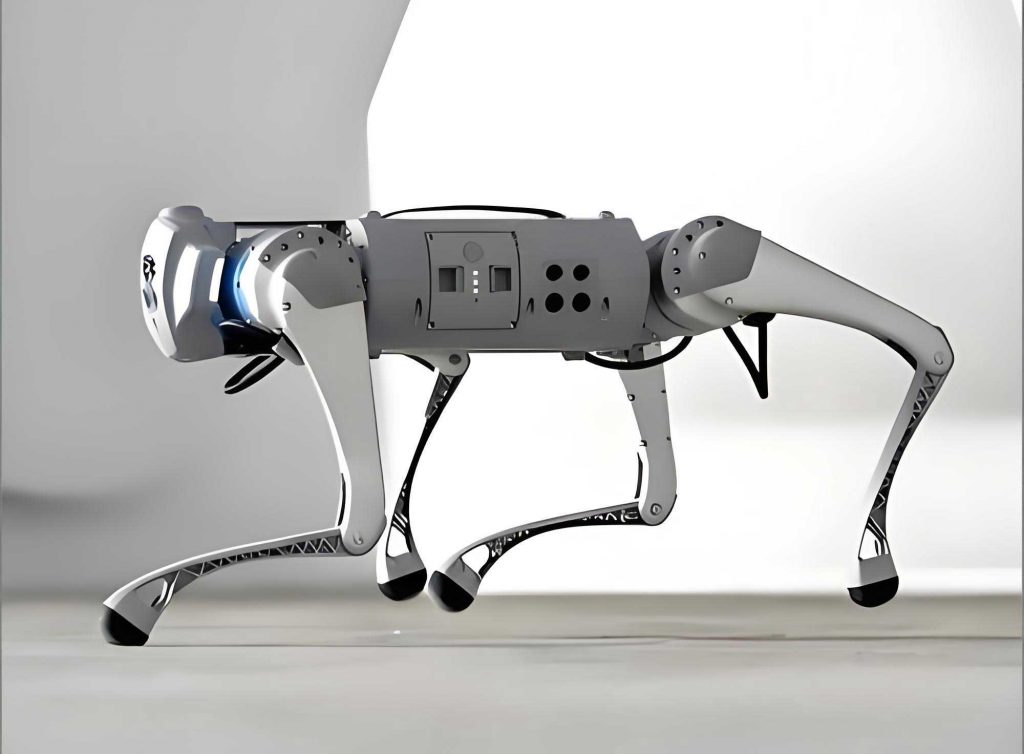
In recent years, I have observed a growing interest in the development of quadruped robots across global academic and research institutions. The focus on quadruped robot research has intensified in my region as well. Compared to other legged robots, the quadruped bionic robot offers a balanced combination of structural complexity, stability, load capacity, control difficulty, and manufacturing cost, making it a preferred choice for researchers. These robots hold promising applications in engineering exploration, military reconnaissance, terrain survey, and rescue operations, and are widely considered the optimal form of legged robots. The essence of a quadruped robot lies in its design inspired by the locomotion of quadruped mammals, co-developed by humans. With advancements in robot vision, intelligent control, automation, and sensor technology, the demand has shifted from bulky and rigid structures to more agile and efficient designs. Unlike horses, where the knees point backward, dogs have limbs oriented forward, facilitating stair climbing and providing greater leg movement space to avoid collisions. In my work, I adopted the dog as the biological prototype for designing and optimizing the quadruped robot structure.
The quadruped robot features four primary joint configurations: all elbow, all knee, front knee and rear elbow, and front elbow and rear knee. My design employs a series leg structure, which offers a larger range of motion compared to parallel leg structures. The joint layout critically influences the kinematic and dynamic performance. Currently, prominent models like Boston Dynamics’ Spot Mini and other high-performance quadruped robots utilize motor-driven all-elbow configurations. This configuration aligns with bionic principles and simplifies control during walking phases. The overall structure of my quadruped robot incorporates 12 power motors and 4 hub motors, with each leg comprising 3 power motors and one hub motor, enabling coordinated operation of all 12 motors. I replaced synchronous belt drives with a crank linkage mechanism for power transmission to the lower leg, as it simplifies the design, enhances precision, and reduces structural bulk associated with pulleys. The crank linkage schematic illustrates this approach, where a rotary input drives link AB, causing point E to oscillate along an arc due to fixed point D.
For material selection, I used aluminum alloy 6061 due to its excellent machinability, strength, corrosion resistance, and minimal deformation post-processing, meeting the mechanical requirements for the robot dog structure. To optimize the leg design, I focused on lightweighting while ensuring strength under load. Using SOLIDWORKS Simulation’s design insight feature, I identified load-bearing regions in the thigh and lower leg components. The analysis highlighted critical areas (dark regions) and non-essential sections (gray translucent areas), allowing me to reduce material usage without compromising integrity. The optimized single-leg model achieved significant weight reduction, enhancing the quadruped robot’s agility and efficiency.
I conducted finite element analysis (FEA) to validate structural robustness under operational loads. FEA is a computational method to assess product behavior under stress, wear, or design conditions. Based on the quadruped robot’s total weight of 150N, I applied a safety factor of 1.2, resulting in a design load of 180N. Assuming a Trot gait where two legs bear weight simultaneously, the maximum force per leg is 90N. In Ansys, I defined the material as aluminum alloy 6061, imported the 3D models, and applied constraints and forces. For the thigh, a perpendicular force was applied at the hip joint hole, with cylindrical support at the knee. Mesh generation used a 1mm element size. The FEA results for the thigh showed a maximum deformation of 0.17 mm, equivalent elastic strain of 3.61 × 10^{-4} mm, and equivalent stress of 26.016 MPa, all within allowable limits for aluminum 6061. Similarly, for the lower leg, a force was applied at the foot with constraints at the knee, yielding a maximum deformation of 0.16 mm, elastic strain of 2.33 × 10^{-4} mm, and stress of 16.82 MPa, confirming structural adequacy for the quadruped robot.
For kinematic analysis, I simplified the leg mechanism into a linkage system and established a coordinate system using the D-H method. The base frame O0-x0y0z0 is at the hip joint, with the y-axis indicating forward motion, z-axis along the joint rotation, and x-axis determined by the right-hand rule. Frames O1-x1y1z1, O2-x2y2z2, and O3-x3y3z3 correspond to subsequent joints and the foot end. The D-H parameters are summarized in the table below:
| Link i | Twist α_{i-1} (°) | Length a_{i-1} (mm) | Offset d_i (mm) | Angle θ_i (rad) |
|---|---|---|---|---|
| 1 | 0 | l1 = 400 | 0 | θ1 |
| 2 | 0 | l2 = 350 | 0 | θ2 |
The transformation matrices derived from the D-H parameters are as follows:
$$^0_1T = \begin{bmatrix} \cos \theta_1 & -\sin \theta_1 & 0 & 0 \\ \sin \theta_1 & \cos \theta_1 & 0 & 0 \\ 0 & 0 & 1 & 0 \\ 0 & 0 & 0 & 1 \end{bmatrix}$$
$$^1_2T = \begin{bmatrix} \cos \theta_2 & -\sin \theta_2 & 0 & L_1 \\ \sin \theta_2 & \cos \theta_2 & 0 & 0 \\ 0 & 0 & 1 & 0 \\ 0 & 0 & 0 & 1 \end{bmatrix}$$
$$^2_3T = \begin{bmatrix} 1 & 0 & 0 & L_2 \\ 0 & 1 & 0 & 0 \\ 0 & 0 & 1 & 0 \\ 0 & 0 & 0 & 1 \end{bmatrix}$$
The foot-end pose relative to the base frame is given by:
$$^0_3T = ^0_1T \cdot ^1_2T \cdot ^2_3T = \begin{bmatrix} \cos(\theta_1 + \theta_2) & -\sin(\theta_1 + \theta_2) & 0 & p_x \\ \sin(\theta_1 + \theta_2) & \cos(\theta_1 + \theta_2) & 0 & p_y \\ 0 & 0 & 1 & p_z \\ 0 & 0 & 0 & 1 \end{bmatrix}$$
where:
$$ p_x = L_1 \cos \theta_1 + L_2 \cos(\theta_1 + \theta_2) $$
$$ p_y = L_1 \sin \theta_1 + L_2 \sin(\theta_1 + \theta_2) $$
$$ p_z = 0 $$
For inverse kinematics, the joint angles are derived from the end-effector position. The solutions are:
$$ \theta_1 = \arctan\left(\frac{p_y}{p_x}\right) – \arctan\left(\frac{L_2 \sin \theta_2}{L_1 + L_2 \cos \theta_2}\right) $$
$$ \theta_2 = \arccos\left(\frac{p_x^2 + p_y^2 – L_1^2 – L_2^2}{2 L_1 L_2}\right) $$
To simulate motion, I exported the SOLIDWORKS model to Adams in (*.x_t) format. After setting gravity, I consolidated parts into the chassis and legs, assigned aluminum 6061 material, and added revolute joints, drives, and drive functions to each joint. Contact parameters between the foot and ground were calibrated. The simulation captured the quadruped robot’s displacement in X (lateral), Y (vertical), and Z (forward) directions. Over 5 seconds, the robot dog moved 2750 mm in Z, averaging 550 mm/s. The Y-direction displacement showed an average amplitude ≤30 mm, with a robot height of 715 mm, yielding a center of mass fluctuation rate of 4.19%, indicating stable motion. The Trot gait pattern, with diagonal legs moving in phase, was consistent with biological quadruped movement, and joint angular velocity plots confirmed periodic behavior. Minor deviations in straight-line motion were attributed to gait dynamics, ground contact forces, and landing impacts, but overall stability met design expectations for the quadruped robot.
In this study, I comprehensively optimized the leg structure of a bionic quadruped robot, validated its durability through FEA, derived kinematic models, and simulated motion in Adams. The results affirm the robot dog’s stability and performance, providing valuable insights for future quadruped robot development. The integration of lightweight design, material selection, and dynamic simulation underscores the potential of quadruped robots in diverse applications.