
As a critical component in electromechanical actuators (EMAs), the planetary roller screw mechanism (PRSM) has garnered significant attention due to its high load capacity, precision, and longevity. In my research, I focus on investigating the load distribution characteristics of planetary roller screw mechanisms under different working temperatures, considering various installation modes. This study is motivated by the fact that planetary roller screw mechanisms often operate in diverse environmental conditions where temperature fluctuations can substantially impact their performance. While prior studies have examined load distribution under mechanical loads, the thermal effects remain underexplored. Here, I aim to bridge this gap by developing a finite element model that incorporates thermal-mechanical coupling to analyze how temperature changes influence the load distribution across the threads of a planetary roller screw mechanism.
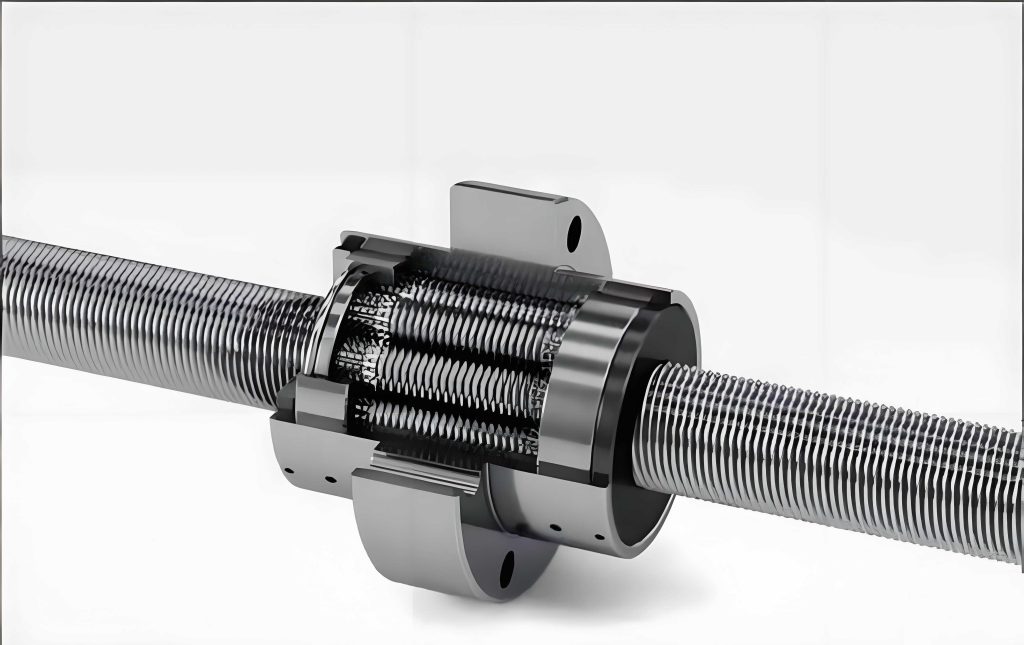
The planetary roller screw mechanism consists of several key components: a screw, multiple rollers, a nut, an internal gear ring, and a planetary carrier. The screw and nut typically feature multi-start trapezoidal threads, while the rollers have single-start arc-shaped threads. This design enables efficient conversion of rotary motion to linear motion through meshing contacts. Understanding the load distribution in a planetary roller screw mechanism is essential for optimizing its durability, efficiency, and reliability. In practical applications, planetary roller screw mechanisms are subjected to varying temperatures, which induce thermal expansions and contractions, thereby altering the contact forces and load sharing among threads. My analysis delves into these aspects to provide insights for engineering design.
To systematically study the planetary roller screw mechanism, I first consider the structural forms and installation modes. The planetary roller screw mechanism can be installed in two primary configurations: same-side installation and opposite-side installation. In same-side installation, the nut’s flange is near the fixed end of the screw, leading to the screw experiencing tensile stress and the nut compressive stress when the nut moves under load. Conversely, in opposite-side installation, the nut’s flange is away from the fixed end, resulting in both the screw and nut being under either compressive or tensile stresses depending on the load direction. These installation modes significantly affect the load distribution in the planetary roller screw mechanism, as they alter the stiffness and deformation patterns under mechanical and thermal loads.
In my finite element analysis of the planetary roller screw mechanism, I adopt several simplifications to make the model computationally tractable while retaining accuracy. I assume that the planetary roller screw mechanism has axisymmetric properties, and due to the uniform distribution of rollers, I model only a symmetric segment corresponding to one roller. The threads on the screw, rollers, and nut are fully represented, but non-essential features like chamfers and fillets are ignored. The material is considered isotropic, and the effects of the internal gear ring and planetary carrier are omitted, as they primarily influence kinematics rather than load distribution. These simplifications allow me to focus on the core contact mechanics of the planetary roller screw mechanism.
The finite element model for the planetary roller screw mechanism is built using a 3D approach. I select a planetary roller screw mechanism with a load capacity of 5 tons, and its structural parameters are summarized in Table 1. The material is GCr15 bearing steel, with properties detailed in Table 2. For meshing, I use eight-node linear hexahedral elements (C3D8I) with refined grids near contact areas to capture stress concentrations accurately. The model comprises over 1 million elements, ensuring convergence and reliability. The contact pairs between the screw-roller and roller-nut threads are defined, totaling 20 pairs per side, numbered sequentially from the fixed end.
| Parameter | Value | Parameter | Value |
|---|---|---|---|
| Screw Pitch Diameter (ds) | 24 mm | Pitch (p) | 2 mm |
| Roller Pitch Diameter (dr) | 8 mm | Number of Threads (τ) | 20 |
| Nut Pitch Diameter (dn) | 40 mm | Thread Angle (β) | 90° |
| Screw Starts (ns) | 5 | Roller Profile Radius (R) | 5.65 mm |
| Roller Starts (nr) | 1 | Number of Rollers (z) | 10 |
| Nut Starts (nn) | 5 | – | – |
| Property | Value |
|---|---|
| Density (ρ) | 7810 kg/m³ |
| Specific Heat Capacity (c) | 553 J/(kg·°C) |
| Thermal Conductivity (λ) | 36.72 W/(m·°C) |
| Coefficient of Thermal Expansion (α) | 13.6 × 10⁻⁶ °C-1 |
| Young’s Modulus (E) | 212 GPa |
| Poisson’s Ratio (μ) | 0.29 |
Boundary conditions are applied to simulate real-world operating scenarios of the planetary roller screw mechanism. For displacement constraints, the nut and rollers are allowed only axial movement, with radial displacements and rotations fixed. The screw’s end is fixed to represent a mounted condition. Force boundaries involve applying axial loads to the nut via a reference point coupled to its loading surface, mimicking different installation modes. The load is applied incrementally to ensure numerical stability. Contact interactions are defined using surface-to-surface contact with frictionless behavior initially, as the focus is on elastic deformations. The thermal loads are imposed by setting uniform temperature fields across the model, ranging from 20°C (room temperature) to 100°C, in increments of 20°C.
To validate my finite element model of the planetary roller screw mechanism, I compare the load distribution results under mechanical loads with theoretical predictions from literature. The load distribution is expressed in terms of the load carried by each thread, normalized by the ideal load per thread. For instance, the ideal load per thread, \( F_{\text{ideal}} \), is given by:
$$ F_{\text{ideal}} = \frac{F_{\text{total}}}{2\tau} $$
where \( F_{\text{total}} \) is the total axial load, and \( \tau \) is the number of engaged threads. The finite element results show good agreement with theoretical models, confirming the accuracy of my approach for the planetary roller screw mechanism. Specifically, the load distribution patterns across the screw and nut sides align with prior studies, as summarized in Table 3 for a sample installation mode.
| Thread Position | Screw Side Load (FE) (%) | Screw Side Load (Theoretical) (%) | Nut Side Load (FE) (%) | Nut Side Load (Theoretical) (%) |
|---|---|---|---|---|
| Front Half | 59.48 | 60.12 | 55.72 | 56.34 |
| Rear Half | 40.52 | 39.88 | 44.28 | 43.66 |
With the validated model, I proceed to analyze the thermal-mechanical coupling effects on the planetary roller screw mechanism. The governing equation for thermal deformation in a component of length \( L \) is:
$$ \Delta L = \alpha L \Delta T $$
where \( \alpha \) is the coefficient of thermal expansion, and \( \Delta T \) is the temperature change. This deformation alters the contact gaps and preloads in the planetary roller screw mechanism, thereby affecting load distribution. I consider four installation modes (labeled a, b, c, d) as described earlier, under temperatures of 20°C, 40°C, 60°C, 80°C, and 100°C. The load distribution is evaluated by calculating the percentage of total load carried by the front half (threads near the fixed end) and rear half (threads away from the fixed end) of the screw and nut sides.
The results for installation mode a (same-side installation, screw in tension, nut in compression) are presented in Table 4. As temperature increases, the load on the screw side shifts toward the front half, exacerbating uneven distribution. Conversely, the nut side shows a more complex trend, with initial improvement in uniformity followed by degradation. This behavior stems from the叠加 of thermal expansion with mechanical deformation: tensile stress in the screw amplifies differences, while compressive stress in the nut partially offsets them. The planetary roller screw mechanism thus exhibits sensitivity to temperature in this mode.
| Temperature (°C) | Screw Side Front Half Load (%) | Screw Side Rear Half Load (%) | Nut Side Front Half Load (%) | Nut Side Rear Half Load (%) |
|---|---|---|---|---|
| 20 | 59.48 | 40.52 | 55.72 | 44.28 |
| 40 | 63.15 | 36.85 | 52.89 | 47.11 |
| 60 | 66.92 | 33.08 | 50.04 | 49.96 |
| 80 | 68.97 | 31.03 | 48.12 | 51.88 |
| 100 | 70.89 | 29.11 | 47.12 | 52.88 |
For installation mode b (same-side installation, screw in compression, nut in tension), the trends reverse, as shown in Table 5. The screw side load becomes more evenly distributed with rising temperature up to a point, while the nut side becomes increasingly uneven. This highlights how the stress state (tension vs. compression) in the planetary roller screw mechanism components modulates thermal effects. The overall load distribution in the planetary roller screw mechanism improves temporarily but deteriorates at higher temperatures.
| Temperature (°C) | Screw Side Front Half Load (%) | Screw Side Rear Half Load (%) | Nut Side Front Half Load (%) | Nut Side Rear Half Load (%) |
|---|---|---|---|---|
| 20 | 59.86 | 40.14 | 55.15 | 44.85 |
| 40 | 55.33 | 44.67 | 58.92 | 41.08 |
| 60 | 51.78 | 48.22 | 61.84 | 38.16 |
| 80 | 49.45 | 50.55 | 62.97 | 37.03 |
| 100 | 48.22 | 51.78 | 63.71 | 36.29 |
Installation mode c (opposite-side installation, both screw and nut in compression) yields the most favorable outcomes for the planetary roller screw mechanism, as detailed in Table 6. Here, thermal expansion counteracts mechanical deformation, leading to more uniform load distribution across both sides. The load sharing improves significantly at moderate temperatures, with optimal uniformity around 60°C. This mode demonstrates the benefits of compressive stresses in mitigating thermal distortions in a planetary roller screw mechanism.
| Temperature (°C) | Screw Side Front Half Load (%) | Screw Side Rear Half Load (%) | Nut Side Front Half Load (%) | Nut Side Rear Half Load (%) |
|---|---|---|---|---|
| 20 | 58.67 | 41.33 | 47.52 | 52.48 |
| 40 | 54.12 | 45.88 | 50.89 | 49.11 |
| 60 | 50.33 | 49.67 | 53.45 | 46.55 |
| 80 | 48.22 | 51.78 | 55.12 | 44.88 |
| 100 | 46.71 | 53.29 | 56.35 | 43.65 |
Finally, installation mode d (opposite-side installation, both screw and nut in tension) shows worsening load distribution with temperature, as in Table 7. The planetary roller screw mechanism experiences aggravated unevenness on both sides, as thermal expansion adds to tensile deformations. This underscores the importance of avoiding such configurations in high-temperature environments for planetary roller screw mechanisms.
| Temperature (°C) | Screw Side Front Half Load (%) | Screw Side Rear Half Load (%) | Nut Side Front Half Load (%) | Nut Side Rear Half Load (%) |
|---|---|---|---|---|
| 20 | 58.26 | 41.74 | 48.14 | 51.86 |
| 40 | 62.44 | 37.56 | 44.78 | 55.22 |
| 60 | 65.91 | 34.09 | 41.23 | 58.77 |
| 80 | 68.33 | 31.67 | 38.95 | 61.05 |
| 100 | 70.70 | 29.30 | 36.83 | 63.17 |
To quantify the unevenness, I define a load non-uniformity index, \( U \), for the planetary roller screw mechanism:
$$ U = \frac{F_{\text{max}} – F_{\text{min}}}{F_{\text{ideal}}} $$
where \( F_{\text{max}} \) and \( F_{\text{min}} \) are the maximum and minimum thread loads, respectively. A lower \( U \) indicates better load distribution. Calculating \( U \) for each case reveals that installation mode c consistently has the lowest values, especially at 60°C, while mode a has the highest. This analytical metric reinforces the visual trends from the tables.
The underlying mechanics can be explained using a simplified stiffness model for the planetary roller screw mechanism. The total deformation, \( \delta_{\text{total}} \), under combined mechanical load \( F \) and temperature change \( \Delta T \) is:
$$ \delta_{\text{total}} = \frac{F}{K} + \alpha L \Delta T $$
where \( K \) is the axial stiffness. For threads in series, the load distribution depends on the relative deformations. When thermal expansion aligns with mechanical deformation (e.g., in tension), stiffness variations amplify, causing uneven loads. Conversely, opposing effects (e.g., compression vs. expansion) reduce disparities. This principle guides the design of planetary roller screw mechanisms for thermal environments.
In discussion, I emphasize that temperature effects on the planetary roller screw mechanism are non-negligible and installation-dependent. For the screw side, temperature influence is consistently greater than for the nut side, due to the screw’s fixed-end constraints. In modes where components are under compression, the planetary roller screw mechanism benefits from thermal均载, whereas tension worsens distribution. Engineering applications of planetary roller screw mechanisms should prioritize installation mode c, where both screw and nut are compressed, to enhance performance across temperature ranges. Moreover, operational temperatures can be tailored: for mode a, 20°C is ideal; for mode b, 40°C; for mode c, 60°C; and for mode d, 20°C. These insights aid in optimizing planetary roller screw mechanism designs for EMAs in aerospace, automotive, and industrial settings.
In conclusion, my comprehensive analysis of the planetary roller screw mechanism under varying temperatures reveals critical load distribution patterns. Through finite element modeling and thermal-mechanical coupling, I demonstrate that temperature significantly alters load sharing, with effects modulated by installation modes and stress states. The planetary roller screw mechanism achieves optimal load uniformity when both screw and nut are under compressive stresses, making opposite-side installation with compressive loading the preferred configuration. Future work could explore dynamic thermal loads or lubricant effects on the planetary roller screw mechanism. This study provides a foundation for designing robust planetary roller screw mechanisms that maintain efficiency and longevity in diverse thermal environments.