
When I consider the digitization of various industries, the healthcare sector often appears to progress at a more measured pace compared to fields like finance or manufacturing. Some individuals even hold reservations or outright抵触 about the integration of artificial intelligence and robotics into medicine. A patient might feel that consulting a machine for a diagnosis or treatment plan is fundamentally inferior to interacting with a human physician. The depth of a doctor’s expertise, the nuance of their training, and the unspoken communication conveyed through eye contact and expression seem irreplaceable by today’s level of machine learning.
However, the advent and evolution of the medical robot have undeniably brought profound benefits to the entire healthcare landscape. Originating as an industry in the 1980s, the medical robot has grown into a vital segment of the broader service robotics market. While it may be premature to claim that robots are entirely redefining future medical models, the火花 ignited at the intersection of robotics and healthcare is already improving lives on a massive scale.
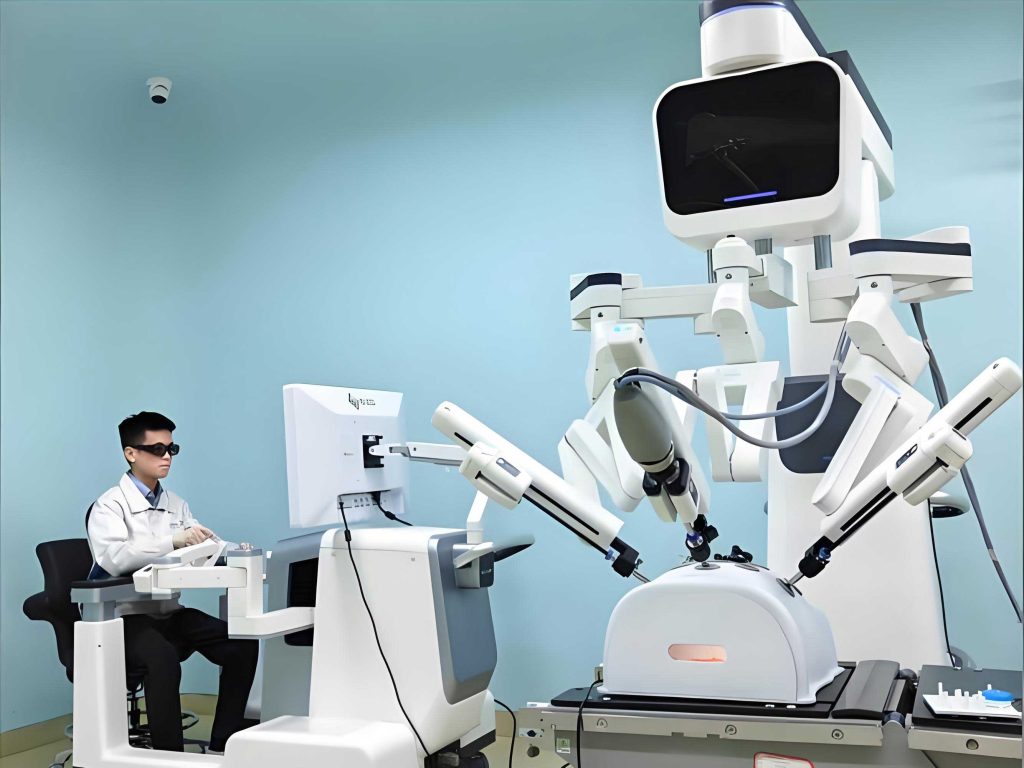
A medical robot is classified as a type of service robot designed for medical and辅助医疗 scenarios, such as hospitals and clinics. These systems can operate semi-autonomously or fully autonomously, performing tasks beneficial to human health. Their functions span a wide range, including surgery, nursing care, rehabilitation, patient transport, and delivery of pharmaceuticals. The International Federation of Robotics (IFR) categorizes them based on utility into four primary classes: surgical robots, rehabilitation robots, assistive robots, and service robots within medical settings.
The current global market structure reflects varying levels of adoption and demand. The breakdown is often summarized as follows:
| Medical Robot Category | Primary Function | Approximate Global Market Share |
|---|---|---|
| Surgical Robot | Performs or assists in precise surgical procedures (e.g., orthopedics, laparoscopy). | 17% |
| Rehabilitation Robot | Aids in recovery therapy, mobility training, and physical rehabilitation. | 47% |
| Assistive Robot | Supports daily living activities for patients or the elderly; includes exoskeletons. | 23% |
| Medical Service Robot | Handles logistical tasks like disinfection, delivery, and warehouse management in hospitals. | 13% |
This distribution highlights the significant role of rehabilitation robots. However, the landscape is dynamic. Recent procurement data from a major market shows a notable shift. While rehabilitation robots previously dominated tenders, their share has decreased significantly, with surgical and medical service robots seeing substantial increases. This suggests a move away from a “偏科” (unbalanced) development phase towards a more comprehensive growth period for all categories of medical robot technology.
The value proposition of a medical robot, particularly in surgery and rehabilitation, is grounded in measurable improvements. Surgical robots enhance procedural accuracy and minimize invasiveness. We can model a simplified representation of this improved precision. Let the error margin in a traditional manual procedure be denoted by $E_m$, and the error margin for a robot-assisted procedure be $E_r$. The enhancement factor $ heta$ can be expressed as:
$$ heta = rac{E_m – E_r}{E_m} = 1 – rac{E_r}{E_m}$$
where $ heta$ approaches 1 as the robotic system’s error becomes negligible compared to the manual method. This leads to benefits such as reduced post-operative pain, shorter recovery times, and lower risk of complications. Rehabilitation robots, with their broader applicability in therapy and support, offer measurable gains in patient outcomes through consistent, data-driven, and repeatable therapy sessions.
Looking ahead, the journey for medical technology is fraught with complex challenges. As healthcare delivery moves towards greater automation, the medical robot is poised for transformative growth. This evolution will likely proceed on two parallel tracks: comprehensive penetration across all medical fields and focused breakthroughs in areas like miniaturization and specialization. The trajectory of technological adoption often follows an S-curve, which can be modeled by the logistic function:
$$ f(t) = rac{L}{1 + e^{-k(t – t_0)}} $$
Here, $f(t)$ represents the market penetration of medical robot technology, $L$ is the curve’s maximum value or carrying capacity (the potential total addressable market), $k$ is the growth rate, $t$ is time, and $t_0$ is the time of the curve’s midpoint. We are arguably in the steep ascent phase of this curve for many medical robot applications, driven by policy support, capital investment, and escalating demand.
For instance, policy frameworks are increasingly supportive. It is projected that by a certain point, the domestic market for medical robot systems could reach a significant scale. The number of enterprises related to medical robot development has surged, with over half concentrated in several economically vibrant regions. This confluence of policy, demand, technology, and capital is enabling domestic medical robot platforms to compete on a global stage, showcasing innovations from hair transplant systems to laboratory automation and pharmacy dispensing robots.
Nevertheless, significant hurdles remain. The medical robot is a高度技术密集型 system characterized by high technology barriers, high entry thresholds, and high added value. Key challenges include:
- Intellectual Property and Innovation: Moving beyond imitation and technology importation towards fundamental innovation and mature product design.
- Core Components and Software: Developing reliable proprietary key components and robust software control systems.
- Business Model Sustainability: Addressing questions about the合理性 and long-term viability of revenue models, especially concerning the high重置 cost of custom robotic consumables.
- Safety and Public Acceptance: This is paramount. Establishing national manufacturing and testing standards to ensure the safety of novel medical robot systems is a critical, unavoidable issue. From a developmental perspective, widespread public trust in the safety of, for example, a surgical medical robot, will necessitate the accumulation of a decade or two of proven安全手术 records. The cost-benefit analysis for adoption must heavily weight this safety factor:
$$ ext{Adoption Utility} = \sum ( ext{Benefits: Precision, Access, etc.}) – \sum ( ext{Costs: Financial, Training, Safety Risk } \sigma_s) $$
where minimizing the safety risk factor $ sigma_s$ is crucial for utility to be positive.
The future direction of the medical robot is pointed towards greater intelligence, accessibility, and miniaturization. The trend in surgical robots, for example, is exploring small-scale, specialized, and intelligent forms. Their primary significance lies in precision and minimally invasive techniques, which can reduce occupational injury for healthcare staff, shorten the learning curve for complex procedures, and facilitate the下沉 of high-quality medical resources. On the frontier of miniaturization, research has produced微型医疗机器人 at the nanoscale. These particles, with diameters as small as 120 nanometers and controlled by magnetic fields, represent a future where a medical robot can interact with individual cells.
The impact on the healthcare workforce will be profound. As noted by leading research institutes, AI and robotics will become fundamental pillars of healthcare. Consequently, the skill set required of medical professionals will evolve, with lifelong learning, digital tool literacy, and competency in AI collaboration becoming essential core skills. Ironically, while automation may change the nature of some tasks, the overall demand for healthcare personnel is projected to grow dramatically—by over 120% in one major经济体’s forecast. This rising demand will, in turn, create even more space for medical robot systems to provide辅助 services, augmenting human capabilities rather than simply replacing them.
In conclusion, the blue ocean for medical robot applications has unequivocally emerged. Every category, from surgical and rehabilitation to assistive and logistical service robots, now possesses vast potential for growth and “纵横驰骋” (galloping freely) across the market. The central challenge lies in balancing accelerated promotion with an unwavering commitment to safety, innovation, and sustainable development. The equation for success in the era of the medical robot is complex, but its solution promises to redefine the standards and accessibility of care for all.