
The current era is defined by the “Internet of Things,” a paradigm of pervasive connectivity. Within this wave, the combined force of the Internet and Artificial Intelligence has swept across the globe, permeating every field. In healthcare, this convergence has given rise to the widespread application of medical robots based on AI and internet information technologies. A medical robot can be defined as an intelligent service robot that possesses rudimentary first-aid logic, is capable of independently formulating simple diagnostic and operational plans, determines treatment procedures based on actual conditions, and then translates these plans into actions analogous to those of medical personnel. These robots are extensively used in hospitals and clinics for medical or auxiliary medical purposes. The emergence of the medical robot has fundamentally transformed the traditional diagnosis and treatment model, which was predominantly reliant on healthcare workers and supported by medical instruments. As the technology behind medical robots matures, their role in the诊疗 domain is becoming irreplaceable, showcasing vast potential for future development. By analyzing the application advantages of medical robots and exploring their innovative design within诊疗 settings, we can fully realize their value, better promote the advancement of the healthcare industry, and meet the evolving needs of society for medical and health services.
The Evolutionary Trajectory of Medical Robots
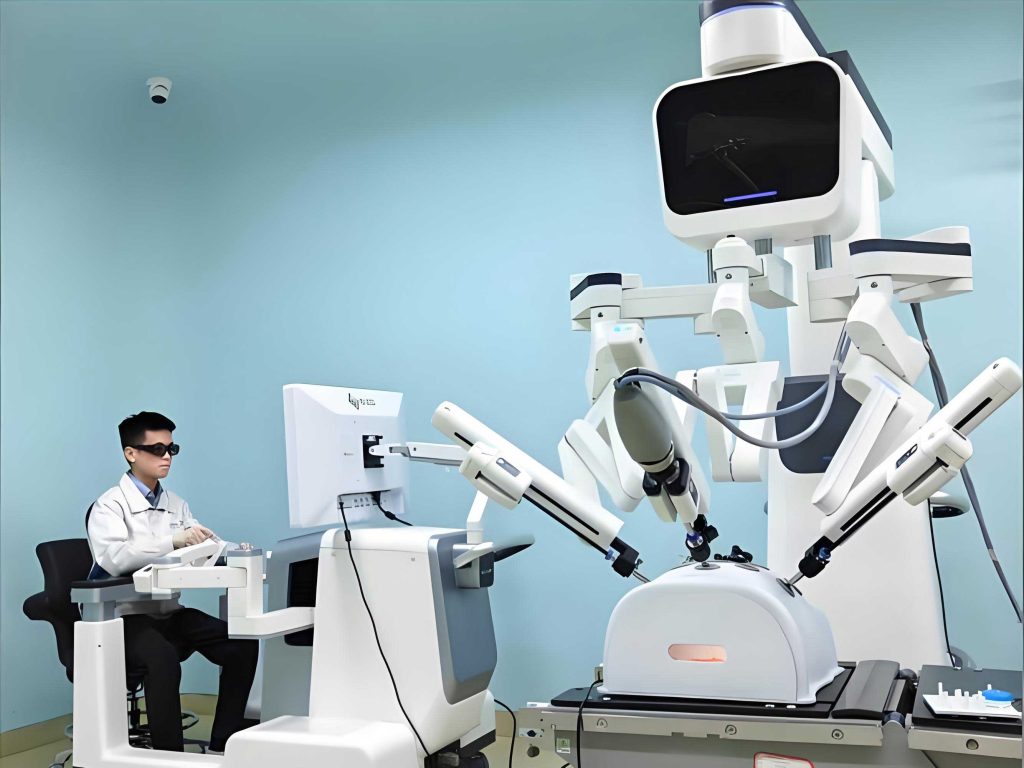
The incursion of robotics into medicine began in the 1980s. The world’s first robot-assisted surgery is credited to the ‘Arthrobot,’ developed and used in Vancouver, Canada, in 1983 for hip replacement surgery. Its success marked the beginning of the robotic era in healthcare. The subsequent decades witnessed significant milestones: the first unmanned robotic surgery in Italy (2006), the development of the first minimally invasive surgical medical robot system with force feedback in Germany (2008), and a truly autonomous robotic procedure on the femoral vascular system in Slovenia (2010), where the robot executed pre-programmed tasks without replicating a surgeon’s hand movements. Since the Da Vinci Surgical System received FDA clearance, it has held a dominant position in the global surgical robot market. The high cost of such systems, including the initial purchase price, annual maintenance fees, and expensive consumables, has been a significant barrier to widespread adoption.
Compared to developed nations, the development of medical robots in many regions started relatively late, leading to a series of challenges. The overall technical level remains comparatively low. As one of the most technologically advanced fields within service robotics, medical robots face high technical and certification barriers. Core technologies have historically been concentrated in North America and Europe, leading to a market dependence on foreign-produced systems. This results in a technological gap and weak related industries. Furthermore, research is often confined to universities and institutes, leading to a serious disconnect between academia, research, and industry, where scientific achievements struggle to transition into practical applications. Inconsistent policy guidance, insufficient support, lack of unified industry standards, and lengthy regulatory approval cycles compared to Western countries have further hindered the普及 and commercial application of medical robots.
However, the present time represents a golden age for the development of medical robots. Positive factors are converging: national policies are increasingly supportive, hospitals and the public are showing greater acceptance of robotic procedures, and the immense potential of the healthcare market is attracting significant interest from医疗机构, research institutes, and corporations. This is fostering a conducive environment for technological R&D and industrial application, providing a solid foundation for promoting the innovative application of medical robots in诊疗.
Analysis of Application Advantages of Medical Robots
The integration of medical robots into healthcare delivery offers profound and multifaceted advantages, fundamentally enhancing safety, efficiency, and procedural outcomes.
1. Reduction of Medical Errors
Medical error is a leading cause of death globally. Human fatigue, inherent physiological limitations, and the complexity of prolonged procedures contribute to an unavoidable margin of error. Medical robots mitigate this risk through several mechanisms. They possess superhuman visual感知 and precise 3D spatial awareness, allowing for exceptional identification and localization of pathologies. Their control precision operates at a microscopic scale, enabling minimally invasive access and manipulation far beyond the steady-state capability of a human hand. Crucially, a medical robot does not fatigue. It can perform sequential procedures with consistent, repeatable accuracy. Furthermore, every movement and data point from a procedure can be recorded and analyzed. This data-driven approach allows for continuous refinement of surgical protocols and error prediction. The potential reduction in errors can be modeled as a function of robotic precision (P) and human error rate (H):
$$ E_{\text{total}} = H \cdot (1 – A) $$
where \( E_{\text{total}} \) is the total error rate in a human-robot collaborative system, \( H \) is the baseline human error rate, and \( A \) is the accuracy enhancement factor provided by the medical robot, where \( 0 \leq A \leq 1 \). As \( A \) approaches 1, the total error rate approaches zero.
2. Creation and Maintenance of Sterile Environments
Aseptic conditions are paramount in healthcare settings. Traditional methods for creating and maintaining sterile fields are labor-intensive and costly. Medical robots can automate and optimize this process. Autonomous disinfection robots equipped with powerful ultraviolet-C (UV-C) light sources can systematically decontaminate rooms. The germicidal effectiveness of UV-C light, which damages the DNA/RNA of microorganisms, follows an exponential decay model based on the dose delivered:
$$ S = e^{-k \cdot I \cdot t} $$
Here, \( S \) represents the survival fraction of microbes, \( k \) is a microbe-specific inactivation rate constant, \( I \) is the irradiance (UV intensity), and \( t \) is the exposure time. A medical robot can ensure optimal \( I \) and \( t \) coverage for all surfaces, achieving a log-reduction in microbial load unattainable by manual cleaning alone, and operates continuously without breaks.
3. Enhancement of Overall Hospital Efficiency
Medical robots streamline operations across the hospital ecosystem, from patient intake to surgery and logistics. Their impact can be summarized in the following table:
| Hospital Domain | Role of Medical Robot | Efficiency Metric Improved |
|---|---|---|
| Triage & Reception | Autonomous patient interaction, symptom preliminary analysis, wayfinding. | Patient throughput, waiting time, accurate departmental routing. |
| Clinical Assistance & Patient Support | Companion robots for patient anxiety (especially children), repetitive monitoring tasks. | Patient satisfaction, staff time freed for complex care, compliance. |
| Rehabilitation | Exoskeletons and assistive devices for gait training, motor function recovery, providing consistent, measurable therapy. | Recovery speed, objectivity of progress assessment (via data logging), therapist leverage. |
| Logistics & Supply Chain | Autonomous Mobile Robots (AMRs) for transporting medication, linens, lab samples, meals, and waste. | Supply delivery time, inventory management, reduction in staff walking distance/mundane tasks. |
| Surgery | Surgical robotic systems for minimally invasive procedures, offering tremor filtration, motion scaling, enhanced 3D visualization. | Operative precision, patient recovery time (due to less invasiveness), surgeon ergonomics. |
The cumulative effect on hospital efficiency (E) can be conceptualized as a weighted sum of improvements across these \( n \) domains:
$$ E_{\text{hospital}} = \sum_{i=1}^{n} w_i \cdot \Delta \text{Eff}_i $$
where \( w_i \) is the weight (importance) of domain \( i \), and \( \Delta \text{Eff}_i \) is the efficiency gain in that domain due to medical robot integration.
For instance, in surgery, a system like the Da Vinci provides a stable, magnified 3D view and instruments with a greater range of motion (pitch, yaw, insertion, rotation) than the human wrist. This dexterity is quantified by the number of degrees of freedom (DoF). If a human hand has \( \text{DoF}_{\text{human}} \) and a robotic instrument has \( \text{DoF}_{\text{robot}} \), the dexterity enhancement \( D \) can be expressed as:
$$ D = \frac{\text{DoF}_{\text{robot}}}{\text{DoF}_{\text{human}}} $$
where typically \( D > 1 \), enabling access and maneuvers in confined anatomical spaces that are otherwise impossible.
Innovative Design and Application of Medical Robots in诊疗 Domains
The design of medical robots is highly specialized, catering to specific functions within the诊疗 workflow. Innovation drives their capabilities in three primary categories.
1. Medical Service Robots
These medical robots handle non-clinical but essential support tasks. Their design prioritizes navigation, payload capacity, human-robot interaction (HRI), and reliability. Key design parameters include:
– **Navigation System:** Fusion of LiDAR, cameras, and ultrasonic sensors for dynamic path planning in crowded corridors. The robot’s position \( \mathbf{p}(t) \) is updated via sensor fusion algorithms like Kalman Filters.
– **Payload & Battery Life:** Designed to carry significant weight (e.g., >450 kg) with battery capacity \( C \) (Ah) to ensure uptime for a full shift, governed by the power consumption model: \( T_{\text{operation}} = \frac{C \cdot V}{P_{\text{avg}}} \), where \( V \) is voltage and \( P_{\text{avg}} \) is average power draw.
– **HRI Interface:** Touchscreens, voice interaction, and clear status indicators to facilitate intuitive use by staff and patients.
Their application directly optimizes hospital operational logistics, allowing clinical staff to focus on patient care.
2. Medical Surgical Robots
This category represents the pinnacle of medical robot technology. Innovations focus on precision, haptic feedback, autonomy, and accessibility. Taking a liver tumor microwave ablation robot as an example, its design incorporates:
– **Mechanical Structure:** A 5-DoF or higher robotic arm mounted on a mobile platform. Kinematics describe the position \( \mathbf{x} \) of the tool tip based on joint angles \( \mathbf{q} \): \( \mathbf{x} = f(\mathbf{q}) \).
– **Control System:** A hybrid architecture using a Programmable Logic Controller (PLC) for reliable low-level motor control and a high-performance motion controller (e.g., PMAC) for precise trajectory execution. Control law often follows: \( \mathbf{\tau} = \mathbf{J}^T(\mathbf{q}) \cdot \mathbf{F} + \mathbf{K}_p(\mathbf{q}_d – \mathbf{q}) + \mathbf{K}_d(\dot{\mathbf{q}}_d – \dot{\mathbf{q}}) \), where \( \mathbf{\tau} \) is joint torque, \( \mathbf{J} \) is the Jacobian, \( \mathbf{F} \) is the desired force, and \( \mathbf{K}_p, \mathbf{K}_d \) are gain matrices.
– **Image-Guided Targeting:** Integration with CT or ultrasound imaging for planning and real-time navigation. The targeting error \( e \) is minimized by registering preoperative images to the intraoperative space: \( e = \|\mathbf{T}_{\text{plan}} – \mathbf{T}_{\text{actual}}\| \).
– **Safety & Reliability:** Redundant power supplies (dual-battery), fault-tolerant circuits, and rigorous software verification.
The design goal is to achieve sub-millimeter accuracy, enabling percutaneous interventions with minimal damage to healthy tissue. The success probability \( P_{\text{success}} \) of a targeting task can be modeled as inversely related to the error \( e \): \( P_{\text{success}} \propto \frac{1}{e} \).
3. Medical Rehabilitation Robots
Designed for restorative therapy, these medical robots, particularly exoskeletons, assist patients with neuromuscular impairments. Their innovative design centers on adaptive, patient-cooperative control.
– **Actuation & Mechanical Design:** Lightweight, compliant actuators (often series elastic actuators – SEAs) that can apply assistive torques \( \tau_a \) at limb joints. The dynamics of the human-robot system are: \( \mathbf{M}(\mathbf{q})\ddot{\mathbf{q}} + \mathbf{C}(\mathbf{q}, \dot{\mathbf{q}})\dot{\mathbf{q}} + \mathbf{G}(\mathbf{q}) = \tau_{\text{human}} + \tau_a \).
– **Control Paradigms:**
– **Passive Mode:** Robot moves the limb along a predefined trajectory.
– **Active-Assist Mode:** Robot provides assistance only when the patient’s muscle effort \( \tau_{\text{human}} \) is detected but insufficient. A common control law is \( \tau_a = \mathbf{K} \cdot (\mathbf{q}_d – \mathbf{q}) + \mathbf{B} \cdot (\dot{\mathbf{q}}_d – \dot{\mathbf{q}}) + \alpha \cdot \tau_{\text{human}} \), where \( \alpha \) is an assistance factor.
– **Active-Resist Mode:** Robot provides resistance to build strength.
– **Assessment & Biofeedback:** Integrated sensors (EMG, force, inertia) quantify patient performance. A rehabilitation progress index \( RPI \) can be calculated from metrics like range of motion (ROM), movement smoothness (Jerk), and force symmetry: \( RPI = \sum \beta_j \cdot M_j \), where \( M_j \) are normalized metrics and \( \beta_j \) are weights.
This data-driven, adaptive approach allows for personalized, intensive, and objectively quantified therapy, accelerating neuroplasticity and functional recovery far beyond conventional manual methods.
Conclusion
The integration of medical robots into healthcare represents a transformative shift driven by advancements in industrial technology, artificial intelligence, and information systems. The medical robot has demonstrated compelling advantages in enhancing procedural safety, ensuring environmental sterility, and boosting systemic hospital efficiency. Through continuous innovation in design—spanning service, surgical, and rehabilitation domains—the capabilities of the medical robot are expanding. These sophisticated machines are evolving from tools of assistance to partners in care, capable of executing complex tasks with superhuman precision and providing objective, data-rich insights into patient treatment and recovery. The ongoing development and thoughtful application of medical robots hold the key to sustainably improving the quality, efficacy, and accessibility of healthcare delivery, ultimately better serving the health needs of populations worldwide. The future of the medical robot is not one of replacement, but of powerful augmentation, forging a new synergy between human clinical expertise and robotic capability.