
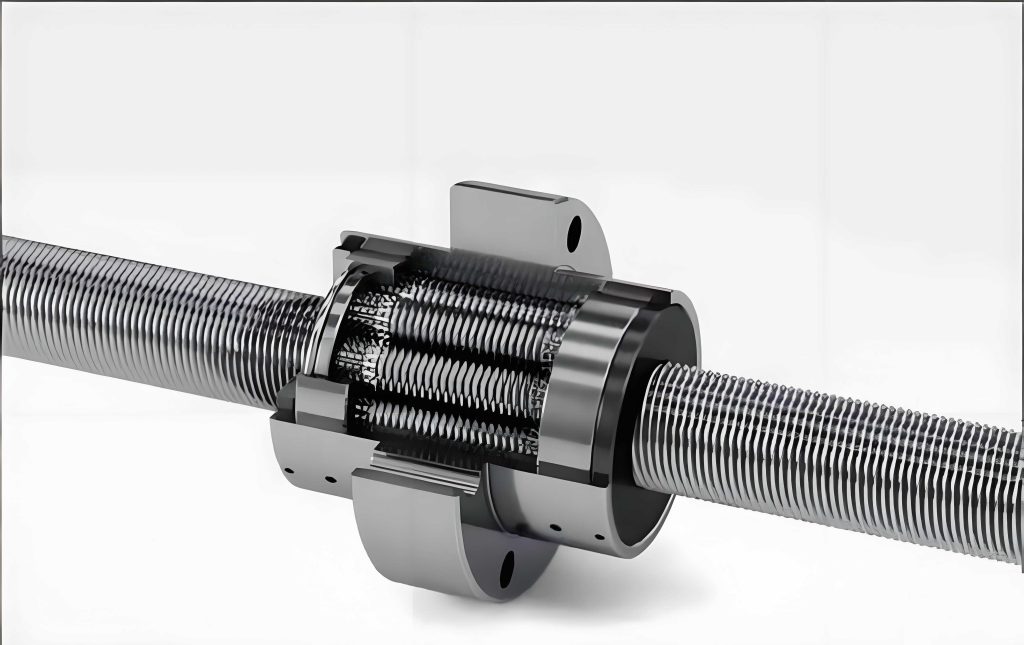
In practical applications, misalignments between the screw, rollers, and nut of a planetary roller screw mechanism are inevitable due to manufacturing tolerances, assembly errors, and operational loads. These misalignments critically influence the mechanism’s performance, including its load distribution, transmission efficiency, and service life. This work addresses this issue by developing a comprehensive method to calculate the meshing positions and clearances for each pair of mating thread teeth when such misalignments are present.
The foundation of this analysis lies in adapting the theory of gearing and tooth contact analysis to the unique geometry of the planetary roller screw. The primary condition for correct operation is that the mating thread surfaces must remain in tangency. When components are misaligned, this tangency condition must account for potential gaps and relative displacements. For two generic mating thread surfaces, denoted $\Sigma_l$ and $\Sigma_m$, the condition for tangency after compensating for a misalignment-induced gap $\delta_{lm}$ is defined by the following vector equations, which state that the position vectors and surface normals must coincide at the contact point M:
$$ \mathbf{r}_l(u_l, \theta_l) = \mathbf{r}_m(u_m, \theta_m) + \delta_{lm} \cdot \mathbf{e}_{lm} $$
$$ \mathbf{n}_l(u_l, \theta_l) = \zeta \cdot \mathbf{n}_m(u_m, \theta_m) $$
Here, $\mathbf{r}_i$ and $\mathbf{n}_i$ are the position and unit normal vectors of surface $\Sigma_i$, $u_i$ and $\theta_i$ are surface parameters, $\mathbf{e}_{lm}$ is the unit vector along the direction of relative approach, and $\zeta$ is a scalar constant. This system provides five independent equations to solve for the five unknowns: $u_l$, $\theta_l$, $u_m$, $\theta_m$, and $\delta_{lm}$.
To apply this general condition, precise mathematical models of the thread surfaces are required. A coordinate system $o_i x_i y_i z_i$ is fixed to each component (screw $i=S$, roller $i=R$, nut $i=N$), with the $z_i$-axis aligned with the component’s nominal axis. The thread profile is defined in a sectional coordinate system. For the screw and nut, which typically have straight-sided (trapezoidal) profiles, the surface equation for the $j$-th start on the screw is given by:
$$ \mathbf{r}^S_{S,j} = \begin{pmatrix} (u_S + r_{S0}) \cos(\theta_S + \theta_{S0,j}) \\ (u_S + r_{S0}) \sin(\theta_S + \theta_{S0,j}) \\ \pm(c_S – u_S \tan \beta_{S0}) + \frac{L_S}{2\pi}\theta_S \end{pmatrix} $$
where the `+` sign corresponds to the upper flank $\Sigma_{i1}$ and the `-` sign to the lower flank $\Sigma_{i2}$. Similarly, for the nut:
$$ \mathbf{r}^N_{N,j} = \begin{pmatrix} (u_N + r_{N0}) \cos(\theta_N + \theta_{N0,j}) \\ (u_N + r_{N0}) \sin(\theta_N + \theta_{N0,j}) \\ \pm(c_N + u_N \tan \beta_{N0}) + \frac{L_N}{2\pi}\theta_N \end{pmatrix} $$
In these equations, $r_{i0}$ is the nominal radius, $c_i$ is the half-thread thickness, $\beta_{i0}$ is the nominal flank angle, $L_i$ is the lead, and $\theta_{i0,j}$ is the starting angular position of the $j$-th thread start.
The roller profile is usually circular (gothic arc). Its thread surface equation is derived from the circular arc profile and is more complex:
$$ \mathbf{r}^R_{R} = \begin{pmatrix} (u_R + r_{R0}) \cos(\theta_R + \theta_{R0,1}) \\ (u_R + r_{R0}) \sin(\theta_R + \theta_{R0,1}) \\ \pm \sqrt{ w_{PR}^2 – (r_{PR}^2 – (u_R + r_{R0} – u_{PR})^2) } + \frac{L_R}{2\pi}\theta_R \end{pmatrix} $$
Here, $r_{PR}$ is the radius of the circular profile arc, and $(u_{PR}, w_{PR})$ are the coordinates of its center in the roller’s sectional coordinate system.
Component misalignments are rigorously described using coordinate transformations. The posture of each component’s local coordinate system $o_i x_i y_i z_i$ relative to a fixed global frame $oxyz$ is defined by translation vectors $\boldsymbol{\epsilon}_i$ and rotation matrices $\mathbf{H}_i$. The rotation matrix accounts for two tilt angles, $\psi_i$ and $\varphi_i$:
$$ \mathbf{H}_i = \begin{pmatrix} \cos\psi_i & \sin\psi_i \sin\varphi_i & \sin\psi_i \cos\varphi_i \\ 0 & \cos\varphi_i & -\sin\varphi_i \\ -\sin\psi_i & \cos\psi_i \sin\varphi_i & \cos\psi_i \cos\varphi_i \end{pmatrix} $$
Thus, the surface point in the global frame is:
$$ \mathbf{r}_{i,j}(u_i, \theta_i) = \mathbf{H}_i \cdot \mathbf{r}^i_{i,j}(u_i, \theta_i) + \mathbf{p}_i $$
where $\mathbf{p}_i = \mathbf{p}_{i0} + \boldsymbol{\epsilon}_i$ is the origin position, and $\mathbf{p}_{i0}$ is the nominal position. A special but common case is rotation about a fixed point $\mathbf{p}_{ir}$, modeled as:
$$ \mathbf{p}_i = \mathbf{H}_i \cdot (\mathbf{p}_{i0} – \mathbf{p}_{ir}) + \mathbf{p}_{ir} $$
This is particularly relevant for modeling roller tilt within its retaining cage or nut tilt.
To analyze the meshing at the screw-roller interface, specific meshing parameters are defined: the meshing radius $r^c$ (distance from the contact point to the component axis) and the meshing angle $\phi^c$ (angular deviation of the contact point from the $x_i$-axis). For the $k_S$-th screw thread in contact with the $k_{Rs}$-th roller thread on its screw-side, these are related to the surface parameters:
$$ r^c_{Sc} = r_{S0} + u_S, \quad \phi^c_{Sc} = \theta_S – \frac{2\pi}{n_S}(k_S – 1) $$
$$ r^c_{Rsc} = r_{R0} + u_R, \quad \phi^c_{Rsc} = -(\theta_R – 2\pi(k_{Rs}-1)) $$
Substituting the surface equations and their normals into the general tangency conditions yields the final set of equations for the screw-roller pair, for example, when screw flank $\Sigma_{S1}$ contacts roller flank $\Sigma_{R2}$:
$$ \begin{cases}
\mathbf{H}_S \cdot \mathbf{r}^S_{Sc}(u_S, \phi^c_{Sc}) + \mathbf{p}_S = \mathbf{H}_R \cdot \mathbf{r}^R_{Rsc}(u_R, \phi^c_{Rsc}) + \mathbf{p}_R + \delta^{k_{Rs}}_{SR2} \cdot \mathbf{e}_{SR} \\
\mathbf{H}_S \cdot \mathbf{n}^S_{Sc}(u_S, \phi^c_{Sc}) = \zeta \cdot \mathbf{H}_R \cdot \mathbf{n}^R_{Rsc}(u_R, \phi^c_{Rsc})
\end{cases} $$
Here, $\delta^{k_{Rs}}_{SR2}$ is the clearance for the $k_{Rs}$-th roller thread, and $\mathbf{e}_{SR}$ is the unit vector of relative approach, typically $(0, 0, -1)^T$ if the roller moves axially relative to the screw. By solving this system for each thread pair ($k_{Rs}=1, 2, …, n_T$, where $n_T$ is the total number of engaged threads), the meshing radii $r^c_{Sc}$, $r^c_{Rsc}$, meshing angles $\phi^c_{Sc}$, $\phi^c_{Rsc}$, and the individual clearance $\delta^{k_{Rs}}_{SR2}$ for every tooth are obtained. The effective axial clearance $\delta_{SR}$ between the screw and roller is the minimum sum of clearances from all potential contact flanks:
$$ \delta_{SR} = \min[ \delta^{1}_{SR1}+\delta^{1}_{SR2}, … , \delta^{n_T}_{SR1}+\delta^{n_T}_{SR2} ] $$
A completely analogous procedure is followed to establish and solve the equations for the meshing between the nut and the roller.
The validity of the proposed model is first verified against an established model for a perfectly aligned planetary roller screw mechanism. Using the geometric parameters listed in Table 1, the calculated meshing positions from both methods show excellent agreement, as seen in Table 2.
| Parameter | Screw | Roller | Nut |
|---|---|---|---|
| Nominal Radius $r_0$ (mm) | 9.75 | 3.25 | 16.25 |
| Thread Crest Height $a$ (mm) | 0.22 | 0.22 | 0.22 |
| Thread Root Height $b$ (mm) | 0.265 | 0.265 | 0.265 |
| Half-thread Thickness $c$ (mm) | 0.282 | 0.282 | 0.310 |
| Flank Angle $\beta_0$ (deg) | 45 | 45 | 45 |
| Number of Starts $n$ | 5 | 1 | 5 |
| Pitch $P$ (mm) | 1.2 | 1.2 | 1.2 |
| Roller Profile Radius $r_{PR}$ (mm) | — | 4.597 | — |
| Engaged Threads on Roller ($n_T$) | — | 25 | — |
| Meshing Parameter | Reference Model | Proposed Model |
|---|---|---|
| Screw Meshing Radius $r_{Sc}$ (mm) | 9.775 | 9.775 |
| Screw Meshing Angle $\phi_{Sc}$ (deg) | 2.232 | 2.227 |
| Roller Meshing Radius $r_{Rsc}$ (mm) | 3.255 | 3.255 |
| Roller Meshing Angle $\phi_{Rsc}$ (deg) | 6.715 | 6.701 |
| Screw-Roller Axial Clearance $\delta_{SR}$ (mm) | — | 0.0123 |
| Nut Meshing Radius $r_{Nc}$ (mm) | 16.25 | 16.25 |
| Roller Meshing Radius (Nut-side) $r_{Rnc}$ (mm) | 3.25 | 3.25 |
Subsequently, the model’s capability to handle misalignment is demonstrated. A specific case is analyzed where the screw remains perfectly aligned, but the roller tilts by an angle $\varphi_R = 3$ arcminutes about a fixed point $\mathbf{p}_{Rr} = (0, 0, (P n_T)/2)^T$, simulating a pivot at the center of its engaged length. The results reveal profound changes in the meshing characteristics of the planetary roller screw mechanism.
First, the meshing radii and angles are no longer uniform across different thread teeth. For the tilted roller, the projection of contact points for its upper ($\Sigma_{R1}$) and lower ($\Sigma_{R2}$) flanks onto the roller’s cross-sectional plane ($o_Rx_Ry_R$) disperses, deviating significantly from the symmetric positions found in the aligned case. This means each tooth on the roller, and correspondingly on the screw, meshes at a unique radial distance and angular position. Second, and critically, the individual tooth clearances $\delta^{k_{Rs}}_{SR1}$ and $\delta^{k_{Rs}}_{SR2}$ become non-uniform. The effective axial clearance $\delta_{SR}$ increases to 0.013 mm for this particular tilt direction. Most importantly, the analysis of these individual clearances, plotted against the roller tooth number in Figure 13, demonstrates that not all tooth pairs can be in contact simultaneously under load. Depending on which flanks are designated as the load-carrying paths (e.g., $\Sigma_{S1}$/$\Sigma_{R2}$ or $\Sigma_{S2}$/$\Sigma_{R1}$), only a subset of teeth will actually share the load, while others will have a residual positive clearance. This invalidates the common assumption of uniform load distribution across all engaged threads in a misaligned planetary roller screw mechanism and has direct implications for calculating stress, stiffness, and fatigue life.
In conclusion, a comprehensive analytical model for determining the precise meshing positions and clearances in a planetary roller screw mechanism with component misalignments has been developed. By integrating coordinate transformations for misalignment description with the fundamental conditions of gear surface tangency, the model successfully quantifies the effects of tilt and offset on the screw-roller and nut-roller interfaces. The results confirm that misalignment destroys the uniformity of meshing geometry across multiple threads and leads to non-simultaneous contact among tooth pairs. This model provides an essential foundation for subsequent high-fidelity analysis of load distribution, stiffness, efficiency, and durability in realistically imperfect planetary roller screw mechanism assemblies, enabling more accurate design and performance prediction for these critical mechanical actuators.