
In recent years, the demand for mobile robots capable of operating in dynamic environments has grown significantly, particularly for applications requiring high energy efficiency, rapid movement, and strong terrain adaptability. However, conventional wheeled or legged robots often struggle to achieve a balanced performance across these diverse objectives. Wheel-legged hybrid systems, such as the quadruped robot dog, offer a promising solution by combining the efficiency of wheeled locomotion with the adaptability of legged systems. Our research focuses on developing a novel power-switching mechanism for a quadruped robot, leveraging planetary gear systems to enable seamless transitions between wheeled and legged modes. This approach reduces the number of actuators required, enhancing cost-effectiveness and reliability while maintaining high performance in complex terrains.
The integration of wheeled and legged functionalities in a single platform, like a quadruped robot, presents unique challenges in mechanical design, control, and trajectory planning. Existing systems, such as ANYmal and HyTRo-I, have demonstrated the potential of hybrid locomotion but often rely on complex actuation schemes. In contrast, our design utilizes a simplified planetary gear-based clutch mechanism to switch power between the leg joints and the wheel, minimizing the need for additional motors. This paper details the kinematic modeling, trajectory planning, and control strategies for our wheel-legged quadruped robot, with an emphasis on optimized foot-end trajectories for both legged and wheeled modes. Through simulations and experimental validation, we demonstrate the effectiveness of our approach in achieving smooth, efficient locomotion and mode transitions.
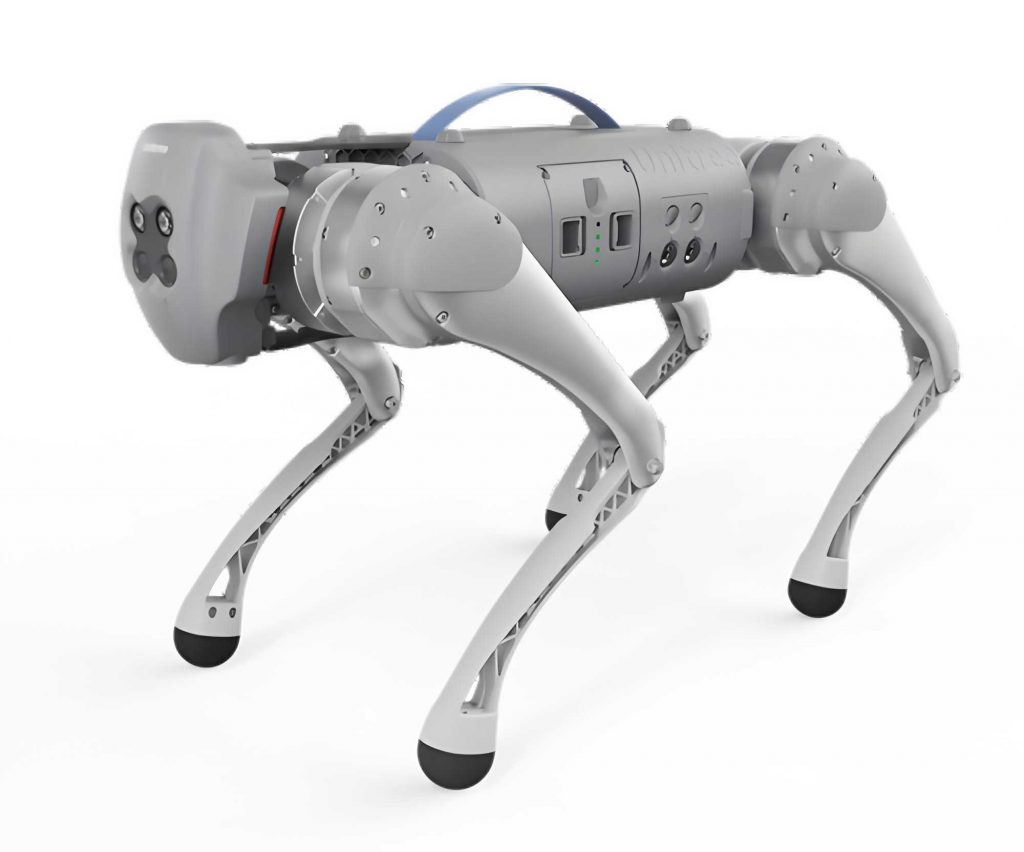
Trajectory planning is critical for ensuring stable and efficient motion in legged robots. For the quadruped robot dog, we employ a modified cycloidal trajectory for the swing phase during legged locomotion, which provides continuous and smooth position, velocity, and acceleration profiles. Additionally, we use a fifth-order polynomial for trajectory planning during mode transitions between wheeled and legged states. These trajectories are designed to minimize abrupt changes in motion, reducing the risk of instability and excessive actuator loads. Our kinematic analysis includes forward and inverse solutions for the leg mechanism, enabling precise control of the foot-end position. The virtual model control (VMC) method is applied to simulate the robot’s trot gait and mode-switching behaviors, providing insights into the dynamic performance of the system.
Experimental validation is conducted using a single-leg prototype, with motion tracking to assess the accuracy of the planned trajectories. The results indicate that the leg structure and control strategies are effective, with minor deviations attributable to mechanical imperfections and friction. Overall, our contributions include a robust mechanical design, optimized trajectory planning methods, and a comprehensive control framework for power-switching wheel-legged robots. This work lays the foundation for future developments in adaptive locomotion systems, particularly for applications in search and rescue, logistics, and exploration where a quadruped robot must navigate varied terrains efficiently.
Leg Structure Design and Power-Switching Mechanism
The leg structure of our wheel-legged quadruped robot is designed to facilitate both legged and wheeled locomotion with minimal actuation. Each leg incorporates a planetary gear system that allows power to be directed either to the leg joints for walking or to the wheel for rolling. This mechanism reduces the number of motors required per leg from three to two, lowering complexity and cost. The planetary gear clutch operates by controlling the rotation of the planet carrier and the ring gear. In legged mode, the planet carrier is fixed, causing the planets to rotate and drive the ring gear, which is connected to the leg segments. In wheeled mode, the ring gear is fixed, and the planet carrier rotates to drive the wheel directly.
The power-switching process is managed by a servo-controlled locking mechanism that engages or disengages the transmission paths. When switching to wheeled mode, the servo moves a locking rod to secure the synchronous pulley connected to the leg, allowing motor power to be routed to the wheel. Conversely, in legged mode, the locking rod secures the wheel pulley, diverting power to the knee and hip joints. This design ensures that the quadruped robot can transition smoothly between modes without requiring additional motors or complex control signals. The leg segments, including the thigh and shank, are designed with lightweight materials to optimize dynamic performance, and the wheel is mounted at the foot end to enable rolling when engaged.
The kinematic parameters of the leg are defined using the Denavit-Hartenberg (D-H) convention, with the base coordinate system located at the hip joint. The leg has three primary segments: the thigh, shank, and foot (wheel). The D-H parameters are summarized in Table 1, where $a_i$ represents the link length, $\alpha_i$ is the twist angle, $d_i$ is the link offset, and $\theta_i$ is the joint angle. For our quadruped robot, the thigh and shank lengths are denoted as $L_1$ and $L_2$, respectively, and the joint angles $\theta_1$ and $\theta_2$ are controlled to achieve desired foot-end positions.
| Joint $i$ | $a_i$ | $\alpha_i$ | $d_i$ | $\theta_i$ |
|---|---|---|---|---|
| 1 | 0 | $\pi/2$ | 0 | $\theta_1$ |
| 2 | $L_1$ | 0 | 0 | $\theta_2$ |
| 3 | $L_2$ | 0 | 0 | 0 |
The homogeneous transformation matrix from the base to the foot-end coordinate system is derived as follows:
$$
\begin{aligned}
{^0_3T} &= {^0_1T} {^1_2T} {^2_3T} \\
&= \begin{bmatrix}
\cos(\theta_1 + \theta_2) & -\sin(\theta_1 + \theta_2) & 0 & L_1 \cos \theta_1 + L_2 \cos(\theta_1 + \theta_2) \\
0 & 0 & -1 & 0 \\
\sin(\theta_1 + \theta_2) & \cos(\theta_1 + \theta_2) & 0 & L_1 \sin \theta_1 + L_2 \sin(\theta_1 + \theta_2) \\
0 & 0 & 0 & 1
\end{bmatrix}
\end{aligned}
$$
From this matrix, the forward kinematics equations for the foot-end position $(p_x, p_z)$ in the horizontal plane are:
$$
\begin{cases}
p_x = L_1 \cos \theta_1 + L_2 \cos(\theta_1 + \theta_2) \\
p_z = L_1 \sin \theta_1 + L_2 \sin(\theta_1 + \theta_2)
\end{cases}
$$
For inverse kinematics, we solve for the joint angles given a desired foot-end position. By substituting $\theta_2 = \theta_3 – \theta_1$, where $\theta_3$ is the total angle, the inverse kinematics equations are derived as:
$$
\begin{cases}
\theta_1 = \theta_3 – \arccos\left( \frac{p_x^2 + p_z^2 – L_1^2 – L_2^2}{2 L_1 L_2} \right) \\
\theta_3 = \arctan\left( \frac{-p_x}{p_z} \right) – \arcsin\left( \frac{p_x^2 + p_z^2 + L_2^2 – L_1^2}{2 L_2 \sqrt{p_x^2 + p_z^2}} \right)
\end{cases}
$$
These equations enable precise control of the foot-end trajectory for the quadruped robot, which is essential for stable locomotion in both legged and wheeled modes.
Trajectory Planning for Legged and Wheeled Locomotion
Trajectory planning is a key aspect of controlling a quadruped robot, as it directly influences stability, energy efficiency, and terrain adaptability. For legged locomotion, we use a modified cycloidal trajectory for the swing phase of the foot-end. The standard cycloid curve is optimized to ensure continuity in position, velocity, and acceleration, reducing abrupt changes that could lead to instability. The swing phase duration is denoted as $T_m = T/2$, where $T$ is the total gait cycle period. The constraints for the trajectory in the $x$ (forward) and $y$ (vertical) directions are defined as follows:
Position constraints:
$$
\begin{cases}
x(t=0) = 0, \quad y(t=0) = 0 \\
x(t=T_m) = S, \quad y(t=T_m/2) = H \\
x(t=T) = 0, \quad y(t) = 0 \text{ for } T_m \leq t \leq T
\end{cases}
$$
Velocity constraints:
$$
\begin{cases}
x'(t=0) = 0, \quad y'(t=0) = 0 \\
x'(t=T_m) = 0, \quad y'(t=T_m/2) = 0 \\
x'(t=T) = 0, \quad y'(t) = 0 \text{ for } T_m \leq t \leq T
\end{cases}
$$
Acceleration constraints:
$$
\begin{cases}
x”(t=0) = 0, \quad y”(t=0) = 0 \\
x”(t=T_m) = 0, \quad y”(t=T_m/2) = 0 \\
x”(t=T) = 0, \quad y”(t) = 0 \text{ for } T_m \leq t \leq T
\end{cases}
$$
where $S$ is the stride length and $H$ is the maximum lift height. The modified cycloidal trajectory for the $x$ and $y$ directions is given by:
$$
\begin{cases}
x(t) = S \left[ \frac{t}{T_m} – \frac{1}{2\pi} \sin\left( \frac{2\pi t}{T_m} \right) \right] \\
y(t) = \begin{cases}
H \left[ \frac{2t}{T_m} – \frac{1}{2\pi} \sin\left( \frac{4\pi t}{T_m} \right) \right], & 0 \leq t < \frac{T_m}{2} \\
H \left[ 2 – \frac{2t}{T_m} + \frac{1}{2\pi} \sin\left( \frac{4\pi t}{T_m} \right) \right], & \frac{T_m}{2} \leq t < T_m
\end{cases}
\end{cases}
$$
This formulation ensures that the position, velocity, and acceleration curves are smooth and continuous, as shown in Figure 1. The parameter $n=4$ is chosen for the $y$-direction trajectory to balance periodicity and energy consumption, avoiding excessively short cycles that could increase power usage. For a quadruped robot dog, this trajectory minimizes actuator loads and enhances stability during walking.
For mode transitions between wheeled and legged states, we employ a fifth-order polynomial trajectory. This allows the foot-end to move smoothly from the wheeled contact point to the legged stance position, or vice versa. The general form of the polynomial is:
$$
\begin{aligned}
x(t) &= k_0 + k_1 (t – t_0) + k_2 (t – t_0)^2 + k_3 (t – t_0)^3 + k_4 (t – t_0)^4 + k_5 (t – t_0)^5 \\
x'(t) &= k_1 + 2k_2 (t – t_0) + 3k_3 (t – t_0)^2 + 4k_4 (t – t_0)^3 + 5k_5 (t – t_0)^4 \\
x”(t) &= 2k_2 + 6k_3 (t – t_0) + 12k_4 (t – t_0)^2 + 20k_5 (t – t_0)^3
\end{aligned}
$$
The coefficients $k_0$ to $k_5$ are determined based on boundary conditions for position, velocity, and acceleration at the start and end points. For instance, with $t_0 = 0$, $t_1 = T$, $x(t_0) = x_0$, $x(t_1) = x_1$, and zero initial and final velocities and accelerations, the coefficients are computed as:
$$
\begin{aligned}
k_0 &= x_0, \quad k_1 = 0, \quad k_2 = 0 \\
k_3 &= \frac{1}{2T^3} [20(x_1 – x_0)] \\
k_4 &= \frac{1}{2T^4} [-30(x_1 – x_0)] \\
k_5 &= \frac{1}{2T^5} [12(x_1 – x_0)]
\end{aligned}
$$
This trajectory is applied to both $x$ and $y$ directions during mode switching, ensuring a straight-line path that minimizes transition time and energy consumption. For our quadruped robot, this approach facilitates rapid and stable transitions, enhancing the robot’s adaptability in dynamic environments.
Simulation Analysis Using Virtual Model Control
To validate the trajectory planning and control strategies, we conducted simulations using the Webots platform. The virtual model control (VMC) method is employed to generate virtual forces and torques that guide the robot’s motion according to the desired trajectories. VMC simplifies the control of complex dynamic systems by treating the robot as a set of interconnected masses subject to virtual springs and dampers. For the quadruped robot dog, we define virtual components at the foot-end and joints to achieve stable trot gait walking and smooth mode transitions.
In the simulation, the robot’s trot gait is implemented with a cycle period $T = 2$ seconds, where the swing and stance phases each last $T_m = 1$ second. The foot-end follows the modified cycloidal trajectory during the swing phase, while the stance phase maintains constant ground contact. The virtual model generates forces proportional to the position and velocity errors between the desired and actual foot-end positions, ensuring accurate tracking. The simulation results show that the planned trajectories are closely followed, with minor deviations due to factors such as joint friction and actuator dynamics. These deviations are within acceptable limits, demonstrating the effectiveness of the trajectory planning for the quadruped robot.
For mode switching, the simulation involves transitioning from legged to wheeled locomotion and vice versa. The fifth-order polynomial trajectory is used to plan the foot-end path during these transitions. The virtual model control adjusts the joint torques to follow this path, with the locking mechanism engaging or disengaging as needed. The simulation captures the dynamics of the switching process, including the impact of ground contact and the redistribution of forces. The results indicate that the transitions are smooth and stable, with no significant oscillations or instabilities. This confirms that our power-switching mechanism and control strategy are suitable for real-world applications of the quadruped robot dog.
The simulation parameters are summarized in Table 2, including the robot’s mass, leg dimensions, and control gains. These parameters are tuned to optimize performance based on the virtual model control framework.
| Parameter | Value | Description |
|---|---|---|
| $m$ | 20 kg | Robot mass |
| $L_1$ | 0.3 m | Thigh length |
| $L_2$ | 0.3 m | Shank length |
| $S$ | 0.1 m | Stride length |
| $H$ | 0.03 m | Lift height |
| $T$ | 2 s | Gait cycle period |
| $k_p$ | 1000 N/m | Spring stiffness in VMC |
| $k_d$ | 50 N·s/m | Damping coefficient in VMC |
The virtual model control law for the foot-end position is given by:
$$
\mathbf{F}_v = k_p (\mathbf{p}_d – \mathbf{p}) + k_d (\dot{\mathbf{p}}_d – \dot{\mathbf{p}})
$$
where $\mathbf{F}_v$ is the virtual force, $\mathbf{p}_d$ and $\mathbf{p}$ are the desired and actual foot-end positions, and $k_p$ and $k_d$ are the proportional and derivative gains. This force is mapped to joint torques using the Jacobian transpose method:
$$
\boldsymbol{\tau} = \mathbf{J}^T \mathbf{F}_v
$$
where $\mathbf{J}$ is the Jacobian matrix of the leg. This approach ensures that the quadruped robot accurately tracks the planned trajectories while maintaining stability.
Experimental Validation with Single-Leg Prototype
To further validate our design and control strategies, we constructed a single-leg prototype of the wheel-legged quadruped robot. The prototype includes the planetary gear mechanism, actuators, and sensors for motion tracking. Experiments were conducted to evaluate the accuracy of the foot-end trajectories during legged locomotion and mode transitions. A laser tracking system was used to record the foot-end position in real-time, with data processed using Spatial Analyzer software.
In the legged mode experiment, the leg performed swinging motions based on the modified cycloidal trajectory. The initial position was set at $(0, -0.36)$ m in the hip coordinate system, with a stride length $S = 0.15$ m and lift height $H = 0.11$ m. The leg executed three to four cycles of motion, and the recorded trajectory formed a closed loop with deviations concentrated at the swing phase endpoint and the highest lift point. The maximum deviation was approximately 20 mm at the endpoint and 5 mm at the lift point, with a repeatability error of 4 mm. This error is within 22.2% of the foot component radius (18 mm), indicating acceptable performance for the quadruped robot dog.
The deviations are attributed to factors such as manufacturing tolerances, assembly errors, and friction in the joints. Additionally, the belt transmission system introduced some backlash, particularly in the shank joint, contributing to the endpoint error. Despite these issues, the trajectory tracking was generally accurate, demonstrating the feasibility of the mechanical design and control approach for a quadruped robot.
For the mode transition experiment, the leg was switched between wheeled and legged states using the fifth-order polynomial trajectory. The transition time varied from 0.8 to 8 seconds to assess the effect of speed on accuracy. The results showed that slower transitions (e.g., 8 seconds) produced trajectories closer to the theoretical curve, with average errors of 2.4 mm in the $x$-direction and 1.26 mm in the $y$-direction. Faster transitions (e.g., 0.8–1 seconds) exhibited larger deviations due to system latency and impact forces when the wheel contacted the ground. However, all transitions were completed successfully, confirming that the power-switching mechanism operates as intended.
These experiments highlight the importance of optimizing control parameters, such as the virtual spring stiffness and damping coefficients, to compensate for mechanical imperfections. Future work will focus on improving the transmission system and implementing adaptive control algorithms to enhance trajectory accuracy for the quadruped robot.
Conclusion
In this paper, we presented a comprehensive framework for the design, modeling, and control of a power-switching wheel-legged quadruped robot. The leg structure, based on a planetary gear system, enables efficient transitions between wheeled and legged locomotion with reduced actuation requirements. Kinematic analysis and trajectory planning methods, including modified cycloidal and fifth-order polynomial trajectories, ensure smooth and stable motion in both modes. Simulations using virtual model control demonstrated the effectiveness of these trajectories in achieving trot gait walking and seamless mode transitions. Experimental validation with a single-leg prototype confirmed the practical feasibility of the design, with acceptable errors in trajectory tracking.
The contributions of this work include a novel mechanical design for power switching, optimized trajectory planning techniques, and a control strategy that leverages virtual model control for dynamic stability. These advancements provide a foundation for developing more adaptive and efficient quadruped robots capable of operating in diverse environments. Future research will focus on integrating the full quadruped system, enhancing the control algorithms with machine learning for terrain adaptation, and conducting field tests in real-world scenarios. The wheel-legged quadruped robot dog represents a significant step toward versatile mobile robots for applications in logistics, exploration, and emergency response.