
Design should fundamentally address the deep-seated emotional needs of users. The appearance and modeling of a product constitute a critical factor influencing the overall user experience and perception. In today’s fast-paced world, characterized by intense work pressure and a hectic lifestyle, individuals frequently find themselves in a state of “sub-health.” This reality has spurred a growing demand for intelligent products designed to alleviate stress and provide companionship. Consequently, users now hold higher standards for the造型, functionality, and emotional resonance of such products. For a companion robot, the visual aesthetic is realized through a psychological process of perception, manifested in造型 features, color, and texture. In contrast, semantic symbolism is achieved through a non-aesthetic socio-psychological process, aiming to evoke feelings of belonging, intimacy, and quality. The造型 design of a companion robot is thus intrinsically linked to users’ perceptual needs. The application of Kansei Engineering occupies a pivotal position in this design domain, enabling the quantification of感性 design elements, the derivation of new design concepts, and the output of造型 solutions that more accurately align with用户 emotional requirements.
The core challenge lies in translating vague, subjective感性 imagery into quantifiable and researchable parameters. This involves constructing a logical mapping between user demands and experiential outcomes, thereby integrating感性 needs into tangible, visual design elements. This study employs E-Prime, a psychology experiment generation software, to investigate the造型 design of a companion robot. We design cognitive experiments to establish mapping relationships between感性 imagery and design elements, extract optimal design output schemes, explore design directions, and optimize the design process. The goal is to provide a more targeted methodological framework for挖掘用户情感需求 in the development of a companion robot.
Current State of Companion Robot造型 Design
Developmental Landscape of Companion Robots
The companion robot is an emerging category of intelligent robotics, traditionally defined as multi-functional service robots designed to accompany users in entertainment, learning, and daily life. Currently, companion robots can be classified into four main functional categories: interactive robots, multimedia entertainment robots, health and safety monitoring robots, and remote-control robots. These categories often overlap, leading to重合 market positioning and low专业区分度. As a nation with a significant aging population, China’s deepening demographic aging trend and the unique “4-2-1” family structure have laid a foundation for the智能陪伴机器人 product market targeting children and the elderly. However, this focus has also resulted in a notable偏差: insufficient exploration of the market for middle-aged and young adults. Designing companion robots for this demographic, aimed at stress relief, reducing loneliness, and preventing sub-health conditions, has gradually become a subject of increasing关注.
Prevalent Issues in造型 Design
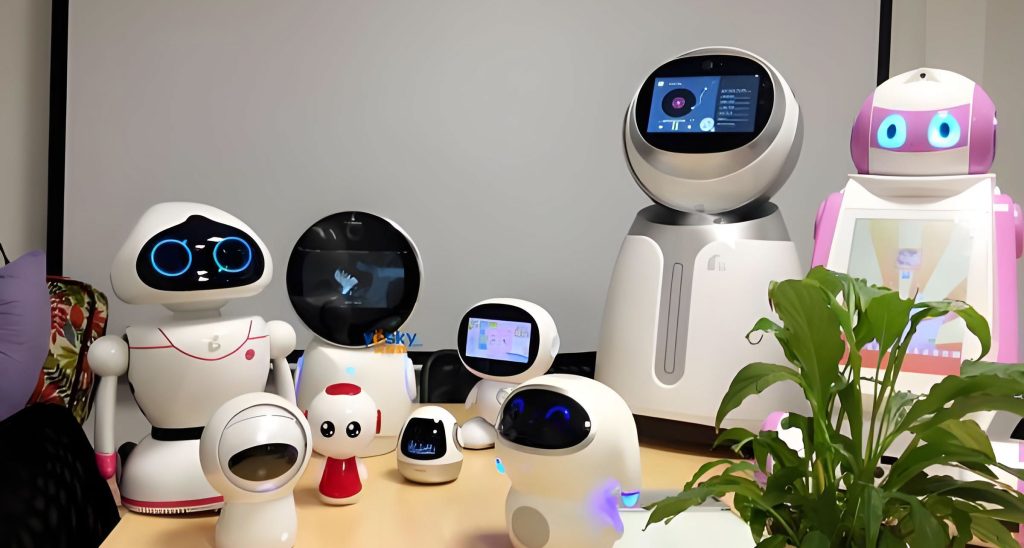
The appearance of existing智能机器人 products in the market generally suffers from two design biases. First, companion robots primarily aimed at children and the elderly are often designed with highly figurative humanoid or cartoon animal appearances. These designs tend to be rigid, frequently feature exposed joints, and although通俗 in造型, lack fluid整体流畅感 in the衔接 of components. Second, industrially-oriented functional robots are typically more抽象, employing large swathes of colors like black and white. While this may convey a certain industrial style, it often fails to meet the审美需求 of younger populations.
Design Process Based on E-Prime and Kansei Engineering
Acquisition of Typical Sample Images
The initial step involves gathering representative images of intelligent robots whose外观造型 aligns with participants’ preferences for a companion robot. These images serve as stimuli for subsequent量化评价. We began by collecting 50 typical智能机器人造型 pictures from online databases, ensuring consistency in clarity,尺寸大小, and background color.
Participant Selection and Experimental Materials
Twenty participants (aged 18-70, diverse occupations, mixed gender) were randomly selected. All participants were confirmed to have normal or corrected-to-normal vision, no color blindness or weakness, and were in good health. The experiment was conducted using E-Prime 3.0 to record participants’ reactions and response times to different造型 image stimuli.
E-Prime Experimental Procedure
The experiment was programmed using E-Prime’s E-Studio module. The procedure was: Instructions → Practice Block → Transition → Experimental Block → Conclusion. Participants were seated approximately 30 cm from the desk, with their eye level aligned with the center of the display. During the formal实验 block, consisting of 50 image stimuli, participants were instructed to press a key as quickly as possible when they perceived an image that matched the semantic and意象特征 of a理想的 companion robot. Reaction times and key presses were automatically logged by E-Prime.
Selection of Representative Sample Images
Sample images were selected based on recorded reaction times. Images that elicited a reaction within 800 ms and were chosen by more than 10 participants were deemed representative of companion robot造型.最终, 12 such images were selected as典型样本.
Selection of Kansei Imagery Vocabulary for Companion Robot
Brainstorming and Preliminary Selection
Through brainstorming, 40感性意象 semantic words符合 companion robot were initially listed. These words were compiled into a questionnaire distributed online. Words with a cumulative selection frequency between 60% and 80% were retained, resulting in 20符合条件的感性意象词.
Cluster Analysis
Cluster analysis was performed on the 20 words to group them based on similarity. The analysis yielded three primary clusters. The representative keywords for each cluster were identified as: “Technological,” “Friendly,” and “Abstract.”
Extraction and Classification of Design Elements
Based on product外观设计 methodology and辅以 morphology analysis, we deconstructed various companion robot products to identify their造型单元 characteristics. The造型 features were归纳 into five distinct design要素: Head (X1), Body (X2), Limbs (X3), Base (X4), and Display Screen (X5). The 12 representative sample images were then decomposed and their components classified into sub-categories (denoted as Yij) under these five main要素. This systematic breakdown allows for a structured analysis of造型 components.
| Design Element (Factor) | Sub-category Illustrations |
|---|---|
| Head (X1) | Y11 (Spherical), Y12 (Cubic), Y13 (Cylindrical), Y14 (Dome), Y15 (Abstract Form) |
| Body (X2) | Y21 (Compact Cuboid), Y22 (Tapered), Y23 (Ovoid), Y24 (Cylindrical), Y25 (Sleek Monolith) |
| Limbs (X3) | Y31 (Exposed Joints), Y32 (Hidden Joints), Y33 (No Limbs) |
| Base (X4) | Y41 (Small Disc), Y42 (Wide Platform), Y43 (Integrated with Body), Y44 (Concealed/Stabilizing) |
| Display Screen (X5) | Y51 (None), Y52 (Round), Y53 (Rectangular), Y54 (Oval/Organic), Y55 (Full-Face) |
The classification of the 12 sample images according to this schema is summarized below:
| Sample # | Head (X1) | Body (X2) | Limbs (X3) | Base (X4) | Display (X5) |
|---|---|---|---|---|---|
| 1 | Y11 | Y25 | Y33 | Y44 | Y51 |
| 2 | Y14 | Y22 | Y32 | Y41 | Y52 |
| 3 | Y13 | Y23 | Y33 | Y41 | Y53 |
| 4 | Y14 | Y22 | Y32 | Y41 | Y53 |
| 5 | Y15 | Y25 | Y31 | Y44 | Y55 |
| 6 | Y15 | Y25 | Y31 | Y44 | Y53 |
| 7 | Y12 | Y25 | Y33 | Y44 | Y54 |
| 8 | Y14 | Y24 | Y33 | Y43 | Y52 |
| 9 | Y12 | Y23 | Y32 | Y44 | Y54 |
| 10 | Y15 | Y23 | Y32 | Y41 | Y54 |
| 11 | Y11 | Y21 | Y33 | Y43 | Y51 |
| 12 | Y11 | Y21 | Y33 | Y43 | Y51 |
Analysis of Results
Establishing the Kansei Evaluation Scale
Based on Kansei Engineering principles, a Likert-scale questionnaire was developed. Twenty evaluators from diverse backgrounds rated the 12 representative companion robot samples against the three key感性意象词汇: “Technological,” “Friendly,” and “Abstract,” using a 5-point scale. The mean score for each sample on each vocabulary was calculated, resulting in the following Kansei Evaluation Scale. This scale quantitatively links design element configurations to perceived attributes.
| Sample # | Kansei Vocabulary (Mean Score) | Design Element Configuration | ||||||
|---|---|---|---|---|---|---|---|---|
| Technological | Friendly | Abstract | X1 | X2 | X3 | X4 | X5 | |
| 1 | 4.34 | 3.46 | 4.11 | Y11 | Y25 | Y33 | Y44 | Y51 |
| 2 | 3.29 | 3.47 | 3.78 | Y14 | Y22 | Y32 | Y41 | Y52 |
| 3 | 3.55 | 3.91 | 4.08 | Y13 | Y23 | Y33 | Y41 | Y53 |
| 4 | 3.69 | 4.25 | 3.77 | Y14 | Y22 | Y32 | Y41 | Y53 |
| 5 | 2.79 | 3.02 | 2.24 | Y15 | Y25 | Y31 | Y44 | Y55 |
| 6 | 1.88 | 2.48 | 1.80 | Y15 | Y25 | Y31 | Y44 | Y53 |
| 7 | 4.15 | 3.07 | 4.08 | Y12 | Y25 | Y33 | Y44 | Y54 |
| 8 | 3.73 | 3.54 | 3.65 | Y14 | Y24 | Y33 | Y43 | Y52 |
| 9 | 2.97 | 3.67 | 3.22 | Y12 | Y23 | Y32 | Y44 | Y54 |
| 10 | 3.56 | 3.04 | 2.14 | Y15 | Y23 | Y32 | Y41 | Y54 |
| 11 | 4.12 | 3.67 | 4.46 | Y11 | Y21 | Y33 | Y43 | Y51 |
| 12 | 4.25 | 3.46 | 4.34 | Y11 | Y21 | Y33 | Y43 | Y51 |
The relationship between a specific design configuration and its resultant kansei score can be conceptually framed. Let \( S_{k} \) represent the mean score for a sample on kansei dimension \( k \) (e.g., Technological). This score is a function of its constituent design elements \( X_m \) and their specific sub-category instantiations \( Y_{mn} \). While a precise weighting requires larger-scale regression analysis, the mapping principle can be expressed as:
$$S_{k} = f(X_1, X_2, X_3, X_4, X_5) = f(Y_{1j}, Y_{2j}, Y_{3j}, Y_{4j}, Y_{5j})$$
For instance, a high score on “Abstract” appears strongly associated with the absence of limbs (\(Y_{33}\)) and a body that is either a compact cuboid (\(Y_{21}\)) or a sleek monolith (\(Y_{25}\)), as seen in samples 11 and 12.
归纳 of造型 Design Direction Features
A comprehensive analysis of the evaluation results was conducted. For each感性 vocabulary, the three product samples with the highest scores were identified, and their造型特征 were extracted to inform design directions for the companion robot.
| Kansei Vocabulary | Representative Samples | 归纳造型 Design Direction Features |
|---|---|---|
| Technological | 1, 11, 12 | Head and display often circular/spherical; body is lightweight, not bulky;轮廓 is sharp and hard-edged. |
| Friendly | 3, 4, 11 | Lines are rounded and soft; materials are温和亲肤; overall form is inviting. |
| Abstract | 1, 11, 12 | Avoids figurative forms (humanoid/animal); possesses a strong整体感; minimal segmentation; body is often a straight, vertical form. |
The optimal design for a companion robot should synthesize features from these directions. We can formulate a composite design objective \( O \) that aims to maximize perceived scores across the key kansei dimensions, subject to the constraints of manufacturability and function:
$$O = \max \left( \alpha \cdot S_{Tech} + \beta \cdot S_{Friendly} + \gamma \cdot S_{Abstract} \right)$$
where \( \alpha, \beta, \gamma \) are weighting coefficients reflecting the relative importance of each dimension for the target user segment (e.g., middle-aged adults).
Companion Robot造型 Design Proposal
Guided by the analytical results, a specific造型 design for a companion robot is proposed. The overall form should deliberately avoid being overly figurative. The prevalent卡通化 and overly humanoid or animal-like appearances, especially with exposed joints, significantly diminish the product’s sense of technology and quality, rendering it unsuitable for the审美偏好 of middle-aged and young adults. Incomplete or highly segmented surfaces can impart a sense of cheapness. A浑然一体的整体轮廓造型 delivers a流畅的抽象感. The application of柔和的线条 and rounded corners, coupled with the strategic concealment of parting lines and the use of温和亲肤 surface materials, can provide users with视触觉亲和感, aligning perfectly with the “companionship”功能特点. An integrated design where the body and base form a cohesive unit contributes to a简洁精致 aesthetic.
Color Design
To enhance the亲切感 of the companion robot and ensure it blends seamlessly into居家办公桌 environments, the color scheme should be simple and elegant. Palettes such as the Morandi color scheme, or white body surfaces accented with small areas of black or grey on the display or base, complemented by淡蓝色 illuminated light strips, can effectively突出家用陪伴产品的温馨感 while maintaining an advanced, technological quality.
Functional Integration
Regarding functionality, a touch-sensitive screen on the head and voice recognition via a waist-level speaker can meet daily交互及倾诉 needs. A vertical呼吸灯带 on the body can serve multiple purposes: functioning as a旋律灯, providing operational feedback, and offering gentle nighttime illumination. A微型投影仪 on the top could project ambient patterns onto the ceiling. Charging ports and microphone holes can be discreetly integrated into the base. Given that the primary use environment for this companion robot is居家办公, its体积 must be relatively compact, suitable for placement on a bedside table or office desk. The base should be slightly recessed, with an outer ring made of防滑材质 to ensure excellent stability and safety.
Conclusion
This study utilized the造型 design of a companion robot as its research vehicle. By employing E-Prime to design and conduct psychological behavioral experiments, we successfully extracted representative sample images of intelligent robot造型. This was combined with感性意象词汇 obtained through brainstorming and clustered into three primary categories of感性意象特征. Through systematic morphological analysis, the companion robot’s造型 was decomposed into five key design要素: Head, Body, Limbs, Base, and Display Screen. To establish the对应关系 between感性意象词汇 and造型形态, a Kansei Evaluation Scale was constructed based on a Likert-scale questionnaire. This allowed for the extraction of造型特征 from representative product samples, culminating in a concrete造型设计方案 for a companion robot. The research验证了 the可行性 of combining E-Prime-based psychological behavioral experiments with Kansei Engineering methods to develop design evaluation scales. This approach ensures the design process is more贴合用户感性需求, providing a valuable and参考 design direction framework for the development of future companion robot products. The methodology demonstrates a targeted pathway for挖掘用户情感需求 and translating them into tangible, desirable product forms for the evolving market of companion robots.