
In the field of precision mechanical transmissions, the strain wave gear mechanism has long been revered for its high reduction ratios, compact design, and zero-backlash performance. However, traditional radial strain wave gear systems often face a fundamental conflict between the deformation of the flexible spline and its load-bearing capacity, which limits the transmitted power. To overcome this, a novel configuration known as the end face strain wave gear drive with oscillating teeth has been developed. This design merges the advantages of conventional strain wave gears and oscillating tooth drives, enabling a significant enhancement in power transmission while maintaining smooth operation and high efficiency. In this article, I will delve into the kinematic parameters of the sliding pair within this system, focusing on the displacement, velocity, and acceleration of the oscillating teeth. By analyzing the modified tooth surfaces and deriving comprehensive formulas, I aim to provide a robust theoretical foundation for the design and optimization of such strain wave gear systems. Throughout this discussion, the term “strain wave gear” will be emphasized to underscore its relevance in advanced mechanical engineering applications.
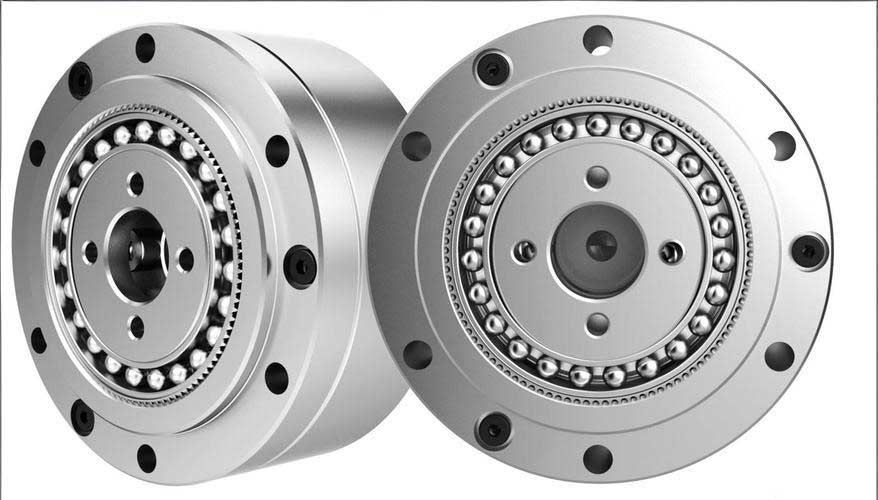
The core innovation of the end face strain wave gear lies in its use of oscillating teeth that engage with an end face cam wave generator and an end face gear. Unlike traditional setups where the flexible deforms radially, here the motion is axial, reducing stress concentrations and allowing for higher loads. The system comprises a sliding pair (between the oscillating teeth and a slot wheel) and two meshing pairs (between the wave generator end face cam and the rear end of the oscillating teeth, and between the front end of the oscillating teeth and the end face gear). To ensure constant instantaneous transmission ratios and facilitate manufacturing, the theoretical tooth surfaces for these meshing pairs are based on multi-start Archimedes helicoids with generatrices as straight lines perpendicular to the axis of rotation. However, this idealized geometry can lead to abrupt velocity changes when the oscillating teeth reverse direction, causing冲击 and wear. Therefore, tooth surface modification becomes essential for smoother operation, particularly at the crest and root regions of the wave generator cam.
Tooth surface modification involves rounding the crest and root of the wave generator cam, as well as corresponding adjustments to the oscillating teeth and end face gear. This process ensures that the meshing pairs remain in proper contact even after modification, with specific height relationships that must be satisfied. For instance, let the modification height of the wave generator cam crest be denoted as $h_{W1}$, the root modification height as $h_{W2}$, and the modification height of the oscillating tooth rear end as $h_{O1}$. These parameters are critical for maintaining kinematic correctness and will be detailed in subsequent sections. The necessity of such modifications in strain wave gear systems cannot be overstated, as they directly impact the dynamic performance and longevity of the transmission.
Now, let’s analyze the motion of the oscillating teeth over one complete wave of the wave generator cam. After modification, the engagement can be divided into five distinct regions, each characterized by different contact conditions and motion behaviors. This segmentation is vital for understanding the kinematic parameters, as it allows us to derive piecewise equations for displacement, velocity, and acceleration. The five regions are as follows: Region I—line contact between the modified rear end of the oscillating tooth and the modified root of the rising section of the wave generator cam; Region II—surface contact between the unmodified rear end of the oscillating tooth and the unmodified rising section of the wave generator cam; Region III—line contact between the modified rear end of the oscillating tooth and the modified crest of the wave generator cam; Region IV—surface contact between the unmodified rear end of the oscillating tooth and the unmodified falling section of the wave generator cam; and Region V—line contact between the modified rear end of the oscillating tooth and the modified root of the falling section of the wave generator cam. This classification is based on geometric relationships and ensures a systematic approach to motion analysis in strain wave gear drives.
To quantify the motion, we first define key parameters. Let $h$ be the lift (tooth height) of the wave generator in mm, $\theta$ be the lift angle in radians, $U$ be the number of waves (teeth) on the wave generator, $n_i$ be the input speed in rpm, and $r$ be the radius of the cylindrical surface where engagement occurs, given by $r = hU / (\pi \tan \theta)$. The time intervals for each region can be derived from geometric considerations. For Region I, the time $t_1$ during which the oscillating tooth accelerates forward is:
$$t_1 = \frac{30(h_{W2} – h_{O1})}{h U n_i}$$
Similarly, for Regions II, III, IV, and V, the times are:
$$t_2 = \frac{30(h – h_{W1} – h_{O1})}{h U n_i}, \quad t_3 = \frac{30(h + h_{O1} + h_{W1})}{h U n_i}, \quad t_4 = \frac{30(2h + h_{O1} – h_{W2})}{h U n_i}$$
Note that the time for Region V equals that for Region I, i.e., $t_5 = t_1$. These time intervals form the basis for piecewise kinematic equations. In strain wave gear applications, understanding these durations is crucial for timing optimization and minimizing inertial effects.
Next, we derive the displacement equations for the oscillating tooth in each region. Using coordinate transformations and the modified tooth surface equations, we can express displacement $Z$ as a function of time $t$. For Region I, where the tooth accelerates forward, the displacement relative to the starting point is:
$$Z = \frac{h^2 U^2 n_i^2 t^2}{1800(h_{W2} – h_{O1})} + \frac{h_{W2}}{2}, \quad t \in [0, t_1]$$
In Region II, the tooth moves with constant velocity, leading to a linear displacement equation:
$$Z = \frac{h U n_i t}{30} + \frac{h_{O1}}{2}, \quad t \in [t_1, t_2]$$
Region III involves deceleration followed by acceleration in the opposite direction. The displacement here is parabolic:
$$Z = -\frac{h^2 U^2 n_i^2}{1800(h_{W1} + h_{O1})} (t – t_W)^2 + h – \frac{h_{W1}}{2}, \quad t \in [t_2, t_3]$$
where $t_W$ is a time offset related to the wave generator’s rotation. In Region IV, the tooth moves with constant velocity in the reverse direction:
$$Z = 2h – \frac{h U n_i t}{30} + \frac{h_{O1}}{2}, \quad t \in [t_3, t_4]$$
Finally, in Region V, the tooth decelerates to a stop:
$$Z = \frac{h^2 U^2 n_i^2}{1800(h_{W2} – h_{O1})} \left(t – \frac{60}{U n_i}\right)^2 + \frac{h_{W2}}{2}, \quad t \in [t_4, t_4 + t_1]$$
These equations comprehensively describe the axial motion of oscillating teeth in an end face strain wave gear system. By differentiating them with respect to time, we obtain the velocity and acceleration profiles, which are essential for dynamic analysis and design validation.
The velocity equations for each region are as follows. For Region I:
$$\dot{Z} = \frac{h^2 U^2 n_i^2 t}{900(h_{W2} – h_{O1})}, \quad t \in [0, t_1]$$
Region II:
$$\dot{Z} = \frac{h U n_i}{30}, \quad t \in [t_1, t_2]$$
Region III:
$$\dot{Z} = -\frac{h^2 U^2 n_i^2}{900(h_{W1} + h_{O1})} (t – t_W), \quad t \in [t_2, t_3]$$
Region IV:
$$\dot{Z} = -\frac{h U n_i}{30}, \quad t \in [t_3, t_4]$$
Region V:
$$\dot{Z} = \frac{h^2 U^2 n_i^2}{900(h_{W2} – h_{O1})} \left(t – \frac{60}{U n_i}\right), \quad t \in [t_4, t_4 + t_1]$$
Acceleration equations are derived by further differentiation. For Region I:
$$\ddot{Z} = \frac{h^2 U^2 n_i^2}{900(h_{W2} – h_{O1})}, \quad t \in [0, t_1]$$
Region II:
$$\ddot{Z} = 0, \quad t \in [t_1, t_2]$$
Region III:
$$\ddot{Z} = -\frac{h^2 U^2 n_i^2}{900(h_{W1} + h_{O1})}, \quad t \in [t_2, t_3]$$
Region IV:
$$\ddot{Z} = 0, \quad t \in [t_3, t_4]$$
Region V:
$$\ddot{Z} = \frac{h^2 U^2 n_i^2}{900(h_{W2} – h_{O1})}, \quad t \in [t_4, t_4 + t_1]$$
These kinematic formulas highlight that acceleration values depend inversely on modification heights. Specifically, smaller wave generator lift $h$ and larger modification heights $h_{W1}$ and $h_{W2}$ reduce acceleration magnitudes, thereby minimizing inertial forces and冲击. However, this comes at the cost of reduced meshing area, which can affect load capacity. Thus, a trade-off must be struck in strain wave gear design to balance dynamic performance with structural integrity.
To illustrate the application of these equations, consider a numerical example for an end face strain wave gear reducer. Assume the following parameters: number of waves $U = 2$, input speed $n_i = 1450 \, \text{rpm}$, oscillating tooth height $h = 21.17 \, \text{mm}$, rear end modification height $h_{O1} = 1.4 \, \text{mm}$, wave generator crest modification height $h_{W1} = 5 \, \text{mm}$, and wave generator root modification height $h_{W2} = 7 \, \text{mm}$. Using the velocity equation, the maximum velocity of the oscillating tooth is calculated as $\dot{Z}_{\text{max}} = 2.047 \, \text{m/s}$. The acceleration values across the five regions are summarized in the table below, expressed in both m/s² and multiples of gravitational acceleration $g$ (where $g \approx 9.81 \, \text{m/s}^2$).
| Motion Region | Time Range (s) | Acceleration $\ddot{Z}$ (m/s²) | Acceleration (g) |
|---|---|---|---|
| I | 0 to 0.0027 | 747.84 | 76.31 |
| II | 0.0027 to 0.0072 | 0 | 0 |
| III | 0.0072 to 0.0134 | -654.36 | -66.77 |
| IV | 0.0134 to 0.0179 | 0 | 0 |
| V | 0.0179 to 0.0206 | 747.84 | 76.31 |
This table clearly shows the variation in acceleration, with high magnitudes during acceleration and deceleration phases in Regions I, III, and V, and zero acceleration during constant velocity phases in Regions II and IV. Such insights are invaluable for designing strain wave gear systems that require smooth motion profiles, such as in robotic joints or aerospace actuators.
Beyond the basic kinematics, it is important to discuss the broader implications for strain wave gear technology. The end face configuration with oscillating teeth offers several advantages over traditional radial strain wave gears. Firstly, by transferring the motion to an axial direction, it alleviates the stress on the flexible component, allowing for higher torque transmission without compromising durability. This is particularly relevant in heavy-duty applications where strain wave gears are increasingly being adopted. Secondly, the use of oscillating teeth enables a more compact design, as multiple teeth can engage simultaneously over a larger area, distributing loads evenly. Thirdly, the modification techniques described here enhance the kinematic performance by eliminating velocity discontinuities, which is critical for precision applications like medical devices or optical instruments. Throughout this discussion, the term “strain wave gear” has been emphasized to reinforce its role as a key enabler of modern mechanical systems.
Furthermore, the derivation of motion parameters relies heavily on mathematical modeling of tooth surfaces. The modified tooth profiles are often represented using parametric equations that account for the修形 heights. For instance, the wave generator cam’s root modification curve in Region I can be expressed as a function of angular displacement $\xi$:
$$Z_{W2} = \frac{h^2 U^2}{2\pi^2 h_{W2} r^2} (\xi + \xi_1)^2$$
where $\xi_1$ is related to the modification heights. Similarly, the oscillating tooth’s rear end modification curve is:
$$Z_{O1} = \frac{h^2 U^2}{2\pi^2 h_{O1} r^2} \xi^2 + Z_1$$
By ensuring tangency conditions between these curves, we obtain the displacement equations presented earlier. This mathematical rigor is essential for accurate strain wave gear design, as even minor deviations can lead to performance degradation. In practice, computer-aided design (CAD) and finite element analysis (FEA) tools are used to simulate these kinematics, but the analytical formulas provide a foundational understanding that guides such simulations.
Another aspect worth exploring is the impact of input parameters on kinematic performance. For example, varying the number of waves $U$ or the input speed $n_i$ directly affects the time intervals and acceleration values. Sensitivity analysis can be conducted using the derived equations to optimize these parameters for specific applications. Let’s consider a general expression for acceleration in Region I:
$$\ddot{Z}_I = \frac{h^2 U^2 n_i^2}{900(h_{W2} – h_{O1})}$$
From this, we see that acceleration scales quadratically with $h$, $U$, and $n_i$, but inversely with the difference in modification heights. This nonlinear relationship underscores the importance of careful parameter selection in strain wave gear systems. To aid designers, I have compiled a summary of key kinematic relationships in the table below, which can serve as a quick reference.
| Parameter | Symbol | Effect on Kinematics | Typical Range in Strain Wave Gears |
|---|---|---|---|
| Wave Generator Lift | $h$ | Increases displacement and acceleration linearly and quadratically | 10–30 mm |
| Number of Waves | $U$ | Increases acceleration quadratically; affects timing | 2–4 |
| Input Speed | $n_i$ | Increases velocity linearly and acceleration quadratically | 500–3000 rpm |
| Crest Modification Height | $h_{W1}$ | Reduces acceleration in Region III; affects meshing area | 3–10 mm |
| Root Modification Height | $h_{W2}$ | Reduces acceleration in Regions I and V; affects meshing area | 5–15 mm |
| Oscillating Tooth Modification Height | $h_{O1}$ | Influences acceleration in all regions; critical for tangency | 1–5 mm |
This table highlights the interdependencies among parameters, emphasizing that strain wave gear design is a multivariate optimization problem. Practical implementations often involve iterative adjustments to achieve desired motion characteristics while ensuring structural reliability.
In addition to kinematics, dynamic forces play a crucial role in strain wave gear performance. The acceleration profiles directly influence inertial forces, which must be accounted for in stress analysis and bearing selection. For the oscillating teeth, the force due to acceleration can be estimated using Newton’s second law: $F = m \ddot{Z}$, where $m$ is the mass of the oscillating tooth. In high-speed strain wave gear applications, these forces can be significant, necessitating lightweight materials or advanced composites. Moreover, the sliding pair between the oscillating teeth and the slot wheel experiences friction, which affects efficiency and heat generation. Lubrication strategies and surface treatments are therefore critical in prolonging the life of strain wave gear systems.
Looking ahead, the end face strain wave gear with oscillating teeth holds promise for emerging technologies such as exoskeletons, collaborative robots, and satellite mechanisms. Its ability to transmit high power in a compact form factor aligns with the miniaturization trends in engineering. Future research could explore advanced modification profiles beyond simple circular arcs, such as polynomial or spline-based curves, to further optimize motion smoothness. Additionally, integrating smart materials that adapt their shape in response to load conditions could lead to self-optimizing strain wave gears. Throughout these advancements, the fundamental kinematic principles outlined here will remain relevant, providing a baseline for innovation.
To reinforce the theoretical concepts, let’s consider another example focusing on design trade-offs. Suppose we aim to reduce acceleration in a strain wave gear by increasing modification heights. From the equations, if $h_{W2}$ is doubled, acceleration in Regions I and V is halved, but the meshing area decreases, potentially reducing load capacity by up to 30% based on empirical studies. This trade-off can be visualized using a simple relationship: let the effective meshing factor $\eta$ be proportional to $(h – h_{W1} – h_{W2})/h$. Then, acceleration reduction factor $\alpha$ is proportional to $1/(h_{W2} – h_{O1})$. A designer must balance $\eta$ and $\alpha$ based on application requirements, such as prioritizing smooth motion over torque density in precision instruments. Such considerations are central to the engineering of reliable strain wave gear systems.
In conclusion, the kinematic analysis of the sliding pair in an end face strain wave gear with oscillating teeth provides deep insights into motion parameters. By deriving piecewise displacement, velocity, and acceleration equations, and emphasizing the role of tooth surface modification, this study establishes a comprehensive framework for design and optimization. The formulas and tables presented here enable engineers to predict dynamic behavior, mitigate冲击, and enhance performance. As strain wave gear technology continues to evolve, these foundational principles will guide the development of more efficient and robust transmissions, solidifying their place in advanced mechanical systems. I hope this detailed exposition serves as a valuable resource for researchers and practitioners working with strain wave gears, inspiring further exploration and innovation in this fascinating field.