
In this article, I explore the motion principles and simulation analysis of the inverted planetary roller screw mechanism, a specialized type of screw transmission system. Compared to other screw mechanisms, such as ball screws and sliding screws, the planetary roller screw offers superior load capacity, longevity, impact resistance, stiffness, and environmental adaptability. The inverted variant, characterized by a long nut and short screw configuration, facilitates integration with electric motors for electromechanical linear actuators, as demonstrated by companies like EXLAR. While standard and recirculating planetary roller screws have been studied extensively, the inverted type remains less documented. Here, I analyze its working principles, geometric relationships, and dynamic behavior through theoretical derivations and multi-body dynamics simulations.
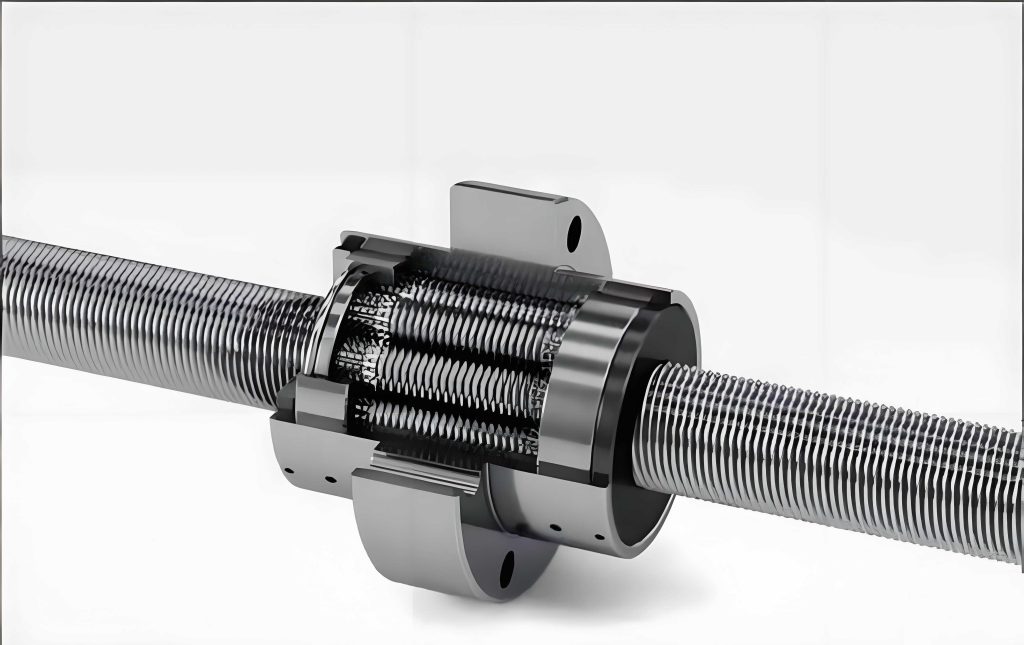
The inverted planetary roller screw mechanism consists of three primary components: a nut, multiple rollers, and a screw. The nut features a multi-start thread with a triangular profile (90° angle), the screw has an external thread matching the nut in start number and profile, and each roller has a single-start thread with rounded flanks to enable point contact with both the nut and screw. To counteract tilting moments from the nut’s helix angle, straight gears are machined at both ends of the rollers and screw, ensuring pure rolling motion and parallelism. The rollers are housed in a cage, evenly spaced circumferentially, and secured axially via a retaining ring. This arrangement allows the nut to rotate circumferentially without axial movement, the screw to move axially without rotation, and the rollers to exhibit both rotation and revolution.
Understanding the kinematics of the planetary roller screw is crucial for parameter selection. I begin by analyzing the motion relationships among the nut, rollers, and screw. Let $\omega_n$ be the angular velocity of the nut, $\omega_r$ the self-rotation angular velocity of a roller, $\omega_c$ the revolution angular velocity of the roller around the screw axis, and $d_n$, $d_r$, $d_s$ the pitch diameters of the nut, roller, and screw, respectively. The roller revolution diameter is $d_c = d_s + d_r$. From pure rolling conditions at the roller-screw interface, the velocity at the roller center gives:
$$ \frac{\omega_n d_n}{4} = \frac{\omega_c d_c}{2} $$
Thus,
$$ \omega_c = \frac{\omega_n d_n}{2(d_s + d_r)} = \frac{\omega_n (d_s + d_r)}{2(d_s + d_r)} \cdot \frac{k+2}{2(k+1)} $$
where $k = d_s / d_r$. For the roller self-rotation, considering pure rolling arc lengths, the relationship between revolution angle $\phi_c$ and self-rotation angle $\phi_r$ is:
$$ \phi_r d_r = \phi_c d_s \Rightarrow \frac{\phi_r}{\phi_c} = k $$
Combining with angular velocities, the roller self-rotation velocity is:
$$ \omega_r = \frac{k(k+2)}{2(k+1)} \omega_n $$
To determine thread handedness and start numbers, I apply the left-hand and right-hand rules for screw motion. For the screw and roller, the axial displacement $L_1$ of the roller relative to the screw must be zero to prevent relative motion, leading to the condition that their threads have opposite handedness and the screw start number $n_s = k$. Similarly, for the nut and roller, minimizing sliding requires opposite handedness and the nut start number $n_n = k$. Consequently, the axial displacement of the screw per nut revolution is:
$$ L_2 = n_n \cdot s $$
where $s$ is the pitch. The screw linear velocity is:
$$ v_s = \frac{\omega_n}{2\pi} n_n s $$
Based on these derivations, I summarize key parameter selection criteria for the inverted planetary roller screw in Table 1.
| Parameter | Criterion |
|---|---|
| Pitch Diameters | $d_n = d_s + d_r$ |
| Start Numbers | $n_n = n_s = k$, with roller as single-start |
| Handedness | Nut and roller opposite; screw and roller opposite |
| Roller Count | Limited by space, no mechanical restriction if $n_n = n_s$ |
| Gear Teeth | $z_s / z_r = k$ for standard gears, where $z$ is tooth count |
| Roller Gear Diameter | Roller tip diameter $\leq$ roller major diameter for assembly |
For dynamic analysis, I developed a three-dimensional solid model of the planetary roller screw mechanism using SolidWorks, incorporating realistic clearances (e.g., 0.175 mm between thread crest and root, 0.13 mm between flanks) to mimic manufacturing tolerances. The model includes five rollers, and I imported it into ADAMS for multi-body dynamics simulation. Constraints were applied as follows: a revolute joint between the nut and ground, a translational joint between the screw and ground, revolute joints between each roller and the cage (for self-rotation), and a cylindrical joint between the cage and ground (for revolution and axial movement). Contact forces between the nut-roller and roller-screw pairs were modeled using the Impact function with stiffness $K = 1.0 \times 10^5$ N/mm, exponent $e = 1.5$, damping $C = 50$ N·s/mm, and penetration depth $d = 0.1$ mm. Friction was included via the Coulomb method with static coefficient $\mu_s = 0.3$, dynamic coefficient $\mu_d = 0.25$, static slip velocity $v_s = 0.1$ mm/s, and dynamic slip velocity $v_d = 10$ mm/s. An external load of $F = 25$ kN was applied axially to the screw to simulate working conditions, and the nut was driven at a constant angular velocity $\omega_n = 9000^\circ/s$ (157.08 rad/s). The simulation ran for 0.1 s with 100 steps.
The simulation results provide insights into the motion and forces within the planetary roller screw. The roller angular velocity $\omega’_r$ (combined self-rotation and revolution) averaged 448.22 rad/s, with fluctuations between 418.02 and 465.81 rad/s. The cage angular velocity $\omega_c$, representing revolution, averaged 89.74 rad/s (86.08–94.35 rad/s). Thus, the roller self-rotation velocity $\omega_r = \omega’_r – \omega_c = 358.48$ rad/s. The screw linear velocity $v_s$ averaged 298.92 mm/s (263.77–349.21 mm/s), and the axial displacement after one nut revolution (0.04 s) was $L_2 = 11.88$ mm. I compare these with theoretical values derived from parameters: $n_n = n_s = 4$, $s = 3$ mm, $\omega_n = 157.08$ rad/s, and $k = d_s / d_r = 20.379 / 5.095 = 4$. Theoretical calculations yield $\omega_r = 376.99$ rad/s, $\omega_c = 94.25$ rad/s, $v_s = 300$ mm/s, and $L_2 = 12$ mm. The relative errors, shown in Table 2, validate the simulation approach despite minor discrepancies due to clearances and modeling approximations.
| Parameter | Simulation Value | Theoretical Value | Relative Error |
|---|---|---|---|
| $\omega_r$ (rad/s) | 358.48 | 376.99 | 4.91% |
| $\omega_c$ (rad/s) | 89.74 | 94.25 | 4.79% |
| $v_s$ (mm/s) | 298.92 | 300 | 0.36% |
| $L_2$ (mm) | 11.88 | 12 | 1.0% |
Contact forces are critical for assessing the durability and performance of the planetary roller screw. I analyzed the nut-roller and roller-screw contact forces under varying external loads $F = 5, 15, 25$ kN. The results, summarized in Table 3, show that mean contact forces increase proportionally with load, alongside greater fluctuation ranges due to enhanced deformation and axial play. For $F = 25$ kN, the nut-roller contact force averaged 10.52 kN (5.82–17.02 kN), while the roller-screw contact force averaged 9.58 kN (3.64–16.66 kN). The nut-roller force is slightly higher, attributed to relative motion between different thread pairs and unequal helix angles, compounded by geometric errors in the model. The force profiles exhibit similar波动 patterns, indicating synchronized interactions within the planetary roller screw assembly.
| External Load $F$ (kN) | Nut-Roller Mean Force (kN) | Nut-Roller Range (kN) | Roller-Screw Mean Force (kN) | Roller-Screw Range (kN) |
|---|---|---|---|---|
| 5 | 1.95 | 0.60–4.95 | 1.82 | 0.65–4.06 |
| 15 | 6.09 | 2.59–9.63 | 5.61 | 2.39–11.63 |
| 25 | 10.52 | 5.82–17.02 | 9.58 | 3.64–16.66 |
Further analysis of the planetary roller screw dynamics involves examining the influence of parameters like pitch and roller count. For instance, the transmission ratio, defined as the screw linear displacement per nut revolution, is given by $L_2 = n_n s$. Optimizing this ratio requires balancing start numbers and pitch to avoid excessive sliding or stress. The efficiency of the planetary roller screw can be estimated by considering friction losses at contacts, which depend on the coefficient of friction and normal forces. In my simulation, the Coulomb friction model accounts for these losses, and future studies could incorporate thermal effects to predict long-term performance.
The stiffness of the planetary roller screw mechanism is another vital aspect. It derives from the contact stiffness between threads and the axial stiffness of components. Using the Impact function parameters, the equivalent stiffness $K$ affects system resonance and positioning accuracy. For high-precision applications, minimizing clearances and optimizing thread profiles are essential. The inverted planetary roller screw, with its long nut design, offers inherent advantages in stiffness due to distributed load sharing among multiple rollers, as evidenced by the contact force distribution in my simulation.
In terms of design applications, the planetary roller screw is increasingly used in aerospace, robotics, and industrial automation where high load and precision are paramount. The inverted configuration enables compact linear actuators by integrating the nut as a motor rotor. My simulation methodology provides a virtual prototyping tool to evaluate different designs without physical testing, reducing development time and cost. For example, varying the roller count or pitch diameter can be simulated to assess impacts on load capacity and motion smoothness.
To enhance the analysis, I derived additional formulas for the planetary roller screw kinematics. The relationship between nut rotation angle $\theta_n$ and screw displacement $x_s$ is linear: $x_s = (\theta_n / 2\pi) n_n s$. The roller self-rotation angle $\theta_r$ relates to nut angle as $\theta_r = [k(k+2)/(2(k+1))] \theta_n$. These equations facilitate control system design for precise positioning. Moreover, the gear ratio at the roller ends ensures synchronization; for standard gears, the tooth count ratio must satisfy $z_s / z_r = d_s / d_r = k$ to maintain pure rolling. If modified gears are used, the ratio should approximate $k$ to minimize skew.
My simulation also highlights the importance of clearances in the planetary roller screw. The specified clearances $h_1 = 0.175$ mm and $h_2 = 0.13$ mm led to velocity and force fluctuations, as seen in the results. In practice, tighter tolerances can reduce these variations but increase manufacturing complexity. A trade-off analysis using simulation can guide tolerance selection based on application requirements, such as backlash or load distribution.
For reliability assessment, contact stress analysis is crucial. The Hertzian contact stress between the roller and screw or nut can be calculated based on normal force and curvature radii. Using my simulation outputs, the maximum contact stress can be estimated to prevent pitting or wear. The rounded flanks on rollers reduce stress concentration compared to sharp profiles, enhancing the lifespan of the planetary roller screw. Future work could integrate finite element analysis with multi-body dynamics for detailed stress evaluation.
In conclusion, this article presents a comprehensive study on the inverted planetary roller screw mechanism. Through theoretical kinematics, I established handedness and start number relationships, providing practical parameter guidelines. The dynamics simulation using ADAMS validated theoretical predictions with minor errors, demonstrating the viability of virtual prototyping for this complex system. Contact force analysis under varying loads revealed increasing magnitudes and fluctuations, informing design for load distribution and durability. The inverted planetary roller screw offers significant advantages for high-performance linear actuation, and my analysis method serves as a foundation for further optimization and application in advanced mechanical systems. The integration of simulation tools enables efficient exploration of design parameters, ultimately contributing to the development of more robust and efficient planetary roller screw mechanisms.
To further elaborate, the planetary roller screw mechanism represents a versatile solution for converting rotary to linear motion with high efficiency and load capacity. The inverted variant, with its unique long nut and short screw, opens avenues for innovative actuator designs. By leveraging simulation, engineers can predict performance metrics like speed, force, and wear, facilitating iterative improvement. As demand for precision motion control grows, the planetary roller screw will continue to play a pivotal role, and studies like this provide essential insights for its advancement. I recommend future research to explore thermal effects, lubrication dynamics, and material choices to fully harness the potential of the planetary roller screw in demanding environments.