
In the realm of modern aerospace manufacturing, the pursuit of automation and precision is paramount. As a researcher focused on advanced manufacturing equipment, I have dedicated significant effort to enhancing the performance of automated drilling systems used in aircraft assembly. The core of such a system is the drilling end effector—a sophisticated device that integrates components like high-speed electric spindles, precision guides, and sensors to perform accurate drilling operations on aircraft skin panels. The structural design of this end effector directly impacts drilling accuracy, process stability, and overall system efficiency. Traditionally, the design of the end effector’s frame relied heavily on empirical judgment and conservative safety factors, often leading to overweight structures that hinder dynamic performance and increase robot load. This paper presents a comprehensive design methodology that combines neural network fitting algorithms for initial dimension prediction with topology optimization for subsequent lightweight design. The goal is to move beyond experience-based design towards a data-driven, optimized approach that ensures both structural integrity and minimal mass.
The drilling end effector serves as the critical interface between the industrial robot and the workpiece, responsible for applying precise drilling forces while maintaining positional accuracy. Its frame structure must provide a rigid platform for mounting various components, withstand operational loads, and minimize deformation to ensure hole quality. However, the design space for the frame is complex, involving multiple components, material choices, and dimensional parameters. A conventional approach might uniformly use high-strength steel and generous thicknesses, resulting in unnecessary weight. My investigation began with the hypothesis that an optimal material and thickness distribution exists, which can be discovered through computational intelligence. This led to the development of a two-stage method: first, using a neural network to predict key frame dimensions based on performance requirements; second, applying topology optimization to the predicted design for further mass reduction without compromising performance.
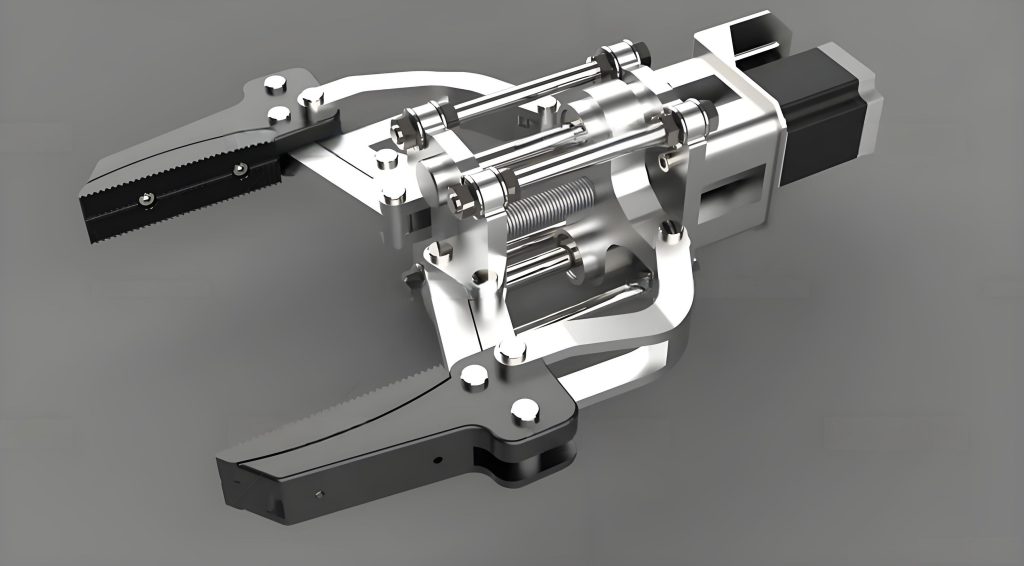
To initiate the structural design process, I first analyzed the end effector’s frame composition. The frame can be decomposed into several major components, which for simplicity were categorized into three types based on symmetry and functional role. Let these three frame component types be denoted as Type A, Type B, and Type C. Each type has two design variables: material selection and thickness. Material options considered were hard aluminum alloy (e.g., 7075) and 45# steel, chosen for their favorable strength-to-weight ratio and machinability. Thickness for each component could range from 8 mm to 30 mm, with 2 mm increments. Theoretically, the number of combinations is vast: material combinations (2³ = 8) multiplied by thickness combinations (12³ = 1728) results in 13,824 possible designs. Evaluating each via finite element analysis (FEA) for deformation and mass under load would be computationally prohibitive. Therefore, I employed a neural network fitting algorithm to model the relationship between design inputs (material, target performance) and output (thickness parameters).
The neural network’s purpose was to predict the optimal thickness values for the three frame components given specific material assignments and performance constraints. The performance constraints were defined as: maximum deformation at the tool tip under a 1000 N axial drilling force should not exceed 0.05 mm, and the total mass of the frame should be below 30 kg (considering a symmetric half-model for analysis). To train the network, I needed a dataset. I created a simplified symmetric model of the end effector frame, representing the three component types. For various combinations of materials and thicknesses, I performed static FEA simulations to compute the maximum deformation and mass. This generated sample data where each sample was a 5-dimensional vector: three entries for material codes (e.g., 1 for steel, 2 for aluminum), one for the computed deformation, and one for the computed mass. The corresponding outputs were the three thickness values. A total of 80 such sample vectors were generated, covering a diverse range of the design space. Table 1 summarizes a subset of this training data.
| Material (Type A) | Material (Type B) | Material (Type C) | Deformation (mm) | Mass (kg) | Thickness A (mm) | Thickness B (mm) | Thickness C (mm) |
|---|---|---|---|---|---|---|---|
| 1 | 1 | 1 | 0.050192 | 33.369 | 10 | 16 | 22 |
| 1 | 1 | 1 | 0.032168 | 37.365 | 12 | 18 | 24 |
| 1 | 1 | 2 | 0.064177 | 21.698 | 10 | 16 | 22 |
| 1 | 2 | 2 | 0.064364 | 15.623 | 10 | 16 | 22 |
| 2 | 1 | 1 | 0.146296 | 29.573 | 10 | 16 | 22 |
| 2 | 2 | 2 | 0.167923 | 11.827 | 10 | 16 | 22 |
With the dataset prepared, I constructed a feedforward neural network model. The network had five input neurons (for the three material codes, deformation, and mass), a hidden layer with a sufficient number of neurons (determined through experimentation), and three output neurons (for the predicted thicknesses of Type A, B, and C components). The activation function used in the hidden layer was the hyperbolic tangent sigmoid function, and the output layer used a linear activation function. The training algorithm was the Levenberg-Marquardt backpropagation, chosen for its efficiency in function approximation. The performance metric was the mean squared error (MSE). The dataset was divided into training (70%), validation (15%), and test (15%) sets. After training, the network achieved an MSE of 0.06 on the test set, indicating a good fit. The regression analysis showed an R-value exceeding 0.99, confirming the model’s predictive capability. The mathematical representation of the network’s prediction can be abstracted as:
$$ [H_A, H_B, H_C] = f_{NN}([\delta_A, \delta_B, \delta_C, D_{target}, M_{target}]; \mathbf{W}, \mathbf{b}) $$
where $H_A, H_B, H_C$ are the predicted thicknesses, $\delta_A, \delta_B, \delta_C$ are material codes, $D_{target}$ is the target deformation constraint, $M_{target}$ is the target mass constraint, and $\mathbf{W}, \mathbf{b}$ are the network’s weight and bias parameters learned during training.
For the specific design case of this end effector, I set the following input based on engineering judgment and load requirements: Material for the flange connection component (Type A) should be 45# steel for high stiffness and strength at the robot interface, while the other components (Type B and C) could be hard aluminum alloy to reduce weight. The target deformation was set to 0.05 mm, and the target mass for the symmetric half-frame was set to 15 kg (leading to a full frame target under 30 kg). Feeding these inputs into the trained neural network yielded predicted thicknesses: $H_A = 12.32$ mm, $H_B = 17.99$ mm, $H_C = 24.21$ mm. After rounding to nearest available gauge, the dimensions were set to 12 mm, 18 mm, and 24 mm respectively. A subsequent full FEA check of a frame designed with these parameters showed a mass of 17.8 kg for the half-frame (slightly above the 15 kg target but acceptable) and a maximum deformation of 0.04 mm, which satisfied the deformation constraint. This validated the neural network’s prediction and provided a solid, performance-driven starting point for the frame design, moving decisively away from pure empirical guesswork.
The next phase focused on lightweight optimization of the frame structure whose key dimensions were now determined. While the neural network provided an efficient initial design, further mass reduction was possible through topology optimization, which seeks the optimal material distribution within a given design space subject to loads and constraints. The objective was to minimize the mass of the end effector frame while keeping stress and deformation within safe limits. I used the Abaqus software with its ATOM topology optimization module. The process began by creating a “blank” or “design domain” model of the frame components. This model represented the maximum volume that material could occupy, based on the outer envelopes from the initial design, but excluding non-design regions such as bolt holes and mounting surfaces that were essential for assembly. The flange component (Type A) was partially frozen to maintain a solid area for robot attachment and to prevent internal contamination, but other areas were free for optimization.
The boundary conditions and loads for the topology optimization were defined to mimic the actual drilling operation. The frame was fixed at the interface where it connects to the robot’s sixth axis flange. A concentrated force of 1000 N was applied along the axis of the pressure foot, simulating the drilling thrust. The self-weight of the structure was also included as a body force with gravitational acceleration. The finite element model used tetrahedral elements, with over 1.1 million elements to ensure accuracy. The topology optimization problem was formally defined with an objective function and constraints. The goal was to minimize the maximum von Mises stress in the structure to enhance strength uniformity, subject to constraints on deformation and volume reduction. The mathematical formulation is as follows:
$$
\begin{aligned}
\text{Minimize:} & \quad S_{max} \\
\text{Subject to:} & \quad D_{max} \leq 0.05 \, \text{mm} \\
& \quad V \leq 0.5 \, V_0 \\
& \quad \text{Equilibrium equations} \\
\end{aligned}
$$
where $S_{max}$ is the maximum von Mises stress, $D_{max}$ is the maximum displacement magnitude, $V$ is the volume of the optimized structure, and $V_0$ is the volume of the initial design domain. The volume constraint of 50% was chosen aggressively to drive significant mass reduction. The optimization was run for up to 100 iterations. Figure 9 in the original manuscript illustrated the evolution of the material distribution over iterations. After convergence, the algorithm generated a density-based material layout indicating where material should be kept (density ~1) and where it could be removed (density ~0).
The raw topological output is not directly manufacturable; it requires interpretation and conversion into a smooth, parametric computer-aided design (CAD) model. This step is known as secondary modeling. I exported the topology results and, using CAD software, reconstructed the frame components by approximating the optimal material layout with solid features while ensuring manufacturability (e.g., avoiding overly thin walls, maintaining symmetry, and accommodating standard machining tools). This resulted in a new, lightweight frame design with intricate, organic-looking rib structures and hollow sections, contrasting sharply with the original block-like design.
To verify the performance of this topologically optimized end effector frame, I conducted a full static structural analysis under the same loading conditions as before. The material properties used in the analysis are listed in Table 2.
| Material | Elastic Modulus (GPa) | Density (kg/m³) | Poisson’s Ratio | Yield Strength (MPa, approx.) |
|---|---|---|---|---|
| Hard Aluminum Alloy (e.g., 7075) | 72 | 2700 | 0.3 | >400 |
| 45# Steel | 200 | 7800 | 0.3 | >355 |
The FEA results for the optimized frame were compelling. The maximum von Mises stress was found to be 42.7 MPa, which occurred near the bolt connections of the pressure nose—a common stress concentration area. This was actually a slight decrease from the 44 MPa observed in the initial neural-network-predicted design. More impressively, the maximum deformation reduced from 0.04 mm to 0.026 mm, a 35% improvement in stiffness. Crucially, the mass of the half-frame dropped dramatically from 17.8 kg to 10.1 kg, which corresponds to a full-frame mass reduction of approximately 43% (from 35.6 kg to 20.2 kg). Table 3 provides a comparative summary of the key performance metrics before and after the complete design process.
| Design Stage | Max. Deformation (mm) | Max. Stress (MPa) | Mass (Half-Frame, kg) | Mass (Full Frame, kg) | Mass Reduction |
|---|---|---|---|---|---|
| Initial (Neural Network Prediction) | 0.040 | 44.0 | 17.8 | 35.6 | Baseline |
| After Topology Optimization & Secondary Modeling | 0.026 | 42.7 | 10.1 | 20.2 | ~43% |
The integration of a neural network for initial sizing and topology optimization for detailed refinement proved highly effective. The neural network bypassed the need for exhaustive search or trial-and-error in the early design phase, providing a near-optimal starting point that already met core performance constraints. The subsequent topology optimization then acted as a powerful tool for “material sculpting,” removing redundant material from low-stress regions and reinforcing critical paths. This two-step methodology ensured that the final end effector design was not only lightweight but also structurally efficient, with improved stiffness compared to the initial design. The success of this approach highlights the potential of machine learning to augment traditional engineering design cycles, particularly for complex systems like an aircraft drilling end effector where weight and precision are at a premium.
In conclusion, this research demonstrates a novel, data-driven structural design methodology for a drilling end effector used in automated aircraft assembly. By employing a neural network fitting algorithm, I was able to predict the key dimensional parameters of the end effector frame based on target performance criteria, eliminating reliance on purely empirical judgment. The predicted design served as an excellent initial configuration, which was then subjected to topology optimization to achieve significant mass reduction. The final optimized end effector frame exhibited a 43% reduction in mass while simultaneously improving its stiffness, as evidenced by a lower maximum deformation under load. The entire process, from data generation to optimization and verification, represents a systematic approach to designing high-performance, lightweight structures. Future work could explore more advanced neural network architectures, include dynamic or multi-physics constraints, and integrate the design process with additive manufacturing techniques to produce the complex topologically optimized geometries directly. This methodology opens new avenues for the intelligent design of not only end effectors but also a wide range of mechanical systems in aerospace and beyond, where efficiency and performance are critical.
The implications of this work extend beyond a single component. The philosophy of combining predictive modeling with generative design can be applied to many structural optimization problems. For instance, the neural network could be trained on a broader dataset including fatigue life, thermal effects, or cost parameters, making the initial prediction more comprehensive. Furthermore, the topology optimization stage could be extended to multi-material or functionally graded material designs, potentially unlocking even greater performance gains for the next generation of aircraft assembly end effectors. As industrial robots and automation systems become more pervasive, the demand for lightweight, precise, and reliable end effectors will only grow. The methodology presented here provides a robust framework to meet that demand through computational intelligence and advanced optimization.