
A peer-reviewed study published in the Journal of Machine Design has proposed a structured pathway for designing more approachable humanoid robots by combining Kansei engineering with artificial intelligence image-generation training. The research, conducted by a team at the School of Urban Design, Wuhan University, focuses on the appearance of humanoid robots in daily life and commercial service settings. It argues that user acceptance and trust in a humanoid robot are shaped not only by function but also by visual and emotional cues. To address the cold, rigid, and low-affinity appearance common in engineering-led humanoid robot development, the study builds a quantitative evaluation system for affinity and uses it to train a stable diffusion model capable of generating large numbers of affinity-oriented humanoid robot appearance concepts.
The study defines a humanoid robot as a robot with a human-like appearance that imitates human function and intelligence. As humanoid robots enter more service, care, retail, hospitality, and public environments, collaboration between people and humanoid robots is expected to become more frequent. Appearance influences how users perceive both the emotional character and functional competence of a humanoid robot. When a humanoid robot appears cold or unapproachable, users may resist it, reducing their willingness to use it. The researchers therefore identify affinity as a critical design objective for the next generation of humanoid robot development.
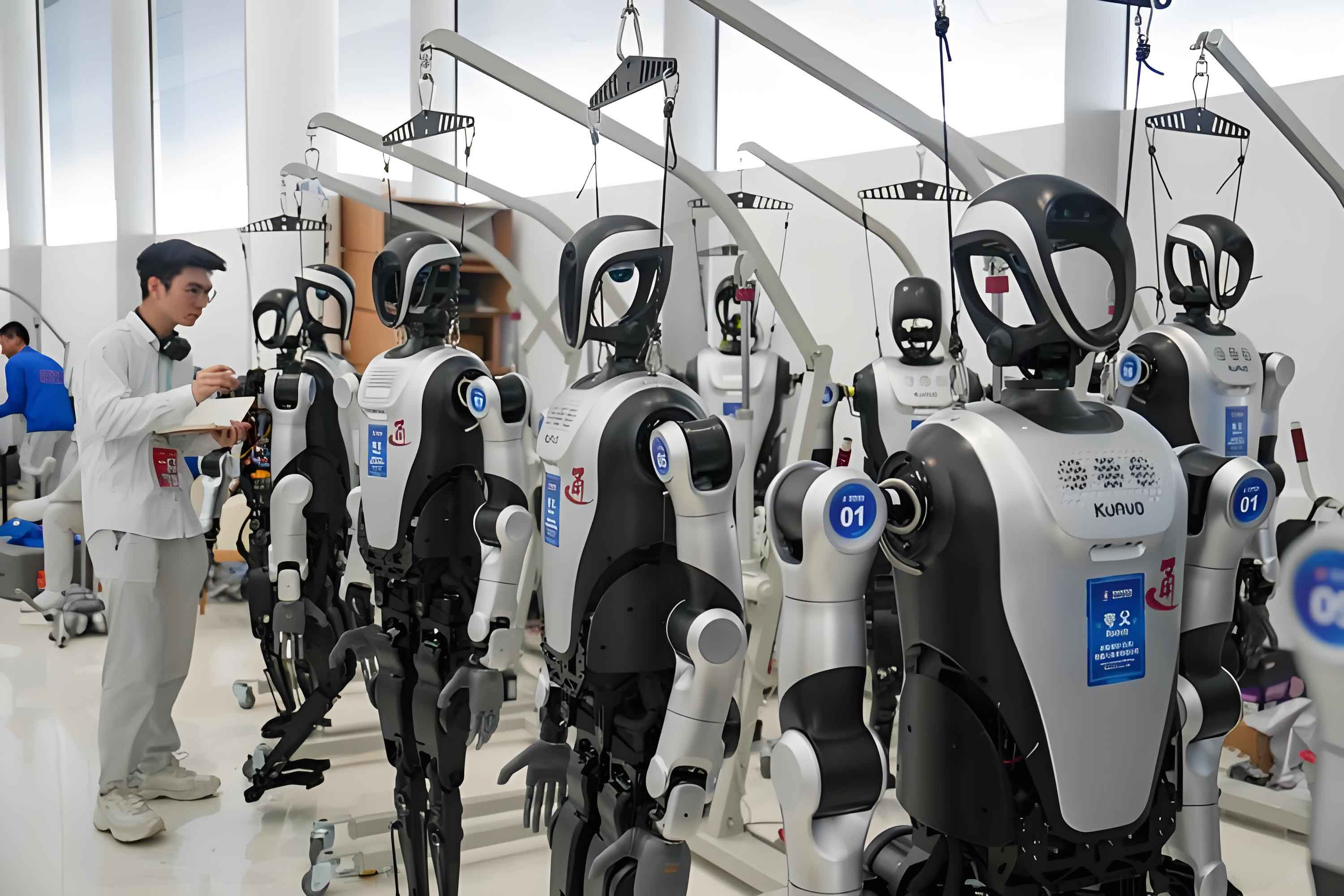
The study notes that current humanoid robot design is often driven primarily by engineering considerations. As a result, many humanoid robot concepts present stiff, hard, and distant visual qualities. Affinity design, by contrast, emphasizes that a product should match human physiological and psychological factors and produce pleasant, comfortable, and relaxed emotional experiences. For a humanoid robot, affinity is not merely an abstract impression. It is expressed through external features such as shape, material, texture, and color. The research therefore treats affinity as a measurable design outcome that can be translated into concrete requirements for a humanoid robot appearance.
1. The Growing Need for Affinity in Humanoid Robot Design
Among theories that explore product-emotion relationships, Kansei engineering is described as especially representative. Its goal is to translate subjective affective cognition into engineering design elements so that affinity can be expressed through product attributes. The study applies this logic to the humanoid robot. It seeks to determine which visual features make a humanoid robot feel closer, gentler, and more alive to users, and then to convert those findings into training data for an artificial intelligence model.
Earlier observations cited in the study suggest that a humanoid robot can gain affinity when its overall proportions are coordinated, its contours are smooth, its shape is simple, and its style is cute. Color research indicates that gentle tones can create an affinity-rich and bright visual atmosphere. Work on soft robotics suggests that soft materials can give users a sense of affinity and safety. These insights are important, but the study notes that existing literature has not sufficiently quantified affinity in humanoid robot appearance. In addition, although stable diffusion has become a popular AI tool because of its openness and adjustability, prompt-based generation alone often fails to produce humanoid robot designs with reliable affinity and detailed design control. The new research aims to close that gap.
Stable diffusion is described as an AI image-generation technology based on a latent diffusion model. It has text-to-image and image-to-image functions and consists of a text encoder such as Clip, a latent diffusion model including Unet, and an autoencoder decoder such as Vae. Its principle is to repeatedly denoise an average noise image through a model function until a clear image is obtained. However, the study states that stable diffusion alone, driven only by prompts, has difficulty generating humanoid robot designs with strong affinity and cannot satisfy detailed and specific content requirements. For this reason, the research uses quantitative affinity findings to guide stable diffusion training.
2. How the Study Measured Humanoid Robot Affinity
The research used Kansei engineering to explore the design features of affinity-focused humanoid robot appearance. It followed a design studies paradigm, using shape analysis to extract design elements such as form, material, texture, and color. It then used the semantic differential method to measure the relationship between affinity perception and those design elements. Questionnaire surveys and quantitative analysis produced affinity features and scores for different design elements. Those scores guided the selection and production of training samples for a stable diffusion model. After sample import, parameter setting, and multiple rounds of iterative training, several stable diffusion models were generated and the best-performing model was selected. The model could be used alone or combined with other style models to generate an affinity appearance scheme matrix. The affinity score table was then used to identify high-affinity humanoid robot design proposals.
2.1 Questionnaire design and affinity dimensions
To determine affinity measurement dimensions, the researchers collected 30 pairs of image words related to affinity. Based on dictionary-based semantic interpretation, the pairs were divided into three groups: social impression, which describes the closeness between a person and a humanoid robot; temperament style, which describes the robot’s style and temperament; and vitality, which describes the robot’s life force and activity. A professional group discussion removed semantically similar, rare, and difficult-to-evaluate word pairs. Then 25 design professionals voted. From each group, the word pair considered most able to describe humanoid robot affinity design was selected: cold-indifferent versus affinity, cold-hard versus gentle, and serious versus lively. These correspond to affinity, gentleness, and liveliness.
Affinity directly measures how close the humanoid robot feels to users. Gentleness serves as an auxiliary evaluation dimension from the perspective of temperament and style, reflecting the degree of care and thoughtfulness the humanoid robot conveys. Liveliness serves as another auxiliary dimension from the perspective of vitality and activity, representing how vivid and animated the humanoid robot appears. The questionnaire collected user feedback on these three dimensions, and the analysis examined differences and associations among them to provide specific guidance for improving design elements.
| Social impression | Votes | Temperament style | Votes | Vitality | Votes |
|---|---|---|---|---|---|
| Cold-indifferent versus affinity | 14 | Cold-hard versus gentle | 10 | Serious versus lively | 11 |
| Cold-indifferent versus kind | 4 | Cold versus mild | 6 | Rigid versus vivid | 6 |
| Cold-indifferent versus enthusiastic | 2 | Solemn versus easygoing | 3 | Stiff versus active | 5 |
| Fierce versus charitable | 2 | Icy versus warm | 3 | Slow versus agile | 2 |
| Distant versus close | 2 | Hoarse versus sweet | 2 | Heavy versus relaxed | 1 |
| Abrupt versus harmonious | 1 | Green versus sweet | 1 | Turbid versus fresh | 0 |
| Delicate versus modest | 0 | Strong versus supple | 0 | Sorrowful versus gratified | 0 |
| Irritated versus peaceful | 0 | Common versus elegant | 0 | Dim versus bright | 0 |
| Tense versus relaxed | 0 | Awkward versus comfortable | 0 | Crude versus refined | 0 |
| Uncomfortable versus smooth | 0 | Rough versus gentle | 0 | Fine versus coarse | 0 |
2.2 Appearance elements tested
The questionnaire materials were abstracted to precisely investigate how each design element affects affinity. For humanoid robot heads, common shapes were summarized as square, circle, vertical runway circle, horizontal runway circle, and semicircle. For eyes, four shapes were used: circle, square, vertical runway circle, and horizontal runway circle. For body proportions, planar forms were drawn with reference to infant, child, adolescent, and adult proportions. These were divided into slim types and sturdy types. For shell materials, plastic, fabric, metal, and transparent materials were used, with two surface effects for each material. For color, three cool hues, three warm hues, and neutral colors of white, grey, and black were selected. Saturation and brightness were adjusted for each hue.
3. Key Quantitative Findings on Humanoid Robot Affinity
A total of 645 valid questionnaires were collected. Based on data type and research purpose, suitable statistical methods were used. The influence of design elements on affinity, from high to low, was head shape, facial expression, color, material, and body proportion. This ranking indicates that the head and face of a humanoid robot carry a large share of the affinity signal, while body proportion, though still important, has a comparatively smaller effect.
3.1 Influence ranking and correlations
For head shape, eye shape, body proportion, material and surface treatment, and color, the three affinity dimensions were treated as equidistant ordered grade variables, so Kendall correlation analysis was used to examine relationships among affinity, gentleness, and liveliness. The results showed strong positive correlations for the major appearance features. Head shape, eye shape, body proportion, material type, and color all showed significant positive associations among the three dimensions. This indicates that the three measurement dimensions are strongly consistent and can accurately describe affinity. At the same time, for material surface treatment and warm-color high-low saturation, affinity and liveliness showed negative relationships. In other words, affinity increased as liveliness decreased in those specific cases.
| Design element | Affinity-gentleness | Affinity-liveliness | Gentleness-liveliness |
|---|---|---|---|
| Head shape | 0.356** | 0.303** | 0.284** |
| Eye shape | 0.318** | 0.345** | 0.368** |
| Body proportion | 0.160** | 0.113** | 0.152** |
| Plastic | 0.048** | -0.006 | -0.060** |
| Fabric | -0.016 | -0.006 | -0.020 |
| Metal | 0.029 | -0.010 | 0.028 |
| Transparent | -0.001 | 0.013 | -0.032 |
| White, grey, black | 0.294** | 0.319** | 0.301** |
| High-saturation warm | 0.055** | 0.006 | 0.038* |
| Low-saturation warm | -0.020 | 0.004 | -0.003 |
| High-saturation cool | 0.047** | -0.020 | -0.007 |
| Low-saturation cool | 0.032 | 0.006 | -0.019 |
For material types and warm or cool tones, the three affinity dimensions were normally distributed continuous variables, so Pearson correlation analysis was used. The results again showed significant positive relationships among the dimensions for the main material and color categories. The strongest relationship among the tested categories was between affinity and gentleness for the four material types, with a value of 0.501. This supports the idea that the three dimensions are not competing measures but are closely related components of humanoid robot affinity.
| Design element | Affinity-gentleness | Affinity-liveliness | Gentleness-liveliness |
|---|---|---|---|
| Four materials | 0.501** | 0.148** | 0.143** |
| Warm color high-low saturation | 0.144** | -0.062* | 0.007 |
| Cool color high-low saturation | 0.121** | 0.016 | 0.035 |
| White and high saturation | 0.280** | 0.158** | 0.180** |
| White and low saturation | 0.155** | 0.128** | 0.134** |
3.2 Shape, facial expression, and body proportion
Multi-group rank score differences for head shape, eye shape, and body proportion were compared using the Kruskal-Wallis H nonparametric test. Values greater than 3 were considered positive evaluations. For head shape, the horizontal runway circle was the most affinity-rich, followed by the circle. Other head shapes did not show affinity. For eye shape, the vertical runway circle was the most affinity-rich, followed by the circle and the square, while the horizontal runway circle did not show affinity. For body proportion, affinity from high to low was infant body, child slim body, adolescent slim body, child sturdy body, adolescent sturdy body, and adult sturdy body. These results suggest that a humanoid robot can appear more approachable when its head and eyes use soft, rounded, simplified forms and when its body suggests a younger or adolescent slim figure rather than a full adult sturdy build.
| Design element | Category | Affinity M (P25, P75) | Gentleness M (P25, P75) | Liveliness M (P25, P75) |
|---|---|---|---|---|
| Head shape | A1 | 6 (5, 7) | 6 (5, 7) | 6 (5, 7) |
| Head shape | A2 | 6 (5, 6) | 6 (5, 6) | 6 (5, 6) |
| Head shape | A3 | 3 (2, 4) | 3 (2, 4) | 4 (3, 5) |
| Head shape | A4 | 6 (5, 7) | 6 (5, 7) | 6 (5, 7) |
| Head shape | A5 | 3 (2, 4) | 3 (2.5, 4.5) | 4 (3, 5) |
| Eye shape | B1 | 4 (4, 5) | 4 (3, 5) | 4 (3, 5) |
| Eye shape | B2 | 4 (4, 5) | 4 (4, 5) | 4 (4, 5) |
| Eye shape | B3 | 6 (5, 7) | 6 (5, 7) | 6 (5, 7) |
| Eye shape | B4 | 3 (2, 3) | 3 (2, 3) | 2 (2, 3) |
| Slim body | C1 | 6 (5, 6) | 5 (5, 6) | 5 (5, 6) |
| Slim body | C3 | 6 (5, 7) | 6 (5, 7) | 6 (5, 6) |
| Slim body | C4 | 6 (4, 6) | 5 (5, 6) | 5 (4, 6) |
| Sturdy body | C2 | 5 (4, 6) | 5 (4, 6) | 5 (4, 6) |
| Sturdy body | C5 | 5 (4, 6) | 6 (5, 6) | 5 (3, 5) |
| Sturdy body | C6 | 4 (3, 5) | 4 (3, 5) | 4 (3, 5) |
| Sturdy body | C7 | 4 (3, 5) | 3 (2, 4) | 4 (3, 5) |
3.3 Material and surface treatment
For material and surface treatment, two-group rank score differences were compared using the Mann-Whitney U nonparametric test. Values greater than 3 were considered positive. Fabric was the most affinity-rich material, and plush texture scored higher than textile texture. Plastic and transparent materials showed similar affinity levels, and matte surfaces scored higher than glossy surfaces. Metal material, although it had relatively high liveliness, did not show affinity. Across materials, different surface treatments produced a negative relationship between affinity and liveliness, meaning that increasing surface roughness could help improve affinity. The practical implication is that a humanoid robot should not rely on glossy, hard, and reflective surfaces if the goal is to feel warm and approachable. Soft, textured, matte, and fabric-like surfaces are more likely to support affinity.
| Design element | Category | Affinity M (P25, P75) | Gentleness M (P25, P75) | Liveliness M (P25, P75) |
|---|---|---|---|---|
| Plastic | D1 | 4 (3, 5) | 4 (3, 5) | 5 (4, 5) |
| Plastic | D2 | 5 (4, 5) | 5 (4, 5) | 4 (3, 5) |
| Fabric | D3 | 6 (5, 7) | 6 (5, 7) | 5 (4, 6) |
| Fabric | D4 | 6 (5, 7) | 6 (4, 6) | 5 (4, 6) |
| Metal | D5 | 2 (1, 3) | 2 (1, 3) | 4 (2, 5) |
| Metal | D6 | 2 (1, 4) | 2 (1, 4) | 4 (3, 6) |
| Transparent | D7 | 4 (3, 5) | 4 (2, 5) | 5 (4, 6) |
| Transparent | D8 | 4 (4, 5) | 4 (3, 5) | 4 (3, 5) |
3.4 Color, height, and saturation
Spearman correlation analysis was used to examine changes in evaluation scores for height from low to high, neutral colors from white to black, warm colors moving from right to left in the HSB chart, and cool colors moving from left to right in the HSB chart. The data showed that the taller the humanoid robot, the lower the affinity. As height increased, the decrease in affinity was more significant for sturdy bodies than for slim bodies. Among neutral colors, white had the highest affinity, followed by grey, while black had the lowest. For warm colors, the farther left the position, the greater the affinity; for cool colors, the farther right the position, the greater the affinity.
| Design element | Affinity | Gentleness | Liveliness |
|---|---|---|---|
| Overall height from low to high | -0.340** | -0.427** | -0.340** |
| Slim body from low to high | -0.011 | -0.037 | -0.089** |
| Sturdy body from low to high | -0.379** | -0.541** | -0.355** |
| Neutral color from white to black | -0.613** | -0.622** | -0.633** |
| High-saturation warm color from right to left | 0.102** | 0.068** | 0.054** |
| Low-saturation warm color from right to left | 0.071** | 0.095** | 0.095** |
| High-saturation cool color from left to right | 0.220** | 0.228** | -0.072** |
| Low-saturation cool color from left to right | 0.067** | 0.145** | -0.078** |
Single-factor linear regression was used to compare cool and warm color evaluations. For each comparison group, the first item was used as the reference to build the regression model. A positive value means the latter of the two had a more significant positive effect on affinity; a negative value means the former had a more significant positive effect. Low-saturation colors had a higher average affinity than high-saturation colors. Affinity from high to low was low-saturation warm color, white, high-saturation warm color, low-saturation cool color, and high-saturation cool color. This suggests that pale, bright, and low-saturation colors, especially warm ones, are strong candidates for an affinity-focused humanoid robot palette. Beige and light orange can create a warm and comfortable feeling. Increasing brightness and reducing saturation can also make cool colors more approachable.
| Comparison group | Affinity | Gentleness | Liveliness |
|---|---|---|---|
| High versus low saturation, warm color | 0.867 | 0.672 | -0.208 |
| High versus low saturation, cool color | 0.855 | 0.668 | -0.012 |
| White versus high-saturation cool color | -1.633 | -1.647 | -0.705 |
| White versus high-saturation warm color | -0.466 | -0.273 | 0.421 |
| White versus low-saturation cool color | -0.778 | -0.979 | -0.717 |
| White versus low-saturation warm color | 0.401 | 0.399 | 0.213 |
3.5 Affinity score table for design features
To quantify the affinity level of training samples, the study produced an affinity score table for each design feature. The table provided a basis for selecting and producing training samples. The scores are as follows.
| Feature code | Score | Feature code | Score | Feature code | Score | Feature code | Score |
|---|---|---|---|---|---|---|---|
| A1 | 3 | B4 | 0 | D1 | 1 | E1 | 4 |
| A2 | 3 | C1 | 3 | D2 | 2 | E2 | 2 |
| A3 | 0 | C2 | 2 | D3 | 3 | E3 | 2 |
| A4 | 3 | C3 | 4 | D4 | 3 | E4 | 1 |
| A5 | 0 | C4 | 3 | D5 | 0 | E5 | 3 |
| B1 | 1 | C5 | 2 | D6 | 0 | E6 | 0 |
| B2 | 1 | C6 | 1 | D7 | 1 | E7 | 0 |
| B3 | 3 | C7 | 0 | D8 | 1 |
4. Training Stable Diffusion Models for Humanoid Robot Appearance Design
The study used stable diffusion as the AI image generation technology. The training method is based on image pixel RGB value differences. Noise of different concentrations is gradually added to the source model until it becomes an average noise image. A new function is then fitted to obtain the trained model. The main training methods include Dreambooth and Lora. Dreambooth adjusts the weights of all layers in the stable diffusion model neural network, learning features and styles from sample images to meet design needs. Lora is a method that uses a small number of images to train a model. Its principle is to insert a new computation layer into Unet to influence image generation. Compared with Dreambooth, a Lora model is smaller and faster to train.
The study used Dreambooth to train the main model and generate different types of design schemes. It trained multiple Lora models as style models to assist in generating schemes with different characteristics, balancing training quality and efficiency. The model learning process for humanoid robot design features required multiple rounds of training and was divided into four steps: training sample production, training sample annotation, training iteration, and model screening and use.
4.1 Training sample production
Training samples determine the image generation effect. When selecting samples, the study ensured that samples matched affinity features and had similar styles but different details, so that the trained model could generalize. To ensure training quality, stable diffusion modules such as Controlnet, image-to-image, and inpainting were used, combined with Photoshop, to optimize initial materials from overall composition to details. Through multiple rounds of model training, image generation, and revision, the materials gradually met the affinity element features.
4.2 Training sample annotation
After automatic annotation, manual annotation was performed to ensure accuracy for affinity design features. The annotation covered overall shape, detail shape, style, material and surface treatment, and color. For example, one annotated sample included: affinity robot, minimalism, organic form, science fiction, humanoid robot, oval head, vertical eyes, yellow eyes, no mouth, white body, plastic material, shiny joints, teenage figure, full body, standing, arms at sides.
4.3 Iterative training and parameter settings
During training, samples were modified each round according to the model’s generation effect, and each round’s training samples were scored with reference to the affinity score table to improve affinity in each round. In the first round, the training samples and results matched the head and facial features of an affinity-focused humanoid robot but were too cartoonish and lacked realism. In the second round, more realistic samples were added, but the generated body proportions became too short. In the third round, the samples modified the humanoid robot’s body proportion to match the highest-affinity slim adolescent figure and added more design details. After training, the generated results basically met the design needs.
| Round | Head shape | Eye shape | Body proportion | Material type | Overall tone | Score |
|---|---|---|---|---|---|---|
| 1 | A4 | B2 | C3 | D1 | E1 | 12 |
| 2 | A4 | B3 | C1 | D2 | E5 | 14 |
| 3 | A4 | B3 | C3 | D2 | E1 | 16 |
Training parameters mainly included Learning Rate, Iteration, Batch Size, Epoch, Optimizer, Scheduler, DIM, and Alpha. The tested parameter settings were as follows.
| Parameter name | Value | Parameter name | Value |
|---|---|---|---|
| Learning Rate | 1 × 10^-4 | Optimizer | 8bit-Adam |
| Iteration | 10 | Scheduler | Cosine |
| Batch Size | 5 | DIM | 128 |
| Epoch | 10 | Alpha | 64 |
4.4 Model screening, Loss values, and style matrix
When evaluating training results, the Loss value is an important numerical indicator. After training, each Epoch model is output and the dynamic change of the Loss value is recorded. The Loss value has a dynamic process of first decreasing and then increasing. When the Loss value decreased to around 0.08 at the 7th to 9th Epoch, it was considered an ideal reference value. The Loss value change curve could be improved by adjusting training parameters and increasing sample size to bring it closer to the ideal state.
An XY cross chart can generate Epoch model images under different weights to verify actual effects. Combined with the affinity score table to score and screen the XY cross chart, the 6th Epoch model with a weight of 0.6 to 0.8 produced the best effect. The scores for the XY cross chart were as follows.
| Epoch | Loss value | Weight 0.2 | Weight 0.4 | Weight 0.6 | Weight 0.8 | Weight 1.0 |
|---|---|---|---|---|---|---|
| 3 | 0.089 | 9 | 13 | 13 | 13 | 13 |
| 6 | 0.075 | 9 | 9 | 14 | 14 | 13 |
| 9 | 0.068 | 9 | 11 | 12 | 12 | 12 |
Affinity emphasizes personalization and diversification. By combining the model with different style models, a large number of humanoid robot appearance schemes with different styles can be generated and organized into a style matrix. Combined with the affinity score table, high-affinity schemes can be quickly identified. In the style matrix, the first scheme in each style had the highest affinity score. The scores were as follows.
| Style | Scheme 1 | Scheme 2 | Scheme 3 | Scheme 4 | Scheme 5 |
|---|---|---|---|---|---|
| 1 | 15 | 12 | 10 | 9 | 8 |
| 2 | 15 | 14 | 14 | 14 | 14 |
| 3 | 15 | 14 | 14 | 12 | 12 |
| 4 | 14 | 12 | 12 | 9 | 9 |
5. What the Findings Mean for Humanoid Robot Design and Deployment
The study concludes that Kansei engineering can quantify the affective concept of affinity. By using affinity, gentleness, and liveliness as three evaluation dimensions, it revealed appearance design features for an affinity-focused humanoid robot and formed precise design requirements and evaluation mechanisms. With AI-assisted design tools, a series of affinity-focused humanoid robot appearance design models were trained according to those requirements. Stable diffusion could then generate a large number of humanoid robot design schemes with different styles in a short time, form a style matrix, and allow rapid screening. The method can significantly improve the efficiency and quality of humanoid robot appearance design. It provides a new technical path for emotional design in robotics and offers a reference for future affinity-focused humanoid robot appearance design. It may also help promote the application of humanoid robots in life and commercial service scenarios and enhance user acceptance and willingness to use them.
5.1 Practical design implications
- Start with the face: horizontal runway circle heads and vertical runway circle eyes scored as the most affinity-rich humanoid robot facial features in the study.
- Use younger, slim proportions: infant, child slim, and adolescent slim body types scored higher than adult sturdy body types.
- Choose soft and textured materials: fabric, especially plush texture, and matte surfaces scored higher than metal, glossy, or transparent surfaces.
- Use bright, low-saturation colors: low-saturation warm colors, white, and high-saturation warm colors were the strongest affinity color categories.
- Increase brightness and reduce saturation: these adjustments made cool colors more approachable for a humanoid robot.
- Increase surface roughness: roughness helped reduce the coldness of glossy surfaces and raised affinity.
- Train AI models with scored samples: the affinity score table provided a practical filter for stable diffusion training samples and generated design schemes.
- Combine main and style models: Dreambooth main models and Lora style models allowed diverse humanoid robot appearance concepts to be generated and screened efficiently.
5.2 Limitations and future research
The study notes some limitations. The questionnaire sample group was relatively concentrated, so the universality of the results needs validation with a larger range of users. Future work could expand in several directions: cross-cultural research, diversified style generation, and integrated research on appearance and interactive behavior. These directions could help achieve a more universal and scalable design methodology and promote higher-level affinity for humanoid robots in multiple scenarios.
For designers, engineers, and researchers working on humanoid robot appearance, the combination of Kansei engineering and stable diffusion training offers a structured way to move from subjective impressions of affinity to measurable design features and AI-generated humanoid robot concept portfolios. The findings suggest that the most approachable humanoid robot is not simply a smaller or softer machine. It is a humanoid robot whose face, body, material, and color all communicate the same coordinated emotional message. By turning that message into data, the research provides a practical foundation for future humanoid robot design workflows that are faster, more systematic, and more attuned to human emotional response.