
In the field of precision mechanical transmissions, harmonic drive gears have garnered significant attention due to their compact structure, high torque capacity, and exceptional accuracy. These systems, comprising a wave generator, a flexible spline, and a circular spline, operate through the elastic deformation of the flexible spline to achieve meshing with the circular spline. This unique mechanism enables applications in robotics, aerospace, and military domains where reliability and performance are paramount. However, traditional tooth profiles, such as the involute, often suffer from limitations like edge contact or point contact under load, which can compromise stability and load-bearing capacity. To address these challenges, this paper focuses on the double-circular-arc tooth profile for harmonic drive gears, which promises enhanced dual-conjugate meshing, improved transmission stability, and increased承载能力. I will delve into the mathematical modeling, optimization design, and simulation analysis of this profile, aiming to provide a comprehensive methodology for advancing harmonic drive gear technology.
The core of this study lies in developing a precise mathematical framework for the double-circular-arc tooth profile. I begin by establishing the coordinate system and equations for the flexible spline’s tooth profile, which combines circular arcs and a straight line segment. This approach allows for better control over the meshing characteristics and stress distribution. Consider the flexible spline’s tooth profile in a moving coordinate system \( S_1(O_1, X_1, Y_1) \), where the \( Y_1 \)-axis aligns with the tooth’s symmetry axis. The profile consists of a convex circular arc \( \overset{\frown}{AB} \), a concave circular arc \( \overset{\frown}{CD} \), and a straight line \( BC \) that is tangent to both arcs. Let \( \rho_a \) and \( \rho_f \) be the radii of the convex and concave arcs, respectively, with their centers at points \( M \) and \( N \). The coordinates of these centers are given by:
$$ x_M = -l_a, \quad y_M = r \cos a_d – r_{af} + \frac{t}{2} – e_a, $$
$$ \alpha_a = \arcsin\left( \frac{h_a + e_a + r – r \cos a_d}{\rho_a} \right), $$
where \( r \) is the pitch circle radius, \( r_{af} \) is the addendum circle radius of the flexible spline, \( t \) is the spline thickness, \( h_a \) is the addendum height, \( l_a \) and \( e_a \) are offsets, and \( a_d \) is the tooth top width angle calculated as \( a_d = \arcsin\left( \frac{s_a}{2r} \right) \), with \( s_a \) being the tooth thickness. Similarly, for point \( N \):
$$ x_N = r_{af} \sin\left( \frac{\pi}{z_1} \right) + l_f, \quad y_N = r \cos a_d – r_{af} + \frac{t}{2} + e_f, $$
where \( z_1 \) is the number of teeth on the flexible spline. The tooth profile is parameterized by the arc length \( s \). For the convex arc \( \overset{\frown}{AB} \), the position vector \( \mathbf{r}_{AB} \) and unit normal vector \( \mathbf{n}_{AB} \) are:
$$ \mathbf{r}_{AB} = \begin{bmatrix} \rho_a \cos\left( \alpha_a – \frac{s}{\rho_a} \right) + x_M \\ \rho_a \sin\left( \alpha_a – \frac{s}{\rho_a} \right) + y_M \\ 1 \end{bmatrix}, \quad \mathbf{n}_{AB} = \begin{bmatrix} \cos\left( \alpha_a – \frac{s}{\rho_a} \right) \\ \sin\left( \alpha_a – \frac{s}{\rho_a} \right) \\ 1 \end{bmatrix}, \quad s \in (0, l_1), $$
with \( l_1 = \rho_a (\alpha_a – \delta) \), where \( \delta \) is the tooth profile process angle. For the straight line segment \( BC \):
$$ \mathbf{r}_{BC} = \begin{bmatrix} \rho_a \cos \delta + x_M + (s – l_1) \sin \delta \\ \rho_a \sin \delta + y_M + (s – l_1) \cos \delta \\ 1 \end{bmatrix}, \quad \mathbf{n}_{BC} = \begin{bmatrix} -\cos \delta \\ -\sin \delta \\ 1 \end{bmatrix}, \quad s \in (l_1, l_2), $$
where \( l_2 = l_1 + h_1 / \cos \delta \), and \( h_1 \) is the radial height of the straight segment. For the concave arc \( \overset{\frown}{CD} \):
$$ \mathbf{r}_{CD} = \begin{bmatrix} x_N – \rho_f \cos\left( \delta + \frac{s – l_2}{\rho_f} \right) \\ y_N – \rho_f \sin\left( \delta + \frac{s – l_2}{\rho_f} \right) \\ 1 \end{bmatrix}, \quad \mathbf{n}_{CD} = \begin{bmatrix} -\cos\left( \delta + \frac{s – l_2}{\rho_f} \right) \\ -\sin\left( \delta + \frac{s – l_2}{\rho_f} \right) \\ 1 \end{bmatrix}, \quad s \in (l_2, l_3), $$
with \( l_3 = l_2 + \rho_f \alpha_f \), and \( \alpha_f \) being the central angle of the concave arc. This mathematical representation forms the basis for analyzing the meshing behavior of the harmonic drive gear.
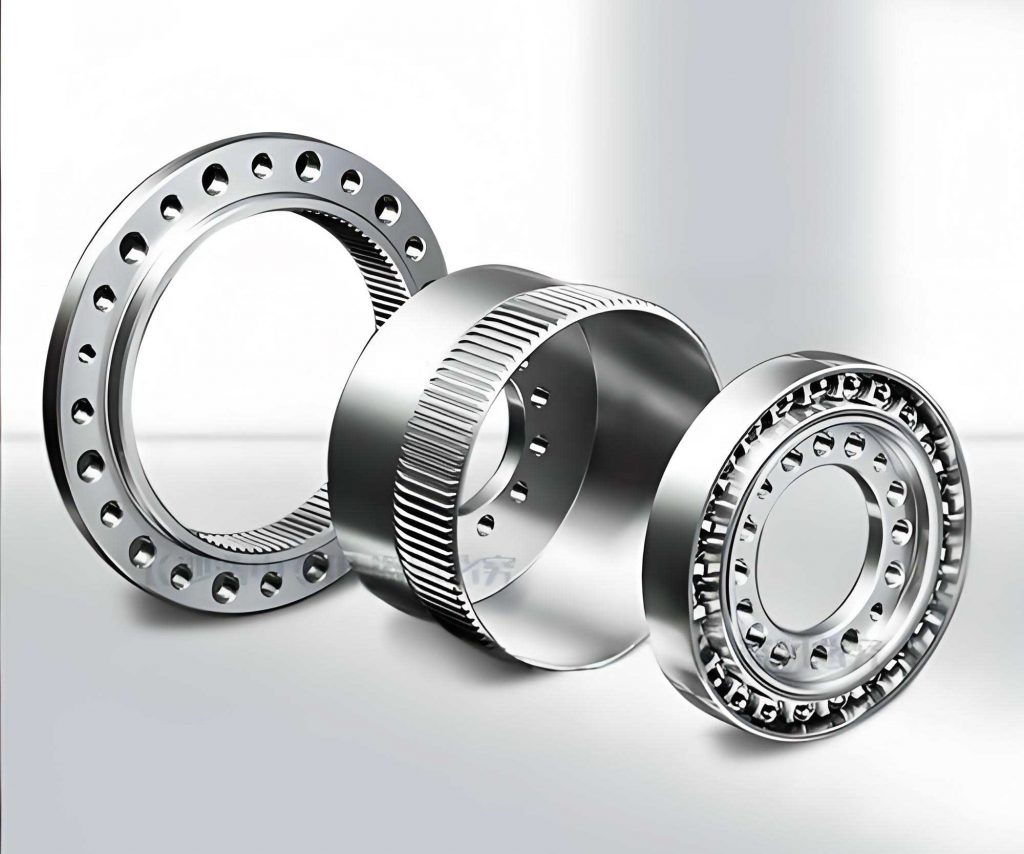
A critical aspect of harmonic drive gear analysis is accounting for the deformation of the flexible spline caused by the wave generator. The deformation directly influences the meshing kinematics and must be calculated accurately to ensure optimal performance. I consider the elongation of the neutral line after deformation, which is often overlooked in simplified models. The wave generator induces a radial deformation described by a function \( r(\varphi_1) \), where \( \varphi_1 \) is the angle relative to the wave generator after deformation. For a common elliptical wave generator, the radial displacement is \( u(\varphi_1) = u_0 \cos(2\varphi_1) \), with \( u_0 \) as the maximum radial deformation. The neutral line radius becomes \( r(\varphi_1) = r_m + u_0 \cos(2\varphi_1) \), where \( r_m \) is the initial neutral line radius. The elongation over one-quarter of the circumference is computed as:
$$ l_w = \int_0^{\pi/2} \sqrt{ r(\varphi_1)^2 + \left( \frac{dr(\varphi_1)}{d\varphi_1} \right)^2 } \, d\varphi_1 – \frac{r_m \pi}{2}, $$
which is distributed evenly among the teeth in that segment. The angular position of the flexible spline tooth during meshing involves several angles: \( \mu(\varphi_1) = \arctan\left( \frac{\dot{r}(\varphi_1)}{r(\varphi_1)} \right) \), where \( \dot{r} \) denotes differentiation with respect to \( \varphi_1 \); \( \gamma(\varphi_1) = \varphi_1 – \varphi_2 \), with \( \varphi_2 \) as the wave generator’s rotation angle; and \( \beta(\varphi_1) = \gamma(\varphi_1) + \mu(\varphi_1) \), which represents the orientation of the tooth coordinate system relative to the fixed circular spline system. This precise calculation ensures that the meshing equations account for real deformation effects, crucial for high-accuracy harmonic drive gear design.
To derive the tooth profile of the circular spline, I employ the curve envelope method and coordinate transformations. The meshing condition between the flexible spline and circular spline is expressed through the equation of contact. In a fixed coordinate system \( S_2(O_2, X_2, Y_2) \) attached to the circular spline, the condition for conjugate action is given by:
$$ \mathbf{n}_i^T \mathbf{B} \mathbf{r}_i = 0, \quad i = AB, BC, CD, $$
where \( \mathbf{n}_i \) is the normal vector of the flexible spline tooth profile, \( \mathbf{r}_i \) is the position vector, and \( \mathbf{B} \) is a matrix relating the angular velocities and deformation rates:
$$ \mathbf{B} = \begin{bmatrix} 0 & \dot{\beta} & r\dot{\gamma} \cos \mu – \dot{r} \sin \mu \\ -\dot{\beta} & 0 & r\dot{\gamma} \sin \mu + \dot{r} \cos \mu \\ 0 & 0 & 0 \end{bmatrix}. $$
This equation yields the conjugate angle \( \varphi_1 \) for each point on the tooth profile, defining the meshing region. The transformation from the flexible spline coordinate system \( S_1 \) to the circular spline system \( S_2 \) is achieved via the matrix:
$$ \mathbf{M}_{21} = \begin{bmatrix} \cos \beta & \sin \beta & r \sin \gamma \\ -\sin \beta & \cos \beta & r \cos \gamma \\ 0 & 0 & 1 \end{bmatrix}. $$
Thus, the theoretical tooth profile of the circular spline is obtained as:
$$ \mathbf{r}’_i = \mathbf{M}_{21} \cdot \mathbf{r}_i, \quad i = AB, BC, CD. $$
Interestingly, for each discrete point on the flexible spline profile, two solutions for \( \varphi_1 \) exist, leading to two theoretical profiles for the circular spline. This duality is a hallmark of the double-circular-arc harmonic drive gear, enabling dual-conjugate meshing where two teeth pairs engage simultaneously, enhancing load distribution and transmission stability.
Optimizing the tooth profile parameters is essential to maximize the performance of the harmonic drive gear. The primary goals are to minimize the gear backlash and maximize the effective meshing tooth height, both of which contribute to smoother operation and higher承载能力. Backlash, defined as the minimum circumferential clearance between mating teeth, is determined along the normal direction of the tooth flank. I discretize the flexible spline tooth profile into \( k \) points and compute the normal distances to the circular spline profile. The minimum normal distance \( L_{\min} \) is converted to backlash \( j_{\min} \) using:
$$ j_{\min} = \frac{L_{\min}}{\cos(\alpha_1 + \alpha_2)}, $$
where \( \alpha_1 \) is the slope of the normal line at a point, and \( \alpha_2 \) is the slope of the line connecting that point to the origin \( O_2 \). The effective meshing tooth height \( h_n \) is calculated as:
$$ h_n = r_{ag} – r_{ab} + u_0, $$
with \( r_{ag} \) and \( r_{ab} \) being the addendum circle radii of the flexible spline and circular spline, respectively. I formulate a multi-objective optimization problem using a weighted sum approach. The objective function to minimize is:
$$ \min F(\mathbf{X}) = w_1 \cdot j_{\min} + w_2 \cdot h_n, $$
where \( w_1 \) and \( w_2 \) are weighting factors (e.g., \( w_1 = 0.7 \), \( w_2 = 0.3 \) to prioritize backlash reduction), and \( \mathbf{X} \) is the vector of optimization variables. Key variables include the addendum height coefficient \( h_a^* \), radial deformation coefficient \( w^* \), convex arc radius coefficient \( \rho_a^* \), concave arc radius coefficient \( \rho_f^* \), straight segment radial height coefficient \( h_1^* \), and process angle \( \delta \). These coefficients are normalized relative to the module \( m \) for generality. Constraints are imposed to avoid interference, ensure positive tooth thickness, and maintain practical manufacturing limits.
To illustrate the optimization process, I present a case study with a harmonic drive gear set of module \( m = 0.35 \, \text{mm} \), flexible spline tooth number \( z_1 = 160 \), circular spline tooth number \( z_2 = 162 \), tip clearance coefficient \( c^* = 0.35 \), and section thickness ratio \( k = 1.3 \). The concave arc central angle is fixed at \( \alpha_f = 28^\circ \). Using numerical methods such as genetic algorithms or gradient-based optimization, I solve for the optimal parameters. The results before and after optimization are summarized in the following tables, showcasing the improvements in harmonic drive gear performance.
| Parameter | Before Optimization | After Optimization |
|---|---|---|
| Addendum height coefficient \( h_a^* \) | 0.6500 | 0.6190 |
| Radial deformation coefficient \( w^* \) | 1.0000 | 0.9987 |
| Convex arc radius coefficient \( \rho_a^* \) | 1.4000 | 1.4562 |
| Concave arc radius coefficient \( \rho_f^* \) | 1.8000 | 1.7860 |
| Straight segment radial height coefficient \( h_1^* \) | 0.1400 | 0.1404 |
| Process angle \( \delta \) (degrees) | 11.0000 | 10.9990 |
| Profile Type | Before Optimization (Center Coordinates, Radius) | After Optimization (Center Coordinates, Radius) |
|---|---|---|
| Convex Arc | (0.894, 28.443), 0.658 | (0.895, 28.449), 0.662 |
| Concave Arc | (-0.257, 28.279), 0.503 | (-0.279, 28.275), 0.526 |
The optimization yields a backlash reduction from 3.5 µm to 2.4 µm, a 30% decrease, while the effective meshing tooth height slightly decreases from 0.455 mm to 0.433 mm. This trade-off is acceptable as the significant backlash minimization enhances transmission precision and reduces vibration, key factors for harmonic drive gear applications in sensitive systems. The minimal change in tooth height indicates that the load-bearing capacity remains largely unaffected, ensuring the harmonic drive gear maintains its robustness.
Simulation analysis is conducted to validate the optimized harmonic drive gear design and visualize the meshing behavior. Using software tools, I model the tooth profiles and simulate the relative motion between the flexible spline and circular spline. The conjugate region analysis reveals the dual-conjugate nature of the double-circular-arc profile. Plotting the conjugate angle \( \varphi_1 \) against the arc length \( s \) shows two distinct curves corresponding to the meshing-in and meshing-out regions. Before and after optimization, these curves exhibit similar shapes, indicating that the conjugate characteristics are preserved, which is crucial for maintaining the dual-contact advantage of the harmonic drive gear. This consistency ensures that multiple tooth pairs engage simultaneously, distributing loads evenly and reducing wear.
The motion trajectory of the flexible spline teeth relative to the circular spline is simulated over a full rotation cycle. The trajectory forms a concave curve, with teeth entering from the lower right, meshing completely, and exiting from the lower left. Throughout this motion, no interference is observed, confirming the correctness of the mathematical model. The harmonic drive gear operates smoothly, with the flexible spline teeth始终 remaining inside the circular spline teeth, a testament to the precise profile design. This simulation underscores the importance of accurate deformation modeling in predicting real-world behavior.
Backlash distribution during meshing is analyzed by computing the clearance at various conjugate angles. The results show that backlash values remain below 6 µm across the entire cycle, with optimized parameters yielding consistently lower clearances. This reduction minimizes non-linearities in torque transmission, which is vital for high-precision applications like robotic joints or satellite actuators. The following table summarizes key simulation metrics, highlighting the benefits of optimization for harmonic drive gear performance.
| Metric | Before Optimization | After Optimization |
|---|---|---|
| Average Backlash (µm) | 4.2 | 2.8 |
| Maximum Backlash (µm) | 5.8 | 4.1 |
| Effective Meshing Tooth Height (mm) | 0.455 | 0.433 |
| Conjugate Region Arc Length (mm) | 1.2 | 1.18 |
| Number of Simultaneous Tooth Pairs | 2 | 2 |
The double-conjugate meshing inherent to the double-circular-arc profile is further evidenced by the presence of two contact points per tooth pair at any given moment. This feature significantly enhances the harmonic drive gear’s ability to handle high loads without compromising accuracy. Compared to traditional involute profiles, which may suffer from edge contact under deformation, the optimized double-circular-arc design ensures stable contact patterns, reducing stress concentrations and prolonging service life. These advantages make the harmonic drive gear ideal for demanding applications where reliability is critical.
In conclusion, this paper presents a comprehensive methodology for the optimal design of harmonic drive gears with a double-circular-arc tooth profile. By developing precise mathematical models that account for flexible spline deformation and elongation, I enable accurate derivation of the circular spline profile and meshing analysis. The optimization framework targets minimal backlash and maximal effective meshing tooth height, resulting in a 30% reduction in backlash while preserving dual-conjugate characteristics. Simulation studies confirm the improved performance, with smoother motion trajectories and reduced clearances. These findings demonstrate that the double-circular-arc harmonic drive gear offers superior stability,承载能力, and precision over conventional designs, paving the way for advanced applications in robotics, aerospace, and beyond. Future work could explore dynamic load analysis, thermal effects, or manufacturing tolerances to further refine the harmonic drive gear design.
Throughout this study, the importance of integrating mathematical rigor with practical optimization cannot be overstated. The harmonic drive gear represents a complex system where small geometric adjustments yield significant performance gains. By leveraging modern computational tools, I have shown that targeted parameter optimization can enhance transmission quality without compromising structural integrity. This approach not only benefits the harmonic drive gear community but also sets a precedent for other precision mechanical systems where类似 principles apply. As technology evolves, continued refinement of these methods will undoubtedly lead to even more efficient and reliable harmonic drive gear solutions, driving innovation across multiple industries.