
The pursuit of higher performance, reliability, and longevity in industrial robotics has placed significant emphasis on the critical components within their drive trains. Among these, the rotary vector reducer stands out due to its exceptional combination of high torque capacity, compactness, precision, and rigidity. However, statistical field data consistently identifies a specific internal component as the primary life-limiting factor for the entire rotary vector reducer assembly: the turning arm bearing. This integrated bearing, which supports the crankpins within the cycloidal gears, is subjected to complex loading and is often the first point of failure. Therefore, enhancing the fatigue life of this bearing directly translates to extending the service life of the rotary vector reducer as a whole. This article presents a comprehensive methodology for the optimal design of this crucial bearing using a genetic algorithm, aiming to maximize its basic dynamic load rating and, consequently, the operational lifespan of the reducer system.
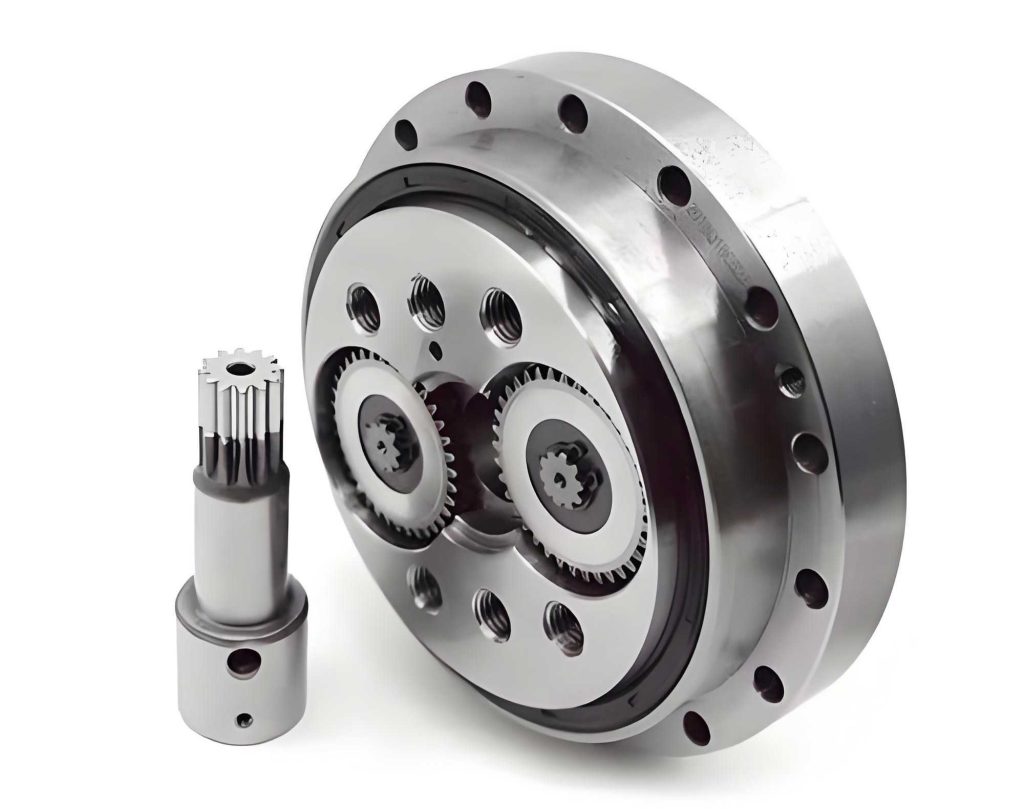
The fundamental principle behind improving the durability of the rotary vector reducer lies in optimizing the internal geometry of its turning arm bearing. Unlike standard bearing cartridges, this bearing utilizes the crankpin outer diameter as its inner raceway and the bore of the cycloidal disc as its outer raceway, with cylindrical rollers placed between them. The fatigue life of a rolling bearing, under a constant load, is predominantly governed by its basic dynamic load rating, Cd. For a roller bearing, the life calculation at 90% reliability is given by the standard formula:
$$ L_{10} = \frac{10^6}{60n} \left( \frac{C_d}{P} \right)^{\epsilon} $$
where n is the rotational speed, P is the equivalent dynamic load, and ε is the life exponent (10/3 for roller bearings). It is evident that maximizing Cd is the most direct path to maximizing L10. For a single-row cylindrical roller bearing, the basic dynamic load rating is calculated as:
$$ C_d = b_m f_c l_e^{7/9} Z^{3/4} D_r^{29/27} $$
Here, le is the effective roller length, Z is the number of rollers, Dr is the roller mean diameter, and bm is a quality improvement factor. The geometry factor fc is a function of the bearing’s conformity, defined as:
$$ \gamma = \frac{D_r}{D_m} $$
$$ f_c = 208 \lambda_{\nu} \frac{\gamma^{2/9} (1-\gamma)^{29/27}}{(1+\gamma)^{1/4}} \left\{ 1 + \left[ 1.04 \left( \frac{1-\gamma}{1+\gamma} \right)^{143/108} \right]^{9/2} \right\}^{-2/9} $$
where Dm is the bearing pitch diameter and λν is a correction factor. Our optimization problem is thus formulated as a search for the set of internal geometric parameters that maximize Cd, subject to a series of practical constraints derived from geometry, strength, lubrication, and functional requirements of the rotary vector reducer.
The core of the design optimization is the selection of independent design variables. For the turning arm bearing in a rotary vector reducer, four key geometric parameters are chosen:
| Design Variable | Symbol | Description |
|---|---|---|
| Pitch Diameter | Dm | Diameter of the circle passing through the centers of the rollers. |
| Roller Diameter | Dr | The mean diameter of the cylindrical rollers. |
| Number of Rollers | Z | The count of rollers in the bearing assembly. |
| Effective Roller Length | le | The length of the roller actively involved in load-carrying contact. |
Therefore, the design variable vector is X = [Dm, Dr, Z, le]T. The objective function is simply: max f(X) = max Cd(X).
A realistic and manufacturable design must satisfy numerous constraints. These constraints are categorized and derived as follows:
1. Geometric and Interference Constraints: These ensure the components fit within the allocated space in the rotary vector reducer and do not interfere with each other.
– The roller diameter must be large enough to safely carry the load but small enough to fit within the maximum allowable outer raceway diameter (Do,max).
– The number of rollers must be sufficient for load sharing (typically >5) but limited by the circumferential space to prevent roller-to-roller contact. A minimum angular spacing (e.g., 1°) is enforced.
– The pitch diameter is bounded by the outer raceway diameter and the roller diameters.
– The effective roller length is constrained by the axial space available in the cycloidal disc and is typically kept between 1 and 2.5 times the roller diameter for stability.
2. Strength Constraints (Contact Stress): The maximum Hertzian contact stress at both the inner (crankpin) and outer (cycloidal disc bore) raceways must not exceed the allowable stress for the bearing steel (e.g., 2300 MPa for GCr15). The maximum roller load Qmax is estimated from the radial load Fr on the rotary vector reducer’s turning arm. For a radially loaded bearing:
$$ Q_{max} \approx \frac{4.08 F_r}{Z} $$
The maximum contact stress for line contact is given by:
$$ \sigma_{max} = \frac{2 Q_{max}}{\pi l_e b} $$
where the semi-contact width b is:
$$ b = 3.35 \times 10^{-3} \left( \frac{Q_{max}}{l_e \Sigma\rho} \right)^{1/2} $$
Here, Σρ is the sum of curvatures. For the inner raceway contact: Σρi = 2/Dr + 2/(Dm – Dr). For the outer raceway contact: Σρo = 2/Dr – 2/(Dm + Dr). The constraints are formulated as σc,max,i ≤ σallowable and σc,max,o ≤ σallowable.
3. Lubrication Constraint (Minimum Film Thickness): To ensure elastohydrodynamic lubrication (EHL) and prevent premature wear or surface distress, the minimum oil film thickness (hmin) must be sufficient relative to the combined surface roughness. A common criterion is the film parameter Λ > 3:
$$ \Lambda = \frac{h_{min}}{(R_{q, race}^2 + R_{q, roller}^2)^{1/2}} \geq 3 $$
An empirical formula for line-contact minimum film thickness is used:
$$ h_{min} = 0.154 \alpha^{0.541} (\eta_0 n)^{0.7} D_r^{0.43} D_m^{0.7} \frac{(1-\gamma)^{1.13}(1+\gamma)^{0.7}}{E’^{0.03} l_e^{0.13} Q_{max}^{0.13}} $$
where α is the pressure-viscosity coefficient, η0 is the atmospheric dynamic viscosity, and E’ is the reduced elastic modulus.
4. Friction Constraint: The total frictional torque of the bearing must be below a permissible limit to ensure efficient operation of the rotary vector reducer. The total torque M includes load-dependent torque (M1) and viscous churning torque (Mv):
$$ M = M_1 + M_v $$
$$ M_1 = f_1 F_r D_m $$
$$ M_v = 10^{-7} f_0 (v_0 n)^{2/3} D_m^3 \quad \text{(for } v_0 n \geq 2000) $$
The constraint is M ≤ Mlimit.
The resulting non-linear constrained optimization problem is solved using a Real-Coded Genetic Algorithm (RCGA). RCGA is well-suited for such problems with mixed-integer variables (like Z) and a non-smooth, non-convex search space. The algorithm operates on a population of candidate designs (chromosomes), applying selection, crossover, and mutation operators to evolve towards an optimal solution. Key parameters include population size, crossover and mutation probabilities, and the number of generations. The optimization workflow is as follows: 1) Initialize a random population within variable bounds, 2) Evaluate fitness (Cd) and check constraints for each design, applying penalty functions for infeasible ones, 3) Select parents based on fitness, 4) Create offspring via crossover and mutation, 5) Form a new generation and repeat until convergence.
To demonstrate the method, we consider a specific size of a rotary vector reducer, RV-110E. The input parameters, including maximum radial load Fr derived from the reducer’s output torque and geometry, material properties, and lubricant data, are fed into the algorithm. The initial (empirical) design parameters and the optimized results are compared below:
| Parameter | Initial Design | Optimized Design |
|---|---|---|
| Pitch Diameter, Dm (mm) | 36.0 | 33.6 |
| Roller Diameter, Dr (mm) | 6.0 | 8.4 |
| Number of Rollers, Z | 13 | 12 |
| Effective Length, le (mm) | 10.0 | 10.0 |
| Basic Dynamic Load Rating, Cd (N) | 27,445.7 | 36,382.7 |
The optimization process successfully increased the basic dynamic load rating by approximately 32.5%. This significant improvement directly translates to a dramatically extended fatigue life for the turning arm bearing, and by extension, for the entire rotary vector reducer. The life ratio can be calculated as:
$$ \lambda_L = \frac{L_{10, optimized}}{L_{10, initial}} = \left( \frac{C_{d, optimized}}{C_{d, initial}} \right)^{10/3} $$
For the RV-110E case, λL ≈ 2.56. This means the optimized bearing is expected to have over 2.5 times the fatigue life of the original design. Similar optimization runs on other reducer sizes (e.g., RV-160E, RV-320E) yielded life improvement factors between 2.1 and 2.6, demonstrating the robustness and general applicability of the method for enhancing the durability of various rotary vector reducer models.
Finally, a parametric sensitivity analysis is conducted to assess the impact of manufacturing tolerances on the achieved optimal design. The analysis evaluates how a ±1% variation in each key design variable (Dm, Dr, le) around its optimized value affects the basic dynamic load rating Cd. The results are summarized below:
| Parameter Variation | Change in Cd | Notes |
|---|---|---|
| Dm +1% | +0.14% | May violate outer diameter constraint. |
| Dr +1% | +0.92% | May violate roller spacing/outer diameter constraints. |
| le +1% | +0.78% | May violate axial length constraint. |
| Dr -1%, le -1% | -1.70% | Feasible combination with largest negative impact. |
The sensitivity analysis reveals crucial insights for manufacturing the optimized rotary vector reducer bearing. The pitch diameter (Dm) has the smallest influence on Cd, making it the least critical parameter from a performance tolerance perspective. In contrast, the roller diameter (Dr) and the effective length (le) have a substantially higher sensitivity. A 1% decrease in both simultaneously leads to a nearly 1.7% drop in Cd, which would correspondingly reduce the predicted fatigue life. Therefore, tight control over roller grinding and length sizing is essential to preserve the life gains achieved through optimal design. Furthermore, the analysis shows that positive deviations in key parameters often push the design against geometric constraints (like maximum outer diameter or roller crowding), underscoring the importance of adhering to the specified optimal dimensions during the production of the rotary vector reducer’s components.
In conclusion, this work establishes a systematic, algorithm-driven framework for the optimal design of the turning arm bearing within a rotary vector reducer. By formulating the design challenge as a constrained optimization problem with the basic dynamic load rating as the objective, and by employing a genetic algorithm to navigate the complex design space, significant improvements in bearing life are achievable. The proposed methodology accounts for all major practical considerations—geometry, contact strength, lubrication, and friction—ensuring the viability of the optimized designs. The accompanying sensitivity analysis provides valuable guidance for setting manufacturing tolerances. Implementing such optimized bearing designs is a decisive step towards building more robust, reliable, and long-lasting rotary vector reducers, which are fundamental to the advancement of high-performance industrial robotics and precision mechanical systems.