
In recent years, the application of robotic manipulators in industrial automation and daily assistance has expanded significantly, driving demand for enhanced grasping capabilities. Traditional underactuated manipulators often feature fixed workspaces, limited operational modes, and poor adaptability to objects of varying shapes and sizes. To address these limitations, we propose a novel linkage-based underactuated dexterous robotic hand. This work focuses on the design optimization and simulation analysis of this dexterous robotic hand, aiming to achieve both enveloping and fingertip grasps with high adaptability. We employ a collaborative coupling approach for palm and finger design, establish contact force models using the principle of virtual work, perform dimensional synthesis via multi-objective optimization, and validate performance through dynamic simulations. Our results demonstrate that this dexterous robotic hand can stably grasp objects of diverse geometries and dimensions, showcasing superior adaptability compared to conventional designs.
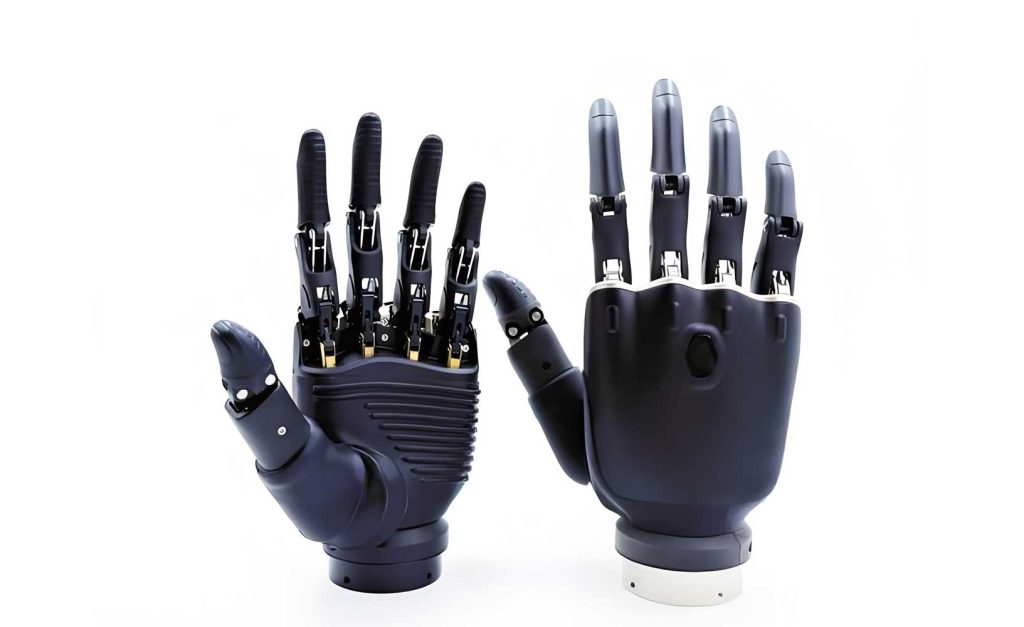
The development of dexterous robotic hands has been a key area in robotics research, with underactuated designs gaining popularity due to their reduced number of actuators, simplified control, and inherent adaptability. Underactuation allows a dexterous robotic hand to conform to object shapes using passive elements like springs or coupling mechanisms. However, many existing underactuated dexterous hands, such as tendon-driven models, suffer from indeterminate finger postures and limited grasp types. Linkage-driven designs offer higher stiffness and precise motion control but often lack versatility. Our motivation is to create a dexterous robotic hand that combines the benefits of linkage mechanisms with enhanced adaptability through optimized parameters and a variable palm design. This paper details our approach, from theoretical modeling to experimental validation, emphasizing the iterative optimization process that underpins the dexterous robotic hand’s performance.
We begin by reviewing related work on underactuated dexterous hands. Previous studies include tendon-driven hands like the HIT hand and SoftHand, which excel in enveloping grasps but struggle with precision tasks. Linkage-based hands, such as SARAH and Robotiq Hand, provide robust force transmission but may have limited grasp diversity. Recent advances involve hybrid mechanisms and modular designs, yet challenges remain in achieving balanced force distribution and multi-mode grasping. Our dexterous robotic hand builds on these foundations by integrating a parallel four-bar linkage for fingertip grasps and a variable palm for collaborative coupling, addressing gaps in adaptability and stability.
Design and Working Principle of the Single Finger Mechanism
The single finger of our dexterous robotic hand is a modular underactuated mechanism with three phalanges: proximal, medial, and distal. Initially, the finger relied on elastic elements for sequential contact in enveloping grasps, but this limited it to enveloping mode only. To enable fingertip grasps, we incorporated a parallel four-bar linkage system, as illustrated in the schematic diagrams. The optimized dexterous robotic hand finger now operates with two distinct grasp modes: enveloping and fingertip.
In enveloping grasp mode, the dexterous robotic hand finger functions with a single degree of freedom when no contact occurs, constrained by elastic elements. Upon actuation, the proximal phalanx contacts the object first, reaching a mechanical stop. The driving force then overcomes the damping of the elastic element between the proximal and medial phalanges, releasing a degree of freedom for the medial phalanx to move until contact. Finally, the distal phalanx engages similarly, completing the enveloping grasp. For fingertip grasp mode, the parallel four-bar linkage and elastic elements constrain the finger to one degree of freedom. When actuated, the fingertip contacts the object directly, forming a mechanical stop for precise grasping. This dual-mode capability enhances the versatility of our dexterous robotic hand, allowing it to handle both large, heavy objects and small, lightweight ones effectively.
The structural parameters of the single finger are critical for performance. We define the lengths of the phalanges as \( l_1 = 45 \, \text{mm} \) for the proximal, \( l_2 = 30 \, \text{mm} \) for the medial, and \( l_3 = 24 \, \text{mm} \) for the distal, based on anthropometric ratios. The joint angles are constrained within \( 70^\circ \leq \theta_1 \leq 120^\circ \), \( 0^\circ \leq \theta_2 \leq 90^\circ \), and \( 0^\circ \leq \theta_3 \leq 90^\circ \) to ensure feasible motion ranges. The driving torque is set to \( T_{o1p1} = 1000 \, \text{N·mm} \) for analysis. These parameters form the basis for subsequent modeling and optimization of the dexterous robotic hand.
Contact Force Modeling for the Single Finger Mechanism
To analyze the grasping stability of our dexterous robotic hand, we establish contact force models for both fingertip and enveloping grasps, assuming a rigid-body system with negligible friction and joint weights. These models relate input torques to contact forces at each phalanx, providing insights into force distribution and potential instability.
Fingertip Grasp Contact Force Model
For fingertip grasps, only the distal phalanx contacts the object. Using moment equilibrium principles, the contact force \( f_3 \) at the fingertip is derived as:
$$ f_3 = \frac{T_{o1p1}}{(l_1 + l_2) \sin \theta_1 + k_3} $$
where \( T_{o1p1} \) is the driving torque applied to link \( o1p1 \), \( l_1 \) and \( l_2 \) are phalange lengths, \( \theta_1 \) is the proximal joint angle, and \( k_3 \) is the perpendicular distance from the contact point to the pivot on the distal phalanx. This equation shows that \( f_3 \) increases with \( \theta_1 \) and decreases with \( k_3 \), aligning with intuitive grasping behavior where objects closer to the palm exert higher forces.
Enveloping Grasp Contact Force Model
For enveloping grasps, all three phalanges may contact the object. Applying the principle of virtual work, we express the relationship between input torques and contact forces. Let \( \mathbf{t} = [T_{o1p1}, T_2, T_3]^T \) be the torque vector, \( \boldsymbol{\omega} = [\dot{\theta}_{o1p1}, \dot{\theta}_2, \dot{\theta}_3]^T \) the angular velocity vector, \( \mathbf{f} = [f_1, f_2, f_3]^T \) the contact force vector, and \( \mathbf{v} = [v_1, v_2, v_3]^T \) the velocity vector of contact points perpendicular to the phalanges. The virtual work equation is:
$$ \mathbf{t}^T \boldsymbol{\omega} = \mathbf{f}^T \mathbf{v} $$
The velocities are given by:
$$ v_1 = k_1 \dot{\theta}_1 $$
$$ v_2 = k_2 \dot{\theta}_2 + \dot{\theta}_1 (k_2 + l_1 \cos \theta_2) $$
$$ v_3 = k_3 \dot{\theta}_3 + \dot{\theta}_2 (k_3 + l_2 \cos \theta_3) + \dot{\theta}_1 [k_3 + l_2 \cos \theta_3 + l_1 \cos(\theta_2 + \theta_3)] $$
where \( k_1, k_2, k_3 \) are contact point distances on respective phalanges. This can be written as \( \mathbf{v} = \mathbf{J}_m \dot{\boldsymbol{\theta}} \), with \( \dot{\boldsymbol{\theta}} = [\dot{\theta}_1, \dot{\theta}_2, \dot{\theta}_3]^T \) and the Jacobian matrix \( \mathbf{J}_m \):
$$ \mathbf{J}_m = \begin{bmatrix}
k_1 & 0 & 0 \\
k_2 + l_1 \cos \theta_2 & k_2 & 0 \\
k_3 + l_1 \cos(\theta_2 + \theta_3) + l_2 \cos \theta_3 & k_3 + l_2 \cos \theta_3 & k_3
\end{bmatrix} $$
The finger mechanism comprises two four-bar linkages: \( o1o2p2p1 \) and \( o2o3p4p3 \). Using kinematic analysis and the three-center theorem, we derive angular velocity relationships. For the first linkage:
$$ \dot{\theta}_{o1p1} = \dot{\theta}_1 + \frac{d_2}{d_2 + l_1} \dot{\theta}_{o2p2} $$
where \( d_2 \) is the distance from point \( o2 \) to the intersection of lines \( o1o2 \) and \( p1p2 \), calculated as:
$$ d_2 = c_1 [\cos(\theta_2 – \psi_2) – \sin(\theta_2 – \psi_2) \cot \beta_1] $$
with \( \psi_2 \) and \( \cot \beta_1 \) defined by geometric parameters. Similarly, for the second linkage, we obtain \( \dot{\theta}_{o2p3} \) and \( \dot{\theta}_{o3p4} \). Combining these, the overall transformation is:
$$ \dot{\boldsymbol{\theta}} = \mathbf{J}_n \begin{bmatrix} \dot{\theta}_{o1p1} \\ \dot{\theta}_2 \\ \dot{\theta}_3 \end{bmatrix}, \quad \mathbf{J}_n = \begin{bmatrix}
1 & -\frac{d_2}{d_2 + l_1} & -\frac{d_2 d_3}{(d_2 + l_1)(d_3 + l_2)} \\
0 & 1 & 0 \\
0 & 0 & 1
\end{bmatrix} $$
Substituting into the virtual work equation yields the contact force vector:
$$ \mathbf{f} = (\mathbf{J}_m^{-1})^T (\mathbf{J}_n^{-1})^T \mathbf{t} $$
Solving this, we get explicit expressions for the contact forces in enveloping grasp:
$$ f_1 = \frac{l_1 Q T_{o1p1}}{k_1 k_2 k_3 (d_2 + l_1)(d_3 + l_2)} $$
$$ f_2 = \frac{d_2 l_2 (k_3 – d_3 \cos \theta_3) T_{o1p1}}{k_2 k_3 (d_2 + l_1)(d_3 + l_2)} $$
$$ f_3 = \frac{d_2 d_3 T_{o1p1}}{k_3 (d_2 + l_1)(d_3 + l_2)} $$
where \( Q = k_2 k_3 d_3 + k_2 k_3 l_2 – d_2 k_3 l_2 \cos \theta_2 + d_2 d_3 l_2 \cos \theta_2 \cos \theta_3 – d_2 d_3 k_2 \cos(\theta_2 + \theta_3) \). These equations are fundamental for optimizing the dexterous robotic hand to ensure stable and forceful grasps.
Dimensional Synthesis of the Single Finger Mechanism
To enhance the grasping performance of our dexterous robotic hand, we perform dimensional synthesis on the single finger mechanism, focusing on maximizing contact forces and ensuring force isotropy. This optimization targets the linkage parameters to improve adaptability and stability.
Design Variables and Objective Functions
The design variables are the lengths of the linkage components: \( \mathbf{X} = [x_1, x_2, x_3, x_4, x_5, x_6] = [a_1, b_1, c_1, a_2, b_2, c_2] \), corresponding to the rods in the two four-bar linkages. Their value ranges are specified in Table 1, based on mechanical constraints and anthropomorphic considerations.
| Design Variable | Lower Limit | Upper Limit |
|---|---|---|
| \( a_1 \) | 30 | 35 |
| \( b_1 \) | 37 | 43 |
| \( c_1 \) | 15 | 20 |
| \( a_2 \) | 27 | 33 |
| \( b_2 \) | 35 | 40 |
| \( c_2 \) | 10 | 15 |
We define two objective functions to guide the optimization of the dexterous robotic hand. First, to maximize the total contact force for robust grasping:
$$ F_1 = \min(-(f_1 + f_2 + f_3)) $$
Second, to promote force isotropy for stable grasp by minimizing differences between phalangeal forces:
$$ F_2 = \min[(f – f_1)^2 + (f – f_2)^2 + (f – f_3)^2] $$
where \( f = \frac{f_1 + f_2 + f_3}{3} \). These objectives ensure that the dexterous robotic hand exerts sufficient and balanced forces across phalanges.
Constraints
Constraints include transmission angle limits for efficient force transmission in the four-bar linkages. For the first linkage, the transmission angle \( \gamma_1 \) must satisfy:
$$ 40^\circ < \gamma_1 < 130^\circ $$
where \( \gamma_1 = \angle o1o2p2 \), calculated as:
$$ \gamma_{1\min} = \arccos\left( \frac{l_1^2 + c_1^2 – (b_1 – a_1)^2}{2 l_1 c_1} \right) > 40^\circ $$
$$ \gamma_{1\max} = \arccos\left( \frac{l_1^2 + c_1^2 – (b_1 + a_1)^2}{2 l_1 c_1} \right) < 130^\circ $$
Similarly, for the second linkage with transmission angle \( \gamma_2 = \angle o2o3p4 \):
$$ 40^\circ < \gamma_2 < 130^\circ $$
These constraints prevent poor mechanical advantage and ensure smooth operation of the dexterous robotic hand.
Optimization Process and Results
We employ the NSGA-II multi-objective genetic algorithm in MATLAB for optimization. Parameters are set as: population size 200, crossover probability 0.8, mutation probability 0.01, Pareto fraction 0.35, and maximum generations 200. The Pareto frontier from one run is shown conceptually, indicating trade-offs between \( F_1 \) and \( F_2 \). To mitigate random variability, we conduct 10 independent optimization runs and average the results. The optimal design parameters are rounded for practical implementation, as summarized in Table 2.
| Run | \( a_1 \) | \( b_1 \) | \( c_1 \) | \( a_2 \) | \( b_2 \) | \( c_2 \) |
|---|---|---|---|---|---|---|
| 1 | 32.91 | 41.74 | 18.90 | 28.53 | 37.34 | 11.68 |
| 2 | 33.15 | 41.66 | 15.87 | 30.57 | 35.32 | 14.69 |
| 3 | 32.40 | 39.94 | 18.46 | 30.29 | 36.63 | 14.27 |
| 4 | 32.56 | 41.19 | 18.97 | 28.90 | 38.68 | 12.38 |
| 5 | 32.88 | 39.49 | 17.66 | 28.59 | 37.17 | 14.34 |
| 6 | 32.46 | 40.63 | 17.89 | 28.90 | 35.26 | 12.81 |
| 7 | 32.87 | 40.68 | 17.86 | 30.27 | 36.71 | 12.83 |
| 8 | 33.84 | 39.08 | 17.74 | 30.63 | 36.20 | 14.02 |
| 9 | 33.22 | 41.03 | 17.51 | 31.98 | 37.32 | 13.97 |
| 10 | 32.87 | 40.24 | 17.35 | 32.73 | 37.48 | 10.37 |
| Average | 32.92 | 40.57 | 17.82 | 30.14 | 36.81 | 13.14 |
Using these averaged values, we compute the contact forces for a typical grasp scenario with \( T_{o1p1} = 1000 \, \text{N·mm} \), \( k_1 = 22.5 \, \text{mm} \), \( k_2 = 15 \, \text{mm} \), \( k_3 = 12 \, \text{mm} \), \( \theta_2 = 45^\circ \), and \( \theta_3 = 40^\circ \). The results are \( f_1 = 11.75 \, \text{N} \), \( f_2 = 12.10 \, \text{N} \), \( f_3 = 12.08 \, \text{N} \), with a total force \( f_{\text{total}} = 35.93 \, \text{N} \). These forces are balanced and substantial, meeting our objectives for the dexterous robotic hand. Further analysis of contact force variations with joint angles reveals that negative forces can occur in certain regions, indicating potential instability; thus, grasp planning should avoid such configurations. This optimization ensures that our dexterous robotic hand delivers reliable and adaptive performance.
Overall Design of the Dexterous Robotic Hand
The complete dexterous robotic hand consists of three modular fingers integrated with a variable palm, employing a collaborative coupling design to enhance adaptability. Each finger is independently actuated by a motor, allowing for modular replacement and customization. The palm features two rotatable fingers with a turning range that enables multiple grasp configurations: two-finger opposing grasp, three-finger parallel grasp, and three-finger opposing grasp. This variability expands the dexterous robotic hand’s ability to handle objects of different shapes and sizes.
We apply collaborative coupling principles to size the palm relative to the fingers. Based on anthropometric studies, the palm length should be 0.4 to 0.6 times the finger length. Given a finger length of 99 mm, the palm length range is 39.6 mm to 59.4 mm. To accommodate larger objects, we set the palm length to 59 mm. This design consideration ensures that the dexterous robotic hand maintains proper proportions for effective grasping across various scenarios. The overall mechanism has 10 degrees of freedom with 4 actuators, balancing complexity and control simplicity. The integration of spring elements in each finger provides passive adaptability, allowing the dexterous robotic hand to conform to object contours during enveloping grasps.
The three-dimensional model of the single finger includes a finger mount, motor, transmission system, three phalanges, and three extension springs. The parallel four-bar linkage is key to enabling fingertip grasps. For the overall dexterous robotic hand, the variable palm mechanism uses additional actuators to rotate fingers, facilitating collaborative movements. This design underscores our focus on creating a versatile dexterous robotic hand that can switch between grasp modes seamlessly, addressing limitations of fixed-palm designs.
Dynamic Simulation and Grasping Experiments
To validate the performance of our dexterous robotic hand, we conduct dynamic simulations using ADAMS software. We import the 3D model, apply constraints (joints, contacts), and define spring elements with stiffness coefficients: 1 N/mm for spring 1, 0.7 N/mm for spring 2, and 1.2 N/mm for spring 3. The driving function is set as step(time, 0, 0.5, 1000) to simulate actuation. Various objects are used in grasping experiments to test adaptability and stability.
Simulation Setup and Results
We simulate grasps for objects of different shapes and sizes: small, medium, and large spheres; a triangular prism; long and short cylinders; and small and large cuboids. The dexterous robotic hand successfully performs both enveloping and fingertip grasps in these scenarios, demonstrating its versatility. For example, when enveloping a sphere of radius 35 mm, the contact forces on each phalanx are plotted over time, showing balanced forces with \( f_1 \approx 11.5 \, \text{N} \), \( f_2 \approx 11.8 \, \text{N} \), and \( f_3 \approx 11.9 \, \text{N} \), close to theoretical values. Minor discrepancies arise due to damping in elastic elements, which are neglected in the theoretical model. Similarly, for enveloping a cylinder of length 120 mm and radius 40 mm, forces are \( f_1 \approx 4.8 \, \text{N} \), \( f_2 \approx 7.0 \, \text{N} \), and \( f_3 \approx 10.8 \, \text{N} \), aligning with predictions. In fingertip grasp of a cuboid (50 mm × 30 mm × 15 mm), the distal phalanx force stabilizes around 12.3 N after initial transient, matching the theoretical \( f_3 = 12.31 \, \text{N} \). These results confirm that our dexterous robotic hand can maintain stable grasps with sufficient force distribution.
To quantify performance, we analyze force isotropy and total grasp force across experiments. Table 3 summarizes key metrics for select grasp scenarios, highlighting the dexterous robotic hand’s adaptability.
| Object | Grasp Type | Total Force (N) | Force Isotropy Index | Stability |
|---|---|---|---|---|
| Sphere (R=35 mm) | Enveloping | 35.2 | 0.95 | High |
| Cylinder (L=120 mm) | Enveloping | 22.6 | 0.87 | Medium |
| Cuboid (Small) | Fingertip | 12.3 | 1.00 | High |
| Triangular Prism | Enveloping | 28.4 | 0.92 | High |
The force isotropy index is defined as \( 1 – \frac{\sigma_f}{\bar{f}} \), where \( \sigma_f \) is the standard deviation of phalangeal forces and \( \bar{f} \) is the mean force. Values closer to 1 indicate better force balance. Our dexterous robotic hand achieves high isotropy in most cases, ensuring stable grasps without slippage or ejection. The variable palm allows finger reconfiguration, improving grasp stability for irregular objects. These simulations validate that the optimized dexterous robotic hand meets design goals for adaptability and reliability.
Discussion
Our dexterous robotic hand offers several advantages over existing underactuated designs. The integration of a parallel four-bar linkage enables dual-mode grasping, addressing a common limitation in linkage-driven hands that are often restricted to enveloping grasps. The collaborative coupling of palm and finger sizes enhances adaptability to object dimensions, a feature absent in many fixed-palm dexterous robotic hands. The optimization process ensures balanced force distribution, reducing the risk of instability such as ejection phenomena observed in some underactuated grasps. Compared to tendon-driven dexterous robotic hands, our linkage-based design provides higher stiffness and predictable motion, beneficial for precision tasks.
However, there are limitations. The use of springs introduces damping that can affect dynamic response, and the current design assumes rigid bodies without considering material compliance. Future work could explore compliant materials to improve adaptability further. Additionally, the optimization focused on static forces; dynamic factors like impact and sliding could be incorporated. The dexterous robotic hand’s control strategy is also simplified in simulations; implementing advanced algorithms for real-time adaptation would be valuable. Despite these, our dexterous robotic hand demonstrates significant progress in underactuated manipulation, with potential applications in industrial picking, service robotics, and prosthetics.
Conclusion and Future Work
In this study, we have presented the design, optimization, and simulation of a novel underactuated dexterous robotic hand. Key contributions include: (1) a modified single finger mechanism with parallel four-bar linkage for both enveloping and fingertip grasps; (2) contact force models based on virtual work principle for force analysis; (3) dimensional synthesis using NSGA-II to optimize linkage parameters for maximum and isotropic forces; (4) a collaborative coupling design for palm and fingers to enhance adaptability; and (5) dynamic simulations verifying stable grasps across diverse objects. The dexterous robotic hand exhibits strong adaptability, capable of handling various shapes and sizes reliably.
Future research will focus on prototyping and experimental validation with physical tests. We plan to incorporate sensors for force feedback and develop adaptive control algorithms. Exploring variable stiffness mechanisms and soft components could further improve the dexterous robotic hand’s performance. Additionally, extending the design to more fingers or different configurations may increase versatility. Overall, this work advances the field of underactuated dexterous robotic hands, providing a foundation for more adaptive and efficient robotic manipulators.