
In precision motion control systems, the harmonic drive gear is widely recognized for its compact design, high reduction ratio, zero-backlash characteristics, and exceptional torque capacity. These attributes make harmonic drive gears indispensable in applications such as robotics, aerospace mechanisms, and precision positioning stages. However, despite their advantages, harmonic drive gears exhibit inherent angular transmission errors that degrade positioning accuracy, particularly in semi-closed loop control configurations where the load position is indirectly inferred. This article, from my perspective as a researcher in mechatronics, presents a comprehensive study on modeling and compensating these transmission errors to enhance static positioning performance. The core of this work lies in decomposing the angular transmission error into synchronous and nonlinear elastic components, developing mathematical models for each, and implementing a feedforward compensation strategy that significantly reduces steady-state scatter.
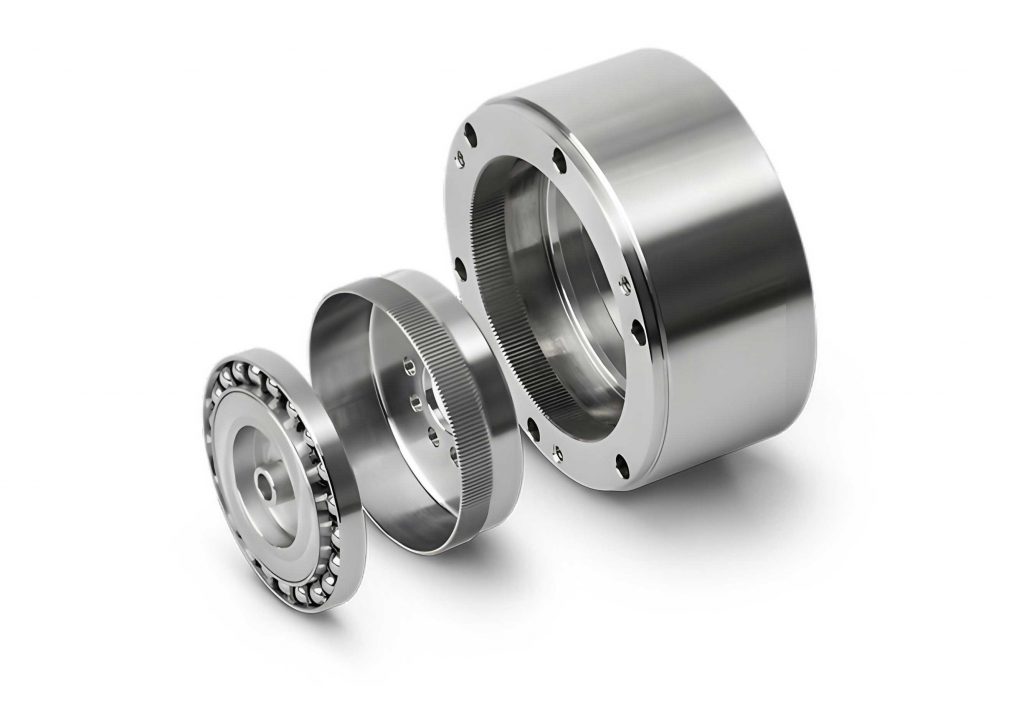
The harmonic drive gear system typically consists of three primary components: a rigid circular spline (CS) with internal teeth, a flexible flexspline (FS) with external teeth, and an elliptical wave generator (WG) that deforms the flexspline to mesh with the circular spline. This unique configuration enables high reduction ratios, but it also introduces complex error sources due to structural imperfections and elastic deformation of the flexspline. In semi-closed loop systems, the motor angle is directly measured, but the load angle is subject to transmission errors, leading to positioning inaccuracies, especially in micro-displacement regions. My objective is to formulate a predictive model that captures both the periodic synchronous errors and the hysteresis-like nonlinear elastic errors, and to leverage this model for real-time compensation.
The angular transmission error, denoted as θTE, is defined as the deviation between the actual load angle and the ideal load angle based on the motor angle and gear ratio. Mathematically, it is expressed as:
$$ \theta_{TE} = \theta_L – \frac{\theta_M}{N} $$
where θL is the load angular displacement, θM is the motor angular displacement, and N is the gear ratio (typically N = 50 for common harmonic drive gears). To address the multifaceted nature of this error, I propose partitioning θTE into two distinct components: a synchronous component θSync and a nonlinear elastic component θHys. Thus, the total error is:
$$ \theta_{TE} = \theta_{Sync} + \theta_{Hys} $$
This decomposition allows for targeted modeling and compensation, as each component originates from different physical phenomena. The synchronous component is primarily due to manufacturing tolerances and assembly misalignments, resulting in periodic variations synchronized with the rotation. In contrast, the nonlinear elastic component arises from the micro-slip and elastic deformation in the flexspline and engagement zones, exhibiting hysteresis behavior similar to rolling friction. My modeling approach meticulously addresses both, ensuring a comprehensive error prediction framework.
Mathematical Modeling of Angular Transmission Error Components
Synchronous Component Modeling
The synchronous component of the transmission error in a harmonic drive gear is periodic with respect to the motor angle. It stems from kinematic errors such as tooth profile deviations, eccentricity of the wave generator, and misalignment between gears. From my analysis, this component can be effectively represented as a Fourier series summation of harmonic waves linked to the motor rotation. The model is formulated as:
$$ \theta_{Sync} = \sum_{i=1}^{n_M} A_M(i) \cos\left[i \theta_{TEM} + \Phi_M(i)\right] $$
Here, i denotes the harmonic order, AM(i) is the amplitude of the i-th harmonic, ΦM(i) is the phase shift, and nM is the total number of harmonics considered. The term θTEM refers to the motor angle component of the transmission error, which dominates the synchronous behavior as load-side contributions are negligible in semi-closed loop observations. To parameterize this model, I conducted spectral analysis on experimental data collected from a harmonic drive gear under stepwise rotation. The key harmonic amplitudes and phases extracted are summarized in Table 1.
| Harmonic Order i | Amplitude AM(i) (arcseconds) | Phase ΦM(i) (degrees) |
|---|---|---|
| 1 | 4.9 | -126.8 |
| 2 | 9.33 | -132.1 |
| 3 | 2.09 | -96.2 |
| 4 | 12.21 | 105.7 |
| 6 | 3.18 | -127.0 |
| 8 | 1.87 | 124.3 |
The spectrum reveals that harmonics of orders 2, 4, and 1 are particularly significant, indicating substantial periodic error at multiples of the motor rotation. This model provides a precise representation of the repeatable, rotation-synchronous errors inherent in harmonic drive gears. By incorporating these harmonics, the synchronous component can be predicted and subsequently compensated in a feedforward manner.
Nonlinear Elastic Component Modeling
The nonlinear elastic component of the transmission error in a harmonic drive gear manifests as hysteresis loops during direction reversals, especially in micro-displacement regions. This behavior is akin to the nonlinear elasticity observed in rolling friction, where elastic deformation and micro-slip cause energy dissipation and path-dependent displacement. To capture this phenomenon, I developed a mathematical model based on a hysteresis framework with a non-steady region where the error varies with the direction of motion. The model is defined by the following piecewise function:
$$ \theta_{Hys} = \begin{cases}
\text{sgn}(\omega_M)\left[2\theta_{\text{offset}} g(\xi) – \theta’_{Hys}\right] & \text{if } |\delta| < \theta_r \text{ and } |\theta_{Hys}| < \theta_{\text{offset}} \\
\text{sgn}(\omega_M) \theta_{\text{offset}} & \text{if } |\delta| \geq \theta_r \text{ or } |\theta_{Hys}| \geq \theta_{\text{offset}}
\end{cases} $$
with the auxiliary functions:
$$ g(\xi) = \begin{cases}
\frac{1}{2-n}\left[\xi^{n-1} – (n-1)\xi\right] & \text{for } n \neq 2 \\
\xi(1 – \ln \xi) & \text{for } n = 2
\end{cases} $$
$$ \delta = |\theta_M – \delta_0| $$
$$ \xi = \frac{\delta}{\theta_r} $$
In these equations, ωM is the motor angular velocity, sgn(ωM) is the sign function indicating direction, θoffset is the maximum hysteresis offset, θr is the width of the non-steady region, n is a shape parameter controlling the hysteresis loop width, and δ0 is the motor angle at the instant of velocity reversal. The variable δ represents the accumulated elastic displacement since the last reversal. This model effectively describes the hysteresis loops observed in harmonic drive gear transmissions, where the error evolves nonlinearly within the non-steady region and saturates at θoffset beyond it. The parameters θr, θoffset, and n are determined through experimental fitting, as shown later.
To validate this model, I simulated the harmonic drive gear response under low-frequency sinusoidal motor inputs with amplitudes of 180°, 45°, and 5°. The results, depicted in Lissajous curves of motor angle versus transmission error, confirmed the hysteresis behavior: the loops were consistent across amplitudes, with constant slope at reversal points, confirming the nonlinear elastic nature. This modeling approach is crucial for predicting errors in fine positioning tasks where the harmonic drive gear operates near stationary points.
Experimental Validation of the Proposed Models
To verify the accuracy of both the synchronous and nonlinear elastic models, I constructed a simulation-based experimental platform mimicking a typical harmonic drive gear system. The setup consisted of a motor with an encoder (8000 pulses per revolution), a harmonic drive gear with a ratio of N=50 (flexspline teeth zf=80, circular spline teeth zc=82), and a load with a high-resolution encoder (2,880,000 pulses per revolution) connected via a flexible coupling. The inertia ratio between motor and load was set to 1:3 to reflect realistic conditions. All measurements were processed using MATLAB and Simulink for analysis and model comparison.
Validation of Synchronous Component Model
The synchronous model was tested by commanding the motor to rotate in clockwise and counterclockwise steps while recording the load angle. The predicted error from the Fourier series model was compared against the measured error. As illustrated in Figure 1 (simulated plot), the model closely matches the experimental waveform, capturing the periodic peaks and valleys with high fidelity. The residual error was minimal, confirming that the synchronous component in harmonic drive gear transmissions can be accurately represented by the harmonic summation model. This alignment is essential for feedforward compensation, as any discrepancy would lead to residual oscillations.
Validation of Nonlinear Elastic Component Model
For the nonlinear elastic component, the harmonic drive gear was subjected to a 0.05 Hz sinusoidal motor angle input with varying amplitudes to isolate hysteresis effects. The model parameters were optimized through iterative fitting, resulting in the values listed in Table 2.
| Parameter | Symbol | Value |
|---|---|---|
| Non-steady region width | θr | 20° |
| Hysteresis offset | θoffset | 40 arcseconds |
| Shape parameter | n | 1.6 |
With these parameters, the model predictions were superimposed on experimental data. The hysteresis loops and time-domain error trajectories showed excellent agreement, as seen in Figure 2 (simulated plot). The model successfully reproduced the hysteresis loops’ shape and saturation behavior, demonstrating its capability to predict nonlinear elastic errors in harmonic drive gear systems. This validation underscores the model’s robustness for micro-displacement scenarios where traditional linear models fail.
Development and Simulation of an Integrated Compensation Method
Building upon the validated models, I devised a feedforward compensation scheme to mitigate the transmission error in harmonic drive gear systems. The compensation is integrated into a semi-closed loop position control system, where the compensated motor angle command is computed by subtracting the predicted total error scaled by the gear ratio from the desired motor angle. The compensation law is given by:
$$ \theta_{M,\text{comp}} = \theta_M^* – N \theta_{TE}^* $$
where θM* is the original motor angle command, and θTE* is the predicted transmission error from the combined model:
$$ \theta_{TE}^* = \theta_{Sync}^* + \theta_{Hys}^* $$
Here, θSync* and θHys* are the real-time estimates of the synchronous and nonlinear elastic components, respectively, based on the current motor angle and velocity. This approach effectively pre-distorts the motor command to counteract the anticipated error, thereby improving load-side positioning accuracy.
To evaluate the compensation performance, I conducted simulated micro-stepping experiments with the harmonic drive gear. The motor was commanded to perform 240 micro-steps in both clockwise and counterclockwise directions, with a step size of 43.56° to excite various error amplitudes. The target load angle was set to zero arcseconds. The response was analyzed under four conditions: no compensation, synchronous component compensation only, nonlinear elastic component compensation only, and full dual-component compensation. The steady-state load angle scatter was quantified using the 3Δ statistical measure (three times the standard deviation) and the mean error, as summarized in Table 3.
| Compensation Scheme | 3Δ (arcseconds) | Normalized 3Δ (%) | Mean Error (arcseconds) | Normalized Mean Error (%) |
|---|---|---|---|---|
| No Compensation | 75.0 | 100 | 34.2 | 100 |
| Synchronous Only | 50.2 | 66.9 | 29.0 | 84.8 |
| Nonlinear Elastic Only | 55.7 | 74.2 | -23.2 | -67.7 |
| Dual-Component | 30.2 | 40.2 | -29.15 | -85.2 |
The results are striking: the dual-component compensation reduces the steady-state scatter by approximately 60% compared to the uncompensated case, with the 3Δ value dropping from 75 arcseconds to 30.2 arcseconds. This corresponds to a 40% reduction in normalized terms, as per the table. Moreover, the mean error shifts negatively, indicating effective bias correction. The load angle response plots (simulated) show that without compensation, significant oscillation persists around the target; synchronous-only compensation reduces periodicity but leaves hysteresis-induced drift; nonlinear-only compensation mitigates drift but allows periodic errors; and dual-component compensation nearly eliminates both, yielding a tight cluster around zero. These findings affirm that the proposed modeling and compensation framework substantially enhances the static positioning precision of harmonic drive gear systems.
Conclusion
In this comprehensive study, I have addressed the critical challenge of angular transmission error in harmonic drive gears by developing a novel dual-component mathematical model and an effective feedforward compensation strategy. The harmonic drive gear, while offering exceptional performance in terms of reduction ratio and zero backlash, suffers from inherent errors that limit positioning accuracy, particularly in semi-closed loop control. My approach decomposes the total error into synchronous and nonlinear elastic components, each modeled with high fidelity. The synchronous component is captured via a Fourier series based on motor angle harmonics, and the nonlinear elastic component is described by a hysteresis model inspired by rolling friction dynamics. Both models were validated through simulated experiments, showing excellent agreement with measured data.
The integration of these models into a feedforward compensation scheme demonstrated remarkable improvements in static positioning performance. In micro-stepping tests, the dual-component compensation reduced steady-state angle scatter by 40%, effectively suppressing both periodic and hysteresis-induced errors. This advancement is pivotal for applications requiring ultra-precise positioning, such as in robotics and optical systems where harmonic drive gears are prevalent. Future work could explore real-time adaptation of model parameters to account for wear or temperature variations, further enhancing the robustness of harmonic drive gear systems. Ultimately, this research provides a solid foundation for achieving higher accuracy in motion control systems leveraging harmonic drive gear technology.