
In my research on advanced robotic manipulation, I focus on overcoming the limitations of traditional parallel-jaw grippers. The dexterous robotic hand, with its multi-fingered design, offers unparalleled flexibility. It can perform precise force and motion control on objects with complex geometries, ensuring stable grasps even in hazardous environments like space, nuclear facilities, or for delicate tasks such as disarming explosives. However, this complexity introduces numerous constraints. For effective fine manipulation, the hand-object system must exhibit superior flexibility, as well as efficient velocity and force transmission capabilities. Therefore, grasp optimization is a critical area of my work.
Current grasp planning methodologies, assuming sufficient sensory information, often rely on optimization based on Jacobian matrix ellipsoid metrics. Among these, the study of manipulability is fundamental, applied widely from the kinematic design of robotic fingers to optimizing workpiece placement within the workspace. Existing measures, like Yoshikawa’s manipulability, provide a comprehensive, isotropic metric of a mechanism’s overall agility at a given configuration. Yet, for practical tasks with defined trajectories, demanding identical performance in non-motion directions as in the motion direction leads to a waste of optimization potential. Furthermore, these global metrics do not conveniently describe the specific velocity and force transmission performance along the intended task direction.
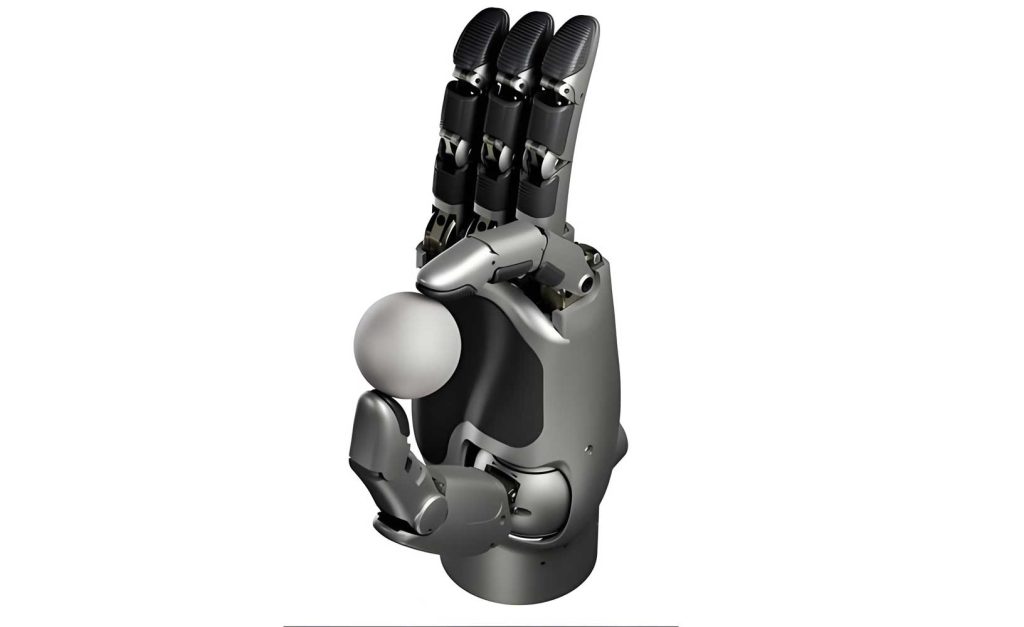
My approach addresses this by introducing the concept of directional manipulability. This allows for task-oriented optimization: for a given grasp posture, I can determine the hand’s capacity to transmit velocity and force to the object along a specific direction, identifying the optimal directional axes. Conversely, for a known object trajectory, I can optimize the hand’s configuration to maximize performance along that path. This makes the study of directional velocity and force manipulability highly valuable for the operational planning of a dexterous robotic hand.
Theoretical Foundation: Manipulability Ellipsoids for a Three-Fingered Hand
I begin by establishing the kinematic and static models for a canonical three-fingered dexterous robotic hand. Let {B} denote the base (palm) frame, {C} the object frame, and {B_i} the base frame of the i-th finger. The contact points between the fingers and the object are C_i (i=1,2,3). Assuming stable grasping with no slip at the contacts, the kinetostatic relationship mapping from joint space to the object’s center-of-mass (CoM) C is derived.
1.1 Velocity Manipulability Ellipsoid
The object’s twist at its CoM, $^B\mathbf{u}_C = [^B\mathbf{v}_C^T, ^B\boldsymbol{\omega}_C^T]^T \in \mathbb{R}^{6 \times 1}$, expressed in the base frame {B}, is related to the joint velocities $\dot{\boldsymbol{\theta}} \in \mathbb{R}^{(n_1+n_2+n_3) \times 1}$ by:
$$\mathbf{u} = \mathbf{G}^{-1} \mathbf{J} \dot{\boldsymbol{\theta}}$$
where $\mathbf{G} = \text{block diag}(\mathbf{G}_1, \mathbf{G}_2, \mathbf{G}_3) \in \mathbb{R}^{18 \times 18}$ is the grasp matrix and $\mathbf{J} = \text{block diag}(^B\mathbf{J}_1, ^B\mathbf{J}_2, ^B\mathbf{J}_3) \in \mathbb{R}^{18 \times (n_1+n_2+n_3)}$ is the hand Jacobian. For a point contact with friction model, $\mathbf{G}_i$ is:
$$\mathbf{G}_i =
\begin{bmatrix}
\mathbf{I}_3 & -[^B\mathbf{r}_{C_i} \times]^T \\
\mathbf{0} & \mathbf{I}_3
\end{bmatrix}
\in \mathbb{R}^{6 \times 6}$$
Here, $[^B\mathbf{r}_{C_i} \times]$ is the skew-symmetric matrix of the position vector $^B\mathbf{r}_{C_i}$ from the object’s CoM to contact point $C_i$, expressed in {B}.
Mapping the unit sphere $\dot{\boldsymbol{\theta}}^T\dot{\boldsymbol{\theta}} = 1$ from joint space to the object’s twist space at CoM C yields the velocity manipulability ellipsoid:
$$\mathbf{u}_C^T \left[ (\mathbf{J}_{1C}\mathbf{J}_{1C}^T)^{-1} + (\mathbf{J}_{2C}\mathbf{J}_{2C}^T)^{-1} + (\mathbf{J}_{3C}\mathbf{J}_{3C}^T)^{-1} \right] \mathbf{u}_C = 1$$
where $\mathbf{J}_{iC} = \mathbf{G}_i^{-1} {^B\mathbf{J}_i} = [\mathbf{J}_{iCv}^T, \mathbf{J}_{iC\omega}^T]^T$. This can be decomposed into linear and angular velocity ellipsoids:
$$\mathbf{v}_C^T \left[ \sum_{i=1}^{3} (\mathbf{J}_{iCv}\mathbf{J}_{iCv}^T)^{-1} \right] \mathbf{v}_C = 1 \quad \text{(Linear Velocity)}$$
$$\boldsymbol{\omega}_C^T \left[ \sum_{i=1}^{3} (\mathbf{J}_{iC\omega}\mathbf{J}_{iC\omega}^T)^{-1} \right] \boldsymbol{\omega}_C = 1 \quad \text{(Angular Velocity)}$$
For an arbitrary point A on the object, the linear velocity ellipsoid differs, while the angular velocity ellipsoid remains identical across all points.
1.2 Force Manipulability Ellipsoid
Under static equilibrium, the resultant wrench $\mathbf{F}_e = [\mathbf{f}_e^T, \mathbf{m}_e^T]^T$ at the object’s CoM is related to the joint torques $\boldsymbol{\tau}$ through the transpose of the grasp Jacobian. The force manipulability ellipsoid, mapping the unit sphere $\boldsymbol{\tau}^T\boldsymbol{\tau}=1$ to the resultant force $\mathbf{f}_e$ at the CoM, is given by:
$$\mathbf{f}_e^T \left[ \sum_{i=1}^{3} \mathbf{G}_{if} (\mathbf{J}_{i}\mathbf{J}_{i}^T)^{-1} \mathbf{G}_{if}^T \right]^{-1} \mathbf{f}_e = 1$$
where $\mathbf{G}_{if}$ is the force sub-matrix of $\mathbf{G}_i$. The force ellipsoid is dependent on the point of application on the object.
Defining Directional Manipulability
The core of my contribution is refining these global ellipsoid measures into directional metrics. Let a specific linear velocity direction be defined by a unit vector $\mathbf{p} = [\cos\alpha_1, \cos\alpha_2, \cos\alpha_3]^T$, such that $\mathbf{v}_C = A_{Cv} \mathbf{p}$, where $A_{Cv}$ is the magnitude. Substituting into the linear velocity ellipsoid equation yields:
$$A_{Cv}^2 (\mathbf{p}^T \mathbf{J}_{Cv} \mathbf{p}) = 1 \quad \text{where} \quad \mathbf{J}_{Cv} = \sum_{i=1}^{3} (\mathbf{J}_{iCv}\mathbf{J}_{iCv}^T)^{-1}$$
To maximize the transmissible velocity magnitude $A_{Cv}$ along $\mathbf{p}$, we need to maximize $(\mathbf{p}^T \mathbf{J}_{Cv} \mathbf{p})^{-1}$. I therefore define the Linear Velocity Directional Manipulability at the CoM as:
$$M_{Cv}(\mathbf{p}) = (\mathbf{p}^T \mathbf{J}_{Cv} \mathbf{p})^{-1}$$
Similarly, for a rotational direction $\mathbf{k}$ ($\boldsymbol{\omega}_C = A_{C\omega} \mathbf{k}$) and a force direction $\mathbf{p}$ ($\mathbf{f}_e = A_{f} \mathbf{p}$), I define:
$$M_{C\omega}(\mathbf{k}) = (\mathbf{k}^T \mathbf{J}_{C\omega} \mathbf{k})^{-1} \quad \text{where} \quad \mathbf{J}_{C\omega} = \sum_{i=1}^{3} (\mathbf{J}_{iC\omega}\mathbf{J}_{iC\omega}^T)^{-1}$$
$$M_{Cf}(\mathbf{p}) = (\mathbf{p}^T \mathbf{J}_{Cf} \mathbf{p})^{-1} \quad \text{where} \quad \mathbf{J}_{Cf} = \left[ \sum_{i=1}^{3} \mathbf{G}_{if} (\mathbf{J}_{i}\mathbf{J}_{i}^T)^{-1} \mathbf{G}_{if}^T \right]^{-1}$$
These functions, $M_{Cv}(\alpha_1,\alpha_2,\alpha_3)$, form a hypersurface. For visualization, I parameterize the direction using spherical coordinates $(\alpha, \beta)$, where $\cos\alpha_1=\cos\alpha\cos\beta$, $\cos\alpha_2=\cos\alpha\sin\beta$, $\cos\alpha_3=\sin\alpha$, converting the manipulability into a plottable surface $M_{Cv}=F(\alpha,\beta)$.
Grasp Optimization Problem Formulation
Based on the defined directional manipulability, I formulate two key optimization problems for a dexterous robotic hand.
Problem 1 (Optimal Transmission Direction for a Given Posture): For a fixed grasp configuration, find the direction that maximizes velocity or force transmission capability.
$$\begin{aligned}
&\text{Maximize:} \quad M_{Cv}(\alpha, \beta) = (\mathbf{p}(\alpha,\beta)^T \mathbf{J}_{Cv} \mathbf{p}(\alpha,\beta))^{-1} \\
&\text{Subject to:} \quad 0 \leq \alpha \leq 2\pi, \; 0 \leq \beta \leq 2\pi
\end{aligned}$$
An identical formulation applies for $M_{Cf}(\alpha, \beta)$ to find the optimal force direction.
Problem 2 (Optimal Posture for a Given Task Direction): When the required object motion/force direction $\mathbf{p}_{task}$ is known (e.g., from a trajectory), find the hand posture (joint angles, contact points) that maximizes directional manipulability along that specific direction.
$$\begin{aligned}
&\text{Maximize:} \quad M_{Cv}(\boldsymbol{\theta}, \mathbf{r}_{C_i}; \mathbf{p}_{task}) \\
&\text{Subject to:} \quad \text{Kinematic, Contact, and Stability Constraints}
\end{aligned}$$
This study primarily addresses Problem 1.
Simulation, Computation, and Analysis
To demonstrate the theory, I constructed a computational model of a three-fingered dexterous robotic hand grasping a spherical object. Each finger is identical with three revolute joints. The parameters are as follows:
| Parameter | Value | Description |
|---|---|---|
| $l_1$, $l_2$, $l_3$ | 20 mm, 30 mm, 20 mm | Link lengths for each finger |
| $r$ | 20 mm | Radius of the spherical object |
| Contact Configuration S1 | Points on the equatorial (XY) plane | $^C\mathbf{r}_{C1}=(-r,0,0)^T$, $^C\mathbf{r}_{C2}=(r\sin(\pi/6), -r\cos(\pi/6), 0)^T$, $^C\mathbf{r}_{C3}=(r\sin(\pi/6), r\cos(\pi/6), 0)^T$ |
| Corresponding Joint Angles (S1) | $\boldsymbol{\theta}_1=(0, \pi/6, \pi/2)^T$ $\boldsymbol{\theta}_2=(\pi/3, \pi/6, \pi/2)^T$ $\boldsymbol{\theta}_3=(2\pi/3, \pi/6, \pi/2)^T$ |
Configurations for symmetric grasp |
The velocity Jacobian for each finger in its local frame {B_i} is:
$$^{B_i}\mathbf{J}_i = \begin{bmatrix}
-(l_3c_{i23}+l_2c_{i2})s_{i1} & -(l_3c_{i23}+l_2s_{i2})c_{i1} & -l_3 c_{i1} s_{i23} \\
(l_3c_{i23}+l_2c_{i2})c_{i1} & -(l_3s_{i23}+l_2s_{i2})s_{i1} & -l_3 s_{i1} s_{i23} \\
0 & l_3c_{i23}+l_2c_{i2} & l_3 c_{i23}
\end{bmatrix}$$
where $s_{i1}=\sin\theta_{i1}, c_{i23}=\cos(\theta_{i2}+\theta_{i3})$, etc. This is transformed to the base frame {B} via rotation matrices $^B_{B_i}\mathbf{R}$.
For Configuration S1, I computed the matrices $\mathbf{J}_{Cv}$ and $\mathbf{J}_{Cf}$. Due to symmetry, analyzing $\beta$ in $[0, 2\pi/3]$ is sufficient. The directional manipulability surfaces $M_{Cv}(\alpha,\beta)$ and $M_{Cf}(\alpha,\beta)$ were calculated and are represented graphically. The maximum values found were:
$$M_{Cv}^{max} = 4.244 \times 10^{-4} \quad \text{at} \quad (\alpha = 90^\circ)$$
$$M_{Cf}^{max} = 8.552 \times 10^{-6} \quad \text{at} \quad (\alpha = 270^\circ)$$
The angular velocity directional manipulability $M_{C\omega}$ was found to be a constant $1/3$ for all directions in the y-z plane, indicating isotropic rotational capability in that plane for this grasp.
For comparison, I analyzed a second configuration S2, with contact points offset from the equator (e.g., $^C\mathbf{r}_{C1}=(-r, 0, r/2)^T$). The corresponding maximum values were:
$$M_{Cv}^{max}(S2) = 4.435 \times 10^{-5}$$
$$M_{Cf}^{max}(S2) = 5.436 \times 10^{-6}$$
| Configuration | Max Linear Velocity Manipulability, $M_{Cv}^{max}$ | Max Force Manipulability, $M_{Cf}^{max}$ | Optimal Velocity Direction ($\alpha$) | Optimal Force Direction ($\alpha$) |
|---|---|---|---|---|
| S1 (Equatorial) | 4.244e-4 | 8.552e-6 | 90° (Vertical Up) | 270° (Vertical Down) |
| S2 (Offset) | 4.435e-5 | 5.436e-6 | 90° (Vertical Up) | 270° (Vertical Down) |
Discussion and Implications for Dexterous Robotic Hand Design
The analysis reveals several critical insights for the operation and design of a dexterous robotic hand:
1. Anisotropy of Transmission Capability: The directional manipulability surfaces are highly anisotropic. For the symmetric Configuration S1, the best direction for transmitting linear velocity is vertically upward ($\alpha=90^\circ$), independent of $\beta$. The worst direction is vertically downward ($\alpha=270^\circ$). This anisotropy is a fundamental property that global manipulability measures obscure.
2. Trade-off Between Velocity and Force Transmission: A key finding is the apparent trade-off: the direction optimal for velocity transmission ($\alpha=90^\circ$) is the worst for force transmission, and vice-versa. This is consistent with the duality of velocity and force ellipsoids in robotic kinematics. For a dexterous robotic hand executing a task requiring both motion and force exertion (e.g., peg-in-hole), this trade-off must be carefully balanced during grasp planning, potentially favoring an intermediate direction or selecting a grasp configuration that aligns one optimal axis with the primary task requirement.
3. Configuration-Dependent Performance: Comparing Configurations S1 and S2 shows that the absolute value of directional manipulability is highly sensitive to the grasp geometry. While the optimal *directions* remained vertically up/down for this object shape and hand architecture, the *magnitude* of capability changed significantly. Configuration S1 offers an order of magnitude better velocity transmission than S2. This underscores the importance of contact point optimization (Problem 2) for task-specific performance.
4. Practical Application in Grasp Planning: The directional manipulability metric provides a direct, quantitative tool for the dexterous robotic hand planner. When a task requires precise motion along a known vector $\mathbf{p}_{task}$, the planner can evaluate candidate grasps not by overall isotropy, but specifically by $M_{Cv}(\mathbf{p}_{task})$, choosing the grasp that maximizes it. This leads to more efficient, task-optimized grasps where joint velocities and torques are used most effectively to achieve the desired object motion.
In conclusion, moving beyond global, isotropic measures to task-oriented directional manipulability provides a powerful framework for optimizing the performance of a dexterous robotic hand. My analysis formalizes this concept, derives the relevant metrics from first principles, and demonstrates through simulation how these metrics reveal the inherent anisotropies and trade-offs in grasping. This approach enables the synthesis of grasps that are not just stable, but are optimally tailored to the specific velocity and force requirements of the manipulation task, a crucial step towards achieving true human-like dexterity in robotics.