
In the field of precision motion control and robotics, strain wave gearing, also commonly referred to as harmonic drive, stands out as a fundamentally superior transmission technology. Its unique operating principle, which relies on the elastic deformation of a flexible component, grants it exceptional characteristics unattainable by conventional gear systems. The performance advantages are numerous: exceptionally high positional accuracy, minimal backlash, compact size and weight relative to its high torque capacity, and remarkably smooth and quiet operation. However, the very mechanism that enables these benefits also dictates its primary point of vulnerability. The cyclic elastic deformation of the flexspline under load makes fatigue fracture the most prevalent and critical failure mode for strain wave gear systems. Consequently, a deep and accurate understanding of the stress-strain behavior within the flexspline is paramount for reliable design and longevity.
This article details my comprehensive approach to creating a precise, parametric three-dimensional model of a cylindrical cup flexspline, which serves as the indispensable foundation for any subsequent advanced mechanical analysis, such as Finite Element Analysis (FEA). The accuracy of the stress and strain results from an FEA simulation is directly and profoundly influenced by the fidelity of the underlying geometric model. A poorly constructed model can lead to misleading stress concentrations or an inaccurate distribution of deformation, ultimately compromising the design validation process.
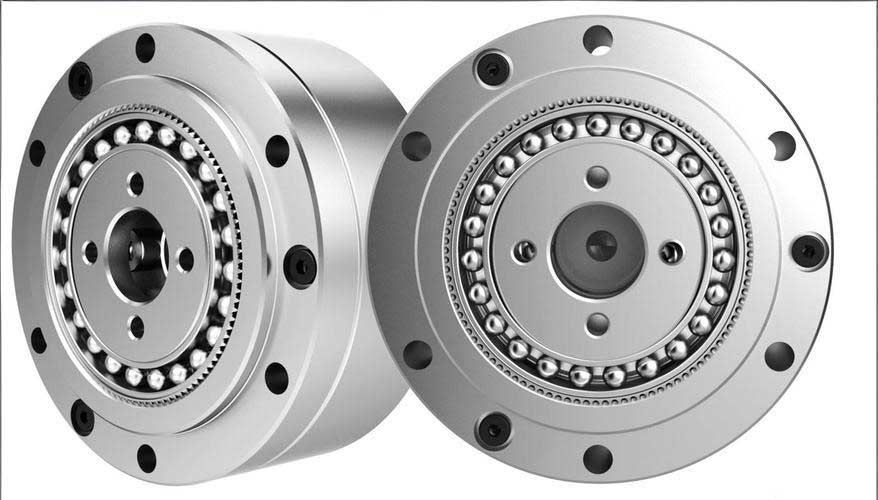
The cylindrical cup flexspline is a complex thin-walled mechanical element, essentially functioning as a cylindrical shell with a sophisticated gear tooth profile machined onto one of its open ends. Its geometry can be segmented into distinct functional zones: the rigid flange for mounting, the smooth cylindrical body (or “diaphragm”) that undergoes controlled flexing, and the critical toothed rim that engages with the static circular spline. The primary geometric parameters governing its design are outlined in the table below. For this modeling exercise, I have selected a specific set of parameters to demonstrate the process.
| Parameter Name | Symbol | Value | Unit |
|---|---|---|---|
| Module | m | 0.5 | mm |
| Number of Teeth | z | 427 | – |
| Pressure Angle | α | 20 | ° |
| Pitch Diameter | d | 213.25 | mm |
| Base Circle Diameter | d_b | 200.38 | mm |
| Addendum Coefficient | h_a* | 1.0 | – |
| Dedendum Clearance Coefficient | c* | 0.25 | – |
| Cylinder Length | L | 180 | mm |
| Cylinder Wall Thickness | δ1 | 3.6 | mm |
| Gear Rim Width | b | 40 | mm |
| Tooth Rim Wall Thickness | δ | 6.0 | mm |
The choice of modeling software is a critical first step. While ANSYS is exceptionally powerful for finite element analysis, its native geometric modeling capabilities for complex, parametrically defined curves like gear teeth can be less intuitive. For the primary geometric construction, I prefer to use PTC Creo Parametric (formerly Pro/ENGINEER, referred to here as Pro/E for familiarity). Its robust parametric and associative design environment is perfectly suited for this task. It allows me to define the entire model through a set of driving dimensions, features, and relations (equations). This parametric nature means that the entire flexspline model can be regenerated automatically by simply changing a key input value, such as the module or number of teeth—a tremendous advantage for design iteration and optimization studies on the strain wave gear assembly.
My modeling process begins with a strategic simplification. To facilitate meshing and reduce computational cost in later FEA stages, local geometric details that have a negligible impact on the global structural response are omitted. This includes small fillets at the tooth root, rounding at the gear profile transitions, and chamfers on the flange. The core geometry—the cylindrical shell, the transition in wall thickness, and the precise involute tooth form—is captured with high accuracy.
Core Mathematical Foundation: The Involute Tooth Profile
The accurate generation of the gear teeth is the most intricate part of modeling the strain wave gear flexspline. The tooth profile follows a standard involute curve, which is the path traced by a point on a taut string as it is unwound from a base circle. The parametric equations for an involute curve in a Cartesian plane are fundamental:
$$ x = r_b (\cos(\theta) + \theta \sin(\theta)) $$
$$ y = r_b (\sin(\theta) – \theta \cos(\theta)) $$
Where:
– $r_b$ is the radius of the base circle ($d_b / 2$).
– $\theta$ is the involute roll angle in radians.
In Pro/E, these equations are implemented within the curve-from-equation feature. For a cylindrical coordinate system aligned with the gear axis, the equations are adapted. The key geometric diameters for the gear are calculated from the basic parameters using the following standard relations:
Pitch Diameter: $$ d = m \cdot z $$
Base Circle Diameter: $$ d_b = d \cdot \cos(\alpha) $$
Addendum Diameter: $$ d_a = d + 2 \cdot m \cdot h_a^* $$
Dedendum Diameter: $$ d_f = d – 2 \cdot m \cdot (h_a^* + c^*) $$
Substituting our specific values:
$$ d = 0.5 \times 427 = 213.25 \text{ mm} $$
$$ d_b = 213.25 \times \cos(20^\circ) \approx 200.38 \text{ mm} $$
$$ d_a = 213.25 + 2 \times 0.5 \times 1.0 = 214.25 \text{ mm} $$
$$ d_f = 213.25 – 2 \times 0.5 \times (1.0 + 0.25) = 212.0 \text{ mm} $$
Step-by-Step Parametric Modeling Procedure in Pro/E
1. Parameter and Relation Declaration: The first action within Pro/E is to create the parameters (like `m`, `z`, `alpha`) and the relations (equations) that link them, as defined above. This ensures all downstream geometry is driven by these few, easy-to-modify values.
2. Creating the Cylindrical Body: Using the `Blend` feature (`Insert > Blend > Protrusion`), I create the initial smooth cylindrical shell. I select two parallel sketch planes separated by the cylinder length `L` and sketch circles corresponding to the inner diameters. The blend feature seamlessly creates the tapered or straight wall. For the main body with thickness `δ1`, the sketches are defined.
3. Sketching Reference Geometry: On the outer surface of the cylinder, at the end where the teeth will be located, I sketch the critical `Base Circle` ($d_b = 200.38$ mm) as a reference curve. This circle is the genesis of the involute tooth profile.
4. Generating the First Involute Curve: I access the `Curve from Equation` feature. Selecting the appropriate coordinate system, I input the parametric equations. For Pro/E’s canonical Cartesian system, the formulation used is:
“`
theta = 60*t * (pi/180) // ‘t’ varies from 0 to 1, giving a 60-degree arc
m = 0.5
z = 427
alfa = 20 * (pi/180)
rb = (m*z*cos(alfa))/2
x = rb*cos(theta) + rb*theta*sin(theta)
y = rb*sin(theta) – rb*theta*cos(theta)
z = 0
“`
This creates a precise involute curve emanating from the base circle on the chosen datum plane.
5. Mirroring the Curve: A single involute curve defines one side of a tooth space. To create the opposing side of the same tooth space, I mirror the first involute curve about a datum plane that passes through the cylinder axis. The angle of this plane is strategically set relative to the starting point of the involute.
6. Creating a Patterned Instance for the Next Tooth: To generate the adjacent tooth flank, I need a copy of the first involute curve rotated by exactly one circular pitch ($360^\circ / z$). However, due to the involute’s properties and potential for adjustments like profile shifting, an angular offset is often applied. In this case, I create a new coordinate system (`CS1`) offset from the original. I then use the `Copy > Paste Special > Rotate` command, selecting the first involute curve, specifying the central axis, and entering the rotation angle: $$ \frac{360^\circ}{z} + \Delta \theta $$ where $\Delta \theta$ is a small adjustment factor (e.g., 1.74 degrees as per the initial example) to ensure proper tangency and tooth thickness at the pitch circle. This step is crucial for defining the tooth thickness correctly in the strain wave gear.
7. Trimming to Form a Single Tooth Profile: I now use the `Sketch` tool to create a 2D profile. Within the sketch, I use the `Use Edge` (or `Project`) command to reference the four key curves: the two involute segments from one tooth space and the corresponding two from the adjacent space, along with arcs for the dedendum circle ($d_f$) and the addendum circle ($d_a$). By trimming these projected entities, I create a single, closed two-dimensional loop that perfectly defines the cross-sectional shape of one complete gear tooth.
8. Extruding the Tooth: With the closed sketch loop selected, I use the `Extrude` feature. I specify a protrusion with a depth equal to the gear rim width `b` (40 mm). This solidifies the 2D profile into the first three-dimensional tooth of the strain wave gear flexspline.
9. Axial Pattern to Create the Full Gear Rim: This is where the power of parametric modeling shines. I select the single extruded tooth feature and apply an `Axis Pattern` command. I select the central axis of the cylinder as the pattern direction, specify the total number of instances to be equal to the number of teeth `z` (427), and set the incremental angular spacing to $360^\circ / z$. Pro/E then automatically generates the complete ring of 427 teeth around the circumference of the cylinder in a single, associative operation. Any change to `z` will automatically update this pattern.
10. Completing the Flexspline Model: The final steps involve adding the remaining structural features. I use additional `Extrude` and `Blend` features to create the rigid mounting flange at the open end of the cup and to ensure the transitional fillet between the thin cylinder body and the thicker tooth rim is appropriately modeled (albeit simplified as a straight taper for FEA readiness). The final result is a complete, watertight 3D solid model of the cylindrical cup flexspline, ready for export or further manipulation.
Model Validation and Application in Strain Wave Gear Analysis
The parametric model produced is not merely a visual asset; it is an engine for engineering analysis. It can be directly imported into FEA pre-processors like ANSYS Workbench or Simcenter. Before proceeding to complex nonlinear or dynamic analyses, a simple static structural validation is prudent. Applying a pressure to the inner surface of the flexspline to simulate the wave generator’s elliptical forcing, along with fixed constraints at the flange, provides initial insight into deformation patterns and stress distribution. For a typical aerospace-grade alloy like 30CrMnSiNi2A, material properties are assigned:
| Material Property | Symbol | Value | Unit |
|---|---|---|---|
| Young’s Modulus | E | 2.06e5 | MPa |
| Poisson’s Ratio | ν | 0.3 | – |
| Yield Strength | σ_y | ≥ 1080 | MPa |
| Ultimate Tensile Strength | σ_u | ≥ 1275 | MPa |
A preliminary static analysis would solve the basic linear elastic equations:
$$ \{\sigma\} = [D] \{\epsilon\} $$
where $\{\sigma\}$ is the stress vector, $\{\epsilon\}$ is the strain vector, and $[D]$ is the material stiffness matrix derived from E and ν. The primary area of interest is the maximum von Mises stress $\sigma_{vm}$ in the flexspline body, calculated as:
$$ \sigma_{vm} = \sqrt{ \frac{(\sigma_1 – \sigma_2)^2 + (\sigma_2 – \sigma_3)^2 + (\sigma_3 – \sigma_1)^2}{2} } $$
This stress must be compared against the material’s endurance limit for fatigue assessment, which is the dominant failure mode for this component in a strain wave gear.
The true power of this parametric model is unlocked in design exploration. One can establish a table of critical performance outputs versus key input parameters:
| Design Variable | Range Explored | Impact on Max Stress | Impact on Weight | Recommended Optimization Path |
|---|---|---|---|---|
| Tooth Rim Thickness (δ) | 5.0 – 7.0 mm | Decreases non-linearly as δ increases | Increases linearly | Find Pareto-optimal point balancing stress and mass. |
| Cylinder Wall Thickness (δ1) | 3.0 – 4.2 mm | Significant reduction in diaphragm stress | Moderate increase | Increase until stress concentration shifts to tooth root. |
| Pressure Angle (α) | 20° – 30° | May increase root bending stress slightly | Negligible | Larger angle improves load-sharing but requires check on undercut. |
| Transition Fillet Radius | 2 – 10 mm | Dramatically reduces stress concentration factor | Negligible | Maximize within manufacturing constraints. |
In conclusion, the meticulous parametric modeling of the cylindrical cup flexspline, as detailed in this first-person account, is a foundational and non-negotiable step in the advanced engineering of reliable strain wave gear systems. The methodology I employ, leveraging the parametric and associative power of Pro/E coupled with the mathematical rigor of gear geometry, produces a digital prototype of exceptional fidelity. This model faithfully represents the complex reality of the flexspline—the heart of the strain wave gear—enabling accurate finite element analysis for stress, strain, modal, and fatigue life prediction. By mastering this modeling process, engineers gain a powerful tool to push the boundaries of performance, weight, and durability for strain wave gears, ensuring their continued success in the most demanding precision drive applications.