
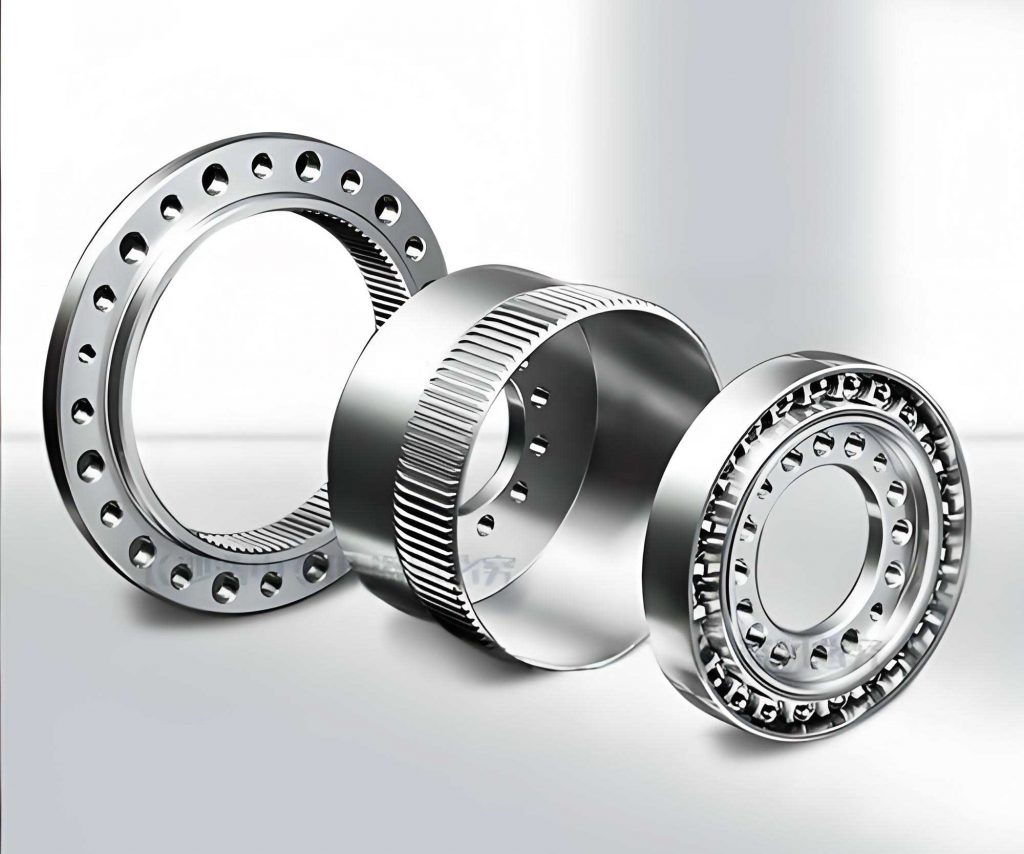
The harmonic drive gear, renowned for its high reduction ratio, compact size, and excellent positional accuracy, is a critical component in precision applications such as robotics and aerospace. Its operational principle relies on the elastic deformation of a thin-walled component called the flexspline. As the flexspline undergoes a cyclical, wave-like deformation twice per revolution of the wave generator, the amplitude of its alternating stress is typically twice its maximum assembly stress. Consequently, the fatigue strength of the flexspline, governed by this maximum assembly stress, is a primary determinant of the entire harmonic drive gear’s service life. Accurately predicting and minimizing this stress is therefore paramount for reliability and longevity. This study focuses on a critical yet underexplored aspect: the influence of the gear teeth themselves on the stress state within the flexspline’s toothed rim. While traditional analyses often simplify the toothed rim as a smooth ring of equivalent thickness, this approach fails to capture the localized stress concentrations at the tooth root fillets. To address this, we establish a detailed, parametric three-dimensional finite element model (FEM) of the flexspline rim incorporating the actual involute tooth profile. This model enables a precise investigation into the maximum circumferential assembly stress and its dependencies on key geometric parameters, providing deeper insights for the optimal design of harmonic drive gear components.
The foundational analysis for stress in a harmonic drive gear flexspline begins with modeling the undeformed toothed section as a plane circular ring. Under assembly by the wave generator, this ring deforms. For a four-roller wave generator, the applied forces and resulting deformations are symmetric. The internal forces at any cross-section defined by the angular coordinate $\varphi$ (measured from the major axis) consist of bending moment $M(\varphi)$, circumferential force $F_N(\varphi)$, and shear force $F_S(\varphi)$. Using principles of structural mechanics for curved beams and applying compatibility conditions at the minor axis, the bending moment distribution can be derived. For a smooth ring (with teeth removed, often called a “smooth ring” or “diaphragm”) with wall thickness $h$, width $b$, and neutral radius $r_m$, the moment is given by:
$$M(\varphi) = \begin{cases}
F r_m [\frac{2}{\pi} \sin\beta – \cos(\beta – \varphi)], & 0 \leq \varphi \leq \beta \\
F r_m [\frac{2}{\pi} \cos\beta – \sin(\beta – \varphi)], & \beta < \varphi \leq \pi/2
\end{cases}$$
where $F$ is the radial force from one roller applied at an angular position $\beta$, and $E$ is the modulus of elasticity. The moment of inertia for the smooth ring cross-section is $I_z = b h^3 / 12$. The radial deflection $u_0$ at the major axis ($\varphi=0$) relates to the roller force $F$ by:
$$F = \frac{E I_z u_0}{r_m^3} \cdot \frac{2}{ \left[ (\pi/2 – \beta)\cos\beta + \sin\beta\cos\beta – 4/\pi \right] }$$
The circumferential bending stress on the outer surface of the smooth ring is then $\sigma(\varphi) = M(\varphi) \cdot (h/2) / I_z$. Substituting the expression for $F$ yields the theoretical stress distribution for the smooth ring model:
$$\sigma(\varphi) = \frac{u_0 E h}{2 r_m^2} \cdot \begin{cases}
\frac{\frac{4}{\pi}\sin\beta – 2\cos(\beta-\varphi)}{\left[ (\pi/2 – \beta)\cos\beta + \sin\beta\cos\beta – 4/\pi \right]}, & 0 \leq \varphi \leq \beta \\
\frac{\frac{4}{\pi}\cos\beta – 2\sin(\beta-\varphi)}{\left[ (\pi/2 – \beta)\cos\beta + \sin\beta\cos\beta – 4/\pi \right]}, & \beta < \varphi \leq \pi/2
\end{cases}$$
For a typical roller position of $\beta = 25^\circ$, the maximum tensile stress occurs at the roller location ($\varphi = \beta$), and the maximum compressive stress occurs at the minor axis ($\varphi = \pi/2$).
In a real harmonic drive gear, the presence of teeth significantly alters this stress state. Design standards often account for this through an empirical stress magnification factor, $K_{rt}$, which is a function of the normalized wall thickness $h^* = h/m$, where $m$ is the module: $K_{rt} = (1 + h^*) / h^*$. The maximum stress in the toothed rim is then estimated as $\sigma_{max} \approx K_{rt} \cdot \sigma(\beta)$. This approach essentially treats the teeth as merely increasing the effective bending stiffness of the rim, raising the average stress. However, it does not account for the local stress concentration at the tooth root fillet. Another model proposes a “tooth influence coefficient” $Y_z$ based on an equivalent rectangular tooth, which incorporates a tooth thickness factor $K_s$ and an equivalent tooth height $h_p$: $Y_z = 1 / \{1 – K_s[1 – (h/(h+h_p))^3] \}$. The determination of $h_p$ is non-trivial and often requires experimental calibration. The actual stress in the toothed rim is thus a combination of increased global bending stress due to stiffness amplification and localized stress concentration. This study aims to decouple and quantify these two effects using detailed finite element analysis of the harmonic drive gear flexspline.
We developed a parametric solid-element finite element model (FEM) of the flexspline rim using ANSYS APDL. The model features an involute tooth profile with positive addendum modification (x-shift) to avoid interference and increase root strength in the harmonic drive gear. Key parameters include: number of teeth $z_1=200$, module $m=0.5$ mm, addendum $h_a=m$, dedendum $h_f=1.35m$, pressure angle $\alpha_0=20^\circ$, and x-shift coefficient $x_1=3$. The rim thickness $h$ and the dedendum fillet radius $r_4$ are treated as primary variables. A “tooth space width ratio” $v$ is defined as $v = e_k / s_k$, where $s_k$ and $e_k$ are the tooth thickness and space width on a specific reference circle of radius $r_k$. A ratio $v=1.0$ represents a standard tooth, while $v>1.0$ represents a “wide-space” design where tooth thickness is reduced to widen the stress-critical tooth space, a known strategy to reduce peak stress in harmonic drive gears. The model is subjected to displacement-controlled loading via four rigid rollers positioned at $\beta=25^\circ$ to achieve a specified maximum radial deflection $u_0$ at the major axis. Contact elements are defined between the roller surfaces and the flexspline’s inner bore. Symmetry boundary conditions are applied, and the mesh is refined, especially in the tooth dedendum region, to ensure accuracy in stress concentration zones.
To validate the FEM methodology, a smooth ring model (teeth removed) with $h=0.7$ mm ($h^*=1.4$) was analyzed. For a small deflection $u_0 = 0.1m = 0.05$ mm, the FEM results showed excellent agreement with theoretical values from the equations above.
| Model / Metric | Roller Force $F$ (N) | Max. Tensile Stress at Roller (MPa) | Max. Compressive Stress at Minor Axis (MPa) |
|---|---|---|---|
| FEM (Smooth Ring) | 0.02613 | 4.152 | -4.441 |
| Theory (Smooth Ring) | 0.02629 | 4.125 | -4.385 |
| Deviation | 0.61% | 0.64% | 1.26% |
This confirms the accuracy of the modeling approach for the fundamental smooth ring behavior in a harmonic drive gear.
Subsequently, the full toothed model (with $h^*=1.4$, $r_4=0.126$ mm, $v=1.0$) was analyzed with $u_0 = m = 0.5$ mm. The maximum circumferential tensile stress of 109.1 MPa was found in the tooth space at the roller location, and the maximum compressive stress of -115.7 MPa was in the tooth space at the minor axis. Comparing the roller force from the toothed model ($F_{toothed} = 0.4554$ N) to the theoretical force for the smooth ring ($F_{smooth, theory} = 0.2629$ N) reveals the bending stiffness amplification due to the teeth. Defining the Bending Stiffness Magnification Factor $K_{tr} = F_{toothed} / F_{smooth, theory}$, we find $K_{tr} = 1.73$ for this case. The overall Tooth Stress Influence Coefficient is defined as $K_T = \sigma_{max, toothed} / \sigma_{max, smooth, theory}$. Using the theoretical smooth ring stress at the roller (41.254 MPa), $K_T = 109.1 / 41.254 = 2.64$. The local Stress Concentration Factor $K_C$ can then be deduced by normalizing out the global stiffness effect: $K_C = K_T / K_{tr} = 2.64 / 1.73 = 1.53$. This factor specifically quantifies the peak stress increase at the fillet relative to the nominal bending stress in the stiffened rim.
A critical design parameter in a harmonic drive gear flexspline is the dedendum fillet radius $r_4$. Its influence on the maximum circumferential stress $\sigma_{\phi, max}$ was investigated for various normalized wall thicknesses $h^*$. The fillet radius was normalized as $r_4^* = r_4 / m$. The results, summarized by the normalized stress $\sigma_{\phi, max} / [u_0 E h / r_m^2]$, show a consistent trend: for each $h^*$, the stress initially decreases sharply as $r_4^*$ increases from a small value, reaches a minimum, and then increases slightly with further increases in $r_4^*$. This non-monotonic behavior occurs because a larger fillet reduces stress concentration, but also increases the local sectional stiffness at the tooth root, thereby increasing the bending moment carried by that section. An optimal fillet radius exists that minimizes the peak stress. Analysis indicates this optimal $r_4^*$ is approximately 0.36 for the studied harmonic drive gear parameters. All subsequent analyses of maximum stress use this optimal fillet radius.
The influence of rim thickness $h^*$ and tooth space width ratio $v$ on the Bending Stiffness Magnification Factor $K_{tr}$ was systematically studied. The factor $K_{tr}$ decreases as the rim becomes thicker relative to the teeth ($h^*$ increases), because the teeth contribute a smaller relative increase to the overall sectional moment of inertia. Furthermore, $K_{tr}$ decreases as the tooth space widens ($v$ increases), since wider spaces mean less tooth material and hence a smaller stiffening effect. The following formula approximates the FEM results for the standard tooth ($v=1.0$):
$$K_{tr} \approx 1.85 – 0.18h^* + 0.02(h^*)^2 \quad \text{(for } 1.0 \le h^* \le 3.0\text{)}$$
This is compared below with the design standard factor $K_{rt}$ and the equivalent rectangular tooth model factor $Y_z$ (assuming $h_p \approx 1.5m$ and $K_s=0.5$).
| $h^*$ | FEM $K_{tr}$ (v=1.0) | Design Standard $K_{rt}$ | Deviation from FEM | Rectangular Model $Y_z$ | Deviation from FEM |
|---|---|---|---|---|---|
| 1.0 | 1.69 | 2.00 | +18.3% | 2.04 | +20.7% |
| 1.4 | 1.60 | 1.71 | +6.9% | 1.78 | +11.3% |
| 2.2 | 1.50 | 1.45 | -3.3% | 1.54 | +2.7% |
| 3.0 | 1.43 | 1.33 | -7.0% | 1.42 | -0.7% |
The results indicate that traditional methods generally overestimate the stiffening effect of teeth for thin rims ($h^* < 2.2$) in a harmonic drive gear.
More importantly, the Stress Concentration Factor $K_C$ was extracted from the FEM results. This factor increases with $h^*$, meaning the local stress concentration effect becomes more severe relative to the bending stress in thicker rims. This is because the stress gradient and notch effect at the fillet become more pronounced. Widening the tooth space (increasing $v$) consistently reduces $K_C$, as it provides a larger, less constrained region of material at the critical section, alleviating the concentration. The design standard provides an empirical stress concentration factor $K_{\sigma} = (1.6h^* + 0.8) / (1 + h^*)$. Comparison shows that $K_{\sigma}$ underestimates the actual $K_C$ obtained from the detailed harmonic drive gear flexspline model, especially for thicker rims.
| $h^*$ | FEM $K_C$ (v=1.0) | FEM $K_C$ (v=1.6) | Design Standard $K_{\sigma}$ | Deviation (v=1.0) |
|---|---|---|---|---|
| 1.0 | 1.56 | 1.35 | 1.40 | +11.4% |
| 1.4 | 1.65 | 1.42 | 1.45 | +13.8% |
| 2.2 | 1.76 | 1.51 | 1.52 | +15.8% |
| 3.0 | 1.84 | 1.57 | 1.57 | +17.2% |
The underestimation by the standard ranges from approximately 11% to 17%, implying that the real safety margin against fatigue failure might be smaller than calculated using standard practices for harmonic drive gear design.
The combined effect of stiffness magnification and stress concentration is embodied in the Tooth Stress Influence Coefficient $K_T = K_{tr} \cdot K_C$. For the optimal design with $r_4^* \approx 0.36$, the maximum normalized circumferential stress $\sigma_{\phi, max} / [u_0 E h / r_m^2]$ for different $h^*$ and $v$ can be summarized. This provides a direct design guideline for estimating peak assembly stress in a harmonic drive gear flexspline.
| $h^*$ | $v=1.0$ | $v=1.2$ | $v=1.4$ | $v=1.6$ |
|---|---|---|---|---|
| 1.0 | 2.64 | 2.42 | 2.28 | 2.18 |
| 1.4 | 2.64 | 2.40 | 2.24 | 2.13 |
| 2.2 | 2.64 | 2.38 | 2.20 | 2.08 |
| 3.0 | 2.63 | 2.36 | 2.17 | 2.04 |
The analysis reveals that increasing the tooth space width ratio $v$ from 1.0 to 1.6 can reduce the maximum stress by approximately 13% to 22%, depending on $h^*$, confirming the significant benefit of the wide-space design for harmonic drive gear flexsplines.
In conclusion, this study employed a detailed parametric solid-element finite element model to dissect the factors influencing the maximum assembly stress in the toothed rim of an involute harmonic drive gear. The key findings are: First, an optimal dedendum fillet radius of approximately $r_4^* = 0.36$ minimizes the peak circumferential stress by balancing stress concentration reduction against local stiffness increase. Second, the bending stiffness magnification due to teeth, quantified by $K_{tr}$, is generally overestimated by traditional methods for thin-walled harmonic drive gear flexsplines. Third, and most critically, the local stress concentration factor $K_C$ is underestimated by the empirical formula in common design standards. This underestimation grows with increasing rim thickness, ranging from about 11% to 17%, indicating a potential non-conservative bias in standard fatigue life calculations for harmonic drive gears. Fourth, widening the tooth space is a highly effective strategy, yielding stress reductions of 13-22%. The presented methodology and results provide a more accurate and nuanced framework for analyzing and optimizing the flexspline of a harmonic drive gear, ultimately contributing to the design of more reliable and durable harmonic drive transmission systems.