
In recent years, the technological revolution in fields like humanoid robotics and automotive engineering, coupled with the product iteration of electrification replacing hydraulics, has revealed the limitations of traditional transmission methods such as ball screws and trapezoidal screws. These conventional solutions often fall short in meeting the stringent demands of modern applications regarding load capacity, transmission efficiency, precision, and service life. This is where the planetary roller screw (PRS) excels. By replacing balls with threaded rollers as the load-carrying elements, and thanks to its multi-point, multi-body contact characteristics, the planetary roller screw offers superior load capacity, high axial stiffness, excellent transmission efficiency, extended service life, robust dynamic performance, and strong impact resistance. Consequently, it has become a critical component in linear actuators for humanoid robots, steering systems for new energy vehicles, aerospace actuators, telescopic arms for engineering machinery, and automated riveting systems, among others. My analysis here delves into the intricacies of this remarkable technology.
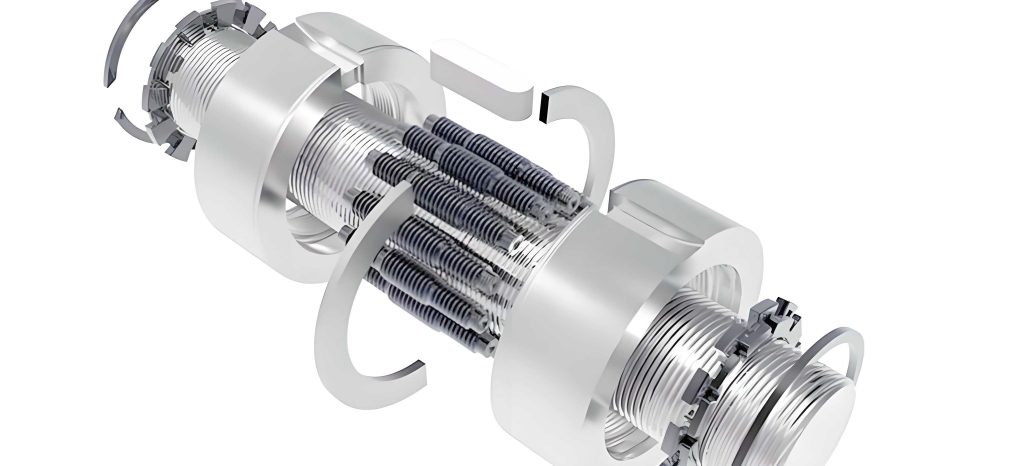
From my perspective, understanding the variants is crucial. Planetary roller screws are not a monolithic technology; they are classified into several distinct structural types based on their composition and kinematic principles, each suited for specific application scenarios.
| Type | Key Components | Working Principle & Advantages | Disadvantages & Typical Applications |
|---|---|---|---|
| Standard (Inline) Planetary Roller Screw | Screw, Rollers, Nut, Internal Ring Gear | The screw rotates as input. Rollers mesh with the screw and nut threads and orbit via gear engagement with the ring gear, causing nut translation. Versatile, suitable for long strokes, heavy loads, and high speeds. | Difficult to manufacture for leads < 2mm. Widely used in industrial automation, heavy machinery. |
| Recirculating Planetary Roller Screw | Screw, Rollers with Grooves, Nut, Retainer, Cam Ring | Rollers have annular grooves and recirculate via a cam track. Allows for very small leads, high thread engagement count, offering high positioning accuracy, resolution, and stiffness. | Noise at high speeds due to roller recirculation impact. Used in high-precision, high-stiffness systems. |
| Bearing Ring Planetary Roller Screw | Screw, Nut, Rollers, Housing, End Caps, Bearings | Integrates support bearings. Minimizes wear under extreme loads. Features very high transmission efficiency and load capacity. | Complex structure, high manufacturing cost. Common in oil & gas, extreme-duty engineering machinery. |
| Reverse (Inverted) Planetary Roller Screw | Screw, Nut, Rollers, Retainer | The nut rotates as input. The screw translates axially. Enables compact design with motor rotor integration directly into the nut. | Limited effective stroke due to nut internal threading constraints. Ideal for compact, high-speed actuators in aerospace, robotics. |
| Differential Planetary Roller Screw | Screw, Nut, Rollers with Grooves, Retainer | Uses grooved rollers and nut for differential motion, achieving high reduction ratios and very small effective leads from larger physical thread pitches. | Output lead can exhibit slight stochastic fluctuations. Suited for medium-speed applications requiring high load and fine control. |
The design and analysis of a high-performance planetary roller screw is a complex undertaking. The dual kinematic nature—combining a thread pair and a gear pair—makes accuracy synthesis and performance prediction challenging. Based on my experience, the process hinges on two pillars: systematic error budgeting and rigorous performance modeling based on contact mechanics.
1. Error Analysis and Accuracy Allocation: The total positional error of the planetary roller screw assembly is a composite of errors from individual components and their interactions. A critical task is to establish the mapping between component tolerances and the final system error. We start by defining the key error sources: screw thread pitch error, roller thread pitch error, nut thread pitch error, gear tooth profile errors, and assembly eccentricities. The system error $\Delta P_{total}$ can be modeled as a function of these individual errors:
$$\Delta P_{total} = f(\Delta P_s, \Delta P_{r,i}, \Delta P_n, \Delta G_{gear}, E_{assembly})$$
where $\Delta P_s$, $\Delta P_{r,i}$, $\Delta P_n$ are pitch errors of the screw, i-th roller, and nut, and $\Delta G_{gear}$ and $E_{assembly}$ represent gear and assembly errors. Through kinematic error modeling and sensitivity analysis, we allocate permissible tolerance bands to each component, ensuring the final assembly meets the target accuracy grade (e.g., G1-G5). This allocation directly informs the machining precision required.
2. Performance Modeling via Hertzian Contact Theory: The core performance metrics—load rating, stiffness, efficiency, and life—are governed by the contact conditions at the thread interfaces. We analyze these using Hertzian contact theory. For a roller contacting the screw or nut, the contact is typically a line contact that can be approximated as contact between two cylinders. The half-width $b$ of the rectangular contact area and the maximum contact pressure $p_0$ are given by:
$$b = \sqrt{\frac{4 F_r}{\pi L} \cdot \frac{(1-\nu_1^2)/E_1 + (1-\nu_2^2)/E_2}{1/R_1 + 1/R_2}}$$
$$p_0 = \frac{2 F_r}{\pi b L}$$
where $F_r$ is the normal load per unit length, $L$ is the effective contact length, $E$ and $\nu$ are the Young’s modulus and Poisson’s ratio of the materials, and $R$ are the effective radii of curvature. For the planetary roller screw thread profile, $R_1$ and $R_2$ are derived from the thread geometry. The axial stiffness $K_{ax}$ is highly dependent on this contact deformation $\delta$:
$$\delta \propto \frac{F_r^{2/3}}{L^{2/3}} \quad \text{and} \quad K_{ax} = \frac{dF_{axial}}{d\delta_{axial}}$$
where $F_{axial}$ is the total axial load shared among the rollers. Load distribution among the rollers is uneven due to manufacturing errors and elastic deflections. Advanced modeling must account for this to predict accurate life using a modified Lundberg-Palmgren theory for rollers, where the rated life $L_{10}$ is:
$$L_{10} = \left( \frac{C}{P_{eq}} \right)^{10/3} \quad \text{(in revolutions)}$$
Here, $C$ is the dynamic load rating of the planetary roller screw assembly, and $P_{eq}$ is the equivalent dynamic load.
The realization of a high-precision planetary roller screw is fundamentally tied to advanced manufacturing processes. The heart of the mechanism lies in the precision threads on the screw, nut, and rollers. Several competing thread generation technologies exist, each with its own trade-offs.
| Method | Process & Material Requirements | Attainable Precision & Quality | Efficiency & Cost | Primary Application Domains |
|---|---|---|---|---|
| Hard Turning | Post-heat treatment machining on high-rigidity lathes. Material requires high surface hardness. | Grade G3-G5. Good surface finish (Ra ≤ 1.6 µm). Thread root radius limited (R > 0.2mm). Profile stability can vary. | High efficiency. Moderate equipment cost, but tool wear is significant. | Automotive systems, general industrial applications. |
| Thread Milling (Whirling) | Dry machining with form cutters on dedicated machines. Requires stable, hardened material with good cylindricity. | Grade G3-G5. Surface quality near grinding (Ra ~ 0.8 µm). Good profile accuracy. | Very high productivity, short process chain. High initial machine and tooling cost. | High-volume components for robotics, commercial actuators. |
| Grinding | Multi-pass process (roughing, semi-finishing, finishing) on precision thread grinders. Demands excellent workpiece preparation (center holes, roundness). | Highest precision (Grade G1 achievable). Excellent profile accuracy, pitch consistency, and low surface roughness (Ra ≤ 0.4 µm). Enables very small leads. | Low efficiency, multiple steps, high overall cost. Sensitive to material and process parameters. | Aerospace, high-end machine tools, precision robotics, medical devices. |
| Thread Rolling | Cold-forming process on soft material prior to heat treatment and polishing. | Lower precision (Grade G9). Smooth surface but poor thread form accuracy. Cannot achieve small root radii. | Extremely high efficiency, low per-part cost. Very high tooling (roll) and machine cost. | High-volume, cost-sensitive automotive or general engineering components. |
Having been involved in process development, I can attest that grinding remains the gold standard for high-performance planetary roller screw components, despite its lower throughput. However, it presents significant technical hurdles.
Challenge 1: External Thread (Screw/Roller) Grinding. The primary difficulties involve maintaining lead accuracy and diameter consistency over the workpiece length. Errors originate from machine thermal drift, screw drive inaccuracies, and, critically, from the wear and elastic deflection of the grinding wheel during the process. Wheel wear alters the form, affecting the thread profile ( $\Delta Profile$ ). Deflection under grinding forces causes a loss of depth of cut, leading to taper in the pitch diameter ( $\Delta D_{taper}$ ). The relationship between actual infeed $I_a$ and commanded infeed $I_c$ can be expressed as:
$$I_a = I_c – \delta_{wheel}(F_t)$$
where $\delta_{wheel}$ is the wheel deflection dependent on tangential grinding force $F_t$. To combat this, a robust solution involves:
- Implementing a strict thermal management protocol for the grinder.
- Using advanced, highly durable abrasive wheels (e.g., CBN with specific bond systems).
- Deploying an intelligent, high-frequency in-process wheel dressing and compensation system. The dressing compensation $\Delta_{comp}$ must be calculated in real-time based on dress count and material removal volume to maintain the wheel’s form and diameter: $\Delta_{comp} = f(N_{dress}, V_{removed})$.
- Optimizing the heat treatment cycle to minimize residual stress and distortion, ensuring stable machining baselines.
Challenge 2: Internal Thread (Nut) Grinding. This is arguably the most demanding operation, especially for small-lead (e.g., $P \leq 0.6 \text{ mm}$ ) or reverse-type nuts. The problems are threefold: limited tool rigidity leading to chatter and form errors, inaccessible thread gaging, and physical interference in long, small-bore nuts. For a reverse planetary roller screw nut with a large length-to-bore ratio, the磨杆 (mandrel) length $L_m$ and nut bore diameter $D_b$ create a compliance issue. The deflection $\delta_{mandrel}$ at the wheel point is:
$$\delta_{mandrel} \propto \frac{F_t \cdot L_m^3}{E \cdot I}$$
where $I$ is the area moment of inertia of the mandrel, which is severely limited by $D_b$. This deflection directly translates to profile error. The solutions we employ are:
- Utilizing high-stiffness, short-overhang quill-type spindles and specially engineered磨具 (grinding arbors) with tuned dynamic properties.
- For reverse nuts, employing “plunge-and-drag” or “eccentric-path” grinding strategies to avoid tool/workpiece collision over the full stroke.
- Developing and using on-machine, non-contact laser scanning probes or custom air-gauging systems for in-situ thread measurement, as traditional ball probe methods fail for sub-millimeter leads.
- Selecting ultra-fine grit CBN or diamond wheels (grit size >200) and optimizing coolant application to achieve the required root radius and surface integrity.
The pursuit of higher quality and productivity in planetary roller screw manufacturing continuously drives the evolution of dedicated machine tools. Key examples of grinding-centric solutions include:
- CNC External Thread Grinders: Modern machines feature linear motor drives on critical axes (Z, X), direct-drive rotary C-axis, and full closed-loop control to achieve exceptional pitch accuracy (e.g., ±1.5 µm over any length). Intelligent software manages automatic grinding cycles, multi-start thread grinding, dynamic wheel dressing, and comprehensive error compensation (pitch, taper, thermal). They are capable of handling a wide range of diameters (20-200mm) and leads (0.25-24mm).
- CNC Internal Thread Grinders: Designed specifically for planetary nuts, these machines tackle the challenges of small bores and high precision. They incorporate high-speed workpiece spindles (up to 80 rpm or more), automatic precision clamping systems for repeatable angular positioning (±0.01 mm), and dual-spindle configurations for separate roughing and finishing. Advanced CNC systems enable complex form dressing (X-Z interpolation) and flexible grinding logic for various thread forms, capable of grinding leads from 0.5 to 12 mm with high consistency.
In conclusion, the planetary roller screw represents a pinnacle of precision mechanical transmission, offering unmatched performance in demanding applications. Its path to widespread commercialization is paved with challenges in design theory, sophisticated analysis, and particularly in high-precision manufacturing. While processes like hard turning and whirling offer productive routes for certain market segments, precision grinding remains indispensable for the highest-performance tiers. The ongoing development of smarter, more stable, and more efficient dedicated machine tools, coupled with advancements in in-process metrology and tooling, is key to unlocking the full potential of planetary roller screw technology. As demands for power density, accuracy, and reliability grow across industries from humanoid robotics to aerospace, the role of the planetary roller screw will only become more central, driving continued innovation in its design and production.