
As I reflect on the evolution of automotive technology, the braking system stands out as a paramount domain where innovation directly translates to safety and performance. The traditional hydraulic brake, while reliable, carries inherent compromises in packaging, environmental impact, and ultimately, response speed. My research interest, and the focus of this detailed analysis, lies in the transformative potential of the Electromechanical Brake (EMB). This by-wire technology promises a paradigm shift, and at the heart of its most promising execution variants lies a critical component: the planetary roller screw. This article delves deeply into the application, advantages, and challenges of utilizing planetary roller screw actuators in EMB systems, offering a comprehensive technical perspective.
The fundamental allure of the EMB concept is its elegant simplicity and direct control. Eliminating the hydraulic fluid, master cylinder, booster, and complex piping network results in a system that is not only more compact and lightweight but also inherently more responsive. Brake commands are transmitted as electrical signals, which can be processed and executed with a speed unattainable by fluid dynamics. This digital foundation allows for seamless and deeply integrated implementation of Advanced Driver-Assistance Systems (ADAS) like Anti-lock Braking Systems (ABS), Electronic Stability Program (ESP), and Torque Vectoring. From my point of view, the EMB is not merely an alternative brake but the enabling platform for the software-defined vehicle and high-level autonomous driving.
Architectural Deep Dive: The EMB System and the Central Role of the Actuator
An EMB system is a symphony of electronics and precision mechanics. Its architecture can be broken down into three core domains:
- Central Control Module (ECU): This is the system’s brain. It receives real-time inputs from various sensors—most critically, the brake pedal’s travel and rate sensors—and calculates the desired braking torque for each wheel. It then issues precise commands to the actuator motors, all while continuously monitoring wheel speeds and vehicle dynamics to execute stability functions seamlessly. The control algorithms here are sophisticated, requiring robust models of the actuator’s behavior.
- Sensor Suite: High-fidelity sensing is non-negotiable. Key sensors include redundant pedal feel simulators (providing driver feedback), wheel speed sensors, and, crucially for this discussion, force or displacement sensors at the caliper to close the control loop on the actual clamping force generated.
- The Brake Actuator (Execution Unit): This is where the electrical command is transformed into physical clamping force. It is the most mechanically intensive part of the system and the primary domain where the planetary roller screw proves its merit. A typical high-performance actuator comprises:
- A high-torque, high-speed electric motor (often a brushless DC type).
- A reduction gear stage (planetary gears are common) to amplify the motor’s torque.
- A rotary-to-linear motion conversion mechanism. This is the pivotal element where the choice between a ball screw and a planetary roller screw defines the actuator’s capabilities.
- A mechanical interface to thrust against the brake pad, typically via a simple tappet or a self-energizing mechanism.
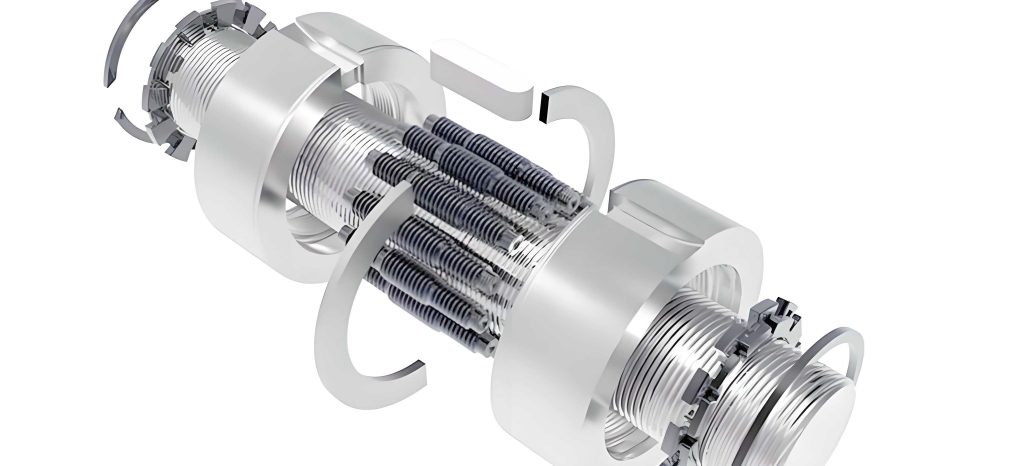
The image above provides a clear visual of the intricate structure of a planetary roller screw. One can appreciate the multiple thread engagements between the screw, the rollers, and the nut, which is the source of its superior load-bearing characteristics compared to a ball screw’s discrete point contacts.
The Mechanical Heart: Why the Planetary Roller Screw is a Superior Choice
The motion conversion stage is the critical juncture where high-speed, low-torque rotation becomes the high-force, low-speed linear motion needed for clamping. While ball screws are well-understood and widely used, my analysis strongly points to the planetary roller screw as the more capable solution for demanding automotive braking applications. The advantages are rooted in fundamental mechanics.
1. Unmatched Load Capacity and Lifetime
The core advantage lies in the contact mechanics. A ball screw transmits load through discrete points of Hertzian contact between the balls and the raceways. In contrast, a planetary roller screw utilizes full line contact between the threads of the screw, the multiple planetary rollers, and the nut. The implications are profound. According to Hertzian contact theory, for a given load \( F \), the contact stress \( \sigma_H \) is significantly lower for a line contact than for a point contact. A simplified comparison can be shown:
For a ball (point) contact, the maximum Hertzian stress is proportional to:
$$ \sigma_{H, ball} \propto \sqrt[3]{\frac{F}{R^2}} $$
For a roller (line) contact, the maximum Hertzian stress is proportional to:
$$ \sigma_{H, roller} \propto \sqrt{\frac{F}{L R}} $$
where \( F \) is the load, \( R \) is an effective radius of curvature, and \( L \) is the length of contact.
The lower contact stress for a given load directly translates to a higher static and dynamic load rating. Industry data and my own comparative modeling suggest that for similarly sized envelopes, a planetary roller screw can support static loads 3 to 5 times greater than a ball screw. This directly impacts the actuator’s size for a required clamping force; a smaller, more compact planetary roller screw can achieve the same duty. Furthermore, the reduced stress drastically extends the fatigue life. It is not uncommon for a planetary roller screw to exhibit a calculated L10 life (time at which 90% of units survive) that is an order of magnitude (10-15x) longer than an equivalent ball screw under the same operating conditions.
2. Superior Stiffness and Dynamic Response
Brake feel and controllability are heavily influenced by the axial stiffness of the actuator. A compliant system leads to spongy feedback and challenges in precise force control. The multiple load-bearing lines of contact in a planetary roller screw assembly give it a much higher axial stiffness compared to a ball screw. This stiffness, \( k_{axial} \), can be approximated by considering the stiffness of each roller contact path in parallel:
$$ k_{axial} \approx N \cdot k_{contact} $$
where \( N \) is the number of load-bearing rollers (often 6-10 in a planetary roller screw) and \( k_{contact} \) is the stiffness of a single thread engagement. This high stiffness minimizes elastic deflection under load, enabling more accurate and immediate force transmission from the motor to the brake pad, which is crucial for the high-bandwidth control required by modern stability systems.
3. High-Speed and High-Efficiency Potential
While ball screws can suffer from ball centrifugal forces and whirl at very high rotational speeds, the kinematics of the planetary roller screw are inherently more stable. This allows the screw to be driven at higher rotational speeds, enabling faster pad approach (important for minimizing brake response time) and retraction. The efficiency \( \eta \) of a planetary roller screw is also very high, typically exceeding 90%, and is less susceptible to rapid degradation under high load than a ball screw. The efficiency can be modeled considering friction losses:
$$ \eta = \frac{P_{out}}{P_{in}} = \frac{F \cdot v}{\tau \cdot \omega} $$
where \( F \) is the output force, \( v \) is the linear speed, \( \tau \) is the input torque, and \( \omega \) is the input angular velocity. The high efficiency means more of the motor’s electrical power is converted into useful clamping force, reducing thermal losses in the actuator itself.
| Performance Parameter | Ball Screw Actuator | Planetary Roller Screw Actuator | Implication for EMB |
|---|---|---|---|
| Load Carrying Mechanism | Point contact (Hertzian) | Line contact (Hertzian) | PRS has inherently lower contact stress. |
| Static Load Capacity | Baseline (1x) | 3x – 5x Higher | More compact actuator design for same force; higher safety margin. |
| Axial Stiffness | Moderate | Very High | Superior brake feel, precise force control, better dynamic response. |
| Lifetime (L10) | Baseline (1x) | 10x – 15x Longer | Dramatically improved reliability and durability over vehicle lifespan. |
| Maximum Operational Speed | Limited by ball whirl | Higher | Faster pad approach/retraction, shorter overall system response time. |
| Mechanical Efficiency | High (>85%) | Very High (>90%) | Reduced thermal load on the actuator for same output work. |
| Backlash | Can be preloaded to near-zero | Can be preloaded to near-zero | Both are capable of precise positioning. |
| Cost & Manufacturing Complexity | Lower | Significantly Higher | Major barrier for PRS adoption in mass-market vehicles. |
| Friction & Heat Generation | Lower rolling friction | Higher sliding/rolling friction mix | PRS may require more sophisticated thermal management. |
Confronting the Challenges: A Realistic Perspective
Despite its compelling mechanical advantages, the path to widespread adoption of the planetary roller screw in EMB systems is not without significant hurdles. A balanced view requires a thorough examination of these challenges.
1. Cost and Manufacturing Complexity
This is the most formidable barrier. A planetary roller screw is a masterpiece of precision engineering. It consists of a central screw, a nut, multiple planetary rollers (each with precise threads), a carrier for the rollers, and synchronization gears (often internal ring gears). Manufacturing these components, especially the hardened and ground threads on all parts with tight tolerances for smooth rolling and minimal backlash, is exponentially more complex and expensive than producing a ball screw. The assembly process is also more delicate. For the cost-sensitive automotive industry, this currently limits the planetary roller screw to premium or specialized vehicle segments unless breakthrough manufacturing techniques are developed.
2. Thermal Management and Friction
The very nature of the multiple line contacts, while great for load distribution, increases the total frictional interface area compared to a ball screw. Under high-frequency braking cycles or sustained braking (e.g., downhill descent), the power dissipated as heat within the planetary roller screw assembly can be substantial. The efficiency \( \eta \) mentioned earlier, while high, still implies losses \( P_{loss} = P_{in}(1-\eta) \). If this heat is not effectively managed, it can lead to:
- Thermal expansion, potentially causing binding or increased preload.
- Degradation of the lubricant, leading to increased wear.
- Heat transfer to the motor and brake pad, affecting their performance.
Therefore, an EMB actuator using a planetary roller screw must incorporate thoughtful thermal design—using materials with good thermal conductivity, integrating heat sinks, or even active cooling in extreme cases—adding to complexity and cost.
3. System-Level Integration Challenges
The EMB system’s success depends on more than just a robust actuator. The high power demand of four independent, high-force actuators necessitates a vehicle electrical system beyond the traditional 12V. A 48V or even higher voltage architecture is practically a prerequisite, which involves redesigning other vehicle systems. Furthermore, the “dry” nature of EMB removes the hydraulic system’s inherent failure-mode of gradual pressure loss. A single-point electronic failure could be catastrophic. This demands rigorous fault-tolerant design with redundancy in power supply, communication networks (e.g., dual CAN FD or Ethernet), and possibly partial mechanical backup systems, all of which add weight and cost.
| Challenge Category | Specific Issue | Potential Mitigation Strategy |
|---|---|---|
| Economic & Manufacturing | High unit cost of PRS | Develop high-volume, net-shape manufacturing (e.g., powder metallurgy, precision forging). Design simplification where possible. |
| Thermal | Heat generation in PRS thread contacts | Optimized low-friction thread profiles. Advanced, high-temperature lubricants. Integrated thermal paths/heat sinks in caliper design. |
| Motor heating during sustained braking | Use of high-temp motor windings. Liquid cooling jacket for motor. Intelligent torque control to manage thermal load. | |
| System & Reliability | High peak electrical power demand | Adoption of 48V/800V vehicle architectures. Local energy storage (supercapacitors) at each wheel. |
| Single-point electronic failure | Fully redundant power and communication lines. Mechanical fail-safe (e.g., spring-applied park brake that can be partially engaged). | |
| Control complexity | Advanced sensor fusion (motor current/position, direct force sensing). Robust adaptive control algorithms to compensate for pad wear and temperature. |
Mathematical Modeling and Control Considerations
To effectively design and control an EMB with a planetary roller screw, a dynamic model is essential. A simplified lumped-parameter model can be described as follows:
The motor’s electromagnetic torque \( \tau_m \) overcomes inertia and friction to drive the gear reduction and the screw:
$$ \tau_m = J_{tot} \cdot \dot{\omega}_m + b \cdot \omega_m + \tau_{load} $$
where \( J_{tot} \) is the total inertia reflected to the motor shaft (including motor rotor, gears, and the screw/rollers/nut assembly), \( \omega_m \) is the motor angular velocity, \( b \) is a viscous friction coefficient, and \( \tau_{load} \) is the load torque from the planetary roller screw.
The load torque is related to the desired clamping force \( F_{clamp} \) and the mechanics of the planetary roller screw:
$$ \tau_{load} = \frac{F_{clamp} \cdot p}{2 \pi \cdot \eta \cdot i} $$
where \( p \) is the lead of the planetary roller screw (linear travel per revolution), \( \eta \) is the mechanical efficiency (which itself is a function of load and speed), and \( i \) is the gear reduction ratio.
The linear position \( x \) of the nut (and thus the brake pad) is related to the screw rotation:
$$ x = \frac{p \cdot \theta_m}{2 \pi \cdot i} $$
where \( \theta_m \) is the motor angular position.
Finally, the clamping force acts against the stiffness of the brake pad and corner assembly:
$$ F_{clamp} = k_{pad} \cdot (x – x_{contact}) + F_{preload} $$
where \( k_{pad} \) is the combined stiffness, \( x_{contact} \) is the position where pad-disk contact is made, and \( F_{preload} \) might represent a small initial force.
Controlling this system requires a cascade control structure, typically with an outer force loop and an inner velocity/current loop for the motor. The non-linearities in the planetary roller screw efficiency \( \eta \) and friction, as well as the changing \( x_{contact} \) point due to pad wear, make this a non-trivial control problem, often addressed with adaptive or robust control techniques.
Conclusion and Future Trajectory
My in-depth exploration solidifies the position that the planetary roller screw is a technologically superior solution for the core actuation mechanism in high-performance Electromechanical Braking systems. Its unparalleled load capacity, stiffness, and durability directly address the critical demands of safety, responsiveness, and longevity in automotive braking. The technical arguments, supported by contact mechanics and comparative analysis, are overwhelmingly in its favor.
However, the transition from a technically optimal solution to a commercially viable one is governed by the economics of manufacturing and system integration. The current high cost and thermal management requirements of the planetary roller screw present significant barriers for mass-market passenger vehicles. Yet, the trajectory is clear. As the automotive industry accelerates towards electrification and higher levels of autonomy, the value proposition of EMB systems grows stronger. The demand for compact, powerful, and ultra-reliable brake-by-wire systems will intensify, particularly in premium EVs and autonomous vehicle platforms where performance and redundancy are paramount.
I anticipate that focused research and development will gradually lower the cost barrier for the planetary roller screw through innovative manufacturing processes and design optimization. Simultaneously, the maturation of 48V+ vehicle architectures and fault-tolerant E/E platforms will solve the systemic integration challenges. Therefore, while the initial adoption of planetary roller screw-based EMB may be in niche, performance-oriented applications, it is poised to become a benchmark technology, gradually trickling down as the definitive actuation solution for the brake-by-wire systems that will define the future of mobility. The journey from hydraulic lines to digital signals finds its most robust mechanical ally in the planetary roller screw.