
The pursuit of high-fidelity motion control in advanced robotics and precision automation is fundamentally dependent on the performance of its core transmission components. Among these, the rotary vector reducer stands as a pivotal element, renowned for its compact design, high torque capacity, and substantial reduction ratio. The transmission accuracy and operational smoothness of a rotary vector reducer directly dictate the positioning precision and dynamic performance of the entire robotic system. However, during the manufacturing and assembly stages of a rotary vector reducer, geometric errors are inevitably introduced. These errors, particularly angular misalignments in critical components like crankshafts, cycloidal gears, and the pin housing, propagate through the assembly and significantly degrade the final kinematic performance. Simply tightening manufacturing tolerances to suppress these errors leads to prohibitive costs. Therefore, developing a systematic methodology for both adjusting these errors during assembly and optimally allocating tolerances during design is of paramount importance for the cost-effective production of high-precision rotary vector reducers.
This article presents a comprehensive framework that addresses this challenge. The core of the method is the application of a state-space model to represent the error propagation during the assembly of a rotary vector reducer. This model, combined with principles from optimal control theory, allows for the calculation of the best possible adjustments at each assembly step, considering the trade-offs between final accuracy, adjustment effort, and measurement uncertainty. Subsequently, the established relationship between component errors and final performance is used within an optimization routine to allocate manufacturing tolerances in a way that minimizes total production cost while meeting a specified accuracy target. We will illustrate this entire process using a representative rotary vector reducer model, detailing the construction of the error flow, the state-space formulation, the optimal adjustment strategy, and the final tolerance allocation.
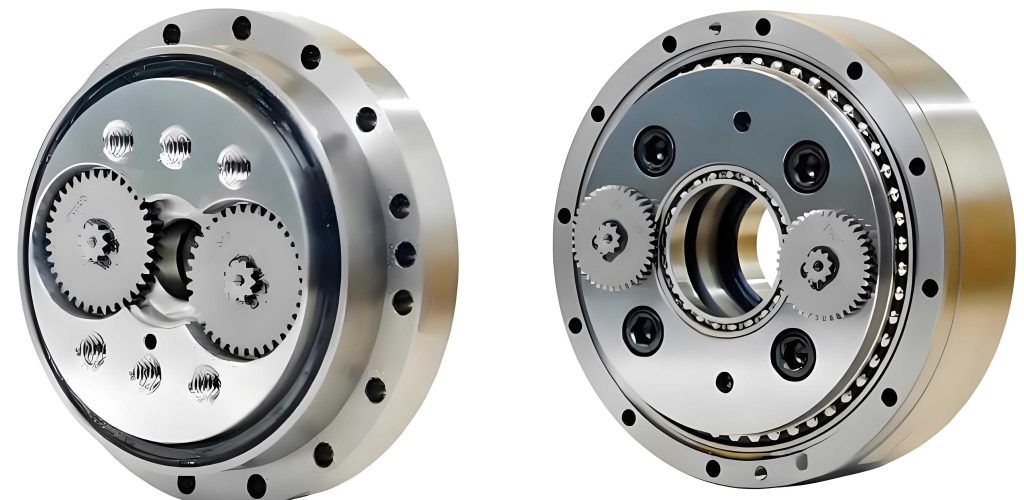
The primary performance metric for a rotary vector reducer is its dynamic transmission error. It quantifies the deviation between the theoretical output motion and the actual output motion, with smaller values indicating higher precision and smoother operation. For a rotary vector reducer with a transmission ratio \(i_z\), the dynamic transmission error \(\theta_e(t)\) is defined as:
$$
\theta_e(t) = \frac{\theta_i(t)}{i_z} – \theta_o(t)
$$
where \(\theta_i(t)\) is the theoretical input angle and \(\theta_o(t)\) is the actual output angle. The goal of our assembly adjustment and tolerance design is to minimize the impact of component errors on \(\theta_e(t)\).
Error Flow Modeling via Key Characteristics
The first step in controlling error propagation is to map how errors flow through the assembly. We employ the concept of Key Characteristics (KCs), which are the critical geometric features on parts that directly influence the final assembly performance. For a rotary vector reducer, the angular relationships between the central axes of its core components are crucial. We typically define the axis of the pin housing (KC0) as the primary datum or reference for the entire assembly. Other critical features include the axes of the crankshaft eccentric journals (KC1, KC3) and the axes of the cycloidal gear bearing bores (KC2, KC4).
The sequence of how these KCs are established relative to each other forms a Datum Flow Chain (DFC). In our case, two primary chains originate from the pin housing datum KC0: one for the first stage (crankshaft 1 and its corresponding cycloidal gear) and another for the second parallel stage. The angular error of any KC can be described by a differential rotation vector \(\delta_n\) relative to the primary datum frame:
$$
\delta_n = [\delta^x_n, \delta^y_n, \delta^z_n]^T
$$
This error accumulates from the contributions of individual part errors \(\Delta\theta_n\) introduced at each assembly step, transformed through the appropriate kinematic relationships defined by the DFC.
State-Space Model of the Assembly Process
The assembly process is a sequential, discrete-time system where errors accumulate and can be adjusted. A state-space model is an ideal formalism for this. The “state” of the assembly at step \(k\), denoted \(\mathbf{x}(k)\), is a vector containing the differential rotation vectors of all defined KCs at that stage. The model is given by:
$$
\begin{aligned}
\mathbf{x}(k+1) &= \mathbf{A}(k)\mathbf{x}(k) + \mathbf{B}(k)\mathbf{u}(k) + \mathbf{F}(k)\mathbf{w}(k) \\
\mathbf{y}(k) &= \mathbf{C}(k)\mathbf{x}(k) + \mathbf{v}(k)
\end{aligned}
$$
Let’s break down each term:
- \(\mathbf{x}(k)\): The state vector containing all KC angular errors at assembly step \(k\).
- \(\mathbf{A}(k)\): The state transition matrix. In many mechanical assemblies, and often for the rotary vector reducer when considering error propagation from one step to the next without rigid body motion changes, this is an identity matrix.
- \(\mathbf{u}(k)\): The adjustment vector. This is a critical control input. It represents the deliberate angular corrections applied to the KCs during assembly step \(k\) to compensate for accumulated errors.
- \(\mathbf{B}(k)\): The control input matrix. It maps the adjustment \(\mathbf{u}(k)\) from the part coordinate system to the global datum frame.
- \(\mathbf{w}(k)\): The process noise or new error vector. It represents the inherent angular error \(\Delta\theta_k\) of the new part being added at step \(k\), expressed in its local coordinate system.
- \(\mathbf{F}(k)\): The noise input matrix. Similar to \(\mathbf{B}(k)\), it transforms the part error \(\mathbf{w}(k)\) into the global datum frame. Often, \(\mathbf{B}(k)\) and \(\mathbf{F}(k)\) are identical if adjustments and part errors are defined in the same coordinate frame.
- \(\mathbf{y}(k)\): The measurement vector. This is what an assembler can actually measure at step \(k\), such as parallelism or perpendicularity between specific features.
- \(\mathbf{C}(k)\): The observation matrix. It selects which states (KCs) are involved in the measurement \(\mathbf{y}(k)\).
- \(\mathbf{v}(k)\): The measurement noise vector, accounting for uncertainty in the measurement process.
For a typical rotary vector reducer assembly with two crankshafts and two cycloidal gears, the state vector might be \(\mathbf{x} = [\delta_1, \delta_2, \delta_3, \delta_4]^T\). The matrices \(\mathbf{F}(k)\) and \(\mathbf{B}(k)\) are constructed from the coefficients that relate part errors to KC errors based on the DFC. A simplified 2D example for one DFC could be:
$$
\begin{bmatrix}
\delta_1(N) \\ \delta_2(N)
\end{bmatrix}
=
\begin{bmatrix}
1 & 0 \\ 1 & 1
\end{bmatrix}
\begin{bmatrix}
\Delta\theta_1 \\ \Delta\theta_2
\end{bmatrix}
$$
This implies the error of KC2 (\(\delta_2\)) is the sum of the error from the first part (\(\Delta\theta_1\)) and the error of the second part itself (\(\Delta\theta_2\)).
Optimal Adjustment Strategy for Assembly
Given the state-space model, the assembly adjustment problem becomes one of optimal control: find the sequence of adjustments \(\mathbf{u}(k)\) that leads to the best final accuracy with reasonable effort. We define a quadratic cost function \(J\) that balances these competing objectives:
$$
J = \mathbf{y}^T(N)\mathbf{Q}(N)\mathbf{y}(N) + \sum_{k=0}^{N-1} \left[ \mathbf{u}^T(k)\mathbf{R}(k)\mathbf{u}(k) \right]
$$
- The first term, \(\mathbf{y}^T(N)\mathbf{Q}(N)\mathbf{y}(N)\), penalizes the final geometric errors after the last assembly step \(N\). The matrix \(\mathbf{Q}(N)\) is a diagonal weight matrix. A higher weight for a particular error in \(\mathbf{Q}(N)\) signifies that this specific geometric precision is more critical for the function of the rotary vector reducer.
- The second term, \(\sum \mathbf{u}^T(k)\mathbf{R}(k)\mathbf{u}(k)\), sums the cost of adjustments made throughout the process. The matrix \(\mathbf{R}(k)\) is also a diagonal weight matrix. A high value in \(\mathbf{R}(k)\) for a specific adjustment degree of freedom indicates that making that adjustment is difficult, time-consuming, or expensive.
The objective is to minimize \(J\). The solution, derived from optimal control theory (specifically, the linear-quadratic regulator for a deterministic system), yields the optimal adjustment at each step \(k\) as a linear function of the current estimated state:
$$
\mathbf{u}^*(k) = -\mathbf{K}(k)\mathbf{x}(k)
$$
The gain matrix \(\mathbf{K}(k)\) is computed recursively backwards from the final step \(N\) using the following equations:
$$
\begin{aligned}
\mathbf{K}(k) &= \left[ \mathbf{R}(k) + \mathbf{B}^T(k)\mathbf{P}(k+1)\mathbf{B}(k) \right]^{-1} \mathbf{B}^T(k)\mathbf{P}(k+1)\mathbf{A}(k) \\
\mathbf{P}(k) &= \mathbf{Q}(k) + \mathbf{A}^T(k)\mathbf{P}(k+1)\left[ \mathbf{I} + \mathbf{B}(k)\mathbf{R}^{-1}(k)\mathbf{B}^T(k)\mathbf{P}(k+1) \right]^{-1}\mathbf{A}(k)
\end{aligned}
$$
with the terminal condition \(\mathbf{P}(N) = \mathbf{Q}(N)\). This calculation requires prior definition of the assembly sequence, the \(\mathbf{A}(k)\), \(\mathbf{B}(k)\), \(\mathbf{C}(k)\) matrices, and the weight matrices \(\mathbf{Q}(N)\) and \(\mathbf{R}(k)\).
Case Study: Application to a BX40E-type Rotary Vector Reducer
To demonstrate the method, we apply it to a model of a BX40E-type rotary vector reducer. We consider a simplified 2D plane where angular errors are rotations about the Z-axis (out-of-plane). Our KCs are: KC0 (Pin Housing datum), KC1 & KC3 (Crankshaft axes), and KC2 & KC4 (Cycloidal Gear axes). The assembly sequence is defined as four steps: 1) Install Crankshaft 1 (establish KC1), 2) Install Cycloidal Gear 1 (establish KC2), 3) Install Crankshaft 2 (establish KC3), 4) Install Cycloidal Gear 2 (establish KC4).
The state vector is \(\mathbf{x} = [\delta_1, \delta_2, \delta_3, \delta_4]^T\). The error propagation model, based on the DFC, is:
$$
\mathbf{x}(k+1) = \mathbf{x}(k) +
\begin{bmatrix}
1 & 0 & 0 & 0 \\
1 & 1 & 0 & 0 \\
0 & 0 & 1 & 0 \\
0 & 0 & 1 & 1
\end{bmatrix} \Delta\boldsymbol{\theta}(k)
$$
Thus, \(\mathbf{A}(k)=\mathbf{I}\) and \(\mathbf{B}(k)=\mathbf{F}(k)\) is the constant matrix shown above. The adjustment matrix \(\mathbf{T}(k)\) defines which KCs can be adjusted at each step (1 means adjustable). The adjustment weight matrix \(\mathbf{R}(k)\) assigns a cost to adjusting each KC. A very high value (e.g., 1000) implies the feature is not yet assembled and cannot be adjusted. The final measurement is the parallelism of gear axes relative to the housing, so \(\mathbf{C}(4) = \begin{bmatrix}1 & 0 & 1 & 0 \\ 0 & 1 & 0 & 1\end{bmatrix}\), meaning we measure the combined error of KC1+KC3 and KC2+KC4.
| Assembly Step k | Adjustable Features T(k) | Adjustment Cost Weights R(k) |
|---|---|---|
| 1 | [KC1: adjustable] | Cost(KC1)=5, others=1000 |
| 2 | [KC1, KC2: adjustable] | Cost(KC1)=10, Cost(KC2)=5, others=1000 |
| 3 | [KC1, KC2, KC3: adjustable] | Cost(KC1)=10, Cost(KC2)=5, Cost(KC3)=5, KC4=1000 |
| 4 | [All KCs adjustable] | Cost(KC1)=10, Cost(KC2)=5, Cost(KC3)=10, Cost(KC4)=5 |
We set the final accuracy weight matrix as \(\mathbf{Q}(4) = Q \cdot \mathbf{I}\), where \(Q\) is a scalar “precision weight” we can vary. A higher \(Q\) places more emphasis on minimizing final geometric error versus adjustment cost. We calculate the optimal gain matrices \(\mathbf{K}(k)\) for different values of \(Q\).
Now, suppose a set of parts with the following inherent angular errors (in milli-radians) arrives for assembly:
| Part Error | Step 1 (Δθ₁) | Step 2 (Δθ₂) | Step 3 (Δθ₃) | Step 4 (Δθ₄) |
|---|---|---|---|---|
| Value (10⁻³ rad) | -1.6 | 5.3 | 5.8 | 3.2 |
Applying the optimal adjustment law \(\mathbf{u}^*(k) = -\mathbf{K}(k)\mathbf{x}(k)\) at each step, we can simulate the assembly. The state \(\mathbf{x}(k)\) evolves, and adjustments are applied. The final state \(\mathbf{x}(4)\) after the last adjustment represents the residual angular errors in the assembled rotary vector reducer. The following table shows how the final error (specifically for one KC, as an example) and the resulting transmission performance change with the precision weight \(Q\).
| Precision Weight Q | Final KC Error Example (10⁻³ rad) | Transmission Error Amplitude (arcsec) | Peak Dynamic Meshing Force (N) | Relative Improvement vs Q=0 |
|---|---|---|---|---|
| 0 (No adjustment emphasis) | High residual error | Largest | Highest | 0% Baseline |
| 5 | Significantly reduced | ~40% smaller | ~20% lower | Substantial |
| 10 | Further reduced | ~50% smaller | ~25% lower | Marginal gain over Q=5 |
| ∞ (Ideal, error-free) | 0 | Smallest | Lowest | 100% Ideal |
The results clearly demonstrate the efficacy of the method. As \(Q\) increases, the optimal controller makes more aggressive adjustments to minimize the final geometric errors of the rotary vector reducer. This leads to a direct improvement in transmission accuracy (reduced transmission error amplitude) and dynamic smoothness (reduced peak meshing forces). However, the law of diminishing returns is evident; the improvement from \(Q=5\) to \(Q=10\) is less dramatic than from \(Q=0\) to \(Q=5\). This analysis allows a production engineer to select a \(Q\) value that achieves the necessary performance for the rotary vector reducer without incurring unnecessarily high adjustment costs.
Optimal Tolerance Allocation Based on the Model
The state-space model not only guides adjustment but also provides the precise mathematical relationship between part tolerances (the variance of \(\mathbf{w}(k)\)) and the final assembly variation (the variance of \(\mathbf{y}(N)\)). Ignoring adjustments for allocation design and considering the propagation of variances, the final KC errors can be expressed as a linear combination of the individual part manufacturing errors:
$$
\mathbf{P} = \mathbf{J} \cdot \mathbf{V}
$$
where \(\mathbf{P}\) is the vector of final KC error sensitivities, \(\mathbf{V}\) is the vector of part angle tolerances (e.g., \(v_{1x}, v_{1y}, …\) for Crankshaft 1), and \(\mathbf{J}\) is the Jacobian matrix derived from the state-space model coefficients (like the \(\mathbf{F}(k)\) matrices). For our simplified 2D model, this might look like:
$$
\begin{bmatrix}
P_1 \\ P_2 \\ P_3 \\ P_4
\end{bmatrix}
=
\begin{bmatrix}
J_{11} & 0 & 0 & 0 \\
J_{21} & J_{22} & 0 & 0 \\
0 & 0 & J_{33} & 0 \\
0 & 0 & J_{43} & J_{44}
\end{bmatrix}
\begin{bmatrix}
v_1 \\ v_2 \\ v_3 \\ v_4
\end{bmatrix}
$$
The tolerance allocation problem is then: Find the set of part tolerances \(\mathbf{V}\) that minimizes the total manufacturing cost \(C_{total} = \sum_i C_i(v_i)\), subject to the constraint that the resulting final assembly variation (calculated from \(\mathbf{P}\)) meets the specification for the rotary vector reducer’s transmission accuracy.
A common cost-tolerance model is the reciprocal or exponential function, e.g., \(C_i(v_i) = a_i / v_i^{b_i}\). We can use an optimization algorithm like a Genetic Algorithm to solve this nonlinear constrained problem. The design variables are the tolerances for each angular degree of freedom of each key part in the rotary vector reducer.
Running such an optimization for our BX40E-type reducer model, with the objective of minimizing total cost while ensuring the composite final KC error is below a threshold, yields an optimal tolerance set. The result typically assigns tighter tolerances to parts whose errors have a larger sensitivity coefficient in the \(\mathbf{J}\) matrix (i.e., parts that influence the final error more), and looser tolerances to less sensitive parts.
| Component | Angle Tolerance v_x (10⁻³ rad) | Angle Tolerance v_y (10⁻³ rad) | Angle Tolerance v_z (10⁻³ rad) |
|---|---|---|---|
| Crankshaft 1 | 1.71 | 1.66 | 1.69 |
| Cycloidal Gear 1 | 2.63 | 2.62 | 2.62 |
| Crankshaft 2 | 1.54 | 1.52 | 1.52 |
| Cycloidal Gear 2 | 1.26 | 1.26 | 1.26 |
This allocation suggests that, for this specific rotary vector reducer design and assembly sequence, the crankshafts require slightly tighter angular tolerances than the cycloidal gears to achieve the system-level precision goal at the lowest possible cost. This is a non-intuitive result that purely cost-based or experience-based tolerance allocation might miss, highlighting the power of the model-based approach.
Conclusion
The integration of state-space modeling, optimal control theory, and cost optimization provides a powerful, systematic methodology for enhancing the precision of rotary vector reducers. This approach moves beyond trial-and-error in both the workshop and the design office. Firstly, it gives assembly technicians a scientifically derived, optimal adjustment sequence that explicitly balances the final accuracy of the rotary vector reducer with the practical cost of making adjustments. Secondly, it provides design engineers with a rational method to allocate manufacturing tolerances, achieving the required performance specification for the rotary vector reducer at the minimum possible production cost. The case study demonstrates that while increasing the precision focus (higher Q) continuously improves performance, the marginal benefit decreases. Therefore, selecting an appropriate precision weight based on actual application requirements is crucial for economic manufacturing. This holistic framework, connecting assembly process control with design-stage tolerance allocation, offers a significant advancement for the robust and cost-effective production of high-performance rotary vector reducers.