
In recent years, the transformation and upgrading of the manufacturing industry, along with national initiatives such as the “machine replacement” project, have propelled the application of robotics and high-end数控 equipment to a climax. However, the RV reducer, based on robotic technology, has always been a technical challenge that directly impacts the performance indicators of robots. The RV reducer is a减速器 with the highest stiffness and lowest vibration for robotic applications, capable of improving the dynamic characteristics during robot operation, reducing transmission backlash, and offering advantages such as compact size, lightweight, high transmission ratio range, high load capacity, high motion accuracy, and high transmission efficiency. The RV减速传动装置 is not only used in robotics but also widely applied in the数控机床 industry, for instance, in数控车床 (NC) spindle indexing drives,加工中心 (MC) coordinate axis drives, factory automation (FA)领域, flexible manufacturing units, and precision servo mechanisms. Currently, China is in a transitional phase from a manufacturing giant to a manufacturing powerhouse, with an increasing number of automated production lines in factories. The use of robots and数控机床 is becoming increasingly普及 in enterprises. With the advancement of manufacturing technology in China, the industrial market prospects for RV减速器 driving robots and数控 equipment are vast, with significant socio-economic benefits.
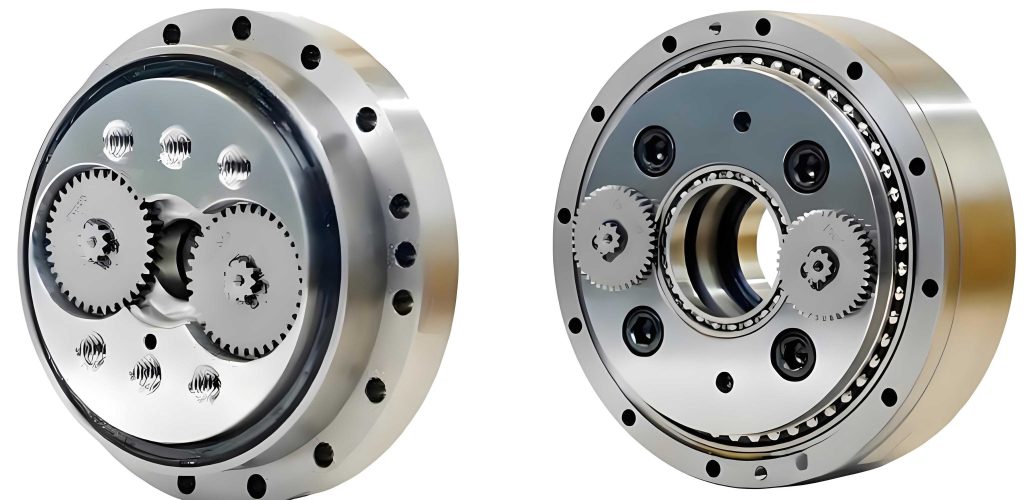
From a structural perspective, the RV减速器 product is composed of a first-stage involute gear transmission and a second-stage cycloid pin-wheel planetary transmission connected in series. The involute gear transmission constitutes the first stage, while the cycloid gear planetary transmission constitutes the second stage. In the second-stage pin-cycloid transmission, the meshing transmission between the cycloid gear and the pin gear housing adopts a structure without pin teeth,即 the internal tooth profile does not use rolling pin teeth but directly employs a cycloid tooth profile. This structure imposes higher requirements on the machining accuracy, surface quality, hardness, strength, and dynamic balance of the cycloid gear and pin gear housing components. To enhance the load-bearing capacity of the RV减速器 and ensure internal force balance during operation, power is input via a gear shaft,然后由两个从动齿轮分别带动两根曲轴同步驱动摆线轮工作. The second-stage transmission of the RV减速器 involves the crankshaft driving the cycloid gear to perform planetary motion. For load balance, two cycloid gears are typically used, installed倒置 at 180 degrees. The cycloid gear meshes with the pin gear housing to generate减速 motion, which is then输出 via the crankshaft拨动 output盘.
Upon解剖 the structure of the RV减速器 product, it becomes evident that the most critical components are the cycloid gear and the pin gear housing. This article focuses on discussing the machining process of the cycloid gear component. The material of the cycloid gear component is bearing steel GCr15, with dimensional accuracy and geometric tolerances reaching high precision levels of 5 and 6; low roughness values required, achieving Ra0.8 or Ra0.4; the cycloid tooth profile curve requires precise modification, with tooth profile pitch tolerance of 0.03mm and cumulative pitch tolerance of 0.075mm; to ensure the strength and hardness requirements of the cycloid gear tooth profile, the teeth undergo quenching heat treatment, with hardness of HRC60~64. The working drawing of the cycloid gear component is as shown in the figure, highlighting the intricate design and stringent specifications necessary for optimal performance in the RV减速器.
As a researcher involved in the development of RV减速器 technology, I have introduced the Quality Function Deployment (QFD) principle and technique源自日本 to effectively control the研发 quality of new RV减速器 products. By implementing QFD, I established a quality house for RV减速器 process design and production control, enabling面向对象需求的设计 for the new RV减速器 product. This approach helped归纳抽出 the key characteristic elements for the cycloid gear process design and production control stage. The cycloid gear process design scheme is summarized in Table 1, which outlines the工序内容 and key工艺特性 for each step. This methodology ensures that the machining process aligns with the critical requirements of the RV减速器, enhancing overall product reliability.
| Step No. | Process Content | Key Process Characteristics |
|---|---|---|
| 1 | Precision casting of cycloid gear blank from GCr15 bearing steel | Precision casting constrained by part material; blank quality determines final machining accuracy |
| 2 | Isothermal spheroidizing annealing treatment | Holding time and temperature determine part hardness |
| 3 | Shot blasting treatment | Cleaning time affects machining accuracy |
| 4 | Surface cleaning treatment | Cleaning time and solution temperature affect machining accuracy |
| 5 | Phosphating treatment | Phosphating time and temperature determine part hardness |
| 6 | Cold extrusion | Pressure constrained by part material; pressure and grinding allowance determine strength and accuracy |
| 7 | Stress relief annealing treatment | Holding time and temperature determine part hardness |
| 8 | Quenching and tempering treatment | Holding time and temperature determine part hardness |
| 9 | Rough grinding of cycloid gear surfaces, inner hole, pin holes, and cycloid tooth profile | Cutting speed, feed rate, depth of cut, cycloid grinding machine |
| 10 | Finish grinding of cycloid gear surfaces, inner hole, pin holes, and cycloid tooth profile | Cutting speed, feed rate, depth of cut, cycloid grinding machine |
| 11 | Modification treatment of cycloid tooth profile surface | Grinding technology |
| 12 | Inspection of cycloid gear, finished product storage | Inspection and storage procedures |
The cycloid tooth profile in the RV减速器 is mathematically defined by a cycloidal curve, which can be represented using parametric equations. For a standard cycloid generated by a circle of radius \(r\) rolling without slipping on a fixed circle of radius \(R\), the coordinates of a point on the cycloid are given by:
$$ x = (R + r) \cos \theta – e \cos\left(\frac{R + r}{r} \theta\right) $$
$$ y = (R + r) \sin \theta – e \sin\left(\frac{R + r}{r} \theta\right) $$
where \(e\) is the eccentricity distance, and \(\theta\) is the rolling angle parameter. In the context of the RV减速器, the cycloid gear tooth profile often requires modification to optimize load distribution and reduce noise. The modification量 \(\Delta\) can be expressed as a function of the tooth angle \(\phi\):
$$ \Delta(\phi) = \sum_{i=1}^{n} a_i \phi^i $$
where \(a_i\) are coefficients determined through kinematic analysis and simulation for the RV减速器. This mathematical foundation is crucial for precise machining of the cycloid gear, ensuring it meets the high accuracy standards required in the RV减速器 assembly.
During the manufacturing process,质量控制 is paramount to achieve the desired properties in the cycloid gear for the RV减速器. The key elements for production control are listed in Table 2, which details the制造过程质量控制 measures for each step. This table serves as a quality house for the cycloid gear production, integrating the QFD approach to monitor and adjust processes in real-time, thereby maintaining consistency in the RV减速器 components.
| Step No. | Process Content | Manufacturing Process Quality Control |
|---|---|---|
| 1 | Precision casting | Measure workpiece to conform to blank工序尺寸加工要求 |
| 2 | Isothermal spheroidizing annealing | Use temperature-time recorder to record and monitor, ensuring holding time and temperature requirements |
| 3 | Shot blasting treatment | Prepare cleaning solution as per process requirements; visually inspect cleaning effect |
| 4 | Surface cleaning treatment | Prepare cleaning solution as per process requirements; control solution temperature and cleaning time; visually inspect cleaning effect |
| 5 | Phosphating treatment | Prepare phosphating solution as per process requirements; control solution temperature and phosphating time; inspect phosphating quality |
| 6 | Cold extrusion | Control cold extrusion pressure as per process requirements; measure workpiece to satisfy工序尺寸加工要求 |
| 7 | Stress relief annealing treatment | Use temperature-time recorder to record and monitor, conforming to holding time and temperature requirements |
| 8 | Quenching and tempering treatment | Use temperature-time recorder to record and monitor, ensuring holding time and temperature requirements; use hardness tester to inspect workpiece hardness |
| 9 | Rough grinding of cycloid gear | Inspect workpiece; control surface roughness to Ra1.6~0.8, satisfying工序加工精度要求 |
| 10 | Finish grinding of cycloid gear | Inspect workpiece; control surface roughness to Ra0.8~0.4, satisfying工序加工精度要求 |
| 11 | Grinding of cycloid tooth profile surface | Grinding technology |
| 12 | Inspection, finished product storage | Satisfy inspection procedure requirements; store according to保管规程 |
To quantify the control parameters, Table 3 provides the key element parameter values for the cycloid gear production. This table acts as a detailed reference for operators and quality inspectors, ensuring that each step in the RV减速器 manufacturing process adheres to strict standards. The parameters are derived from extensive experimentation and optimization to achieve the best performance in the final RV减速器 product.
| Process Step | Process Characteristic | Production Requirement | Control Method | Inspection Means |
|---|---|---|---|---|
| Precision casting | Precision casting | Leave machining allowance 1-1.5mm | QC inspection | Vernier caliper, micrometer |
| Isothermal spheroidizing annealing | Holding time 3-6 hours; natural cooling | Full-process tracking check | Temperature-time recorder | Recording and monitoring |
| Shot blasting treatment | Cleaning time 10 minutes | Cleaning solution check | Visual inspection of cleaning effect | N/A |
| Surface cleaning treatment | Cleaning solution temperature 80-100°C; rinse with 80°C hot water | Temperature and time control | Visual inspection of cleaning effect | N/A |
| Phosphating treatment | Phosphating temperature 85-90°C; processing time 30-40 minutes | Target and instrument detection | Phosphating solution inspection | Temperature-time recorder |
| Cold extrusion | Pressure 20-25MPa; grinding allowance 0.3-0.5mm | Pressure inspection and检验 | Vernier caliper, micrometer | N/A |
| Stress relief annealing treatment | Holding time 3-5 hours; temperature 550-650°C, cool to room temperature with furnace | Full-process tracking check | Temperature-time recorder | Recording and monitoring |
| Quenching and tempering treatment | Holding time 3-4 hours, hardness HRC58-62; quenching 850-860°C, tempering 150-160°C | Full-process tracking check | Temperature-time recorder, hardness tester | Recording and monitoring |
| Rough grinding of cycloid gear | Grinding | Roughness Ra1.6-0.8 | QC inspection | Micrometer-level千分尺 |
| Finish grinding of cycloid gear | Grinding | Roughness Ra0.8-0.4 | QC inspection | Micrometer-level千分尺 |
| Inspection | Detect machining accuracy | Inspection procedure | Re-inspection | Micrometer-level千分尺 |
| Storage | Store as required | Storage instructions | Registration | Storage ledger |
Integrating the process design and production control tables, I compiled a detailed process flow card for the cycloid gear component, as shown in Table 4. This card serves as a comprehensive guide for the entire machining sequence, from raw material to finished product, ensuring that every aspect of the RV减速器 component is meticulously handled. The flow card includes information on equipment, tooling, and specific parameters for each step, facilitating efficient production and quality assurance in the manufacturing of the RV减速器.
| Process No. | Process Name | Process Content | Workshop | Section | Equipment | Process Equipment |
|---|---|---|---|---|---|---|
| 1 | Casting | Precision casting, leave allowance 1~1.5mm | Casting | Precision Casting | Full-automatic wax injection machine | Precision casting mold, gun-type thermometer |
| 2 | Heat Treatment | Isothermal spheroidizing annealing, holding time 3-6h, natural cooling; temperature 800°C, furnace cool to 650°C | Heat Treatment | Annealing | Spheroidizing annealing furnace | Temperature-time recorder |
| 3 | Surface Treatment | Shot blasting, cleaning time 10min | Heat Treatment | Surface Treatment | Q35 rotary shot blasting machine | Shot blaster, wear-resistant rubber belt, screw conveyor, cleaning solution |
| 4 | Surface Treatment | Surface cleaning, cleaning solution temperature 100°C, then rinse with 80°C hot water; cleaning time 35min | Heat Treatment | Surface Treatment | ZY-5072TY cleaning machine | Temperature-time recorder, water-based solvent |
| 5 | Surface Treatment | Phosphating, phosphating temperature 90°C, processing time 35min | Heat Treatment | Surface Treatment | Medium轨双层磷化设备 | Temperature-time recorder, phosphating solution |
| 6 | Pressure Processing | Cold extrusion, pressure 25MPa, leave grinding allowance 0.3~0.5mm | Forging | Cold Extrusion | Cold extrusion hydraulic press | Cold extrusion mold |
| 7 | Heat Treatment | Stress relief annealing, holding time 3-5h, temperature 600°C, furnace cool to room temperature | Heat Treatment | Annealing | Annealing furnace | Temperature-time recorder |
| 8 | Heat Treatment | Quenching and tempering, holding time 3-4h, hardness HRC58-62; quenching 850°C, tempering 150°C | Heat Treatment | Quenching | Fully enclosed quenching processing center | Temperature-time recorder, hardness tester |
| 9 | Rough Grinding | Rough grind cycloid gear surfaces, inner hole, pin holes, cycloid tooth profile curve, roughness Ra1.6-Ra0.8 | CNC | Grinding | Cycloid grinding machine | Cycloid tooth profile grinding wheel, micrometer |
| 10 | Finish Grinding | Finish grind cycloid gear surfaces, inner hole, pin holes, cycloid tooth profile curve, roughness Ra0.8-Ra0.4 | CNC | Grinding | Cycloid grinding machine | Cycloid tooth profile grinding wheel, micrometer |
| 11 | Bench Work | Grind cycloid gear tooth profile curve | CNC | Bench Work | Grinding oilstone | N/A |
| 12 | Inspection | Inspect, clean, oil seal, store | CNC | Inspection | Inspection table | Micrometer-level千分尺, cycloid gear tooth profile detector |
The machining forces involved in the grinding processes for the cycloid gear can be estimated using empirical formulas. For instance, the tangential grinding force \(F_t\) can be expressed as:
$$ F_t = K \cdot a_p \cdot v_f $$
where \(K\) is a specific grinding force coefficient dependent on the material (e.g., GCr15 steel for the RV减速器 component), \(a_p\) is the depth of cut, and \(v_f\) is the feed rate. This formula helps in optimizing the grinding parameters to achieve the desired surface finish and accuracy for the cycloid gear in the RV减速器. Additionally, the heat treatment processes involve diffusion equations to model temperature distribution. The time-temperature transformation (TTT) diagrams for GCr15 steel are critical, and the hardness after quenching can be related to the cooling rate \(V_c\) through an empirical relation:
$$ \text{Hardness} = A – B \cdot \log(V_c) $$
where \(A\) and \(B\) are material constants. These mathematical models aid in fine-tuning the processes to meet the stringent requirements of the RV减速器.
Through the trial production of RV减速器 prototypes and practical machining of cycloid gear components, I observed that in the production process of cycloid gear parts, the quality house based on QFD for process design and production control,同步 with the零件加工工艺卡 and工序卡, effectively controls the machining quality. The cycloid gear machining process discussed in this article saves over 40% of raw materials, reduces工时 by 50%, decreases energy consumption by 10%, and improves工效 by 1倍, fully ensuring the machining accuracy and surface quality requirements of the cycloid gear components. This efficiency gain is crucial for scaling up production of the RV减速器 in industrial applications, contributing to cost reduction and enhanced competitiveness in the market.
Furthermore, the integration of advanced technologies such as computer-aided design (CAD) and computer-aided manufacturing (CAM) has revolutionized the加工 of cycloid gears for the RV减速器. For example, the tooth profile modification can be simulated using finite element analysis (FEA) to predict stress分布 and wear patterns. The modified cycloid curve can be represented as a superposition of the standard cycloid and a correction function \(f(\theta)\):
$$ x_{\text{mod}} = x + f_x(\theta) $$
$$ y_{\text{mod}} = y + f_y(\theta) $$
where \(f_x(\theta)\) and \(f_y(\theta)\) are polynomial functions determined through optimization algorithms aimed at minimizing transmission error in the RV减速器. This approach ensures that the cycloid gear operates smoothly under varying loads, enhancing the durability and performance of the RV减速器.
In terms of quality assurance, statistical process control (SPC) methods are employed to monitor key parameters such as hardness, roughness, and dimensional accuracy. Control charts are used to track the mean and variability of these parameters over time, ensuring that the production process remains within specified limits. For instance, the hardness measurement for the cycloid gear after quenching can be modeled as a normal distribution with mean \(\mu\) and standard deviation \(\sigma\), and control limits are set at \(\mu \pm 3\sigma\) to detect any deviations. This rigorous monitoring is essential for maintaining the high standards required for the RV减速器 in demanding applications like robotics and数控机床.
The economic impact of optimizing the cycloid gear machining process for the RV减速器 cannot be overstated. By reducing material waste and improving efficiency, manufacturers can lower production costs while increasing output. This aligns with national goals of sustainable manufacturing and supports the broader adoption of RV减速器 technology in various industries. As the demand for precision motion control grows, the RV减速器 will continue to play a pivotal role, and advancements in cycloid gear加工 will drive further innovations. Future research may focus on additive manufacturing techniques for cycloid gears, exploring new materials, or implementing artificial intelligence for real-time process adjustment, all aimed at enhancing the capabilities of the RV减速器.
In conclusion, the加工工艺设计 of the cycloid gear is a critical aspect of RV减速器 manufacturing, requiring a holistic approach that combines theoretical analysis, empirical optimization, and stringent质量控制. Through the application of QFD, mathematical modeling, and advanced machining techniques, I have demonstrated a process that not only meets the high precision and quality standards but also offers significant economic benefits. As the RV减速器 industry evolves, continuous improvement in cycloid gear加工 will be essential to meet the growing demands for performance and reliability in modern automation systems.