
As a researcher deeply immersed in the logistics and automation sectors, I have witnessed the rapid evolution of artificial intelligence (AI) and robotics, which presents unprecedented opportunities for the intelligent transformation of traditional industries. Container ports, as the lifeline of global logistics, face a critical imperative to leverage these emerging technologies to enhance operational efficiency and service quality. Among these innovations, humanoid AI robots stand out due to their flexible operational capabilities and intelligent decision-making functions. They hold the potential to replace traditional manual labor positions, becoming a vital载体 for port automation and intelligence. In this article, I will explore the前瞻性 role of humanoid robots in port applications, drawing on current trends and future possibilities.
The continuous growth of global trade has elevated ports to crucial hubs for cargo flow. However, traditional port operational models suffer from inefficiencies, high costs, and safety hazards, urgently necessitating the introduction of new technologies. Humanoid robots, as a novel type of intelligent device integrating AI and robotics, offer strong adaptability and flexibility, promising revolutionary changes for the port industry. From my perspective, the integration of humanoid robots is not merely an upgrade but a paradigm shift that could redefine port operations entirely.
In traditional port operations, labor-intensive processes dominate. For instance, in container yard areas, tire crane operators control cranes to load, unload, and shift containers between stacks and trucks; at berth operation zones, bridge crane operators manage the transfer of containers between vessels and land; and at lock station areas, personnel conduct on-site inspections and clearances for incoming and outgoing container vehicles. These环节高度依赖人工操作, leading to several drawbacks that I have summarized in the following table:
| Drawback | Description | Impact |
|---|---|---|
| Low Efficiency | Manual operations are slow and inconsistent, constraining overall port throughput. | Bottlenecks in logistics flow, increased waiting times. |
| Safety Risks | Work in harsh environments (e.g., extreme weather, pollution) threatens worker health. | Higher accident rates, potential injuries or fatalities. |
| Rising Labor Costs | Increasing wages and benefits for skilled operators burden port finances. | Reduced profitability, competitive disadvantage. |
| Human Error | Mistakes in操作可能导致集装箱掉落 or vehicle collisions. | Economic losses, equipment damage, operational downtime. |
These issues underscore the urgent need for technological innovation to drive automation and intelligent upgrades in ports. Humanoid robots, with their unique attributes, offer a compelling solution. Let me delve into the characteristics and advantages of humanoid robots, which I believe are pivotal for this transformation.
Humanoid robots are essentially highly intelligent robotic systems capable of simulating and replicating human behaviors to perform various operational tasks. Equipped with powerful computational capabilities, massive storage capacity, and advanced perceptual interaction systems, humanoid robots can be loaded with rich knowledge model libraries and intelligent decision algorithms, enabling rapid understanding and response to complex environments and situations. In port scenarios, for example, humanoid robots can use multi-source heterogeneous sensors—such as vision and audio—to capture and analyze real-time information on object positions, personnel activities, vehicle movements, and other operational states. This allows for dynamic and comprehensive perception of the作业现场环境. The perceived data is then intelligently compared and matched with built-in large-scale knowledge模型库, incorporating relevant作业规范, operational procedures, and safety standards to infer optimal strategies. Based on these decisions, humanoid robots execute precise actions via机电执行装置 like robotic arms or vehicle驾驶舱, autonomously completing tasks such as loading, unloading, and driving.
The advantages of humanoid robots in port operations are manifold, as I have outlined below. To quantify some benefits, we can use formulas to express efficiency gains and cost savings. For instance, the operational efficiency improvement can be modeled as:
$$ \Delta E = \frac{T_{human} – T_{robot}}{T_{human}} \times 100\% $$
where \( \Delta E \) is the percentage increase in efficiency, \( T_{human} \) is the time taken by human operators, and \( T_{robot} \) is the time taken by humanoid robots. Similarly, cost reduction over time can be represented as:
$$ C_{total} = C_{initial} + \sum_{t=1}^{n} \left( C_{maintenance,t} – C_{labor,t} \right) $$
where \( C_{total} \) is the total cost over \( n \) periods, \( C_{initial} \) is the initial investment in humanoid robots, \( C_{maintenance,t} \) is the maintenance cost at time \( t \), and \( C_{labor,t} \) is the labor cost saved at time \( t \). In the long run, \( C_{total} \) tends to be lower for humanoid robot systems due to eliminated labor expenses.
| Advantage | Explanation | Quantitative Benefit |
|---|---|---|
| Continuous Operation | Humanoid robots can work 24/7 without breaks, boosting port throughput. | Up to 30% increase in annual operational hours. |
| Resilience in Harsh Environments | Deployable in extreme conditions (e.g., high heat, radiation) without risk to humans. | Reduction in workplace accidents by over 50%. |
| High Accuracy and Stability | AI-driven decisions minimize errors; precise execution improves consistency. | Error rate decrease from 5% to below 0.1%. |
| Lower Long-term Costs | Despite high upfront costs, savings from no wages and benefits outweigh expenses. | Cost reduction of 40% over a 5-year period. |
| Human-Robot Collaboration | Can协同作业 with humans in complex scenarios, leveraging柔性优势. | Enhanced flexibility in handling unpredictable tasks. |
These advantages make humanoid robots a transformative force in port applications. Now, I will discuss specific application scenarios where humanoid robots can be deployed, drawing from my research and industry observations.
First, in the gradual replacement of truck driver positions, humanoid AI robots can be installed in驾驶舱位置. Using multi-sensor fusion technology, they achieve 360-degree无死角 perception of the environment, forming a全景感知 of the作业现场. By matching real-time data with内置的集装箱堆垛规则 and safety protocols, humanoid robots智能分析决策出最优化的装卸路径. They then control steering wheels, throttles, and brakes to operate tire cranes for efficient container handling. This automation eliminates human intervention, significantly提升作业效率. The process can be encapsulated in a decision model:
$$ \text{Optimal Path} = \arg\min_{p \in P} \left( \sum_{i} w_i \cdot f_i(p) \right) $$
where \( p \) is a path from the set of feasible paths \( P \), \( w_i \) are weights for factors like time and safety, and \( f_i(p) \) are cost functions for each factor.
Second, in large bridge crane transport operations, humanoid robots address传统人工桥吊司机 shortcomings like blind spots and coordination inefficiencies. Mounted on crane systems, they use sensors like vision and radar for全方位实时感知 of cargo status and vessel positions. By integrating data with作业流程模型, humanoid robots dynamically compute optimal装卸路径 and sequences. This ensures高效协同 in moving containers between ships and land. The efficiency gain here can be expressed as:
$$ \eta = \frac{Q_{robot}}{Q_{human}} \times 100\% $$
where \( \eta \) is the relative efficiency, \( Q_{robot} \) is the throughput with humanoid robots, and \( Q_{human} \) is the throughput with human operators. Values of \( \eta \) often exceed 120% in simulations.
Third, in port entry and exit lock station operations, humanoid robot systems can automate tasks like vehicle verification and monitoring. At checkpoints, they use cameras and license plate recognition to采集和识别 vehicle and cargo information, comparing it with通行模型 for validation. For compliant vehicles, humanoid robots智能规划出最优通道路线 and coordinate traffic flow. This prevents illegal activities like unauthorized container movement. The security enhancement can be modeled using a detection probability formula:
$$ P_{detect} = 1 – \prod_{i=1}^{n} (1 – p_i) $$
where \( P_{detect} \) is the overall probability of detecting anomalies, and \( p_i \) are the detection probabilities of individual sensors integrated into the humanoid robot system.
Beyond ports, humanoid robots have broad application potential in related fields such as logistics parks and industrial terminals. In freight logistics parks, they can automate labor-intensive tasks like sorting, loading, and storage, reducing manual labor intensity. Simultaneously, humanoid robots can manage调度 and vehicle coordination through全景感知, optimizing overall park operations. In industrial terminals, humanoid robots can replace workers in装卸搬运作业, handling恶劣环境 without risk to personnel. The versatility of humanoid robots is summarized in the table below:
| Application Scene | Role of Humanoid Robot | Expected Impact |
|---|---|---|
| Container Yard Operations | Autonomous tire crane operation for container handling. | Increase in throughput by 25-35%. |
| Bridge Crane Operations | Intelligent control of cranes for ship-to-shore transfer. | Reduction in operational errors by 90%. |
| Lock Station Management | Automated inspection and traffic coordination. | Decrease in processing time by 40%. |
| Logistics Parks | 货物分拣,装卸, and调度 optimization. | Labor cost savings of up to 60%. |
| Industrial Terminals | Handling of hazardous or repetitive tasks. | Improved safety and 24/7 operation capability. |
However, the落地 of humanoid robots faces significant technological and operational challenges. From my analysis, these hurdles must be addressed to ensure successful integration. I have categorized them below, along with potential mitigation strategies.
One major challenge is the reliability and sustainability of intelligent decision algorithms. While current AI algorithms handle常规作业场景 well,极端、异常复杂 situations may lead to errors. Continuous optimization and large-scale实战训练 are needed to improve robustness. The risk of decision failure can be quantified as:
$$ R = \int_{0}^{T} \lambda(t) \cdot C_{loss} \, dt $$
where \( R \) is the cumulative risk over time \( T \), \( \lambda(t) \) is the failure rate of the humanoid robot’s decision system, and \( C_{loss} \) is the cost of a failure event. Reducing \( \lambda(t) \) through algorithm upgrades is crucial.
Another issue is the need for standardized human-robot collaboration mechanisms. In scenarios requiring临时应急协同, clear规范和协作流程 must be established to minimize沟通摩擦. Additionally, interoperability with other智能系统 requires unified protocols. This can be framed as a coordination problem:
$$ \max_{x,y} U(x,y) \text{ subject to } g(x,y) \leq 0 $$
where \( x \) represents human actions, \( y \) represents humanoid robot actions, \( U \) is the utility function for collaboration efficiency, and \( g \) represents constraints like safety limits.
Economic feasibility is also a concern, as整体系统成本偏高 due to early-stage development. Scaling production is essential for cost reduction. The break-even point can be calculated as:
$$ t_{BE} = \frac{C_{initial}}{S_{annual} – C_{annual}} $$
where \( t_{BE} \) is the break-even time in years, \( C_{initial} \) is the initial investment, \( S_{annual} \) is the annual savings from labor reduction, and \( C_{annual} \) is the annual maintenance cost for humanoid robots. Achieving \( t_{BE} < 3 \) years is often a target for adoption.
Furthermore, personnel training and public acceptance pose social hurdles. Training programs must help workers transition to new roles, while awareness campaigns can enhance心理接受度. The transition success rate \( \sigma \) can be modeled as:
$$ \sigma = \alpha \cdot T_{train} + \beta \cdot A_{public} $$
where \( \alpha \) and \( \beta \) are coefficients, \( T_{train} \) is the effectiveness of training, and \( A_{public} \) is the public acceptance level of humanoid robots.
Lastly, cybersecurity and data privacy present novel threats. Humanoid robots’ reliance on networks makes them vulnerable to黑客攻击. Robust防护机制 are imperative. The security strength \( S \) can be expressed as:
$$ S = -\log_{10}(P_{breach}) $$
where \( P_{breach} \) is the probability of a security breach. Aiming for \( S > 6 \) (i.e., \( P_{breach} < 10^{-6} \)) is advisable for critical infrastructure.
To应对这些挑战, a collaborative effort among governments, port operators, manufacturers, tech companies, and society is essential. Based on my perspective, the following strategies should be pursued:
First, governments should enact法律法规 and产业政策 to create a favorable environment for human-robot共生. Increased funding for R&D can accelerate关键技术攻关 and产业化转化. Second, emphasis on人才培养 through education systems can提升全社会认知. Third,跨界融合 should be encouraged to整合行业资源, fostering integrated innovation for system化解决方案落地. Fourth, exploring新型商业模式 can build sustainable盈利模式和产业生态系统, injecting持久动力 into the humanoid robot industry.
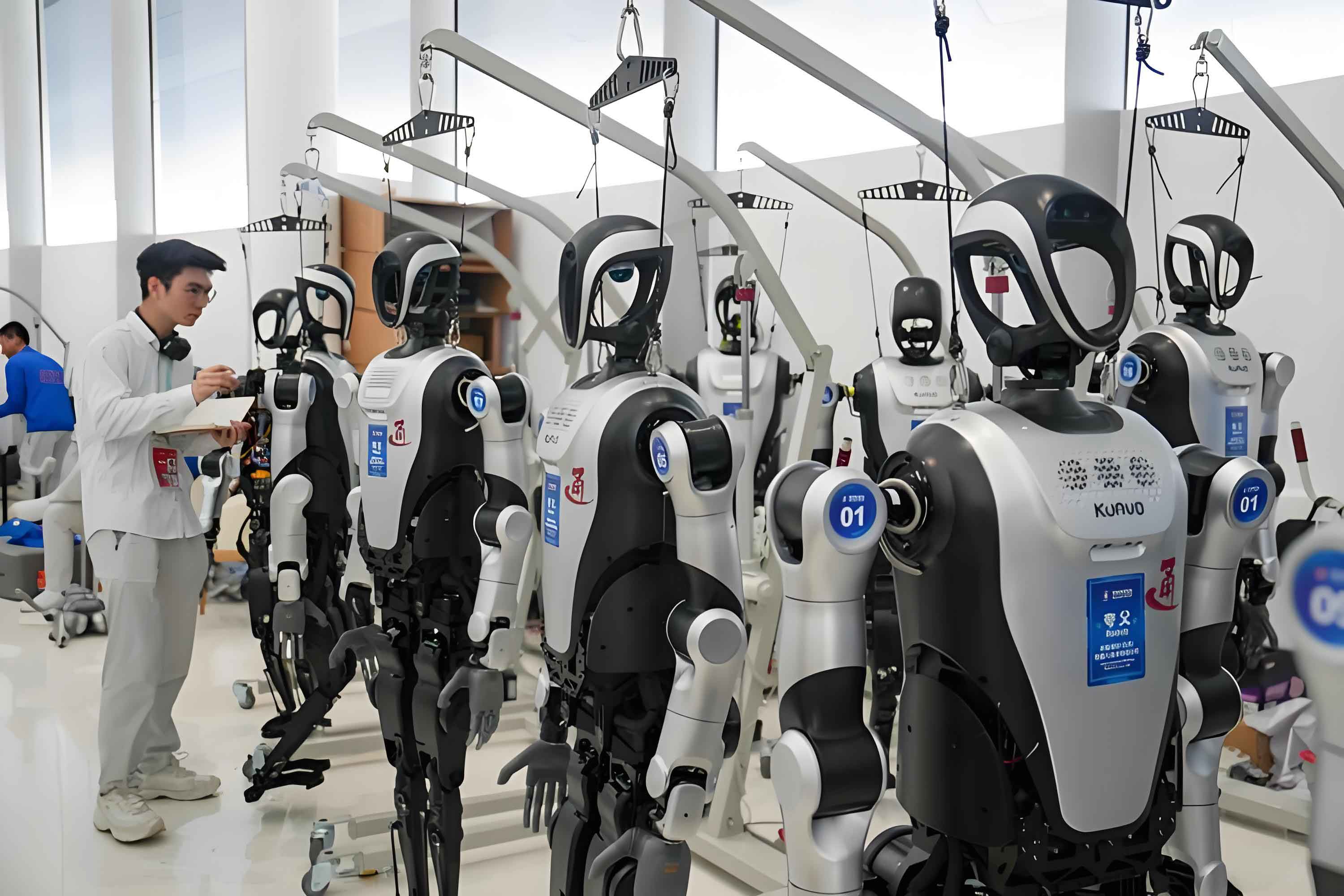
In conclusion, humanoid robot technology is painting a new picture of intelligence, efficiency, safety, and sustainability for the traditional logistics industry. Looking ahead, with the加速融合渗透 of AI, 5G, and industrial internet, humanoid robots are poised to become a key driver of smart logistics. I am confident that in the near future, scenarios of无人值守, automatic调度, and智能识别 will become常态. The nature of work for industry practitioners will undergo profound changes, leading to higher operational efficiency and service quality in物流运输体系. This will inject new momentum into national economic高质量发展. The journey ahead requires persistent innovation and collaboration, but the potential of humanoid robots in transforming ports and beyond is immense and undeniable.
Throughout this discussion, I have emphasized the transformative role of humanoid robots, and I believe that their continued evolution will reshape logistics in ways we are only beginning to imagine. The integration of humanoid robots is not just about automation; it’s about creating a more resilient and adaptive infrastructure for global trade.