
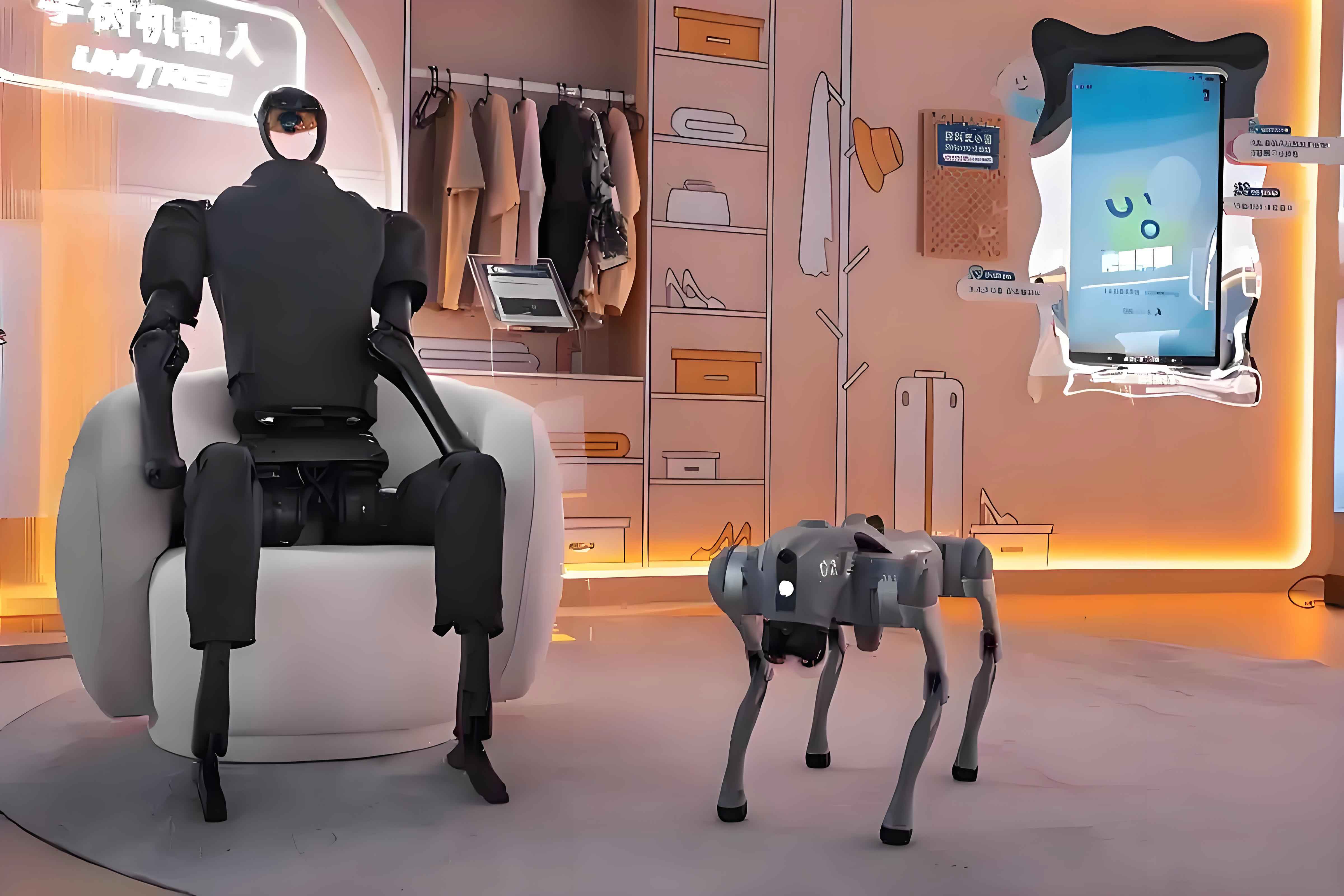
At the 2026 World Robot Conference, a scene at the Leju Robotics booth offered a clear view of how humanoid robots and other embodied intelligence machines are moving from demonstration to practical work. A retail service robot received a command on a touchscreen, turned toward a shelf, identified and grasped a target item, turned back smoothly, and handed the item to the person operating the screen. Not far away, another robot at a small-parts feeding station kept working on its own, while a large screen displayed live operational data.
The important detail was not that a robot could pick up an object or feed a workstation. Robotic arms, mobile robots, and humanoid robots have appeared in retail, logistics, and guide applications for years. The important detail was that these machines were working by themselves. They were not being moved step by step through remote control. The shift from remote-controlled operation to autonomous work marks an industrial inflection point for humanoid robots and the broader embodied intelligence sector.
For a humanoid robot to work autonomously and continue working over time, three elements are essential: the body, the model, and the data. That assessment was offered by Zhang Dapeng, assistant vice president of Leju Robotics. Those three elements are also the three key pieces that Qingdao has assembled in its embodied intelligence ecosystem. Qingdao is now home to more than 600 artificial intelligence and robotics enterprises, covering key points across the industrial chain. The city is accelerating the growth of this base and building the outline of an embodied intelligence industry matrix.
- Qingdao’s Three-Piece Puzzle: Body, Model, and Data
The body is the physical foundation. For humanoid robots, the body includes the structure, joints, actuators, reducers, sensors, and control systems that allow movement, balance, and manipulation. A humanoid robot may be judged by how smoothly it walks or how precisely it grasps an object, but those visible capabilities rest on a dense layer of mechanical and electronic subsystems. Harmonic reducers, rotary joint modules, servo motors, and other components determine whether a humanoid robot can move efficiently, repeatedly, and safely.
The model is the decision-making layer. Without a large model, a robot is little more than a remote-controlled toy. A capable embodied intelligence system needs models that can understand instructions, reason about a scene, plan actions, and adapt to changing conditions. In industrial and service settings, the model must also absorb domain knowledge. It must know not only how to move an arm but also when to move it, how much force to apply, and what sequence of actions will complete a real task.
The data is the learning material. Large models require training, and embodied intelligence models require a special kind of training data: action data generated when tasks are performed in the real physical world. This includes data on how to control grip strength, how to coordinate spatial perception with movement, how to recover from a failed grasp, and how to complete complex actions in unstructured environments. Data collection is therefore not a peripheral activity. It is a core input for the next generation of humanoid robots and other embodied intelligence systems.
Qingdao’s position in this landscape is unusual because the city is not concentrated in only one layer. It has manufacturing capabilities in the body layer, model development in the intelligence layer, and data collection infrastructure in the training layer. Together, these pieces form a closed loop that can support the evolution of humanoid robots from laboratory demonstrations to commercial deployment.
That closed loop is especially important for humanoid robots because their value depends on versatility. A single-purpose industrial machine can be engineered around a narrow task. A humanoid robot is expected to operate in human-designed environments, use human tools, and adapt to human workflows. This ambition raises the difficulty across every layer. The body must be compact and strong. The model must generalize across tasks. The data must capture the subtle physical interactions that humans perform without conscious calculation.
| Layer | Qingdao Capability and Initiative | Key Details |
|---|---|---|
| Enterprise Base | Artificial intelligence and robotics enterprises | More than 600 enterprises covering key points across the industrial chain |
| Body | Harmonic reducers, rotary joints, robot arms, humanoid robot bodies | Fengguang Precision has mass production capability for 03-32 series harmonic reducers for humanoid robots; Guohua Embodied Intelligence Industrial Park has annual capacity of 100,000 harmonic reducers, 50,000 rotary joints, and 3,000 humanoid robot bodies; the Qingdao Embodied Intelligence Robot Innovation Center has been completed |
| Model | Vertical domain models, embodied intelligence models, application models | Leju Robotics released KUAVO-VLA; Haier’s CR3 uses an AI cooking large model; Qingdao University of Technology and UBTECH signed a strategic cooperation agreement |
| Data | Training grounds, teleoperation, data collection systems | Qingdao has 8 projects among Shandong’s first batch of 26 key embodied intelligence robot training grounds; the Qingdao Humanoid Robot Data Collection Training Ground plans more than 1 million high-quality real-machine data records per year; DPVR’s RoboPilot solution serves research teams and robotics companies |
- Building the Body: Harmonic Reducers and the Hardware Base for Humanoid Robots
From the opening of the 2026 World Robot Conference to Unitree Technology’s listing on the STAR Market and the second World Humanoid Robot Games, humanoid robots have returned to the center of public attention. At the opening ceremony of the second World Humanoid Robot Games, a humanoid robot ran 100 meters in 9.39 seconds and cleared 2.88 meters in the high jump. Such performances are visually striking, but they depend on precise and efficient motion joint systems. One of the core execution components in those joints is the harmonic reducer.
A harmonic reducer can be understood as a muscle controller for a robot joint. In a humanoid robot, the motor provides force, while the harmonic reducer ensures that the force is applied in the right way. The component helps convert high-speed, low-torque motor output into controlled, high-torque motion. It affects precision, repeatability, size, weight, and energy efficiency. For humanoid robots, which must fit many joints into a compact body while maintaining human-like movement, the performance of harmonic reducers is critical.
Industry estimates indicate that a single humanoid robot usually requires between 14 and 28 harmonic reducers. This makes the component a significant part of robot production costs. According to a recent forecast by CMBI, as the number of reducers used per robot increases, demand for harmonic reducers for humanoid robots is expected to reach 32 million units by 2030, with a compound annual growth rate of 178 percent. That forecast illustrates why component manufacturers are investing heavily in precision reduction technology.
In Qingdao, this core component manufacturing force is growing. Fengguang Precision Machinery Co., Ltd., or Fengguang Precision, is a representative enterprise. The company has long provided harmonic reducer supporting parts to industry customers through precision machining and die-casting manufacturing. As the domestic robot industry advanced rapidly, the company decided to pursue breakthroughs in core technologies for harmonic reducers.
After years of effort, Fengguang Precision has developed mass production capability for the full 03-32 series of harmonic reducers used in the humanoid robot field. The numbers in the series refer to the diameter of the flexspline pitch circle. A smaller number indicates a smaller size and greater processing difficulty. The ability to produce the full series is therefore a meaningful indicator of manufacturing depth, especially for humanoid robots that require compact and lightweight joint components.
Robot-related business is now contributing to Fengguang Precision’s growth. The company’s 2026 semi-annual report showed revenue of 133 million yuan in the first half of 2026, up 30.86 percent year on year. Net profit attributable to shareholders was 3.4951 million yuan, up 332.67 percent. Non-GAAP net profit attributable to shareholders was 3.4421 million yuan, up 171.55 percent. The report stated that during the reporting period, market expansion for the new harmonic reducer product was highly synergistic with existing operations. It not only strengthened cooperation with existing customers in the robot automation field but also attracted new customers upstream and downstream of the robot industrial chain through core technology breakthroughs, laying a foundation for sustained growth.
For humanoid robots, component reliability is not a secondary issue. A humanoid robot may need to walk, balance, crouch, lift, and manipulate objects. Each action places repeated stress on joints. A reducer that loses precision or fails under load can disable the entire system. Manufacturing capability, quality control, and cost reduction are therefore tightly linked. The more mature the component supply chain becomes, the more quickly humanoid robots can move from low-volume prototypes to higher-volume production.
| Body Layer Indicator | Detail |
|---|---|
| Harmonic Reducer Series | Fengguang Precision has mass production capability for the full 03-32 series of harmonic reducers for humanoid robots |
| Harmonic Reducer Demand Forecast | 32 million units by 2030 for humanoid robots, with a compound annual growth rate of 178 percent, according to CMBI |
| Reducers per Humanoid Robot | Typically 14 to 28 harmonic reducers |
| Guohua Embodied Intelligence Industrial Park Annual Capacity | 100,000 harmonic reducers, 50,000 rotary joints, and 3,000 humanoid robot bodies |
| Cost Reduction Example | Harmonic rotary joint module unit price reduced to the thousand-yuan level; robot arm unit price reduced to the ten-thousand-yuan level |
- From Components to Complete Humanoid Robots: The Rise of Full-Stack Manufacturing
Guohua Intelligent Equipment Co., Ltd., or Guohua Intelligent, is another Qingdao enterprise seizing the opportunity in humanoid robots and embodied intelligence. Its business has expanded from planetary roller screws and harmonic rotary joint modules to robot arms, wheeled humanoid robots, and bipedal humanoid robot bodies. The company has achieved full-stack self-research and production from key components to complete hardware.
At the 2026 World Robot Conference, Guohua Intelligent presented a core product matrix that included self-developed harmonic reducers and joint modules. The products received attention and recognition from several original equipment manufacturers because of their performance in motion control. This kind of recognition matters for humanoid robots, where component suppliers must work closely with robot makers to optimize weight, power, control response, and reliability.
Liu Jinyu, founding partner and deputy general manager of Guohua Intelligent, said the industrial park has an annual production capacity of 100,000 harmonic reducers, 50,000 rotary joints, and 3,000 humanoid robot bodies. According to Liu, the advantage of full-stack self-research is cost reduction and speed improvement. The company has reduced the unit price of its harmonic rotary joint module to the thousand-yuan level and the unit price of its robot arm to the ten-thousand-yuan level, significantly lowering the innovation threshold for the industry.
Lower component costs can accelerate experimentation. When humanoid robots and embodied intelligence systems are expensive, only a small number of laboratories and large companies can iterate on hardware and software together. When joint modules and robot arms become more affordable, more startups, universities, and system integrators can build prototypes, collect data, test applications, and refine models. That dynamic can speed up the entire humanoid robots ecosystem.
Components are being refined, and physical carriers are being built. In the Qingdao Artificial Intelligence Industrial Park, the Qingdao Embodied Intelligence Robot Innovation Center project has been completed. The center will host research and development, assembly, and production for industrial application robots, home service application robots, and commercial service application robots. It will also include software and chip research for robot brains and cerebellums, a research and innovation center, industrial ecosystem support, and research and manufacturing related to sensors, servo motors, reducers, joint modules, and other core robot components.
This combination of component production, robot body assembly, software development, and application-specific research is important for humanoid robots. A humanoid robot is not a single product. It is a system that integrates mechanical engineering, electronics, control theory, artificial intelligence, and application knowledge. A cluster that brings these capabilities together can reduce coordination costs and shorten development cycles.
In addition, the presence of multiple application tracks inside one innovation center can help humanoid robots cross over between domains. Industrial robots may require high repeatability and payload capacity. Home service robots may require safety, quiet operation, and natural interaction. Commercial service robots may require navigation, item handling, and customer-facing behavior. Although the requirements differ, the underlying technologies overlap. Shared development in reducers, joint modules, perception, and control can benefit all three application families.
- Building the Brain: Large Models Push Humanoid Robots Toward Autonomy
Wang Xingxing, founder of Unitree Technology, offered a benchmark for the coming industry transition at the 2026 World Robot Conference. He suggested that when a general robot can complete about 80 percent of tasks in an unfamiliar environment, the industry will reach a tipping point. That could happen in two to three years in a fast scenario, or in five to ten years in a slower scenario. At present, the biggest bottleneck worldwide is the insufficient generalization ability of embodied intelligence.
Generalization is the ability to apply learned skills to new tasks, new objects, new environments, and new conditions. A robot that can perform a fixed motion in a fixed setting is useful for demonstration, but it is not enough for real work. A humanoid robot in a warehouse, retail store, laboratory, or home must deal with variation. Objects shift position. Lighting changes. People move. Instructions may be incomplete. A model must interpret the situation, choose an action, and adjust when the first attempt fails.
That is why large models are central to the next stage of humanoid robots. Without a large model, a robot remains a remote-controlled machine. With a large model, it can begin to understand, reason, decide, and execute. At the 2026 World Robot Conference, the focus was not only on hardware. The event presented a full-stack technology system that connects the brain, the cerebellum, and the body. Industry attention has shifted from what a robot can do in a controlled demonstration to how a robot can enter a real scenario.
Leju Robotics described this shift clearly. According to the company, the conference showed that the sector is not a single hardware show. It is a display of embodied intelligence systems that combine understanding, reasoning, decision-making, and execution. Leju Robotics has developed a full-link development toolchain that supports rapid migration of models across configurations. Its modular design allows adaptation to multiple scenarios. The company stated that all demonstrations were mature commercial solutions ready for delivery and aligned with real operational standards.
For humanoid robots, this means the model layer must be tightly connected to the body layer. A model trained for one robot configuration may not transfer directly to another. Differences in arm length, joint range, sensor placement, and actuator response can affect task execution. A full-link toolchain and modular design can reduce the cost of adapting intelligence to different bodies. That capability is essential if humanoid robots are to move from a few standardized platforms to a diverse ecosystem of machines.
The cerebellum layer also plays a role. While the brain handles understanding and planning, the cerebellum-like layer manages balance, coordination, and low-level control. For humanoid robots, walking and manipulation require continuous adjustment. A robot must maintain stability while moving an arm or carrying an object. It must coordinate multiple joints in real time. If the brain is too slow or the body is not responsive, the system cannot operate safely. The integration of brain, cerebellum, and body is therefore a system engineering challenge, not only an artificial intelligence challenge.
| Autonomy Stage | Capability | Industry Implication |
|---|---|---|
| Remote control | Human operator directs movement step by step | Useful for demonstration and data collection but limited scalability |
| Task-specific autonomy | Robot performs a defined task in a known setting | Can support limited commercial deployments |
| Continuous autonomous work | Robot completes repeated tasks without direct control | Requires a robust body, model, and data loop |
| Generalization | Robot handles new tasks and unfamiliar environments | Industry tipping point when roughly 80 percent of tasks can be completed, according to Wang Xingxing of Unitree Technology |
- KUAVO-VLA and the Vertical Model Strategy for Humanoid Robots
Leju Robotics has worked on the brain of embodied intelligence robots for years. On August 26, the company officially released the vertical domain model KUAVO-VLA and opened it to multiple channels. The core idea of KUAVO-VLA is to add an industrial vertical model layer between a general foundation model and task skills. This layer is responsible for body adaptation and the accumulation of domain capabilities.
Compared with a foundation model, KUAVO-VLA does not need to repeatedly learn action space and industrial vertical knowledge. As a result, the data and computing cost for developing new industrial skills are both reduced by more than 50 percent, and the training cycle is compressed from weeks to days. This is a significant shift for humanoid robots. In many industrial settings, the value of a robot depends on its ability to learn a new task quickly. If every new task requires massive data collection and long training runs, deployment becomes expensive. A vertical model layer can make skill development more efficient.
The approach also reflects a broader trend in embodied intelligence. General foundation models provide broad reasoning and language understanding. Vertical models provide domain-specific knowledge and adaptation. The robot body provides physical action. The connection among these three layers determines whether a humanoid robot can work reliably. For humanoid robots in manufacturing, logistics, retail, and service, the vertical model may become a competitive differentiator.
Qingdao’s model layer extends beyond a single company. Haier displayed a fully autonomous home AI cooking robot, CR3, at the conference. The robot has a built-in AI cooking large model. It can control seasoning amounts, heat, cooking time, ingredient placement order, and the ratio of meat to vegetables. The system is designed to accurately replicate master-level cooking standards. For home service robots, this kind of application-specific model is important because cooking requires more than motion control. It requires temporal planning, sensory feedback, and knowledge about ingredients and processes.
Earlier, on August 8, Qingdao University of Technology and Shenzhen-based UBTECH Technology signed a strategic cooperation agreement. The cooperation will focus on education applications, co-building a data collection center, vertical models, and embodied world model development. This agreement connects academic research with industrial application. It also adds another piece to Qingdao’s model and data ecosystem for humanoid robots and embodied intelligence.
Education applications can serve as a bridge between research and deployment. They provide structured environments for testing human-robot interaction, task instruction, and skill learning. They also train future engineers and researchers who will work on humanoid robots. A data collection center connected to a university can generate datasets that are more diverse than those collected in a single factory or laboratory. Vertical models and embodied world models can then be developed with both academic rigor and industrial relevance.
| Model and Application Initiative | Description |
|---|---|
| Leju Robotics KUAVO-VLA | Vertical domain model released and opened to multiple channels; adds an industrial vertical model layer between a general foundation model and task skills; new industrial skill development data and computing costs reduced by more than 50 percent; training cycle compressed from weeks to days |
| Haier CR3 | Fully autonomous home AI cooking robot with an AI cooking large model; controls seasoning, heat, cooking time, ingredient order, and meat-to-vegetable ratio to replicate master-level cooking standards |
| Qingdao University of Technology and UBTECH | Strategic cooperation signed on August 8; focus on education applications, data collection center co-building, vertical models, and embodied world model development |
- Collecting Data: Training Grounds and Teleoperation Systems for Humanoid Robots
Just as a brain needs knowledge to learn, a large model needs data to train. For humanoid robots and other embodied intelligence machines, the required training data is action data generated when tasks are performed in the real physical world. This includes data about how to control grip strength, how to coordinate spatial perception with complex movements, and how to handle the many small variations that occur in real environments.
Qingdao is accelerating the entry of humanoid robots into real scenarios through the construction of data collection and training grounds. In July, the Shandong Provincial Department of Industry and Information Technology announced the first batch of 26 key embodied intelligence robot training grounds. Qingdao had 8 projects selected, the highest number in the province. This concentration of training infrastructure gives Qingdao an advantage in data collection for humanoid robots and other embodied systems.
One example is the Qingdao Humanoid Robot Data Collection Training Ground. It is the first humanoid robot data collection training ground in Shandong. It covers industrial, family, and commercial domains. The annual plan is to collect more than 1 million high-quality real-machine data records. The data collected by robots in the training ground is continuously fed to large models, helping them learn complete work and life skills.
This kind of facility addresses a central challenge for humanoid robots. Real-world data is difficult and expensive to collect. Every task must be set up, every object must be placed, every action must be recorded, and every failure must be labeled. A dedicated training ground can standardize the process. It can create repeatable scenarios, vary parameters systematically, and generate large volumes of data that would be impractical to collect in an ordinary workplace. The result is a data pipeline that supports model training, evaluation, and improvement.
Qingdao is also home to technology companies working on spatial computing. These companies are tackling core technologies in spatial positioning, motion tracking, and low-latency human-machine interaction to lower the threshold for data collection. By making it easier to capture human motion and robot motion, they help create the datasets needed to train humanoid robots.
Data quality is as important as data quantity. A large dataset with poor labels or inconsistent conditions can mislead model training. A smaller dataset with accurate labels and well-controlled variation can be more useful. Training grounds can enforce standards for recording, annotation, and scenario design. They can also capture failure cases, which are often more valuable than successful demonstrations because they show a model how to recover. For humanoid robots, recovery behavior is essential. A robot that cannot recover from a missed grasp or a lost balance will not be trusted in real work.
- RoboPilot and the Data Pipeline for Humanoid Robots
During the 2026 World Robot Conference, DPVR, headquartered in the Qingdao Virtual Reality Industrial Park, presented its RoboPilot robot teleoperation and data collection solution. The company also partnered with Aoyi Technology and Lingqiao Intelligent to demonstrate embodied intelligence applications. The display showed how a VR teleoperation solution can be applied to different robot hardware platforms.
RoboPilot can adapt to different robot hardware and control systems. It obtains the spatial pose and motion trajectory of the operator’s hands in real time. While completing real-time teleoperation, it can simultaneously collect operation data. That data can be used for action teaching, algorithm training, and dataset construction. This dual function is important. Teleoperation provides immediate control, while data collection turns human operation into training material for autonomous humanoid robots.
Chen Chaoyang, founder of DPVR and chairman of Leixiang Technology Co., Ltd., said the solution has already served research teams at universities in the United States and the United Kingdom, as well as several leading embodied intelligence robot companies in Shanghai, Shenzhen, and other domestic locations. The international and domestic use of the solution shows that data collection for humanoid robots is becoming a specialized industry layer.
The combination of training grounds, teleoperation systems, and data collection tools creates a feedback loop. Human operators demonstrate tasks. Robots collect action data. Models learn from the data. Robots attempt tasks autonomously. Failures and corrections generate new data. The loop improves generalization. For humanoid robots, this loop is the path from remote-controlled demonstration to autonomous work.
Teleoperation also has near-term commercial value. In dangerous or difficult environments, a remotely operated humanoid robot can perform work while a human stays safe. The same operation simultaneously generates data that can later be used to automate parts of the task. This dual use can help companies justify investment in humanoid robots before full autonomy is available. It also creates a practical bridge between current capabilities and future goals.
| Data Layer Initiative | Description |
|---|---|
| Shandong Key Training Grounds | First batch of 26 embodied intelligence robot training grounds; Qingdao has 8 projects selected, the highest number in the province |
| Qingdao Humanoid Robot Data Collection Training Ground | First humanoid robot data collection training ground in Shandong; covers industrial, family, and commercial domains; annual plan of more than 1 million high-quality real-machine data records |
| DPVR RoboPilot | Robot teleoperation and data collection solution; adapts to different robot hardware and control systems; obtains operator hand spatial pose and motion trajectory in real time; collects operation data for action teaching, algorithm training, and dataset construction |
| Adoption | Served research teams at universities in the United States and the United Kingdom, as well as several leading embodied intelligence robot companies in Shanghai, Shenzhen, and other domestic locations |
- Investment, Ecosystem, and the Competitive Logic of Embodied Intelligence
Embodied intelligence is widely viewed as one of the core development directions in the second half of artificial intelligence. It carries strong expectations about whether AI can enter the physical world and whether it can truly perform work. Because of that, every step taken by humanoid robots attracts attention from the online world and capital markets.
Data from iiMedia Research shows that in the first half of 2026, there were 172 investment and financing events related to embodied intelligence in China, with a total value of 109.174 billion yuan. This level of activity indicates that investors are looking beyond software-only AI and toward systems that can act in the physical world. Humanoid robots are one of the most visible expressions of that trend, but the investment flows into components, models, data, and application scenarios as well.
Qingdao is not a bystander in this industrial race. The city has gathered more than 600 artificial intelligence and robotics enterprises. It has capabilities ranging from Fengguang Precision’s harmonic reducers to Guohua Intelligent’s full-stack self-research and production, and from model development to the expansion of data collection training grounds. Supported by deep experience in advanced manufacturing, artificial intelligence, and a large volume of real industrial scenario data, Qingdao has quietly built a closed loop around the three key pieces of body, model, and data.
Industrial competition is not only about a single technical breakthrough. It also requires a complete ecosystem that can drive down costs and accelerate technology iteration. Several core component companies are strengthening their extended positioning in the robot industry through market forces. For example, Fengguang Precision acquired Weishi Shenlan to connect precision machining business with intelligent perception system business. The move is intended to help the company upgrade into an integrated solution provider for intelligent equipment.
This kind of integration matters for humanoid robots because performance depends on coordination. A reducer, a joint module, a sensor, and a control algorithm must work together. When companies can combine mechanical precision with perception and system integration, they can offer more complete solutions to robot makers. That reduces the integration burden and can shorten time to market for humanoid robots.
Investment is also flowing into the less visible layers. Data collection, annotation, simulation, testing, and safety validation are not as visually compelling as a walking humanoid robot, but they are necessary for commercial deployment. A robot that performs well in a demo may fail when exposed to thousands of real-world variations. Funding for data infrastructure and testing can improve reliability. In that sense, the ecosystem around humanoid robots is broadening from hardware and models to services and standards.
- Qingdao’s Innovation Corridor and Industrial Clusters
The Qingdao Science and Technology Innovation Corridor, which is being advanced steadily, provides a platform for the flow and interaction of talent, policy, capital, scenarios, and data that the industry needs. The corridor brings together 8 national key laboratories, 8 universities, and nearly 1,000 high-tech enterprises. A group of previously dispersed innovation resources is being linked into a chain.
The Qingdao Artificial Intelligence Industrial Park serves as a core carrier for the embodied intelligence industry within the corridor. It has already gathered 18 embodied intelligence enterprises and attracted more than 300 artificial intelligence enterprises. An initial embodied intelligence industrial cluster has formed, with research institutions, core enterprises, and supporting enterprises interacting with one another. For humanoid robots, this cluster can provide access to components, software, talent, testing environments, and application partners.
Clusters can create advantages that individual companies cannot. A component maker can receive faster feedback from robot body developers. A model developer can access data from training grounds. An application company can test prototypes in real commercial and industrial settings. A university can contribute research and trained personnel. When these actors are geographically and institutionally connected, the iteration cycle for humanoid robots can become shorter.
Qingdao’s manufacturing base is also an advantage. The city has industrial scenarios that generate real operational requirements. These scenarios are not only places to deploy robots. They are sources of data about how work is actually performed. A humanoid robot that learns from real industrial tasks is more likely to develop useful generalization than a robot trained only in a laboratory. The same logic applies to retail, logistics, home service, and commercial service applications.
The presence of supporting enterprises is another strength. Humanoid robots require a wide range of inputs: precision parts, sensors, motors, power systems, communication modules, software tools, and testing services. A cluster that includes these supporting enterprises can reduce supply chain friction. It can also help new companies enter the market because they do not need to build every capability from scratch. They can focus on a specific component, model, or application while relying on the local ecosystem for other needs.
- Challenges and Opportunities for Humanoid Robots
The opportunities for humanoid robots are significant, but the challenges remain substantial. Generalization is the most visible technical challenge. A humanoid robot must handle new objects, new layouts, new instructions, and new interruptions. It must also operate safely around people. Safety requires not only physical limits but also reliable perception and decision-making. A robot that misunderstands a scene or misjudges a force can cause damage or injury.
Cost is another challenge. Humanoid robots contain many joints, sensors, and computing components. Reducing the cost of harmonic reducers, joint modules, and robot arms is therefore critical. Qingdao’s component manufacturers are addressing this challenge directly. The reduction of harmonic rotary joint module prices to the thousand-yuan level and robot arm prices to the ten-thousand-yuan level shows that cost curves can move quickly when full-stack manufacturing and market competition advance.
Data remains a bottleneck. Real-world action data is expensive to collect. It must be labeled, organized, and used effectively. Training grounds help, but they must be complemented by data from real deployments. The more humanoid robots are used in actual work, the more data they can generate. This creates a virtuous cycle, but only if privacy, security, and operational disruption are managed properly.
Models must also become more efficient. Training from scratch for every task is not sustainable. Vertical models like KUAVO-VLA point to a more practical approach. By adding an industrial vertical layer between a foundation model and task skills, developers can reduce data and computing costs and shorten training cycles. This kind of layered model architecture can make humanoid robots more adaptable without requiring enormous resources for every new skill.
Finally, commercial value must be demonstrated. Demonstrations can attract attention, but customers need measurable returns. In manufacturing, a humanoid robot may need to match the speed and reliability of existing automation. In service, it may need to interact naturally and safely with people. In home settings, it may need to operate reliably with minimal supervision. These are high bars, but they also define the path forward. Each successful deployment provides data, revenue, and credibility for the next stage.
- Conclusion: Real Scenarios Will Decide the Future of Humanoid Robots
The future of humanoid robots will not be decided by a single demonstration, a single model release, or a single component breakthrough. It will be decided by whether these elements can be combined into systems that work reliably in real physical scenarios. That is why the shift from remote control to autonomous work observed at the 2026 World Robot Conference is so important. It points toward a stage in which robots are not only shown but used.
For Qingdao, the strategy is becoming clear. The city is using core components to strengthen the body of humanoid robots. It is using models and data to cultivate intelligence. It is building training grounds, innovation centers, and industrial clusters to connect the pieces. It is also leveraging its manufacturing foundation and industrial scenarios to validate embodied intelligence in real conditions.
The result is a developing ecosystem in which humanoid robots can evolve. More enterprises are entering the field. More data is being collected. More models are being trained. More components are being produced at lower cost. More application scenarios are being opened. These factors reinforce one another. As the ecosystem matures, humanoid robots with Qingdao roots can be expected to continue evolving in real and complex environments.
In the global race toward embodied intelligence, the ability to integrate body, model, and data will determine which regions can move from prototypes to production. Qingdao has assembled the key pieces. The next phase will test how quickly those pieces can be turned into scalable systems, commercial products, and everyday applications for humanoid robots.