
In hydraulic transmission systems, gear pumps are ubiquitous components widely employed in machine tools, metallurgy, mining, construction, shipbuilding, and various other industrial applications. However, conventional gear pumps suffer from a significant drawback: they typically have only one pair of meshing gears (driver and driven), leading to unbalanced radial forces. These unbalanced forces exacerbate bearing wear, shorten the pump’s service life, limit further increases in working pressure, and reduce operational reliability. To address this critical issue, I propose a novel pump design that integrates strain wave gear transmission technology with internal gear pump principles, resulting in what I term a strain wave gear pump. This innovative pump retains the advantages of internal gear pumps—such as compact structure, low relative sliding speed, small flow pulsation, and high volumetric efficiency—while incorporating the benefits of strain wave gear drives, including high load capacity, large transmission ratios, high transmission accuracy, and minimal backlash. Most importantly, the strain wave gear pump effectively resolves the problem of unbalanced radial forces.
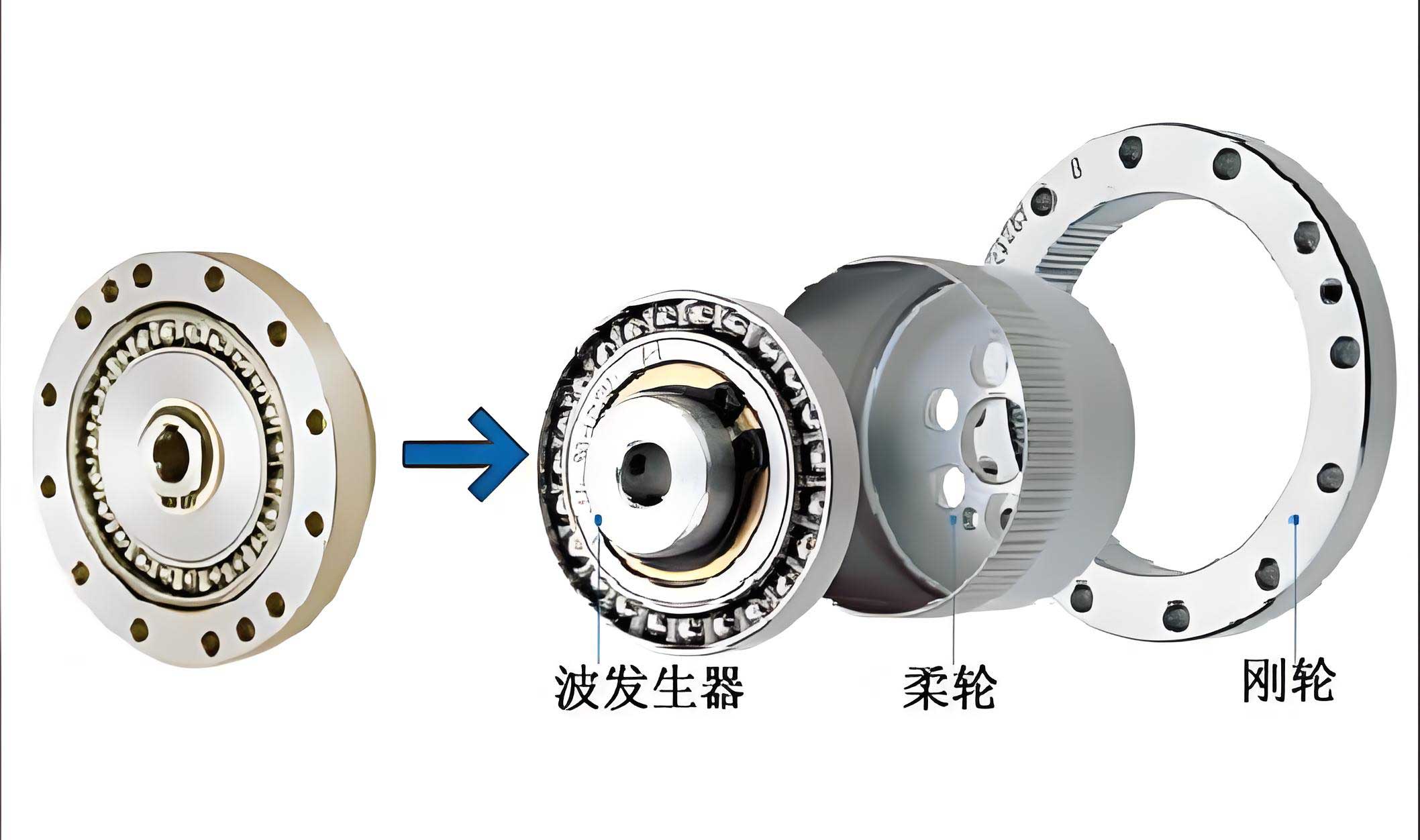
The core of this design lies in the use of a strain wave gear mechanism, commonly known as a harmonic drive, which features a flexible gear (flexspline) and a rigid gear (circular spline) with a wave generator. In the context of a pump, this configuration allows for multiple meshing points and symmetric pressure distribution, fundamentally altering the radial force dynamics. In this paper, I will delve into the working principle of the strain wave gear pump, analyze the radial forces acting on both the flexible and rigid gears through detailed mathematical modeling, and demonstrate that these forces are balanced. This analysis provides a theoretical foundation for the design and development of such pumps, paving the way for more reliable and high-pressure hydraulic systems.
The working principle of the strain wave gear pump is illustrated schematically. The pump consists of a rigid gear (circular spline), a flexible gear (flexspline), a wave generator, and a crescent-shaped partition plate (月牙板) that separates the two gears. This arrangement creates four sealed working chambers. In operation, the wave generator is fixed, the rigid gear acts as the driving component, and the flexible gear serves as the driven component. When the rigid gear rotates in a specified direction, the flexible gear rotates in the same direction due to the strain wave gear transmission. As the teeth of the rigid and flexible gears disengage at the suction port, the volume of the sealed chamber increases, creating a vacuum. This causes external pressure to exceed internal pressure, allowing fluid to enter the suction chamber through the suction port under atmospheric pressure, filling the tooth spaces. Once the suction chamber is filled, the fluid is carried into the discharge chamber as the gears continue to rotate. At the discharge port, the teeth of the rigid and flexible gears gradually mesh, reducing the volume of the sealed chamber and forming a high-pressure zone. The fluid in the tooth spaces is then expelled through the discharge port and delivered to the hydraulic system. With continuous rotation, the strain wave gear pump achieves steady fluid supply.
A key feature of this pump is the symmetric distribution of suction and discharge ports. There are two suction ports and two discharge ports, arranged symmetrically on opposite sides. This symmetry is crucial for balancing radial forces. The radial forces acting on both the flexible and rigid gears arise from two main sources: the radial force due to fluid pressure along the gear circumference (denoted as \( F_p \)) and the radial force generated by gear meshing (denoted as \( F_T \)). By analyzing these forces separately and then combining them, I will show that the net radial force on each gear is zero, ensuring balanced operation.
To analyze the radial forces, I make several simplifying assumptions for computational ease. First, all fluid pressures are assumed to act on the gear tip circles. Second, the angular spans of pressure zones (e.g., low-pressure and high-pressure regions) are treated as constants during operation. Third, the pressure distribution in transition zones between low and high pressures is approximated as linear. These assumptions allow for a tractable mathematical model while capturing the essential physics of the strain wave gear pump.
Let’s begin with the radial force analysis for the flexible gear. Consider the flexible gear with tip radius \( R_a \), tooth width \( B \), and pitch radius \( R \). The fluid pressure varies along the circumference, with low pressure \( p_d \) in suction zones and high pressure \( p_g \) in discharge zones. The pressure difference is \( \Delta p = p_g – p_d \). Define angular coordinates: let \( \beta’ \) be the angle spanning the low-pressure region on one side, and \( \beta” \) be the angle where the transition to high pressure ends, such that \( \beta” – \beta’ \) is the transition zone, and \( \pi – \beta” \) is the high-pressure region. Due to symmetry, the other side has identical zones but mirrored.
The radial force due to fluid pressure on one side of the flexible gear, say the right side in a given coordinate system, can be computed by integrating the pressure over the gear surface. Take an infinitesimal area on the tip circle: \( dA = B R_a d\beta \). The force on this area is \( dF_p = p B R_a d\beta \), where \( p \) is the pressure at angle \( \beta \). Resolving this force into x and y components in a local coordinate system centered on the gear:
$$ dF_{px} = p B R_a \sin\beta \, d\beta $$
$$ dF_{py} = p B R_a \cos\beta \, d\beta $$
The pressure \( p \) varies with \( \beta \). For \( 0 \leq \beta \leq \beta’ \), \( p = p_d \). For \( \beta’ \leq \beta \leq \beta” \), \( p = p_d + \frac{\Delta p}{\beta” – \beta’} (\beta – \beta’) \). For \( \beta” \leq \beta \leq \pi \), \( p = p_g \). Integrating these over the respective intervals yields the total force components for one side. For the left side, using coordinate system \( x_1 O y_1 \), the x and y components of the fluid pressure radial force \( F_{p1} \) are:
$$ F_{p1x} = B R_a \left( p_d + p_g + \Delta p \frac{\sin\beta” – \sin\beta’}{\beta” – \beta’} \right) $$
$$ F_{p1y} = B R_a \Delta p \frac{\cos\beta” – \cos\beta’}{\beta” – \beta’} $$
Due to symmetry, the right side (in coordinate system \( x_2 O y_2 \)) has components \( F_{p2x} = B R_a \left( p_d + p_g + \Delta p \frac{\sin\beta” – \sin\beta’}{\beta” – \beta’} \right) \) and \( F_{p2y} = B R_a \Delta p \frac{\cos\beta” – \cos\beta’}{\beta” – \beta’} \). However, when considering the global coordinate system, the forces from both sides oppose each other. Assuming symmetric port distribution with \( \beta’ = \pi – \beta” \), which implies \( \cos\beta’ = -\cos\beta” \) and \( \sin\beta’ = \sin\beta” \), the net fluid pressure radial force on the flexible gear becomes:
$$ \sum F_{px} = F_{p1x} – F_{p2x} = 0 $$
$$ \sum F_{py} = F_{p1y} – F_{p2y} = 0 $$
Thus, the resultant fluid pressure radial force is zero: \( \sum \mathbf{F}_p = \mathbf{0} \).
Next, consider the meshing force on the flexible gear. The flexible gear experiences a hydraulic torque due to fluid pressure. Since the rigid gear is the driver, the torque on the flexible gear \( M_2 \) is transmitted through the meshing points. The meshing force \( F_T \) can be expressed as:
$$ F_T = \frac{M_2}{R_j} = \frac{1}{2 R_j} B \Delta p (R_a^2 – R^2) $$
where \( R_j \) is the moment arm for the torque. In a strain wave gear pump, meshing occurs at two symmetric points due to the wave generator’s action. The meshing forces at these points are equal in magnitude but opposite in direction, acting along the line of action (which is the common tangent to the base circles at the meshing point). Let the angle of the line of action be \( \alpha \) relative to the coordinate axes. Then, the x and y components of the meshing forces on the left and right sides are:
For left side: \( F_{T1x} = F_T \cos\alpha \), \( F_{T1y} = F_T \sin\alpha \)
For right side: \( F_{T2x} = F_T \cos\alpha \), \( F_{T2y} = F_T \sin\alpha \)
Again, due to symmetry, when summed in the global coordinate system, these components cancel out:
$$ \sum F_{Tx} = F_{T1x} – F_{T2x} = 0 $$
$$ \sum F_{Ty} = F_{T1y} – F_{T2y} = 0 $$
Hence, the net meshing force is zero: \( \sum \mathbf{F}_T = \mathbf{0} \).
Combining the fluid pressure and meshing forces, the total radial force on the flexible gear is:
$$ \mathbf{F} = \sqrt{ (\sum \mathbf{F}_p)^2 + (\sum \mathbf{F}_T)^2 \pm 2 \sum \mathbf{F}_p \sum \mathbf{F}_T \cos\gamma } = \mathbf{0} $$
where \( \gamma \) is the angle between \( \mathbf{F}_p \) and \( \mathbf{F}_T \). This confirms that the radial force on the flexible gear is balanced.
Now, turn to the radial force analysis for the rigid gear. The approach is analogous. The rigid gear also experiences fluid pressure forces and meshing forces. Due to the symmetric design of the strain wave gear pump, the fluid pressure distribution around the rigid gear is similar to that around the flexible gear. Using the same assumptions and coordinate systems, the fluid pressure radial forces on the rigid gear from both sides cancel out, yielding \( \sum \mathbf{F}_p = \mathbf{0} \). Similarly, the meshing forces on the rigid gear arise from the interaction with the flexible gear. Since the rigid gear is the driver, it transmits torque to the flexible gear, and the reaction forces at the meshing points are symmetric. Thus, the net meshing force on the rigid gear is also zero: \( \sum \mathbf{F}_T = \mathbf{0} \). Consequently, the total radial force on the rigid gear is balanced, as expressed by:
$$ \mathbf{F} = \sqrt{ (\sum \mathbf{F}_p)^2 + (\sum \mathbf{F}_T)^2 \pm 2 \sum \mathbf{F}_p \sum \mathbf{F}_T \cos\mu } = \mathbf{0} $$
where \( \mu \) is the angle between the fluid pressure force and meshing force on the rigid gear.
To summarize the radial force balance in the strain wave gear pump, I present the following tables that outline key parameters and force components.
| Symbol | Description | Typical Units |
|---|---|---|
| \( B \) | Gear tooth width | mm |
| \( R_a \) | Tip radius of flexible gear | mm |
| \( R \) | Pitch radius of flexible gear | mm |
| \( R_j \) | Moment arm for torque | mm |
| \( p_d \) | Low pressure (suction side) | bar |
| \( p_g \) | High pressure (discharge side) | bar |
| \( \Delta p \) | Pressure difference, \( p_g – p_d \) | bar |
| \( \beta’ \) | Angular span of low-pressure zone | rad |
| \( \beta” \) | Angular end of transition zone | rad |
| \( \alpha \) | Angle of meshing line of action | rad |
| Gear | Force Source | Net x-Component | Net y-Component | Resultant Force |
|---|---|---|---|---|
| Flexible Gear | Fluid Pressure (\( \mathbf{F}_p \)) | \( \sum F_{px} = 0 \) | \( \sum F_{py} = 0 \) | \( \mathbf{0} \) |
| Meshing (\( \mathbf{F}_T \)) | \( \sum F_{Tx} = 0 \) | \( \sum F_{Ty} = 0 \) | \( \mathbf{0} \) | |
| Rigid Gear | Fluid Pressure (\( \mathbf{F}_p \)) | \( \sum F_{px} = 0 \) | \( \sum F_{py} = 0 \) | \( \mathbf{0} \) |
| Meshing (\( \mathbf{F}_T \)) | \( \sum F_{Tx} = 0 \) | \( \sum F_{Ty} = 0 \) | \( \mathbf{0} \) |
The strain wave gear mechanism is central to this balanced force design. Unlike conventional gears, the strain wave gear relies on elastic deformation of the flexible gear to achieve multiple tooth engagements simultaneously. This not only enhances load distribution but also inherently promotes symmetry in force transmission. The term “strain wave gear” emphasizes the wave-like deformation that propagates through the flexible gear, enabling smooth and efficient motion. In the context of pumps, this characteristic is leveraged to create symmetric pressure zones and meshing patterns, which are the root cause of radial force balance. Therefore, the strain wave gear pump represents a significant advancement over traditional gear pumps.
Beyond radial force balance, the strain wave gear pump offers additional advantages. The multiple tooth engagements in a strain wave gear reduce contact stresses, leading to longer gear life. The high transmission ratio of strain wave gears allows for compact pump designs without sacrificing performance. Moreover, the precision of strain wave gear transmission minimizes flow pulsation, contributing to smoother hydraulic system operation. These benefits make the strain wave gear pump suitable for high-pressure applications where reliability and efficiency are paramount.
To further illustrate the mathematical model, consider the detailed integration for fluid pressure forces. The integrals for the three pressure zones are:
For \( 0 \leq \beta \leq \beta’ \):
$$ F’_{px} = \int_0^{\beta’} p_d B R_a \sin\beta \, d\beta = p_d B R_a (1 – \cos\beta’) $$
$$ F’_{py} = \int_0^{\beta’} p_d B R_a \cos\beta \, d\beta = p_d B R_a \sin\beta’ $$
For \( \beta’ \leq \beta \leq \beta” \):
$$ F”_{px} = \int_{\beta’}^{\beta”} \left[ p_d + \frac{\Delta p}{\beta” – \beta’} (\beta – \beta’) \right] B R_a \sin\beta \, d\beta $$
$$ = B R_a \left[ -p_d (\cos\beta” – \cos\beta’) + \Delta p \frac{-\cos\beta” + \sin\beta” – \sin\beta’}{\beta” – \beta’} \right] $$
$$ F”_{py} = \int_{\beta’}^{\beta”} \left[ p_d + \frac{\Delta p}{\beta” – \beta’} (\beta – \beta’) \right] B R_a \cos\beta \, d\beta $$
$$ = B R_a \left[ -p_d (\sin\beta” – \sin\beta’) + \Delta p \frac{\sin\beta” + \cos\beta” – \cos\beta’}{\beta” – \beta’} \right] $$
For \( \beta” \leq \beta \leq \pi \):
$$ F”’_{px} = \int_{\beta”}^{\pi} p_g B R_a \sin\beta \, d\beta = p_g B R_a (1 + \cos\beta”) $$
$$ F”’_{py} = \int_{\beta”}^{\pi} p_g B R_a \cos\beta \, d\beta = p_g B R_a \sin\beta” $$
Summing these gives the expressions for \( F_{p1x} \) and \( F_{p1y} \) provided earlier. Under symmetry condition \( \beta’ = \pi – \beta” \), simplification yields the net zero force.
The meshing force derivation involves the hydraulic torque. The torque on the flexible gear due to fluid pressure is:
$$ M_2 = \frac{1}{2} B \Delta p (R_a^2 – R^2) $$
This torque is resisted by the meshing force at a distance \( R_j \), typically the pitch radius or effective lever arm. Thus, \( F_T = M_2 / R_j \). In strain wave gears, the meshing occurs at two points diametrically opposed, leading to force cancellation.
In practical design of a strain wave gear pump, parameters such as gear geometry, wave generator profile, and port timing must be optimized. The symmetric port distribution is critical; any asymmetry could introduce unbalanced forces. Additionally, material selection for the flexible gear is vital to withstand cyclic deformation without fatigue failure. The use of high-strength alloys or composites can enhance durability. Computational fluid dynamics (CFD) simulations and finite element analysis (FEA) can aid in refining the design, ensuring that the theoretical force balance translates to real-world performance.
The application potential of strain wave gear pumps is vast. In industries such as aerospace, robotics, and precision machinery, where space constraints and reliability are crucial, these pumps could replace conventional gear pumps. For instance, in aircraft hydraulic systems, reduced radial forces would lower maintenance needs and increase safety. In robotic actuators, the compact size and high pressure capability of strain wave gear pumps could enable more efficient fluid power systems. Moreover, the inherent balance of radial forces allows for higher operating pressures without compromising bearing life, potentially extending the pressure range of gear pumps beyond current limits.
Comparing the strain wave gear pump to other positive displacement pumps, such as vane pumps or piston pumps, highlights its unique advantages. While vane pumps also offer balanced radial forces in some designs, they often suffer from wear at vane tips and lower pressure capabilities. Piston pumps, though capable of high pressures, are complex and costly. The strain wave gear pump combines simplicity, balance, and high performance, making it a compelling alternative. Furthermore, the strain wave gear mechanism itself is known for its reliability in precision applications, such as robotics and aerospace, which bodes well for pump adoption.
Future research directions for strain wave gear pumps include experimental validation of radial force balance, optimization of tooth profiles for minimal leakage, and integration with smart materials for adaptive control. The use of piezoelectric actuators in the wave generator could enable variable displacement, adding functionality. Additionally, studying the thermal effects and cavitation in such pumps would be important for high-speed applications. As additive manufacturing advances, prototyping complex gear shapes for strain wave gear pumps becomes feasible, accelerating development.
In conclusion, the strain wave gear pump effectively solves the long-standing problem of unbalanced radial forces in conventional gear pumps. Through symmetric design and the unique kinematics of strain wave gears, both fluid pressure and meshing forces are balanced on the flexible and rigid gears. This balance reduces bearing wear, extends pump life, allows for higher working pressures, and improves reliability. The mathematical analysis presented here provides a foundation for designing such pumps. With continued innovation, strain wave gear pumps could become a standard in hydraulic systems, offering enhanced performance across various industries. The strain wave gear technology, with its inherent advantages, is poised to revolutionize gear pump design, making fluid power systems more efficient and durable.