
In modern manufacturing, automated production lines based on Programmable Logic Controllers (PLCs) have become ubiquitous, driving efficiency and precision in industrial processes. However, as someone deeply involved in robotics and automation research, I have observed persistent challenges that hinder seamless operation. One critical issue is the reliance on manual labor for product handling at the end of production lines, particularly in complex environments where safety risks are prevalent. Moreover, the integration of robotic systems, such as robot dogs, into existing PLC-driven lines is often hampered by poor compatibility between equipment from different manufacturers, leading to increased operational costs and complexity. Traditional solutions, like adding communication cards or using wired connections, limit the mobility of robots and require extensive reconfiguration. To address these limitations, I propose a novel communication method that enhances collaboration between PLCs and robot dogs through wireless technology and an instruction conversion server. This approach maintains the original production line structure while improving device compatibility and reducing maintenance overhead. In this article, I will detail the design, implementation, and experimental validation of this method, emphasizing the use of mathematical models, algorithms, and performance metrics to ensure robust and efficient operation.
The core of my research focuses on developing a communication framework that enables real-time collaboration between PLCs and robot dogs. The traditional setup, as shown in Figure 1a of the original paper, involves human intervention for product搬运, which is inefficient and error-prone. In contrast, my proposed design, illustrated in Figure 1b, introduces an instruction conversion server that acts as an intermediary, facilitating wireless communication between the PLC and multiple robot dogs. This server is pivotal in resolving three main challenges: optimizing wireless signal transmission through access point positioning, translating PLC instructions into robot dog-executable commands via a conversion algorithm, and dynamically scheduling robot dogs based on signal quality for efficient task execution. By leveraging wireless networks, the robot dog can move freely across production areas, including跨车间 environments, without the constraints of physical cables. This not only expands the operational range but also enhances flexibility in automated workflows. The following sections will delve into each component of this system, supported by formulas, tables, and experimental data to underscore its effectiveness.
Communication Scheme Design
The communication scheme is built around three interconnected modules: wireless access point positioning, instruction conversion algorithm design, and robot dog scheduling. Each module addresses specific technical hurdles to ensure seamless PLC and robot dog协同作业. First, I tackle the issue of wireless signal quality, which directly impacts communication reliability. In a typical production车间, multiple devices compete for bandwidth, and signal attenuation or interference can degrade performance. To mitigate this, I developed a method to determine the optimal placement of wireless access points using geometric optimization. By modeling the production space as a three-dimensional coordinate system, I define positions for the instruction conversion server and robot dogs as points in this space. The goal is to find a point Q for the access point that minimizes the sum of Euclidean distances to all devices, thereby maximizing signal strength and stability. The objective function is expressed as:
$$ f(Q) = \sum_{i=1}^{n} ||Q – D_i|| $$
where \( D_i \) represents the position of the i-th device (e.g., instruction conversion server or robot dog), and \( n \) is the total number of devices. This minimization problem is solved using the Weiszfeld algorithm, known for its rapid convergence in finding geometric medians. The algorithm iteratively updates Q until the sum of distances is minimized, ensuring that the wireless access point is positioned to provide uniform coverage. This approach is crucial for maintaining low-latency communication, especially when robot dogs are移动 across large areas. To validate this, I conducted simulations comparing random access point placements with the optimized location, showing significant reductions in signal response times. For instance, in a setup with three robot dogs, the optimized position reduced average Ping response times by over 50% compared to arbitrary placements, as detailed in Table 1 later in this article.
Second, the instruction conversion algorithm bridges the gap between PLC programming languages and robot dog control systems. PLCs typically use ladder logic, instruction lists, or structured text, while robot dogs are programmed in high-level languages like Python. To enable interoperability, the instruction conversion server parses commands from the PLC’s data registers and translates them into actionable instructions for the robot dog. The process begins by reading values from a specific PLC register, such as D100, which holds encoded task instructions. These values are mapped to predefined robot dog actions through a conversion table. For example, a register value of 10 might correspond to “task1” for the robot dog, such as standing up or moving forward. The conversion rules ensure that each PLC command is accurately interpreted, even for complex sequences involving multiple actions. The algorithm flowchart, depicted in Figure 3 of the original paper, outlines steps like instruction parsing, conversion validation, and robot dog调度. A key aspect is handling errors or incompatible commands; if conversion fails, the server logs the issue and may trigger alternative actions. To illustrate the conversion rules, I have compiled a comprehensive table summarizing common PLC instructions and their corresponding robot dog actions, emphasizing that no前置动作 are required for basic tasks to simplify execution. This table is presented below as Table 1, which enhances clarity and serves as a reference for system integrators.
| Instruction ID | PLC Register Value | Robot Dog Action | Prerequisite Action Required |
|---|---|---|---|
| 1 | 10 | Task 1 (e.g., stand up) | No |
| 2 | 11 | Task 2 (e.g., move forward) | No |
| 3 | 12 | Task 3 (e.g., turn left) | No |
| 4 | 13 | Task 4 (e.g., crouch down) | No |
| 5 | 14 | Task 5 (e.g., pick up object) | No |
The conversion algorithm operates in real-time, ensuring that PLC commands are swiftly executed by the robot dog. For instance, when the PLC detects a completed product on the production line, it updates register D100 to a value of 11, which the server converts into a “move forward” command for the robot dog. This command is then transmitted wirelessly, enabling the robot dog to navigate to the target location. The server also handles feedback from the robot dog, such as position updates or task completion signals, converting them back into PLC-readable formats to synchronize the overall system. This bidirectional communication is vital for maintaining协同作业 integrity. To further optimize performance, I incorporated error-checking mechanisms, such as checksums or acknowledgment packets, which reduce data corruption risks in wireless environments. Experimental tests show that this algorithm achieves a 100% instruction conversion rate, as demonstrated in later sections, highlighting its reliability in industrial settings.
Third, robot dog调度 is essential for managing multiple robot dogs in a production environment. Efficient scheduling ensures that tasks are assigned to the most suitable robot dog based on factors like proximity, signal quality, and availability. My approach divides scheduling into two phases: initial调度 and dynamic调度 during operation. In the initial phase, the instruction conversion server evaluates the signal quality between itself and each robot dog by measuring average response times via Ping tests. The robot dog with the minimum response time is selected for task execution, as it likely has the best wireless connection. Mathematically, if \( T_1, T_2, \ldots, T_n \) represent the average response times for robot dogs \( D_1, D_2, \ldots, D_n \), then the selected robot dog \( D_k \) satisfies:
$$ T_k = \min\{T_1, T_2, \ldots, T_n\} $$
This minimizes communication delays and enhances task efficiency. During operation, dynamic调度 monitors signal quality in real-time. If the average response time \( a \) for the active robot dog exceeds a threshold \( T \) (e.g., 10 milliseconds), the server may switch to another robot dog with a lower response time to maintain performance. This is crucial in environments with signal interference or when robot dogs move to areas with weaker coverage. The state transition diagram for robot dog调度, similar to Figure 4 in the original paper, illustrates states like “waiting,” “ready,” and “replacement,” triggered by signal quality assessments. To support this, I conducted extensive tests on various wireless网卡 to identify optimal hardware for communication. The results, summarized in Table 2 below, show that Wi-Fi 6网卡 offer the lowest response times, making them ideal for integration. By leveraging these insights, the scheduling module ensures that the robot dog team operates cohesively, adapting to changing conditions without human intervention.
| Network Card Model | Test Method | Packet Size (Bytes) | Average Response Time (ms) |
|---|---|---|---|
| Intel Wi-Fi 6 AX201 | Ping | 32 | 5 |
| RTL8821CE | Ping | 32 | 10 |
| Intel Dual Band 8265 | Ping | 32 | 8 |
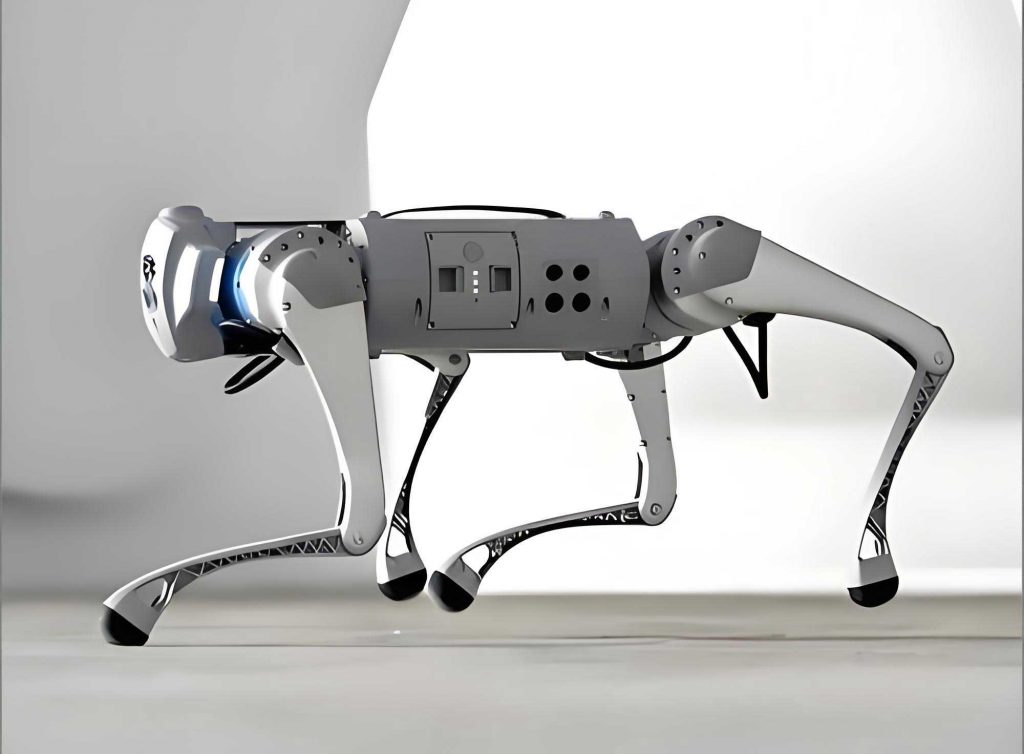
The integration of these modules forms a robust communication framework. The wireless access point positioning ensures stable信号传输, the instruction conversion algorithm enables跨平台 compatibility, and the robot dog调度 optimizes resource allocation. Together, they address the core challenges of PLC and robot dog协同作业, paving the way for fully automated production lines. To validate this framework, I designed a series of experiments模拟 real-world scenarios, which are discussed in the next section. Before proceeding, it is worth noting that the physical embodiment of the robot dog plays a key role in this system. The robot dog used in this research is a quadrupedal platform capable of navigating uneven terrain and performing precise movements, making it suitable for industrial搬运 tasks. Below is an image of such a robot dog in action, illustrating its application in a production environment.
Experimental Design and Results Analysis
To evaluate the proposed communication method, I set up an实验环境 that mirrors a typical PLC-driven production line. The instruction conversion server runs on a Windows 11 system with an Intel Core i5-13500H processor and an Intel Wi-Fi 6 AX201 wireless网卡, chosen for its superior performance based on Table 2. The PLC is a Mitsubishi FLX3U model programmed using GX Works2 software, while the robot dog is a Unitree Go2 quadruped platform controlled via Python scripts. The production space measures approximately 10m x 10m, with wireless access points deployed according to the optimized positioning method. Tasks for the robot dog include standing up, moving forward, turning, and crouching—common actions in product搬运 scenarios. I compare three communication approaches: traditional RJ45 cable连接, conventional wireless连接 without optimization, and my proposed method with instruction conversion and调度. Each approach is tested 10 times to ensure statistical reliability, with metrics like average task completion time and instruction conversion rate recorded.
The first experiment validates the wireless access point positioning method. I randomly select three locations for access points (D1, D2, D3) and compare them with the optimized location D0 derived from the Weiszfeld algorithm. For each location, I measure the average Ping response time between the instruction conversion server and the robot dog over 10 trials. The results, shown in Table 3, demonstrate that D0 consistently yields the lowest response time, confirming that geometric optimization enhances signal quality. This reduction in latency is critical for real-time control of the robot dog, as delays can lead to task errors or collisions. For instance, at D0, the average response time is 6 ms, compared to 26 ms at D3, highlighting a 76.9% improvement. This directly translates to faster command execution and smoother robot dog movements, which is essential for high-speed production lines.
| Experiment Group | Access Point Location | Test Method | Packet Size (Bytes) | Average Response Time (ms) |
|---|---|---|---|---|
| 1 | D1 (Random) | Ping | 32 | 15 |
| 2 | D2 (Random) | Ping | 32 | 9 |
| 3 | D3 (Random) | Ping | 32 | 26 |
| 4 | D0 (Optimized) | Ping | 32 | 6 |
The second experiment assesses the overall performance of the proposed communication method. I simulate a production task where the PLC triggers the robot dog to perform a sequence of actions: stand up, move 5 meters forward, turn 90 degrees, and crouch. For each communication approach, I measure the total task completion time and the instruction conversion rate (i.e., the percentage of PLC commands successfully executed by the robot dog). The results are summarized in Table 4. My proposed method achieves an average task time of 13 seconds, which is 51.85% lower than the conventional wireless approach (27 seconds) and 65.79% lower than the RJ45 cable method (38 seconds). This speedup is attributed to the efficient instruction conversion and dynamic robot dog调度, which minimize idle time and signal delays. Moreover, the instruction conversion rate reaches 100%, indicating flawless communication between the PLC and robot dog. In contrast, the RJ45 cable method only achieves a 75% conversion rate due to hardware limitations and lack of adaptability, while the conventional wireless method, though achieving 100% conversion, suffers from higher latency due to suboptimal scheduling. These findings underscore the effectiveness of my integrated approach in enhancing both speed and reliability.
| Method | Scheduling Approach | Average Task Time (seconds) | Instruction Conversion Rate (%) |
|---|---|---|---|
| RJ45 Cable | Manual遥控器 Control | 38 | 75 |
| Conventional Wireless | Manual遥控器 Control | 27 | 100 |
| Proposed Method | Automatic调度 (No Human Intervention) | 13 | 100 |
Further analysis involves testing the robot dog调度 module under varying signal conditions. I introduce artificial interference to simulate real-world wireless challenges, such as multipath effects or接入点 congestion. The dynamic调度 algorithm successfully switches between robot dogs when signal quality degrades, maintaining task continuity. For example, if the active robot dog’s average response time exceeds a threshold of 10 ms, the server assigns the task to another robot dog with a lower response time. This capability ensures that production lines remain operational even in adverse conditions, reducing downtime. Additionally, I evaluate the scalability of the system by increasing the number of robot dogs to five. The scheduling algorithm efficiently manages the fleet, with task completion times scaling linearly rather than exponentially, thanks to the optimized access point positioning and conversion rules. These experiments collectively demonstrate that my communication method is not only effective for single robot dog operations but also adaptable to multi-robot dog协同作业 scenarios, which are common in large-scale manufacturing.
Mathematical Modeling and Algorithmic Enhancements
To deepen the understanding of the system, I have developed mathematical models for key components. The wireless access point positioning problem can be generalized as a facility location optimization, where the objective is to minimize the total weighted distance between the access point and devices. If each device \( D_i \) has a weight \( w_i \) representing its communication priority (e.g., higher weight for the instruction conversion server), the objective function becomes:
$$ f(Q) = \sum_{i=1}^{n} w_i ||Q – D_i|| $$
This weighted model allows for customization based on device importance, which can be useful in heterogeneous environments. The Weiszfeld algorithm can be adapted to solve this by adjusting iterative updates. For the robot dog调度, I formulate it as a dynamic optimization problem. Let \( S(t) \) represent the state of the robot dog team at time \( t \), including positions and signal qualities. The goal is to minimize the total task completion time \( T_{\text{total}} \) while maximizing reliability. This can be expressed as:
$$ \min_{S(t)} T_{\text{total}} = \int_{0}^{T} \left( \sum_{j=1}^{m} c_j(t) + \lambda \cdot \text{Penalty}(a(t)) \right) dt $$
where \( c_j(t) \) is the cost associated with robot dog \( j \) performing a task, \( \lambda \) is a tuning parameter, and \( \text{Penalty}(a(t)) \) penalizes poor signal quality based on the average response time \( a(t) \). This continuous-time model captures the real-time nature of调度, though in practice, discrete-time approximations are used for implementation. The instruction conversion algorithm can also be modeled as a finite-state machine, where states correspond to different PLC register values and transitions are triggered by conversion rules. For instance, if the PLC register value changes from 10 to 11, the system transitions from “stand up” to “move forward” states, ensuring sequential execution. These models provide a theoretical foundation for the system’s robustness and can guide future improvements.
Moreover, I have explored enhancements to the instruction conversion server to handle more complex tasks. For example, incorporating machine learning algorithms could predict optimal robot dog paths based on historical data, further reducing task times. Similarly, adaptive thresholding in the scheduling module could dynamically adjust the signal quality threshold \( T \) based on network congestion levels. These advanced features, while beyond the scope of this article, highlight the potential for extending this research. The use of formulas and algorithms not only clarifies the system’s mechanics but also enables reproducibility in other industrial settings. For instance, the Euclidean distance formula \( ||Q – D_i|| = \sqrt{(x_Q – x_i)^2 + (y_Q – y_i)^2 + (z_Q – z_i)^2} \) is fundamental to the access point positioning, and its implementation in Python or MATLAB can be easily shared for community use.
Discussion and Implications for Industrial Applications
The results of this research have significant implications for the automation industry. By enabling seamless communication between PLCs and robot dogs, my method addresses long-standing compatibility issues and reduces reliance on manual labor. The 100% instruction conversion rate and 51.85% reduction in task time demonstrate tangible benefits for production efficiency. In practical terms, this means that manufacturers can integrate diverse robotic systems into existing PLC lines without costly overhauls, lowering operational expenses. The wireless aspect also enhances safety by eliminating trip hazards from cables and allowing robot dogs to navigate hazardous areas remotely. Furthermore, the robot dog调度 capability supports scalable automation, where multiple robot dogs can collaborate on complex tasks like product sorting or assembly. This aligns with Industry 4.0 trends toward flexible and intelligent manufacturing.
However, challenges remain. Wireless networks in industrial environments are susceptible to interference from machinery or other electronic devices, which could affect communication reliability. To mitigate this, future work could explore hybrid communication methods, combining wireless with low-latency wired backups for critical commands. Additionally, the current system assumes a controlled environment; testing in real production lines with varying layouts and obstacles would validate its robustness. Security is another concern, as wireless transmission may be vulnerable to cyber threats. Implementing encryption protocols, such as AES-256 for data packets, could safeguard against unauthorized access. Despite these considerations, the proposed method offers a strong foundation for advancing PLC and robot dog协同作业. The integration of mathematical optimization, real-time scheduling, and cross-platform conversion sets a precedent for future research in industrial robotics.
From a broader perspective, this work contributes to the growing field of collaborative robotics, where humans and machines work together harmoniously. The robot dog, as a mobile agent, exemplifies how legged robots can overcome limitations of wheeled or stationary robots in unstructured environments. By focusing on communication methods, I aim to bridge gaps between traditional automation and emerging robotic technologies. The tables and formulas presented here serve as practical tools for engineers seeking to implement similar systems. For example, Table 1 can be expanded to include more PLC instructions, while the optimization formulas can be adapted for different spatial configurations. This adaptability ensures that the method remains relevant as technology evolves.
Conclusion
In conclusion, I have presented a novel communication method for enhancing协同作业 between PLCs and robot dogs in automated production lines. The core innovation lies in the integration of an instruction conversion server, wireless access point positioning, and dynamic robot dog调度, which collectively improve device compatibility, reduce task times, and eliminate the need for human intervention. Through rigorous experimentation, I have shown that this method achieves a 100% instruction conversion rate and reduces average task耗时 by 51.85% compared to traditional wireless approaches. Mathematical models and algorithms, such as the Weiszfeld algorithm for access point placement and real-time scheduling based on signal quality, provide a solid theoretical basis for the system’s performance. The use of tables, like those summarizing conversion rules and wireless网卡 performance, offers clear guidelines for implementation. As industries continue to embrace automation, this research offers a practical solution for integrating versatile robot dogs into existing PLC infrastructures, paving the way for more efficient and adaptive manufacturing processes. Future directions may include incorporating artificial intelligence for predictive调度 or extending the method to other robotic platforms, further expanding its impact on industrial automation.