
The pursuit of a truly versatile and practical dexterous robotic hand has long been a central challenge in robotics. While multi-fingered, high-degree-of-freedom hands showcase remarkable dexterity in laboratory settings, their inherent complexity in control, high cost, and reliability concerns have historically limited their widespread adoption in real-world industrial, service, or domestic applications. This gap between laboratory potential and practical utility motivates the development of simpler, more robust, and cost-effective designs that retain sufficient functionality for stable and adaptive grasping. The control system is the linchpin of such an endeavor, serving as the intelligent core that translates high-level commands into precise, sensor-guided physical actions. It encompasses perception, data processing, actuation, and human-machine interaction, all of which must be seamlessly integrated. In this article, I present a detailed account of the design, implementation, and validation of a comprehensive control system developed for a novel three-fingered, underactuated dexterous robotic hand prototype, designated as the BHG-1.
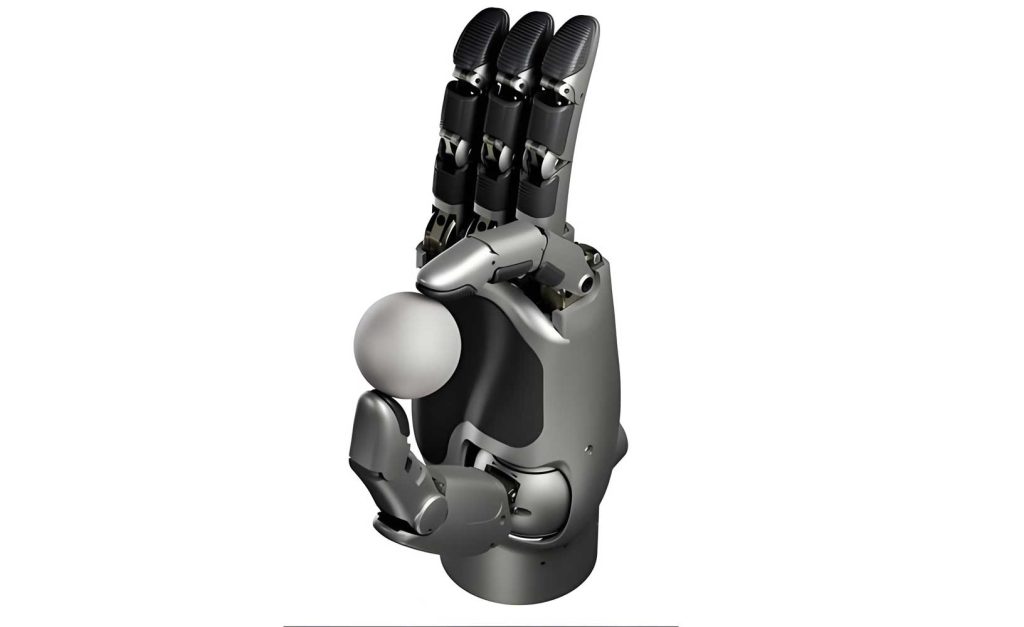
The BHG-1 dexterous robotic hand represents a philosophical shift towards simplified mechanical intelligence. Its mechanical design employs three kinematically coupled fingers driven by a single DC servo motor embedded within the palm, mimicking the synergistic motion of a human thumb, index, and middle finger for enveloping grasps. This underactuation significantly reduces the number of required actuators and the consequent control complexity. Each finger is equipped with piezoresistive tactile force sensors on its distal links, providing crucial haptic feedback. The primary objective of the control system, therefore, is to orchestrate the motion of this mechanically coupled system, regulate the driving motor with high precision, process sensory data, and provide an intuitive interface for operation and monitoring, thereby unlocking the hand’s potential for reliable and stable grasping within its operational envelope.
System Architecture and Hardware Design
The control system adopts a hierarchical two-tier architecture, bifurcating responsibilities between a high-level command station and a low-level, real-time execution unit. This separation of concerns enhances modularity, simplifies debugging, and allows for future expansion.
1.1 Overall System Block Diagram
The foundational blueprint of the control system is depicted in the following functional block diagram. The Host PC serves as the user interface and strategic planner, while the Embedded DSP Controller acts as the tactical real-time executor. Communication between these tiers is established via a serial RS-232 link.
Control System Architecture:
- Host PC (Supervisory Level): Provides graphical user interface (GUI), interprets user commands, sets control parameters, and visualizes real-time sensor data and system status.
- Communication Link: RS-232 serial protocol for reliable command and data transmission.
- Embedded DSP Controller (Execution Level): Performs all real-time critical tasks: motor servo control (PWM generation), sensor data acquisition (encoder, force sensors), PID algorithm execution, and safety monitoring.
- Actuation & Sensing Layer: Includes the DC servo motor with an integrated optical encoder, the H-bridge motor driver, and the finger-mounted force sensors with signal conditioning circuits.
1.2 Core Processing Unit: The DSP Controller
The selection of the processing core is critical for a real-time motion control system. After evaluating several microcontrollers and processors, the Texas Instruments TMS320LF2407A Digital Signal Processor (DSP) was chosen as the centerpiece of the embedded controller. This choice was driven by its specialized features tailored for motor control, which simplify hardware design and enhance performance.
| Feature Module | Description | Benefit for the Dexterous Robotic Hand |
|---|---|---|
| Event Manager (EV) | Contains PWM generators, capture units, and quadrature-encoder pulse (QEP) interface. | Direct generation of PWM signals for motor control; hardware decoding of encoder signals for precise speed/position measurement without CPU overhead. |
| High-Resolution PWM | 16-bit resolution for PWM generation. | Allows for very fine control over motor voltage, leading to smooth torque and motion. |
| Analog-to-Digital Converter (ADC) | 10-bit, multi-channel ADC with fast conversion time. | Enables simultaneous sampling of multiple finger force sensor signals, crucial for coordinated grasp force feedback. |
| Serial Communication Interface (SCI) | Standard UART module. | Facilitates straightforward communication with the host PC for command and telemetry. |
| Interrupt Hierarchy | Supports numerous maskable interrupts with programmable priority levels. | Ensures deterministic response to critical events like encoder pulses, timer events for control loops, and communication requests. |
| Watchdog & Illegal Address Reset | Built-in safety mechanisms. | Enhances system reliability by recovering from software faults or “runaway” conditions, a vital feature for an autonomous dexterous robotic hand. |
1.3 Hardware Circuit Modules
The DSP serves as the brain, but its functionality is realized through a set of carefully designed peripheral circuits. Each module addresses a specific interface or control requirement.
1.3.1 Serial Communication Interface
While the DSP’s SCI module operates at TTL logic levels (0V/3.3V), the host PC’s RS-232 port uses higher voltage bipolar signals (e.g., ±12V). A level-translation chip, the MAX232, is employed as an intermediary. It contains internal charge pumps to generate the required RS-232 voltages from a single 5V supply. The connection follows a minimal “3-wire” scheme (Transmit, Receive, Ground), which is sufficient for this application’s half-duplex communication.
1.3.2 Motor Drive Circuit
Precise control of the DC servo motor is achieved through pulse-width modulation (PWM). The DSP’s event manager generates a fixed-frequency PWM signal whose duty cycle is modulated by the control algorithm. This low-power signal must be amplified to drive the motor. An H-bridge configuration is used for bidirectional control. Instead of designing a discrete H-bridge with power MOSFETs and gate drivers, an integrated solution, the MC33186 full-bridge driver, was selected. Its key advantages include:
- Bidirectional Current Drive: Can source and sink current, allowing for forward, reverse, and braking motor control.
- High Efficiency & Frequency Operation: Suitable for the PWM frequencies (typically 10-20 kHz) used to minimize motor noise and current ripple.
- Integrated Protection: Features like over-temperature shutdown, under-voltage lockout, and short-circuit protection safeguard both the driver and the motor, enhancing the robustness of the dexterous robotic hand.
The DSP’s PWM output channels are connected to the input pins of the MC33186, which then switches the motor supply voltage accordingly. A bipolar PWM drive scheme is utilized where the motor terminals see alternating voltage polarity within each PWM period, reducing audible noise and improving low-speed torque characteristics.
1.3.3 Velocity and Position Sensing
A high-resolution optical quadrature encoder attached to the motor shaft provides closed-loop feedback. It outputs two channels (A and B) in quadrature (90-degree phase shift) and an index (I) pulse per revolution. The signals are fed directly into the DSP’s dedicated Quadrature Encoder Pulse (QEP) circuit. The QEP hardware automatically decodes the phase relationship between A and B to determine direction and counts the rising/falling edges of both channels, providing a 4x increase in effective resolution.
Velocity is calculated using the M-method (frequency method), which is well-suited for medium to high speeds. Within a fixed sampling period $T_s$ (e.g., 1 ms, set by a DSP timer interrupt), the number of encoder counts $N$ is recorded. If the encoder has $P$ pulses per revolution, the angular velocity $\omega$ in radians per second and the rotational speed $n$ in revolutions per minute (RPM) are given by:
$$
\omega = \frac{2 \pi \cdot N}{4P \cdot T_s}, \quad n = \frac{60 \cdot N}{4P \cdot T_s}
$$
For our system with a 256-line encoder ($P=256$) and $T_s = 0.001$ s, the formula simplifies. The factor of 4 accounts for the QEP’s 4x decoding. Position is obtained by simply accumulating the count $N$ over time, providing an absolute angular reference when combined with the index pulse for homing.
1.3.4 Finger Force Signal Conditioning
The tactile force sensors are based on piezoresistive elements arranged in a Wheatstone bridge. Their output is a small differential analog voltage (in the millivolt range) proportional to the applied force. This signal requires amplification and conditioning before being digitized by the DSP’s ADC.
A two-stage instrumentation amplifier circuit is constructed using a low-noise op-amp (e.g., LM324). The first stage performs differential amplification to reject common-mode noise. The second stage provides further gain to scale the signal to match the ADC’s input range (0-3.3V). A critical addition is a DC offset nulling circuit. Manufacturing tolerances and sensor mounting stresses create a non-zero output voltage at zero force (bridge imbalance). A manually adjustable potentiometer, buffered by an op-amp voltage follower, injects a compensating voltage into the second stage’s input. This allows precise calibration to ensure that a zero-force reading corresponds to the midpoint of the ADC range. The conditioned signal from each finger is connected to a separate channel of the DSP’s ADC for simultaneous sampling.
| Module | Key Component | Primary Function |
|---|---|---|
| Core Processor | TMS320LF2407A DSP | Central computation, PWM generation, sensor interfacing, algorithm execution. |
| Motor Driver | MC33186 H-Bridge | Power amplification of PWM signals for bidirectional DC motor control. |
| Position/Speed Sensor | Optical Quadrature Encoder | Provides high-fidelity feedback on motor shaft angle and rotational velocity. |
| Tactile Sensing | Piezoresistive Sensors + Instrumentation Amp | Measures contact forces on finger links, enabling force-feedback control. |
| Host Communication | MAX232 Level Shifter | Translates logic levels for reliable RS-232 serial communication with PC. |
Software Architecture and Control Algorithms
The software transforms the hardware into an intelligent system. It is structured around a foreground/background model with interrupt-driven routines handling all time-critical tasks, ensuring deterministic real-time performance for the dexterous robotic hand.
2.1 Software Structure and Flow
The DSP software begins with a comprehensive initialization routine that configures all on-chip peripherals: the system clock, GPIO pins, Event Manager (PWM frequency and dead-band settings, QEP initialization), ADC (sample rate, channel selection), SCI (baud rate, data format), and interrupt controllers. After initialization, the main program enters an idle loop, waiting for interrupts to trigger specific service routines.
The real-time control is orchestrated by three primary interrupt service routines (ISRs):
- Periodic Timer Interrupt: This is the heartbeat of the control system. Triggered at a fixed rate (e.g., 1 kHz), this ISR is responsible for:
- Reading the current encoder count to compute instantaneous velocity and position.
- Executing the PID control algorithm based on the velocity/position error.
- Updating the PWM duty cycle register (CMPR) with the new control output.
- Reading the sampled ADC values from the force sensors.
- Packaging status data (speed, position, forces) for periodic transmission to the host PC.
- SCI Receive Interrupt: Activated when a byte arrives from the host PC. It assembles complete command packets, which can include:
- Motion Commands: “Grasp,” “Release,” “Move to Position X.”
- Parameter Updates: New PID gains ($K_p$, $K_i$, $K_d$), target speed, target position.
- Control Mode Selection: Switch between velocity control, position control, or force-control modes.
- ADC Conversion Complete Interrupt: Signals that a set of force sensor readings has been digitized and is ready for processing. This data can be used for advanced grip force regulation.
2.2 PID Control Algorithm Implementation
Proportional-Integral-Derivative (PID) control forms the basis for regulating the motor’s speed and position. Its continuous-time form is:
$$
u(t) = K_p e(t) + K_i \int_{0}^{t} e(\tau) d\tau + K_d \frac{de(t)}{dt}
$$
Where $u(t)$ is the control output (e.g., PWM duty cycle), $e(t)$ is the error (setpoint – measured value), and $K_p$, $K_i$, $K_d$ are the proportional, integral, and derivative gains, respectively.
For digital implementation on the DSP, the discrete positional form is used. At the k-th sampling instant:
$$
u_k = K_p e_k + K_i T_s \sum_{j=0}^{k} e_j + K_d \frac{(e_k – e_{k-1})}{T_s}
$$
Where $T_s$ is the sampling period. To avoid integral windup (a common issue where the integral term accumulates error during saturation), an anti-windup scheme is implemented. Furthermore, for velocity control, a PI controller (setting $K_d=0$) often suffices, as the motor’s inherent electrical and mechanical damping provides sufficient derivative action. The control structure for the dexterous robotic hand is typically a cascaded loop: an outer position loop generating a velocity command for a faster, inner velocity loop.
Inner Velocity Loop (PI Control):
The velocity error $e_v = v_{target} – v_{measured}$ is calculated. The PI control output $u_v$ is:
$$
u_v(k) = K_{p_v} e_v(k) + K_{i_v} I_v(k)
$$
$$
\text{where } I_v(k) = I_v(k-1) + e_v(k) \cdot T_s
$$
This $u_v(k)$ is directly mapped to the PWM duty cycle. Tuning these gains involves finding a balance between fast response and stability. Through iterative testing (e.g., Ziegler-Nichols methods or manual tuning on the physical system), an optimal set was found. The improvement was significant: the rise time for a step velocity command was reduced, and steady-state error was minimized to less than 1%, as qualitatively observed from real-time plots on the host interface.
| Control Mode | Primary Sensor | Control Algorithm Focus | Goal for the Dexterous Robotic Hand |
|---|---|---|---|
| Velocity Control | Encoder (Speed derived) | Minimize error between target and measured motor RPM. Fast inner loop. | Execute smooth opening/closing gestures at a consistent speed. |
| Position Control | Encoder (Position derived) | Minimize error between target and measured motor shaft angle. Outer loop. | Precisely set finger aperture for grasping objects of known size. |
| Force-Impedance Control | Finger Force Sensors | Regulate contact force or implement a virtual spring-damper model. | Achieve stable, compliant grasps on fragile or irregular objects. |
2.3 Host Computer Interface
The host interface, developed in a high-level language like C++ or Python with GUI libraries (e.g., Qt, wxWidgets), serves as the primary human-robot interface (HRI). Its design emphasizes clarity and functionality:
- Command Panel: Contains buttons or controls for initiating pre-programmed actions like “Close Hand,” “Open Hand,” “Stop.”
- Parameter Configuration Panel: Allows the user to dynamically update control parameters (PID gains, target speed/position, sampling rates) and send them to the DSP without reprogramming it.
- Real-Time Visualization Panel: Displays streaming data from the dexterous robotic hand in numerical and graphical forms. This includes:
- Plots of motor speed and position over time.
- Bar graphs or plots showing real-time force readings from each fingertip sensor.
- Status indicators for system health (communication, errors).
- Data Logging: Option to record all sensor data and commands for post-experiment analysis and system refinement.
System Integration, Testing, and Performance
With hardware assembled and software modules developed, the integration phase began. Each subsystem was tested independently before being connected. The encoder feedback was verified by manually rotating the motor and observing the count on the host display. The motor driver was tested with simple pre-programmed PWM signals. The force sensor circuits were calibrated by applying known weights and adjusting the offset and gain potentiometers.
3.1 Functional and Grasping Tests
The complete system’s performance was evaluated through a series of functional tests. The most critical were grasping trials. The dexterous robotic hand was commanded to grasp objects of various shapes, sizes, and compliance (e.g., a plastic cylinder, a rubber ball, a marker pen).
Test Procedure:
- The hand was initialized and moved to a known “open” position.
- A “Close” command was issued, typically in velocity control mode until a contact was detected via force sensors.
- Upon detecting initial contact (force exceeding a threshold), the control system could switch to a force-control mode to apply a specified grip force, preventing object damage or slippage.
The system demonstrated reliable and stable enveloping grasps for objects within its kinematic workspace. The real-time force feedback was instrumental in achieving compliant interactions. The single motor, through the mechanical coupling, successfully coordinated the motion of all three fingers, validating the underactuated design philosophy for this class of dexterous robotic hand.
3.2 Performance Metrics and Analysis
Quantitative measurements were taken to characterize the control system’s performance:
- Step Response: For a step change in velocity command, the rise time, settling time, and overshoot were measured from the host interface plots. With tuned PI gains, the system achieved a rise time of approximately 150 ms to reach 3000 RPM with negligible overshoot.
- Steady-State Error: The velocity steady-state error was consistently below 0.8% of the commanded value, as calculated by the DSP and verified by the host.
- Positioning Accuracy: In position control mode, the hand could reliably return to a specific encoder count, with the error being within ±2 encoder ticks (equivalent to a fraction of a degree in motor rotation).
- Communication Reliability: The RS-232 link proved robust at 115200 baud, with no recorded data packet loss during extensive testing.
| Metric | Measured Value / Outcome | Implication for Dexterous Robotic Hand Operation |
|---|---|---|
| Velocity Control Rise Time | ~150 ms (to 3000 RPM) | Enables reasonably fast opening and closing actions for dynamic tasks. |
| Steady-State Velocity Error | < 0.8% | Ensures consistent and predictable motion speed during approach and retraction phases. |
| Positioning Resolution | < 1 degree (motor angle) | Provides fine control over the final grip aperture, allowing adaptation to small size variations. |
| Force Sensing Latency | < 2 ms (ADC sampling + processing) | Allows for rapid detection of contact and initiation of force-reflex loops, crucial for safe interaction. |
| System Stability | No observed oscillations or instability during grasping | Indicates well-tuned controllers and robust mechanical design, leading to reliable operation. |
3.3 Discussion on Advanced Control Considerations
While the implemented PID control provided excellent baseline performance, the architecture is prepared for more sophisticated algorithms to enhance the capabilities of the dexterous robotic hand. The computational power of the DSP and the available sensor suite enable future work on:
- Admittance/Impedance Control: Instead of directly controlling position or force, this method regulates the dynamic relationship between them ($F = Z(s) \cdot X$, where $Z$ is impedance). It can make the hand behave as a programmable spring-damper system, ideal for delicate or uncertain environments.
- Sensor Fusion for Slip Detection: By monitoring the high-frequency components of the force sensor signals or combining force data with motor current sensing, the system could detect incipient slip and automatically increase grip force.
- Adaptive Control: The PID gains could be made to adapt online based on the grasped object’s estimated mass or compliance, optimizing performance across a wider range of tasks.
- Trajectory Generation: Implementing smooth, minimum-jerk trajectory planners for the motor position would result in more natural and efficient finger movements.
The control law for a simple impedance controller, for instance, could be implemented as:
$$
F_{cmd} = K_{virtual} (x_{desired} – x_{actual}) + B_{virtual} (\dot{x}_{desired} – \dot{x}_{actual})
$$
Where $F_{cmd}$ is the desired force output from the PID force controller, and $K_{virtual}$ and $B_{virtual}$ are the programmable stiffness and damping of the dexterous robotic hand in the virtual model.
Conclusion
This research has successfully detailed the development and implementation of a complete, robust, and effective control system for a novel underactuated dexterous robotic hand. The system’s hierarchical architecture, centering on a TMS320LF2407A DSP controller, effectively manages the real-time demands of motor servo control, multi-channel sensor data acquisition, and host communication. The careful design of hardware peripheral circuits—including the motor H-bridge driver, encoder interface, and instrumented force sensing pathways—provides a reliable physical layer. The software framework, built around timed interrupts and modular service routines, ensures deterministic execution of PID control algorithms, resulting in precise speed and position regulation of the driving actuator.
Experimental validation through functional grasping tests confirmed that the system operates stably and meets its design objectives. The dexterous robotic hand, guided by this control system, can perform stable enveloping grasps on a variety of objects, demonstrating the viability of the simplified underactuated approach when paired with an intelligent feedback control system. The use of a dedicated DSP not only simplified the hardware design but also provided ample computational headroom for future integration of more advanced control strategies like impedance control or adaptive algorithms. This work contributes a concrete example of a practical control solution that balances performance, complexity, and cost, aiming to bridge the gap between the high dexterity of research prototypes and the reliability needed for broader application of dexterous robotic hand technology. The modular nature of both the hardware and software ensures that this system can serve as a platform for continued research into sensor-based grasping, compliant manipulation, and human-robot collaboration.