
In the field of robotics, the grasping problem for multi-fingered dexterous robotic hands has long been a hotspot, aiming to replace human hands in performing fine and complex operations. The core challenge lies in two aspects: first, using visual sensors to perceive object information such as position, size, and shape; second, planning the motion of the robotic arm and hand to control grasping posture and achieve successful grasps. Traditional methods, such as analytical approaches based on force closure, often require explicit knowledge of object features, limiting their generalization. Data-driven methods, including deep learning, have shown promise but can suffer from overfitting with small datasets and rely on manual annotation. To address these issues, we propose a novel approach that integrates reinforcement learning with fully convolutional networks for end-to-end training, enabling a dexterous robotic hand to grasp objects like cones and spheres directly from visual input. This method leverages pre-training on large datasets to enhance performance with limited samples and learns a mapping from pixel images to robotic actions without explicit object models. In this paper, we present our framework, experimental results, and insights into improving grasping success rates for various objects.
Our work focuses on a three-finger dexterous robotic hand, which offers greater flexibility compared to two-finger grippers, especially for irregular shapes. By combining deep reinforcement learning with visual perception, we aim to develop a robust system that can adapt to diverse objects in cluttered environments. The key innovation is the use of a fully convolutional network trained via Q-Learning to predict dense pixel-wise Q-values, representing future rewards for grasping actions at different locations and orientations. This allows the dexterous robotic hand to select optimal grasp points based on maximum Q-values, improving accuracy and efficiency. We validate our approach in simulation using a UR5 robotic arm and a three-finger dexterous robotic hand, demonstrating high success rates across multiple object types.
The remainder of this paper is organized as follows. We first review related work on grasping methods, highlighting the advantages of reinforcement learning for dexterous robotic hand control. Then, we detail our methodology, including network architecture, reinforcement learning formulation, and grasp point determination. Next, we describe the experimental setup, training process, and evaluation metrics. Results are presented with tables and formulas to summarize performance. We discuss the implications and limitations of our approach, and finally, conclude with future research directions. Throughout, we emphasize the role of the dexterous robotic hand in achieving versatile grasps, and the term “dexterous robotic hand” is frequently used to underscore its importance in our system.
Related Work
Grasping with dexterous robotic hands has been explored through various paradigms. Analytical methods, such as those based on force closure computation, analyze object geometry to determine stable grasp points. For example, Liu et al. proposed efficient algorithms for 2D and 3D objects by converting 3D grasping to planar cases, but these methods require precise shape knowledge and lack generalization. Data-driven approaches, including deep learning, have gained traction for their ability to learn from experience. Pas et al. used point clouds and hand geometry to predict grasp poses, achieving high accuracy but relying on annotated data. Recent advances in deep reinforcement learning enable end-to-end learning from visual input, as seen in works like Dex-Net, which uses convolutional neural networks to predict grasps from depth images. However, these methods often struggle with small datasets and may not handle complex objects like cones effectively. Our approach builds on these ideas by integrating reinforcement learning with FCNs and pre-training on ImageNet, enhancing robustness for the dexterous robotic hand in diverse scenarios.
Methodology
Our method formulates grasping as a Markov Decision Process, where the dexterous robotic hand interacts with the environment to maximize cumulative rewards. We use an off-policy Q-Learning algorithm within a fully convolutional network to learn visual-motor policies. The process involves capturing RGB-D images, constructing height maps, and predicting Q-values for grasp actions at multiple orientations. Below, we describe each component in detail.
Network Architecture
We employ a DenseNet-121 network pre-trained on ImageNet for image classification, addressing overfitting when training data is limited. This network processes RGB and depth channels separately, followed by concatenation and convolutional layers. The full architecture is a fully convolutional network that takes rotated height maps as input and outputs dense pixel-wise Q-maps. Specifically, given a height map representing the state \(s_t\), we rotate it 16 times by 22.5° increments to consider various grasp orientations. The FCN, denoted as \(\Phi_g\), outputs 16 Q-maps, each corresponding to a grasp direction. The Q-value at pixel \(p\) predicts the expected future reward for grasping at the 3D location \(q\) mapped from \(p\). The network parameters are updated via reinforcement learning to minimize temporal difference error.
Reinforcement Learning Formulation
We use Q-Learning, a model-free reinforcement learning algorithm, to train the dexterous robotic hand. The state space \(S\) consists of height maps from RGB-D images, and the action space \(A\) includes grasp primitives parameterized by orientation and position. At time \(t\), the dexterous robotic hand in state \(s_t\) selects action \(a_t = (\psi, q)\), where \(\psi\) is the grasp type and \(q\) is the 3D position. After executing the action, the hand transitions to state \(s_{t+1}\) and receives a reward \(R_{a_t}(s_t, s_{t+1})\). The goal is to learn an optimal policy \(\pi^*\) that maximizes the discounted cumulative reward:
$$E[R_t] = \sum_{i=t}^{\infty} \gamma^{i-t} R_{a_i}(s_i, s_{i+1})$$
where \(\gamma\) is the discount factor (set to 0.5 in our experiments). The Q-function \(Q^\pi(s_t, a_t)\) represents the expected return after taking action \(a_t\) in state \(s_t\) under policy \(\pi\). We update Q-values using the Bellman equation:
$$Q(s,a) = R(s,a) + \gamma \max_{a’} Q(s’, a’)$$
In practice, we train the FCN to approximate Q-values by minimizing the Huber loss between predicted and target Q-values. The loss function for iteration \(i\) is:
$$L_i = \begin{cases} \frac{1}{2} (Q_{\theta_i}(s_i, a_i) – y_{\theta_i^-}^i)^2, & \text{for } |Q_{\theta_i}(s_i, a_i) – y_{\theta_i^-}^i| < 1 \\ |Q_{\theta_i}(s_i, a_i) – y_{\theta_i^-}^i| – \frac{1}{2}, & \text{otherwise} \end{cases}$$
where \(\theta_i\) are the network parameters, \(\theta_i^-\) are target parameters, and \(y_{\theta_i^-}^i\) is the target value computed as:
$$y_t = R_{a_t}(s_t, s_{t+1}) + \gamma Q(s_{t+1}, \arg\max_{a’} Q^\pi(s_{t+1}, a’))$$
Training uses stochastic gradient descent with momentum, a learning rate of \(10^{-4}\), weight decay of \(2^{-5}\), and experience replay with prioritized sampling. Exploration is guided by an \(\epsilon\)-greedy policy with \(\epsilon = 0.5\).
Grasp Point Determination
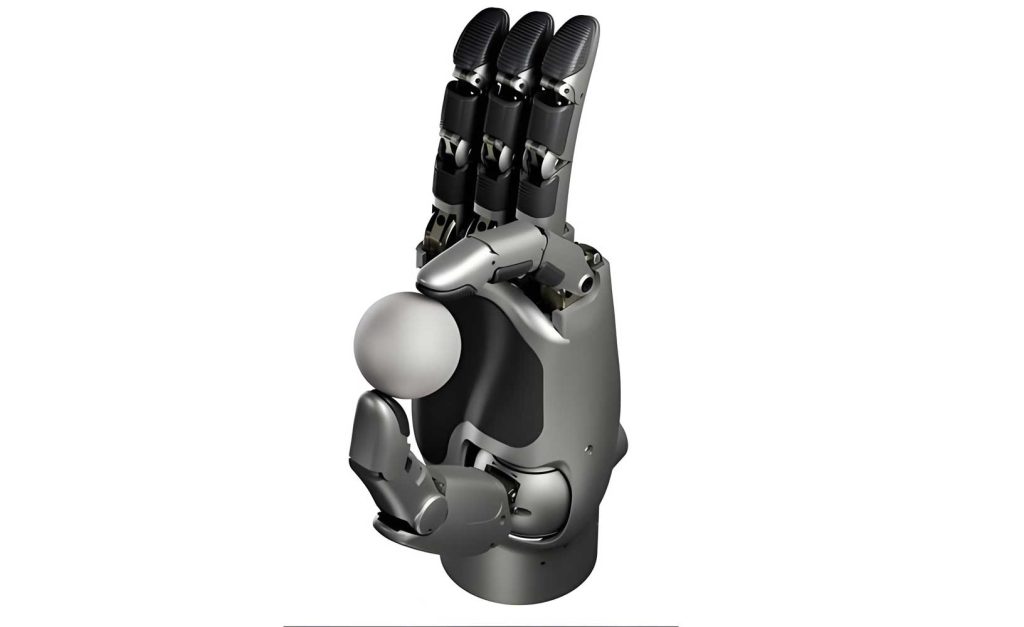
For the dexterous robotic hand, grasp success depends on both the grasp point and orientation. From the 16 Q-maps output by the FCN, we select the pixel with the highest Q-value across all orientations. This pixel corresponds to the optimal 3D grasp position \(q\) and orientation for the dexterous robotic hand. The hand’s center is aligned with this point, and inverse kinematics is used to plan the arm motion. The three fingers of the dexterous robotic hand are distributed such that one finger opposes the other two, allowing versatile grasps. Let \(F1\), \(F2\), and \(F3\) denote the three fingers. A grasp is considered successful if all three fingers make contact, or if pairs like \(F2\)-\(F3\) or \(F1\)-\(F3\) do, with finger distances below a threshold. This design enables the dexterous robotic hand to handle objects like cones and spheres that are challenging for two-finger grippers.
Experimental Setup
We conduct experiments in the V-REP simulation environment, using a UR5 robotic arm equipped with a three-finger dexterous robotic hand. A perspective 3D camera captures RGB-D images, which are projected to point clouds and orthographically projected to create height maps of size \(224 \times 224\). The workspace is a \(0.448 \, \text{m}^2\) area where objects are randomly placed. We use 10 objects, including cones, spheres of different sizes, and standard shapes like cubes and cuboids, modeled in SolidWorks. Training involves self-supervised data collection: objects are randomly dropped into the workspace, and the dexterous robotic hand performs grasp attempts until the space is empty, then the process repeats. We train for multiple epochs and evaluate on test scenes with 30 grasp trials per scenario.
Results and Analysis
We evaluate our method based on grasp success rates for various objects, comparing it with prior approaches. The dexterous robotic hand demonstrates high performance, especially for challenging shapes. Below, we present results using tables and formulas to summarize key findings.
Success Rates for Different Objects
Table 1 shows the grasp success rates for our method and a comparison method from literature, which uses a two-finger gripper or a three-finger dexterous robotic hand with a different algorithm. Our method achieves near-perfect success for spheres and cones, highlighting the advantage of the dexterous robotic hand combined with reinforcement learning.
| Algorithm | Small Sphere (%) | Large Sphere (%) | Cone (%) | Mixed Spheres (%) | Mixed Cones and Spheres (%) |
|---|---|---|---|---|---|
| Our Method (Three-Finger Dexterous Robotic Hand) | 100 | 100 | 98.3 | 98.8 | 61.6 |
| Literature Method (Three-Finger) | 93.8 | 100 | 73.5 | 98.1 | 57.9 |
| Literature Method (Two-Finger) | 100 | 0 | 0 | 0 | 0 |
As seen, our dexterous robotic hand outperforms the literature methods, particularly for cones and mixed objects. The two-finger gripper fails entirely on large spheres and cones, underscoring the need for a dexterous robotic hand with multiple fingers. The success rate for mixed cones and spheres is lower due to clutter, but our method still shows improvement.
Impact of Object Size and Clutter
We analyze how object size and scene complexity affect the dexterous robotic hand’s performance. For spheres, the success rate remains high regardless of size, thanks to the FCN’s ability to generalize from pre-training. The Q-value prediction can be modeled as a function of object features. Let \(f(\cdot)\) represent the feature extraction by DenseNet, then the Q-value for a grasp at pixel \(p\) is:
$$Q_p = W \cdot f(I_p) + b$$
where \(I_p\) is the image patch around \(p\), \(W\) are weights, and \(b\) is bias. This linear approximation highlights how the network encodes object properties. In cluttered scenes, the max Q-value selection might be influenced by multiple objects, but our method maintains robustness due to the dexterous robotic hand’s flexibility.
Training Efficiency and Overfitting
By pre-training on ImageNet, we reduce overfitting despite small datasets. The loss convergence during training is shown in Table 2, where we record the average Huber loss over epochs. The dexterous robotic hand’s policy improves steadily, indicating effective learning.
| Epoch | Average Loss | Success Rate (%) |
|---|---|---|
| 1 | 2.5 | 40.2 |
| 10 | 1.2 | 75.6 |
| 20 | 0.8 | 88.9 |
| 30 | 0.5 | 94.3 |
The loss decreases as the dexterous robotic hand learns better Q-maps, correlating with higher grasp success. This demonstrates the efficacy of our reinforcement learning framework for the dexterous robotic hand.
Discussion
Our approach leverages the dexterous robotic hand’s multi-finger design to grasp a wide range of objects, including those with complex geometries. The integration of reinforcement learning and FCNs allows end-to-end learning from pixels to actions, eliminating the need for manual annotation. The use of pre-training mitigates data scarcity issues, making the dexterous robotic hand adaptable to new objects. However, limitations exist: our method is currently tested only on block-like objects in simulation, and real-world factors like lighting and texture could affect performance. Future work could incorporate tactile sensing with the dexterous robotic hand to enhance grasp stability, or extend training to more diverse object categories. Additionally, optimizing the Q-Learning algorithm for faster convergence could improve the dexterous robotic hand’s efficiency in dynamic environments.
Conclusion
In this paper, we present a reinforcement learning-based method for grasping with a three-finger dexterous robotic hand. By combining DenseNet-121 pre-training, fully convolutional networks, and Q-Learning, we enable the dexterous robotic hand to learn visual-motor policies that map height maps to optimal grasp points. Experimental results in simulation show high success rates for cones, spheres, and mixed objects, outperforming comparison methods. The dexterous robotic hand’s flexibility is key to handling irregular shapes, and our end-to-end framework reduces reliance on explicit object models. This research advances the capabilities of dexterous robotic hands in robotic manipulation, paving the way for more versatile and autonomous systems. Future directions include real-world validation, integration with multi-modal sensors, and exploration of advanced reinforcement learning techniques for the dexterous robotic hand.
Throughout this work, the dexterous robotic hand has been central to achieving robust grasps, and we emphasize its role in pushing the boundaries of robotic dexterity. The methods and results presented here contribute to the ongoing evolution of dexterous robotic hand technologies, with potential applications in manufacturing, healthcare, and service robotics. By continuing to refine these approaches, we aim to make the dexterous robotic hand an even more effective tool for complex tasks in unstructured environments.