
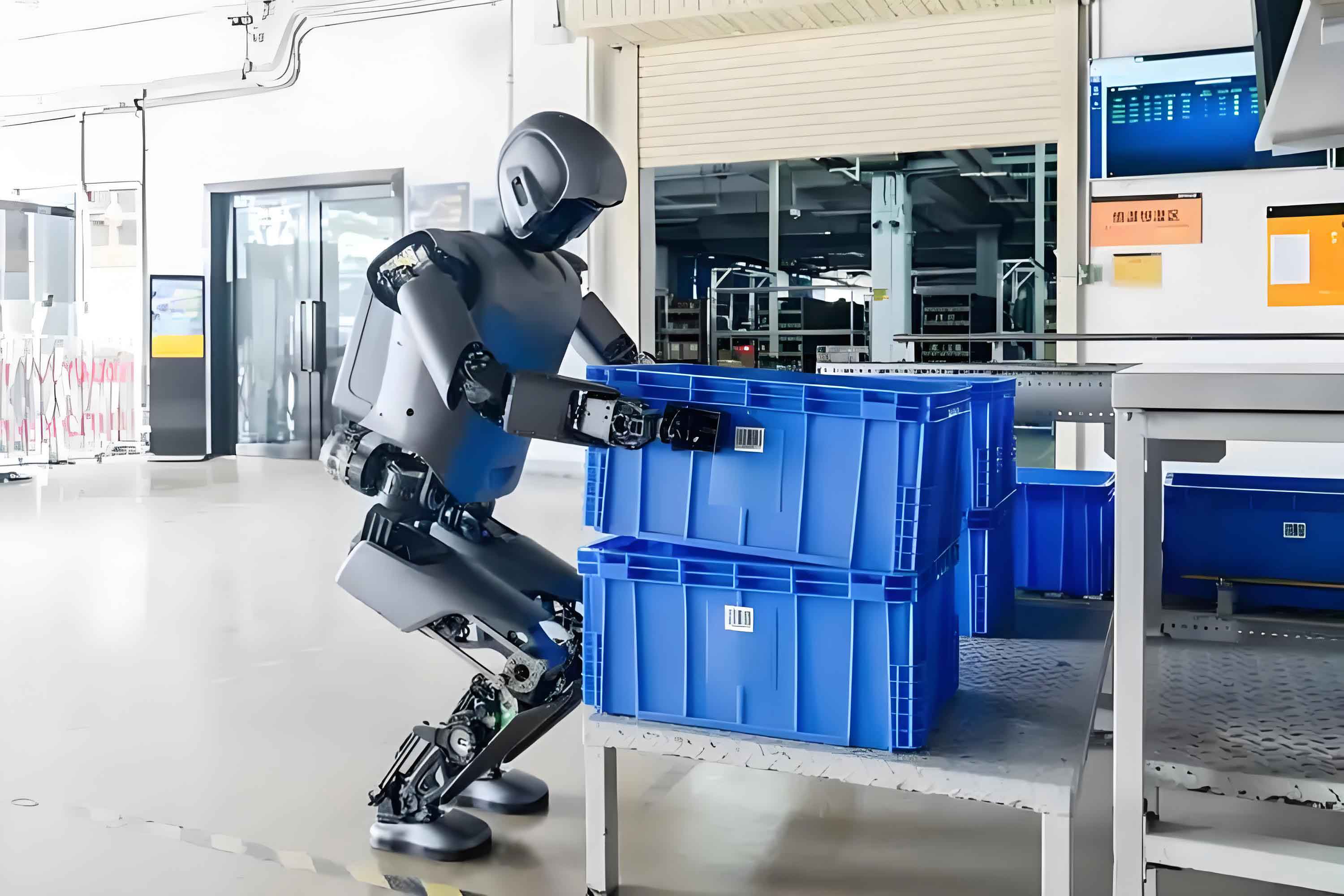
Handkerchief twirling, acrobatic flips, martial arts performances – since this year’s Spring Festival, the diverse capabilities of humanoid robots have consistently drawn public admiration. As the latest technological sensation following large-scale AI models, humanoid robots are emerging as a critical breakthrough for “AI+” applications, capturing widespread attention across society.
For Xu Lijin, a National Committee member of the Chinese People’s Political Consultative Conference (CPPCC) and Chairman/General Manager of Wuhu Robot Industry Development Group Co., Ltd., years of deep engagement in the robot industry have instilled an urgent sense of racing against time to keep pace with rapid technological evolution. This urgency directly informs his proposals at this year’s National Two Sessions.
The robot industry has gained unprecedented policy momentum. In 2023, China’s Ministry of Industry and Information Technology issued the “Guiding Opinions on Innovation and Development of Humanoid Robots.” Following this, regional governments introduced supporting policies throughout 2024, collectively accelerating humanoid robot industrialization. Widely projected to become the next-generation intelligent terminal after computers, smartphones, and new energy vehicles, humanoid robots are poised to penetrate diverse sectors and households. Industry analysts forecast 2025 as the inaugural year for commercial mass production in this transformative segment of the robot industry.
At the current National Two Sessions, Xu Lijin has submitted proposals centered on accelerating scenario-based applications for humanoid robots. His goal is to drive practical implementation across more fields, generating enhanced commercial value for industrial manufacturing and daily life while strengthening China’s position in the global robot industry.
Through professional investigations and industry engagements with companies like Unitree, Ubtech, Xingdong Jiyuan, and Zhiyuan, Xu observes China’s humanoid robot sector transitioning from “catch-up innovation” to “pioneering innovation.” However, he identifies persistent challenges in mass production and real-world application deployment that require focused solutions to advance the robot industry.
Xu’s comprehensive proposals address critical bottlenecks through strategic pillars:
- Application Scenario Expansion: Policy support should prioritize opening pilot sectors, aggregating cross-domain application data into standardized scenario libraries. These repositories will drive algorithmic iterations and accelerate product deployment, unlocking practical pathways for the robot industry’s growth. Targeted incentives could stimulate enterprise adoption in manufacturing, healthcare, and domestic services – establishing foundational use cases for broader robot industry integration.
- Core Technology Breakthroughs: Investment must concentrate on humanoid robot intelligence. Leading enterprises should helm innovation consortiums to tackle pivotal technologies: environmental perception, autonomous decision-making, physics simulation, digital twin modeling, and end-to-end large models. Such advancements will underpin multi-scenario functionality essential for scaling the robot industry. Collaborative R&D between academia and corporations can accelerate this technological maturation within the robot industry ecosystem.
- Standardization Framework Development: Immediate establishment of “General Technical Standards for Humanoid Robots” is crucial, complemented by dynamic updating mechanisms. A national-level testing and certification center should enforce product evaluation systems, providing authoritative quality assurance and market access protocols. Standard harmonization will enhance interoperability, safety, and global competitiveness – vital for the robot industry’s maturation.
- Ethical Governance Reinforcement: Comprehensive safety and ethical frameworks must evolve alongside technological progress. Proactive guidelines should address human-robot interaction protocols, data privacy safeguards, and ethical deployment parameters to foster sustainable development and public trust in the robot industry. International cooperation on ethical standards will position China’s robot industry as a responsible innovation leader.
Beyond robotics, Xu actively addresses socioeconomic concerns. Last year, he advocated for institutional innovations in Yangtze River Delta rail transit connectivity. This year, his additional proposals focus on strengthening personal data protection against harassment/fraud and regulating electronic debt instruments.
“As entrepreneurs in the robot industry, we must relentlessly follow technological revolutions and industrial transformation,” Xu emphasized. “Through sustained R&D investment and core technology breakthroughs, we will strengthen our primary businesses, enhance industrial capabilities, and contribute to high-quality development of the private economy. The robot industry stands ready to fulfill its role in advancing Chinese modernization.”
Xu’s dual focus – advancing cutting-edge robotics while addressing societal needs – reflects the expanding influence of the robot industry. With humanoid robots transitioning from laboratories to factories and homes, systematic solutions across technology, policy, and ethics will determine the pace at which this sector reshapes economies and daily life globally. The ongoing institutional support and entrepreneurial vigor position China’s robot industry at a pivotal inflection point, with 2025 poised to validate its commercial viability and scalability.