
The planetary roller screw stands as a pivotal mechanical transmission component, renowned for its exceptional load-bearing capacity, high positioning accuracy, and superior stiffness. These attributes make it indispensable in demanding applications such as humanoid robots, aerospace actuators, and high-end computer numerical control (CNC) machine tools. At its core, the planetary roller screw converts rotary motion into linear motion (or vice-versa) through the meshing of threaded surfaces between a central screw, multiple satellite rollers, and an enclosing nut. However, this seemingly simple principle belies a complex interaction at the contact interfaces. The inevitable differences in the helix angles among the screw, rollers, and nut create a fundamental kinematic condition where pure rolling is impossible. This results in a coupled rolling-sliding motion at the screw-roller and roller-nut contacts. While the rolling component enables efficient power transmission, the sliding component is a primary source of friction, wear, and energy loss, ultimately affecting transmission efficiency, precision retention, and service life. Therefore, a profound understanding of the rolling-sliding mechanism, particularly under realistic loaded conditions, is paramount for the optimal design and performance enhancement of planetary roller screw systems.
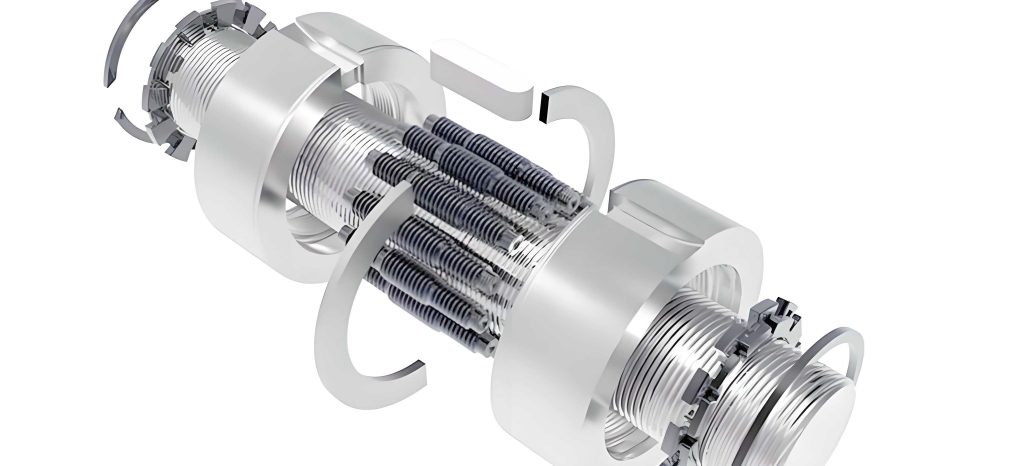
Traditional kinematic models often simplify the analysis by assuming rigid bodies, neglecting the significant deformations that occur under operational axial loads. In a real planetary roller screw, the applied axial force induces load-induced deformations in the threaded teeth of the screw, rollers, and nut. These deformations are not merely elastic contact deflections at the point of contact (Hertzian deformation) but also include substantial bending, shear, and tilting of the entire threaded tooth root. This load-induced deformation fundamentally alters the geometry of the contacting surfaces, shifting the actual contact point locations and modifying the local curvatures. Consequently, the kinematic relationships governing the rolling and sliding velocities are directly affected. Ignoring these effects leads to an inaccurate prediction of the slip velocity, underestimating friction and wear. This analysis delves into the intricacies of the loaded contact state and establishes a comprehensive kinematic model for the planetary roller screw that explicitly accounts for load-induced tooth deformations, providing a more accurate framework for analyzing the rolling-sliding coupling mechanism.
Analysis of Loaded Contact State in Planetary Roller Screws
Under an operational axial load \( F_a \), the threaded teeth within a planetary roller screw experience a complex state of stress and deformation. To analyze the load distribution and the resulting deformations, we consider a system with \( N \) rollers, each having \( n_t \) engaged thread turns. The load is shared among all contacting teeth, but not uniformly. The total deformation at any contact interface \( (i, j) \) (denoting the \( j \)-th tooth of the \( i \)-th roller) can be decomposed into two primary components: the local Hertzian contact deformation \( \delta^c \) and the structural deformation of the threaded tooth itself \( \delta^t \). The equivalent normal deformation at the screw-roller or nut-roller interface, considering force equilibrium, can be initially approximated as:
$$
\delta^E_{n(i,j)} = \frac{F_a \cdot L_r \cdot \sin \beta}{E \cdot A \cdot N \cdot n_t \cdot \cos \lambda}
$$
where \( L_r \) is the roller length, \( E \) is the Young’s modulus, \( A \) is the cross-sectional area, \( \beta \) is the contact angle, and \( \lambda \) is the lead angle. Based on Hertzian theory, the corresponding equivalent normal contact force \( Q^E_{n(i,j)} \) is related to this deformation by a contact stiffness factor \( K \), which depends on the material properties and the principal curvatures \( \sum \rho \) of the contacting surfaces:
$$
Q^E_{n(i,j)} = \left( \frac{\delta^E_{n(i,j)}}{K_{rn} + K_{rs}} \right)^{3/2}, \quad K_{ri} = K_{ei} \left( \frac{\pi m_{ai}}{9\sum \rho_i} \left( \frac{1-\mu_r^2}{E_r} + \frac{1-\mu_i^2}{E_i} \right) \right)^{3}
$$
However, this is a simplified average. The actual force on a specific tooth must satisfy static equilibrium and compatibility of deformations along the thread. The key is to recognize the deformation of the tooth structure. The total axial displacement \( \chi_{(i,j)} \) between the screw and nut threads at the location of the \( j \)-th tooth of the \( i \)-th roller arises from the cumulative difference in contact deformations on adjacent teeth and the bending of the teeth themselves:
$$
\chi_{(i,j)} = \frac{1}{\sin \beta \cos \lambda} \left( \delta_{sr(i,j-1)} – \delta_{sr(i,j)} + \delta_{rn(i,j-1)} – \delta_{rn(i,j)} \right)
$$
This axial displacement is resisted by the stiffness of the screw and nut tooth arms. It can be expressed as a function of the axial force \( F_{n(i,j)} \) carried by that tooth segment:
$$
\chi_{(i,j)} = \chi_{s(i,j)} + \chi_{n(i,j)} = \frac{F_{s(i,j)} p}{2E_s A_s} + \frac{F_{n(i,j)} p}{2E_n A_n} = \frac{F_{n(i,j)} p (A_s + A_n)}{2E_s A_s A_n}
$$
where \( p \) is the pitch. The axial force \( F_{n(i,j)} \) is the sum of the axial components of all normal contact forces from that tooth to the end of the roller:
$$
F_{n(i,j)} = \sum_{k=j}^{n_t} Q_{n(i,k)} \sin \beta \cos \lambda
$$
By combining the geometric compatibility condition with the force-deformation relation, an iterative equation can be established to solve for the actual load distribution \( Q_{n(i,j)} \) along the engaged threads of each roller in the planetary roller screw:
$$
Q_{n(i,j)}^{2/3} = Q_{n(i,j-1)}^{2/3} – \frac{(\epsilon_{(i,j-1)} – \epsilon_{(i,j)}) \sin \beta \cos \lambda}{K_{rs} + K_{rn}} – \frac{\sum_{k=j}^{n_t} Q_{n(i,k)} \sin^2 \beta \cos^2 \lambda \cdot p (A_s + A_n)}{2E_s A_s A_n (K_{rs} + K_{rn})}
$$
The total deformation \( \delta^t \) of an individual threaded tooth includes several modes: bending deflection \( \delta^1 \), shear deflection \( \delta^2 \), tooth root tilting \( \delta^3 \), and tooth root shear \( \delta^4 \). The final loaded position of the thread surface is thus offset from its nominal position by this deformation \( \delta^t \) plus the local contact deformation \( \delta^c \). This combined load-induced deformation \( \delta = \delta^t + \delta^c \) critically modifies the geometry for kinematic analysis.
| Deformation Type | Symbol | Primary Cause | Effect on Kinematics |
|---|---|---|---|
| Tooth Bending | \( \delta^1 \) | Moment from normal contact force | Shifts contact point radially and axially |
| Tooth Shear | \( \delta^2 \) | Shear force from normal contact force | Shifts contact point axially |
| Root Tilting | \( \delta^3 \) | Non-uniform support at tooth base | Changes local surface orientation |
| Root Shear | \( \delta^4 \) | Shear at the tooth root cross-section | Contributes to axial displacement |
| Hertzian Contact | \( \delta^c \) | Local pressure at contact ellipse | Modifies effective contact curvature |
Kinematic Modeling of Rolling-Sliding Motion Incorporating Load-Induced Deformation
To analyze the rolling-sliding mechanism in a planetary roller screw, precise knowledge of the contact point geometry is essential. We define three key coordinate systems: the screw-fixed frame \( S(x_s, y_s, z_s) \), the roller-fixed frame \( R(x_r, y_r, z_r) \), and the carrier-fixed frame \( P(x_p, y_p, z_p) \). The screw rotates relative to the carrier with an angular velocity \( \vec{\omega}_{s/p} \), and each roller rotates relative to the carrier with \( \vec{\omega}_{r/p} \).
The nominal thread surface of a screw or roller can be generally described in its own coordinate system by an equation of the form:
$$
z(r, \theta) = \frac{\gamma}{\cos \beta} h(r) + \frac{\theta l}{2\pi}
$$
where \( \gamma = \pm 1 \) indicates the flank side, \( r \) and \( \theta \) are polar coordinates on the thread surface, \( h(r) \) is a function defining the thread profile (e.g., circular arc for the nut/screw, straight line for the roller in a triangular profile), and \( l \) is the lead. When load-induced deformation \( \delta \) occurs, the thread surface is effectively displaced. For a roller with a straight (triangular) tooth profile, the deformed surface equation becomes:
$$
z_{mr} = \frac{\gamma}{\cos \beta_r} \left[ K + \delta – (r_{mr} – r_{Tr}) \tan \alpha_n \right] + \frac{\theta_{mr} l_r}{2\pi}
$$
For a screw/nut with an arc profile, the equation modifies to:
$$
z_{ms} = \frac{\gamma}{\cos \beta_s} \left( K – r_{Bs} \cos \alpha_n + \delta + \sqrt{r_{Bs}^2 – r_{ms}^2} \right) + \frac{\theta_{ms} l_s}{2\pi}
$$
Here, \( \alpha_n \) is the pressure angle, \( r_{Tr} \) and \( r_{Ts} \) are nominal radii, and \( r_{Bs} \) is the radius of the thread arc. The parameter \( K \) is a constant related to the pitch. The contact point \( E \) between the screw and roller is defined by two conditions: 1) the points are coincident in space, and 2) the surface normals are collinear but opposite. These conditions yield a system of equations for the contact radii \( r_{ES} \), \( r_{ER} \) and angles \( \theta_{ES} \), \( \theta_{ER} \).
Spatial Coincidence:
$$
\begin{pmatrix} r_{ES} \cos \theta_{ES} \\ r_{ES} \sin \theta_{ES} \end{pmatrix} – \begin{pmatrix} r_{ER} \cos \theta_{ER} \\ r_{ER} \sin \theta_{ER} \end{pmatrix} = \begin{pmatrix} d \\ 0 \end{pmatrix}
$$
where \( d \) is the center distance between the screw and roller axes.
Normal Vector Collinearity: This leads to two scalar equations. The first ensures the normal vectors have the same magnitude (which is a property of the surfaces):
$$
f_1(r_{ES}, r_{ER}) = \left( \frac{h’_1}{\cos \beta_s} \right)^2 + \left( \frac{l_s}{2\pi r_{ES}} \right)^2 – \left( \frac{h’_2}{\cos \beta_r} \right)^2 – \left( \frac{l_r}{2\pi r_{ER}} \right)^2 = 0
$$
The second equation enforces the parallelism of the normals, which can be simplified to:
$$
f_2(r_{ES}, r_{ER}) = \left( \frac{r_{ES} \gamma_1 h’_1}{d \cos \beta_s} – \frac{r_{ER} \gamma_2 h’_2}{d \cos \beta_r} \right)^2 + \left( \frac{l_s – l_r}{2\pi d} \right)^2 – \left[ \left( \frac{h’_1}{\cos \beta_s} \right)^2 + \left( \frac{l_s}{2\pi r_{ES}} \right)^2 \right] = 0
$$
The variables \( h’_1 \) and \( h’_2 \) are derivatives related to the thread profiles. The system \( f_1=0, f_2=0 \) is solved iteratively for \( r_{ES} \) and \( r_{ER} \). Subsequently, the contact angle \( \theta_{ER} \) can be found from:
$$
\begin{pmatrix} \cos \theta_{ER} \\ \sin \theta_{ER} \end{pmatrix} = \begin{pmatrix} \frac{-(r_{ER} + b_1)d}{(r_{ER} + b_1)^2 + a_1^2} \\ \frac{a_1 d}{(r_{ER} + b_1)^2 + a_1^2} \end{pmatrix}
$$
where \( a_1 \) and \( b_1 \) are expressions involving \( r_{ES}, r_{ER}, l_s, l_r, h’_1, h’_2, \beta_s, \beta_r \).
Once the loaded contact point \( E \) is determined, the velocity analysis can proceed. The velocity of point \( E \) on the roller relative to the carrier frame \( P \) is \( \vec{v}_{r/p}(E) = \vec{\omega}_{r/p} \times \vec{r}_{E/R} + \vec{v}_{O_r/p} \), where \( O_r \) is the roller center. Similarly, the velocity of point \( E \) on the screw relative to \( P \) is \( \vec{v}_{s/p}(E) = \vec{\omega}_{s/p} \times \vec{r}_{E/S} \). The relative sliding velocity at the contact is the difference between these two velocities:
$$
\vec{v}_{slide} = \vec{v}_{r/s}(E) = \vec{v}_{r/p}(E) – \vec{v}_{s/p}(E)
$$
After derivation in the carrier coordinate system, and defining ratios \( \lambda = \omega_{r/p} / \omega_{s/n} \) and \( \epsilon = \omega_{p/n} / \omega_{s/n} \) (where \( \omega_{s/n} \) is the input screw speed relative to the nut), the sliding velocity components can be expressed as:
$$
\vec{v}_{slide} = \omega_{s/n} \begin{pmatrix} (1 – \epsilon – \lambda) r_{ES} \sin \theta_{ES} \\ -c\lambda + (\epsilon + \lambda – 1) r_{ES} \cos \theta_{ES} \\ -\frac{l_s}{2\pi} \end{pmatrix}
$$
The rolling velocity, which is the velocity of the screw surface at the contact point relative to the carrier, represents the component of motion that would occur if there were pure rolling. It is given by:
$$
\vec{v}_{roll} = \vec{v}_{s/p}(E) = \omega_{s/n} \begin{pmatrix} (\epsilon – 1) r_{ES} \sin \theta_{ES} \\ (1 – \epsilon) r_{ES} \cos \theta_{ES} \\ \frac{l_s}{2\pi} \end{pmatrix}
$$
It is crucial to note that the contact radii \( r_{ES}, r_{ER} \) and angle \( \theta_{ES} \) in these velocity equations are the loaded values, solved from the deformed geometry equations \( f_1=0, f_2=0 \). This directly couples the load-induced deformation state to the kinematic output, defining the rolling-sliding mechanism of the planetary roller screw.
Experimental Validation of the Rolling-Sliding Mechanism
To validate the proposed kinematic model that accounts for load-induced deformation, a dedicated experimental platform was constructed to measure the motion characteristics of a planetary roller screw. The core principle involves measuring the input screw rotation and the resulting axial displacement of the nut (which is kinematically tied to the roller’s axial movement) to back-calculate the roller’s rotation and infer the rolling-sliding behavior.
| Component | Parameter | Value (Screw) | Value (Roller) |
|---|---|---|---|
| Geometry | Pitch Diameter (mm) | 24 | 8 |
| Lead Angle (°) | 2.28 | 1.37 | |
| Lead (mm) | 3 | 0.6 | |
| Thread Angle (°) | 90 | 90 | |
| Operation | Input Velocity | 3, 5, 7 mm/s (Nut) | |
The test procedure was as follows: 1) A servo motor drove the screw to rotate at a target speed while the nut was constrained to only linear motion. 2) The screw rotational speed (\( n_s \)) was directly measured using an encoder. 3) The nut axial displacement (\( s_n \)) was measured with a linear scale. Since in a standard planetary roller screw the rollers have no net axial displacement relative to the nut (only orbital and rotational motion), the axial displacement of the nut over time directly gives the axial travel per revolution of the screw. More importantly, the relationship between nut displacement and roller rotation is fixed by the roller’s lead. Therefore, the effective rotational speed of the roller (\( n_r \)) can be deduced from the nut’s axial velocity \( v_n \) and the roller lead \( l_r \): \( n_r = v_n / l_r \).
The measured screw speed and the derived roller speed under different input velocities are the foundational experimental data. According to kinematic theory, the ratio of roller to screw speed is related to the geometry. Any deviation from the ideal rigid-body kinematic ratio indicates the presence of slip. By comparing the experimentally observed speed ratio with the theoretical one calculated from both the traditional rigid model and the proposed deformation-aware model, the validity of the models can be assessed.
The experimental results confirmed the presence of slip. For instance, at a 5 mm/s input, the measured rolling speed component showed a close match with the theoretical prediction from the deformation-aware model, with a deviation of only about 0.6%. The sliding speed prediction also aligned well, with deviations under 1.5%. These low error margins validate the accuracy of the proposed analytical framework for the planetary roller screw rolling-sliding mechanism. In contrast, a rigid-body model showed systematically larger errors, especially under higher loads, confirming the necessity of incorporating load-induced deformation.
| Input Velocity (mm/s) | Experimental Rolling Speed (rpm) | Theoretical Rolling Speed (rpm) – Proposed Model | Deviation (%) |
|---|---|---|---|
| 3 | 142.5 | 141.8 | 0.49 |
| 5 | 237.0 | 235.6 | 0.59 |
| 7 | 331.8 | 329.2 | 0.78 |
In-Depth Analysis: The Impact of Load-Induced Deformation on the Rolling-Sliding Mechanism
With the validated model, we can quantitatively investigate how axial load—and the resulting deformation—affects the fundamental rolling-sliding behavior of the planetary roller screw. The analysis reveals several critical trends.
1. Deformation and Contact Point Shift: As axial load \( F_a \) increases, the thread tooth deformations \( \delta \) become more pronounced. This deformation is not uniform along the engaged length of the roller. Teeth closer to the load-bearing end of the nut experience greater force and thus greater deformation. The model calculations show that with increasing load, the contact radius on the roller side \( r_{ER} \) increases, while the contact radius on the screw side \( r_{ES} \) decreases. This shift in the contact point location is a direct consequence of the thread tooth bending and compression, altering the effective meshing geometry of the planetary roller screw.
2. Effect on Rolling and Sliding Velocities: The change in contact point geometry directly influences the kinematic velocities. The analysis was conducted for axial loads of 10 kN, 30 kN, and 50 kN. The results demonstrate that as load-induced deformation grows:
- Both rolling velocity (\( v_{roll} \)) and sliding velocity (\( v_{slide} \)) increase.
- The rate of increase for sliding velocity is dramatically higher than for rolling velocity.
For example, when the load increases from a nominal reference state to 50 kN, the average increase in the rolling speed component is only about 0.106%. This minor change indicates that the fundamental rolling constraint is largely preserved. In stark contrast, the sliding speed component experiences an average surge of approximately 19.012%. This disproportionate increase highlights a crucial mechanism: load-induced deformation in the planetary roller screw primarily exacerbates the unfavorable sliding motion, not the desired rolling motion.
The underlying physics can be interpreted as follows: The deformation alters the effective lead angles and contact positions in such a way that the kinematic condition for pure rolling is further violated. The screw and roller surfaces are “forced” to undergo additional relative tangential motion (sliding) to maintain continuous contact and satisfy the overall motion transfer, given the new deformed geometry of the teeth. This significantly higher sliding velocity under load directly translates to increased interfacial friction, higher heat generation, accelerated wear, and reduced mechanical efficiency—key concerns for the reliability of the planetary roller screw.
| Axial Load \( F_a \) (kN) | Avg. Increase in \( v_{roll} \) (%) | Avg. Increase in \( v_{slide} \) (%) | Primary Consequence |
|---|---|---|---|
| 10 | 0.042 | 7.605 | Moderate wear increase |
| 30 | 0.074 | 13.308 | Significant efficiency drop |
| 50 | 0.106 | 19.012 | Severe wear & overheating risk |
This analysis provides a clear design insight: to improve the performance and longevity of a planetary roller screw, strategies must focus not only on optimizing the nominal geometry for minimal slip but also on enhancing the stiffness of the threaded teeth to minimize load-induced deformation. Techniques such as tooth profile modification, optimized root fillets, or the use of higher-strength materials can be guided by this model to effectively “decouple” the load from the sliding kinematics, thereby achieving a transmission that is more robust and efficient across its operational load range.
Conclusion
This comprehensive investigation successfully bridges the gap between the structural mechanics and kinematics of the planetary roller screw. By rigorously modeling the load-induced deformations of the threaded teeth and integrating this deformed geometry into a detailed kinematic analysis, a more accurate and realistic model of the rolling-sliding mechanism has been established. The experimental validation confirms the model’s reliability, showing close agreement between predicted and measured motion characteristics.
The key finding of this research is the quantitative revelation of how axial load detrimentally affects the planetary roller screw performance through deformation-mediated kinematics. While the rolling motion remains relatively stable, the sliding velocity is highly sensitive to load, increasing nearly twenty times more rapidly than the rolling velocity. This underscores that the primary tribological challenge in heavily loaded planetary roller screw applications is not just contact stress but the dramatically intensified sliding friction caused by elastic deflections.
Therefore, future work in the design and development of high-performance planetary roller screw systems must adopt this coupled perspective. The proposed model serves as a powerful theoretical tool and data source for guiding structural optimization, material selection, and profile modification aimed at reducing sensitivity to load-induced deformation. By mitigating the root cause of excessive sliding, the transmission efficiency, positioning accuracy, and operational lifespan of the planetary roller screw can be substantially enhanced, meeting the ever-growing demands of advanced precision engineering applications.