
The second World Humanoid Robot Games has closed after a competition period in which humanoid robots repeatedly broke records previously set by humans, pushed the boundaries of speed, balance, autonomy, and dexterity, and offered a vivid preview of how humanoid robots may move from spectacle to service. By the evening of August 26, before the closing ceremony, all 51 events had been completed. The results showed that humanoid robots are not only becoming faster and stronger, but also more capable of operating in environments designed for people. From sprint tracks to household settings, from tug-of-war ropes to catering counters, humanoid robots demonstrated that their evolution is accelerating and that their path toward human life is becoming more concrete.
1. Humanoid Robots Break Records From the Opening Night
Almost every day during the competition period, humanoid robots broke world records previously held by humans. On the opening night alone, humanoid robots surpassed two human world records. The Tianzhuo team’s humanoid robot completed the 100-meter sprint in 9.39 seconds, breaking the 9.58-second men’s 100-meter world record held by Jamaican sprinter Usain Bolt. In the standing high jump, the Tiangong Ultra humanoid robot recorded 288.43 centimeters, breaking the human limit. These performances immediately established the tone of the second World Humanoid Robot Games: humanoid robots are being tested not merely for participation, but for record-breaking capability.
The opening-night results also signaled that humanoid robots have entered a phase in which hardware, control algorithms, and learning systems are converging. A humanoid robot that can sprint at such speed must manage balance, propulsion, joint coordination, energy use, and rapid feedback. A humanoid robot that can achieve a standing high jump of 288.43 centimeters must combine explosive power with stable landing control. Together, these results showed that humanoid robots are moving beyond carefully staged demonstrations and into competitive environments where every fraction of a second and every centimeter matters.
2. Sprint Final Delivers Another Leap for Humanoid Robots
By the time the 100-meter final for the large-group category was held, the opening-night record had already been surpassed again. The Tianjiao team’s humanoid robot ran the distance in 8.64 seconds. That result represented a further breakthrough after the opening night and underlined how quickly humanoid robots can improve within a single competition cycle. For humanoid robots, such progress is not simply a matter of stronger motors or lighter materials. It reflects advances in motion control, gait generation, real-time perception, and the ability to recover from disturbances at high speed.
The sprint events became one of the clearest measures of progress for humanoid robots because they compress many technical challenges into a short, visible performance. Humanoid robots must start quickly, accelerate efficiently, maintain balance at speed, and cross the line without falling. When humanoid robots run faster than elite human athletes, the comparison draws public attention, but the deeper significance lies in the control architecture. A humanoid robot that can run at 8.64 seconds over 100 meters is demonstrating that its underlying systems can coordinate complex mechanical and computational tasks under extreme pressure.
3. Organizers Say Extreme Breakthroughs Were Expected for Humanoid Robots
The event’s organizing committee and team engineers appeared to have anticipated such breakthroughs. Jiang Guangzhi, executive deputy director of the World Humanoid Robot Games organizing committee and director of the Beijing Municipal Bureau of Economy and Information Technology, said at a previous news conference that from a technical capability perspective, extreme breakthroughs were worth waiting for. He noted that in April, the champion result of a humanoid robot half marathon had been shortened from 2 hours, 40 minutes, and 42 seconds one year earlier to 50 minutes and 26 seconds. That was less than one-third of the previous duration and also broke the human record. After several more months of iterative upgrades, the humanoid robots ready to compete as “flyers” were prepared to impress the world again.
Jiang’s comments placed the record-breaking performances in a broader trajectory. Humanoid robots are not improving in isolation. Their progress is being driven by repeated testing, competition, and engineering iteration. Each event creates a demanding benchmark. Each benchmark exposes weaknesses in balance, perception, planning, or endurance. Each iteration then feeds back into the next generation of humanoid robots. The second World Humanoid Robot Games therefore served as both a public showcase and a stress test for humanoid robots.
4. Engineering Teams See Humanoid Robots Learn From Failure and Return Stronger
Han Gang, a motion control algorithm expert at the Beijing Humanoid Robot Innovation Center, said in an interview with media outlets that he found the competition deeply satisfying to watch. His team’s Tiangong Omni humanoid robot had just won the 400-meter small-group final. When the humanoid robot ran through the curve, Han described its performance as outstanding, even somewhat like a motorcycle racer leaning into a turn. That image captured how far humanoid robots have come in dynamic balance and cornering control.
Returning with a humanoid robot after one year, Han described the effort as a comeback. One year earlier, the humanoid robot he led fell from a staircase during an obstacle event, and the robot’s head fell off. That moment became a prominent clip in the previous year’s collection of humanoid robot falls, and people repeatedly used the image to push his team forward. The second World Humanoid Robot Games offered a different outcome. The Tiangong Omni humanoid robot’s 400-meter small-group victory showed that failure can become a foundation for improvement when engineering teams treat it as feedback rather than defeat.
For humanoid robots, falling is not merely a visual embarrassment. It reveals problems in perception, state estimation, foot placement, compliance control, and recovery strategy. A humanoid robot that falls on stairs may lack sufficient awareness of terrain or may fail to adjust its center of mass quickly enough. A humanoid robot that learns from that failure can become more robust. The comeback story surrounding Han’s team illustrated how humanoid robots advance through cycles of failure, diagnosis, redesign, and retesting.
5. Tug-of-War Victory Shows How Humanoid Robots Learn Human Motion
After the Xingzhe Taishan team won the lightweight tug-of-war final, Liu Jingxuan, a test engineer at Shandong Youbaote Intelligent Robot Co., Ltd., explained how the team prepared. During preparation, the humanoid robot collected human tug-of-war motions and imitated them in a simulation environment. Technicians then gradually increased external force while ensuring stability, so that the humanoid robot could both pull the rope backward and resist the opponent’s resistance. This process showed how humanoid robots can learn from human motion and then adapt that learning to competitive tasks.
Tug-of-war is a particularly revealing event for humanoid robots because it requires more than strength. The humanoid robot must maintain grip, coordinate its arms and legs, adjust posture, and respond to changing resistance. It must avoid losing balance while applying force. The simulation-based learning approach described by Liu demonstrates how humanoid robots can acquire skills in virtual environments before transferring them to physical bodies. For humanoid robots, this is a crucial pathway toward performing useful work in unpredictable real-world settings.
Before stepping onto the award podium, the young engineer, born after 2000, said that humanoid robots are evolving very quickly and that this year’s progress has been enormous. When he competed last year, many humanoid robots completed tasks under remote control. This year, more humanoid robots had switched to autonomous mode. That shift is significant because autonomy is one of the clearest dividing lines between a remote-controlled machine and a humanoid robot that can assist people independently.
6. Autonomy Becomes the Defining Test for Humanoid Robots
Yu Qingfeng, executive deputy director of the organizing committee and director of the Beijing Municipal Bureau of Sports, introduced that except for the 100-meter obstacle and 400-meter obstacle events, all track events and other competitive events required humanoid robots to complete their tasks fully autonomously. This rule transformed the competition into a test of perception, decision-making, planning, and control. Humanoid robots could not rely solely on human operators to guide every movement. They had to interpret their environments and act on their own.
Autonomy is difficult for humanoid robots because it requires the integration of multiple systems. A humanoid robot must see the track, identify obstacles, estimate its own state, plan a path, generate movements, and adjust in real time. It must handle unexpected disturbances and recover from errors. When humanoid robots operate autonomously, every mistake is amplified because no human is immediately available to correct it. The requirement for full autonomy in most events therefore represented a major step toward practical humanoid robots.
The competition also showed that autonomy is not an all-or-nothing achievement. Some humanoid robots completed tasks smoothly, while others moved slowly or briefly lost connection. Yet even these difficulties revealed progress. The fact that more humanoid robots could attempt autonomous operation in complex events marked a meaningful advance over the previous year, when remote control was more common.
7. Spectators Cheer Humanoid Robots and Ask Whether They Can Work at Home and in Factories
At the edge of the arena, spectators did not hide their amazement when humanoid robots completed difficult movements or sprinted across the finish line. During the 100-meter obstacle event, when a humanoid robot placed its hands on a platform and climbed over a high wall, the audience responded with widespread exclamations. Such reactions showed that humanoid robots can still inspire wonder when they perform actions that humans recognize as physically demanding and dynamically complex.
At the same time, many spectators and online viewers watched humanoid robots lose control, dance unexpectedly, or remain on the ground and wondered whether humanoid robots can truly enter homes and factories to help people work. The question is natural. Competitive performances can be dramatic, but daily life and industrial work require reliability, safety, and adaptability. A humanoid robot that can run quickly may still struggle to fold laundry or identify a tool. A humanoid robot that can jump may still need to learn how to navigate a crowded room.
Yet the second World Humanoid Robot Games did not avoid these practical questions. It placed them at the center of several events. By extending competition into real-world scenarios and by rewarding autonomy more heavily than teleoperation, the event encouraged teams to develop humanoid robots that can do more than perform in a controlled arena. The skepticism expressed by audiences was therefore part of the conversation that humanoid robots must answer through demonstrated capability.
8. Humanoid Robots Have Already Entered Home and Catering Scenarios, Researcher Says
Wang He, founder of Galaxy General Robot Co., Ltd. and a researcher at Peking University, responded directly to the doubt that humanoid robots can enter homes and factories. He said they have already entered such environments. At this year’s games, Galaxy General’s humanoid robots won gold medals in both the home scenario event and the catering scenario event. On the opening night, the company’s humanoid robot also participated in a tennis exhibition match with tennis player Zheng Jie.
Wang explained that the humanoid robot’s tasks in the scenario events were genuinely difficult. In the home scenario, the humanoid robot had to take clothes out of a washing machine, transfer them to a bed, fold them, and finally place them in a wardrobe. The clothes on the bed were in a randomly scattered state, but the algorithm was already able to respond well to such natural variations and random challenges in daily life. This was an important demonstration for humanoid robots because homes are not structured like factories. Objects vary in shape, position, and condition.
Wang added that humanoid robots still cannot reach the point where they can say, “Tomorrow I will go to my home and work.” The reason is that during the games, humanoid robots collected data from the current scene within a specified time. In real life, humanoid robots must face more than the “questions” presented in the arena. They must re-identify whether the clothing on the bed is a dress or a pair of jeans. Collecting the “questions” of daily life may consume more time and research resources than a human would need to complete the task itself. However, as foundation models absorb more data and humanoid robots become more capable, future learning costs may become lower, efficiency may increase, and humanoid robots may have a more substantial impact on human production and life.
9. Real-World Scenario Events Put Humanoid Robots Through Practical Tasks
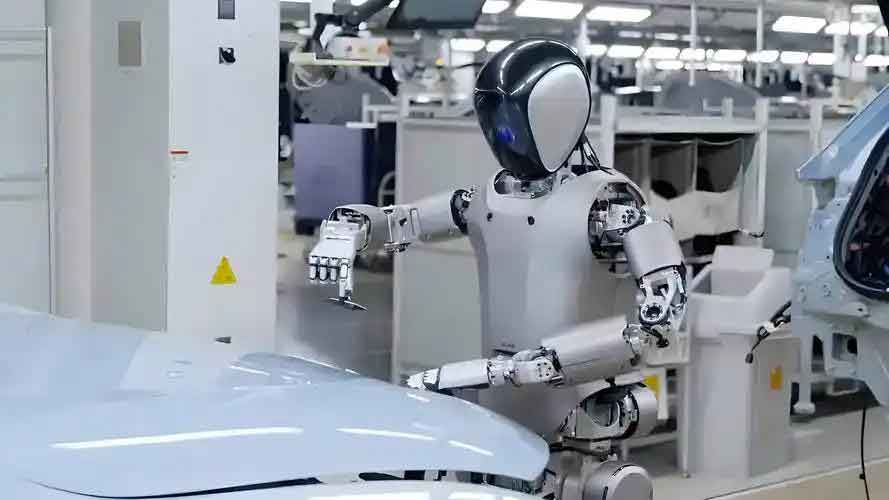
In fact, many events at this year’s games were designed around real needs. Scenario events extended competition into real environments and covered fields such as industry, hotels, homes, and logistics. A dedicated dexterous hand event was also established. Among the scenario events, assembly and feeding, housekeeping services, fire rescue, and library organization were carefully designed for dull, dirty, dangerous, and difficult settings. These are precisely the kinds of work that humanoid robots may eventually perform to assist or replace human labor in hazardous or repetitive conditions.
The dexterous hand events included powder weighing, picking beans with tweezers, and opening bottles and prying caps. These tasks tested whether humanoid robots could see clearly, hold steadily, and act accurately at the level of fingertip precision. For humanoid robots, dexterous manipulation is one of the hardest challenges because it requires fine motor control, tactile feedback, visual recognition, and task planning. A humanoid robot that can run quickly may still fail to pick up a small object. A humanoid robot that can jump may still struggle to open a bottle. The dexterous hand events therefore highlighted a different but equally important dimension of humanoid robot development.
10. Dexterous Hands and Precision Tasks Reveal the Fine Motor Challenge for Humanoid Robots
Gong Xiao, a member of the organizing committee and deputy director of the China Software Testing Center, gave examples from the competition. In the powder weighing event, a humanoid robot needed to use a spoon to take and place 20 grams of powder, with the error controlled within plus or minus 0.5 grams. In the catering scenario’s “catering production and sales post,” the event simulated a relatively complete food preparation and sales process. Within 20 minutes, a humanoid robot needed first to follow on-site voice ordering instructions, use food tongs to pick up food, place it into a microwave according to customer needs for heating, then pour no less than 200 milliliters of a beverage and deliver it to the delivery area.
Gong said the catering scenario competition focused on testing humanoid robots’ speech recognition and object recognition capabilities, tool use capabilities, and ability to work in narrow spaces such as microwaves and hot food cabinets. These requirements are directly relevant to commercial deployment. A humanoid robot in a restaurant or food service environment must understand spoken orders, identify ingredients and containers, use tools safely, and operate within confined spaces. The tasks are not merely demonstrations. They are approximations of real work that humanoid robots may be expected to perform.
11. Catering Scenario Tests Humanoid Robots in Voice, Object Recognition and Small Spaces
The catering scenario also illustrated why humanoid robots need integrated intelligence. Following a voice order requires speech recognition and language understanding. Picking up food with tongs requires visual recognition and fine manipulation. Placing food into a microwave requires spatial reasoning and safe interaction with appliances. Pouring a beverage requires controlling flow and volume. Delivering the order requires navigation and social awareness. Each step may appear simple to a human, but for humanoid robots, every step involves multiple subsystems working together.
The 20-minute time limit added pressure. Humanoid robots could not simply pause indefinitely to process each step. They had to act within a realistic service window. The requirement to pour no less than 200 milliliters of a beverage introduced a measurable precision standard. The use of a microwave and a hot food cabinet introduced narrow-space operation, where a humanoid robot must avoid collisions and manage heat-related safety. These details showed that the event designers were not only interested in spectacle. They were interested in whether humanoid robots can perform useful tasks under constraints that resemble real businesses.
12. Autonomy Score Weight Shows the Direction for Humanoid Robots
Gong Xiao also pointed to a detail that spectators could easily overlook. In scenario events, the score weight for fully autonomous operation was 1.0, while the score weight for teleoperation was only 0.5. The coefficient difference was double. The reason was simple: the organizers hope humanoid robots will truly become autonomous helpers that collaborate and coordinate with humans. This scoring system sent a clear signal. Humanoid robots that rely on remote control may still complete tasks, but they are not the ultimate goal. The goal is for humanoid robots to perceive, decide, and act on their own.
This emphasis on autonomy is central to the future of humanoid robots. In a factory or home, a humanoid robot may need to work alongside people without constant supervision. It must recognize when a task is complete, when an obstacle appears, and when a human needs assistance. It must adapt to changes in layout, lighting, and object placement. Remote control can be useful for safety or difficult operations, but it cannot provide the scalability that humanoid robots need for widespread deployment. By assigning a higher score to autonomy, the games encouraged teams to build humanoid robots that can operate independently.
13. Competition as a Mechanism to Push Humanoid Robots Forward
Although the humanoid robots on the field sometimes appeared slow and occasionally experienced disconnection, the progress within the world of humanoid robots was still substantial. For teams participating for the first time, participation itself was a breakthrough. For teams making a comeback, winning a turnaround was a breakthrough. For teams that have won many gold medals, using competition to drive technological progress was the real breakthrough. These different definitions of success reflected the multiple levels on which the games contributed to humanoid robot development.
Han Gang said after the competition that when humanoid robots participate in competitions, it is equivalent to using a relatively intense competitive mechanism to force companies and even the entire industry to deliver better hardware and better algorithms, so that everyone can improve. Competition creates deadlines, benchmarks, and public comparisons. It exposes weaknesses that might remain hidden in private testing. It also motivates teams to integrate advances across mechanics, electronics, control, perception, and artificial intelligence. For humanoid robots, this competitive pressure can accelerate the transition from laboratory prototypes to reliable products.
14. From Arena Records to Real-World Productivity for Humanoid Robots
Wang He said that people may think humanoid robots are toys or things that need remote control. But once there is a good foundation model, humanoid robots will become productivity. He expressed strong hope that by 2028, with a data volume 10 times greater than the present and more thorough training, the field can reach the “ChatGPT moment” of embodied intelligence. That statement connected the games to a broader technological horizon. The record-breaking sprints and high jumps are visible achievements, but the deeper transformation will come when humanoid robots can understand, reason, and act across a wide range of real-world tasks.
For humanoid robots, the “ChatGPT moment” would mean that learning and generalization improve dramatically. Instead of programming every task or collecting data for every scenario, humanoid robots could leverage foundation models trained on vast datasets. They could transfer skills across environments, understand natural language instructions, and adapt to new objects. The games provided a testing ground for pieces of that future. The sprinting humanoid robots showed dynamic control. The household humanoid robots showed manipulation and task sequencing. The catering humanoid robots showed speech, vision, and tool use. Together, they pointed toward integrated capability.
Gong Xiao said that the competition is not the endpoint but the starting point. Behind every arena task is a question from a real production and life scenario. “Using actual combat to test and taking demand as the guide” is the original mission of the event. This perspective reframes the games as a bridge between research and deployment. The records matter, but they matter because they reveal what humanoid robots can do. The failures matter, too, because they reveal what humanoid robots must still learn.
15. Key Results and Event Features for Humanoid Robots
| Event or Metric | Result or Rule | Significance for Humanoid Robots |
|---|---|---|
| Opening-night 100-meter sprint | Tianzhuo team humanoid robot: 9.39 seconds | Broke the 9.58-second men’s 100-meter world record held by Usain Bolt |
| Opening-night standing high jump | Tiangong Ultra humanoid robot: 288.43 centimeters | Broke the human limit |
| 100-meter large-group final | Tianjiao team humanoid robot: 8.64 seconds | Further breakthrough after the opening night |
| 400-meter small-group final | Tiangong Omni humanoid robot won | Showed outstanding cornering, compared to a motorcycle racer leaning into a turn |
| Tug-of-war lightweight final | Xingzhe Taishan team won | Humanoid robot learned from human tug-of-war motions in simulation and resisted external force |
| Humanoid robot half marathon in April | Champion result: 50 minutes 26 seconds, down from 2 hours 40 minutes 42 seconds one year earlier | Less than one-third of the previous duration and broke the human record |
| Total events | 51 events completed by the evening of August 26 before the closing ceremony | Provided a broad test bed for humanoid robots across sport and service tasks |
| Autonomy requirement | Except for the 100-meter obstacle and 400-meter obstacle, all track and other competitive events required full autonomy | Pushed humanoid robots beyond remote control toward independent operation |
| Scenario score weight | Full autonomy: 1.0; teleoperation: 0.5 | Signaled that autonomous humanoid robots are the desired direction |
16. Scenario Task Details for Humanoid Robots
| Scenario or Task | Required Action | Capabilities Tested in Humanoid Robots |
|---|---|---|
| Powder weighing | Use a spoon to take and place 20 grams of powder, with error within plus or minus 0.5 grams | Dexterity, precision, measurement, and controlled manipulation |
| Catering production and sales post | Within 20 minutes, follow on-site voice ordering instructions, use food tongs to pick up food, heat it in a microwave according to customer needs, pour no less than 200 milliliters of beverage, and deliver it | Speech recognition, object recognition, tool use, and operation in narrow spaces such as microwaves and hot food cabinets |
| Home scenario | Take clothes from a washing machine, transfer them to a bed, fold them, and place them in a wardrobe | Manipulation, task sequencing, adaptation to randomly scattered clothing, and natural variation |
| Assembly and feeding | Complete practical assembly and material feeding tasks | Industrial relevance, repetition, precision, and coordination |
| Housekeeping services | Perform domestic service tasks | Adaptability in home environments and interaction with everyday objects |
| Fire rescue | Operate in dangerous emergency-related settings | Use in dirty, dangerous, and difficult conditions |
| Library organization | Organize books and related materials | Recognition, sorting, placement, and routine service work |
| Dexterous hand tasks | Powder weighing, picking beans with tweezers, opening bottles, and prying caps | Seeing clearly, holding steadily, and acting accurately at fingertip level |
17. What Comes Next for Humanoid Robots
The second World Humanoid Robot Games ended with humanoid robots competing for gold medals and sprinting toward world records. But the more important journey begins outside the arena. Humanoid robots will next face real environments where lighting changes, objects are misplaced, humans move unpredictably, and tasks rarely unfold exactly as planned. The games offered a controlled but increasingly realistic set of challenges. The results showed that humanoid robots can break records, but they also showed that humanoid robots must continue improving in reliability, autonomy, and generalization.
For humanoid robots, the path toward daily life will require more than faster running and higher jumping. It will require humanoid robots to understand instructions, manipulate small objects, navigate crowded spaces, and collaborate safely with people. It will require humanoid robots to learn from data at scale and to transfer skills from one setting to another. It will require hardware that is robust enough for factories and affordable enough for homes. The games did not solve all these challenges, but they made them visible and measurable.
The event also demonstrated that progress in humanoid robots is cumulative. A fall on a staircase one year can become a winning run through a curve the next year. A remote-controlled task one year can become an autonomous attempt the next. A simulation-trained tug-of-war motion can become a physical victory. A household task that begins with scattered clothes can become a step toward a humanoid robot that folds laundry in a real home. Each advance builds on the last, and each competition adds pressure that pushes the field forward.
As humanoid robots leave the arena, they will carry with them the records, the failures, the lessons, and the expectations generated by the second World Humanoid Robot Games. The event showed that humanoid robots are accelerating in evolution and moving toward human life. It also showed that the journey is far from complete. The next records for humanoid robots may not be measured only in seconds or centimeters. They may be measured in tasks completed, hours saved, risks reduced, and human lives improved. That is the larger promise of humanoid robots, and it is the standard against which their next generation will be judged.