
As a pivotal force in the global artificial intelligence landscape, we are spearheading an ambitious initiative to cement our leadership in embodied intelligence. The recent unveiling of our comprehensive development plan marks a strategic leap forward, positioning our city at the forefront of the next wave of AI evolution. Embodied AI, which integrates perception, reasoning, and physical interaction with the environment, is not merely a technological subset; it is the cornerstone for creating autonomous, adaptive systems that can operate in the real world. Our vision is to build a robust ecosystem where embodied AI robots become ubiquitous, driving innovation across manufacturing, healthcare, logistics, and daily life. This article outlines our multifaceted approach, detailing the targets, mechanisms, and foundational support that will propel this vision into reality.
The core of our strategy is encapsulated in a series of ambitious milestones set for 2027. We aim to achieve breakthroughs in fundamental algorithms and technologies, particularly those enabling sophisticated embodied AI robots. The following table summarizes our quantitative targets across various dimensions, reflecting our commitment to scale and excellence.
| Domain | Target by 2027 | Metric |
|---|---|---|
| Core Algorithm & Technology Breakthroughs | ≥20 items | In areas like embodied models, embodied corpora |
| High-Quality Incubators | ≥4 units | Dedicated to embodied intelligence ventures |
| Industry Agglomeration | ~100 leading enterprises | Clustering of key players in the embodied AI robot sector |
| Innovative Application Scenarios | ~100 major deployments | Real-world use cases for embodied AI robots |
| Internationally Leading Products | ~100 products promoted | Globally competitive embodied AI robot solutions |
| Core Industry Scale | >¥500 billion | Revenue from embodied intelligence core industries |
To realize these targets, we are deploying a model-driven approach, emphasizing the development of advanced algorithms that form the “brain” of every embodied AI robot. The perceptual and decision-making capabilities of an embodied AI robot can be modeled through frameworks that integrate sensory inputs with action policies. For instance, a foundational equation governing decision-making in an embodied AI robot often involves maximizing expected utility over a sequence of actions. This can be represented as:
$$ \pi^* = \arg\max_\pi \mathbb{E} \left[ \sum_{t=0}^T \gamma^t R(s_t, a_t) \mid \pi \right] $$
where \( \pi \) is the policy mapping states \( s_t \) to actions \( a_t \), \( R \) is the reward function, and \( \gamma \) is a discount factor. Mastering such algorithms is crucial for creating embodied AI robots that can navigate complex, unstructured environments autonomously.
We are establishing public computing platforms to provide the immense processing power required for training these models. The computational demand for training a sophisticated embodied AI robot model scales dramatically with model complexity and data volume. A simplified relation for training cost \( C \) can be expressed as:
$$ C \propto N_{\text{params}} \times D_{\text{data}} \times F_{\text{flops}} $$
Here, \( N_{\text{params}} \) represents the number of parameters in the embodied model, \( D_{\text{data}} \) is the size of the embodied corpora (the multimodal training data crucial for an embodied AI robot), and \( F_{\text{flops}} \) is the floating-point operations required. Our public platforms aim to drastically reduce \( C \) for researchers and startups, democratizing access to resources necessary for innovating the next generation of embodied AI robots.
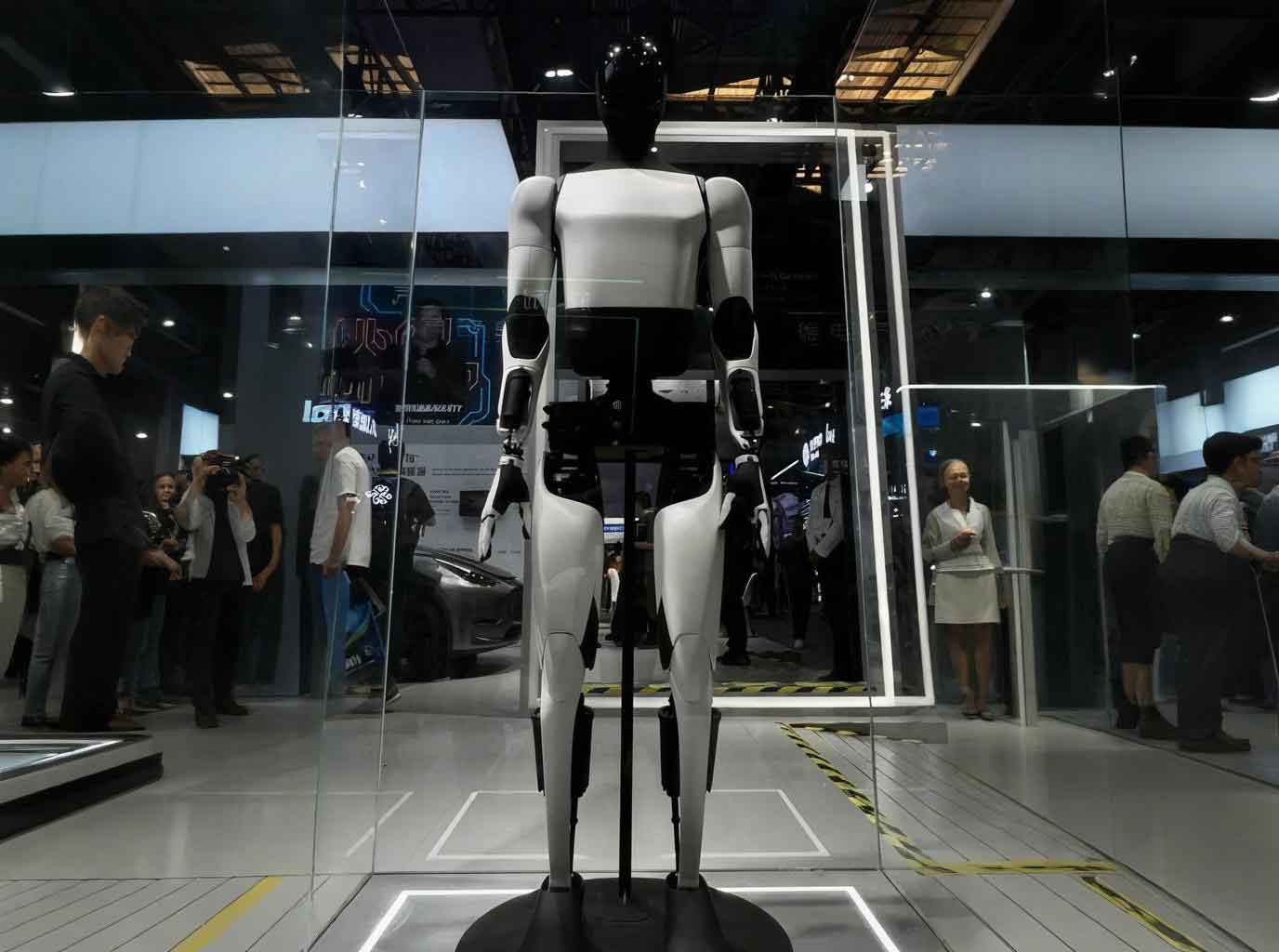
Support for key technological攻关 is channeled through substantial financial incentives. We have earmarked funding to accelerate progress in critical subsystems that define an embodied AI robot. The table below outlines the focus areas and support mechanisms.
| Key Technology Area | Description (Relevant to Embodied AI Robot) | Financial Support |
|---|---|---|
| Perception & Decision-Making | Algorithms for sensor fusion, scene understanding, and real-time planning in an embodied AI robot. | Up to 30% of total project investment, max ¥50 million. |
| Motion Control | Dynamic control systems enabling precise and agile movement for an embodied AI robot. | Up to 30% of total project investment, max ¥50 million. |
| Embodied Corpora | Curated, multimodal datasets (visual, tactile, proprioceptive) essential for training embodied AI robots. | Up to 30% of total project investment, max ¥50 million. |
| Operating Systems | Specialized OS for robotic hardware, providing a stable software foundation for any embodied AI robot. | Up to 30% of total project investment, max ¥50 million. |
Beyond direct funding, we are fostering a vibrant open-source ecosystem. We believe collaboration is key to rapid advancement in embodied intelligence. We are building a comprehensive open-source architecture encompassing models, data, algorithms, operating systems, and toolchains. This will lower the barrier for universities, SMEs, and individual developers to contribute to and build upon shared resources for embodied AI robot development. To stimulate this, we offer rewards of up to ¥5 million for significant open-source communities and products. This initiative ensures that innovation in embodied AI robots is not siloed but synergized across a global community.
Our confidence in this strategic push is underpinned by a thriving AI foundation. The broader AI industry here has seen explosive growth, creating a fertile ground for specialized fields like embodied intelligence. The following data highlights this momentum:
| Period / Metric | Value | Notes |
|---|---|---|
| AI Enterprises (by 2025) | >10,000 | Approximately one-third of the national total. |
| AI Workforce (by 2025) | ~300,000 professionals | A deep talent pool for developing embodied AI robots. |
| AI Industry Scale (Previous Year) | >¥400 billion | Base upon which the embodied AI robot sector will expand. |
| Q1 2025 AI Industry Scale | ¥118 billion | 29% year-on-year growth, demonstrating robust expansion. |
| Q1 2025 AI Industry Profit Growth | 65% increase | Indicates high value creation and commercial viability, relevant for embodied AI robot ventures. |
The equation for compound annual growth rate (CAGR) can contextualize this expansion. If \( V_0 \) is the initial industry scale and \( V_t \) is the scale after \( t \) years with a growth rate \( r \), we have:
$$ V_t = V_0 (1 + r)^t $$
Given the observed growth, the embodied AI robot segment is poised to follow a similarly steep trajectory, contributing significantly to the overall \( V_t \) of our AI economy.
Application demonstration is a critical pillar. We are actively identifying and supporting flagship projects that showcase the transformative potential of embodied AI robots. Recent high-level forums have catalyzed this process, resulting in major investment commitments. Over 30 projects in intelligent driving, embodied intelligence, and robotics secured investments exceeding ¥15 billion. These projects will serve as living laboratories, generating valuable data and refining technologies for broader deployment. For instance, the vision of an embodied AI robot seamlessly operating in a smart factory or assisting in complex assembly tasks is moving from blueprint to reality through such demonstrations.
The hardware-software co-evolution is vital. In our Pudong New Area, the inaugural heterogeneous humanoid robot training facility, operational since January 2025, symbolizes this integration. Capable of hosting over 100 humanoid robots simultaneously, it provides a physical proving ground for algorithms. The dynamics of a humanoid embodied AI robot can be described by complex equations of motion. For a simplified model, the Lagrangian formulation for a robot with \( n \) joints is:
$$ L = K – U = \frac{1}{2} \dot{\mathbf{q}}^T \mathbf{M}(\mathbf{q}) \dot{\mathbf{q}} – U(\mathbf{q}) $$
where \( \mathbf{q} \) is the vector of generalized coordinates (joint angles), \( \mathbf{M} \) is the inertia matrix, \( K \) is kinetic energy, and \( U \) is potential energy. The equations of motion follow from:
$$ \frac{d}{dt} \left( \frac{\partial L}{\partial \dot{\mathbf{q}}} \right) – \frac{\partial L}{\partial \mathbf{q}} = \boldsymbol{\tau} $$
Here, \( \boldsymbol{\tau} \) represents the generalized forces (torques). Training facilities allow for the empirical tuning and validation of control policies \( \pi(\mathbf{q}, \dot{\mathbf{q}}) \) that output \( \boldsymbol{\tau} \) to achieve stable, efficient movement for an embodied AI robot. This hands-on iteration is indispensable for achieving the agility and reliability required for real-world tasks.
The ripple effects of embodied intelligence extend into traditional industries, catalyzing their green and intelligent transformation. Consider the coatings and paints sector, which is undergoing a profound shift. Here, the principles driving embodied AI robot development—such as intelligent perception, automated control, and data-driven optimization—are being applied to create smarter manufacturing processes. AI-powered vision inspection systems, akin to the perceptual systems of an embodied AI robot, ensure flawless product quality. Automated guided vehicles (AGVs), essentially mobile embodied AI robots for material handling, streamline logistics within plants. Furthermore, AI R&D systems analyze vast datasets to formulate new coatings, mirroring the learning algorithms used to train an embodied AI robot. This synergy demonstrates how the core technologies of embodied intelligence are becoming horizontal enablers, boosting efficiency, safety, and sustainability across the industrial board. The convergence is clear: the same algorithmic prowess that guides an embodied AI robot through a physical space can optimize a chemical process or manage a supply chain, thereby multiplying the economic impact.
To ensure sustained leadership, we are meticulously building the entire innovation chain. This involves clustering enterprises to create a dense network of suppliers, manufacturers, and service providers focused on embodied AI robots. The agglomeration effect can be modeled as a positive feedback loop. Let \( I \) represent the innovation output (e.g., patents, product launches in embodied AI robots), \( E \) the number of enterprises in the cluster, and \( S \) the level of supporting infrastructure (platforms, funding). A simplified relationship could be:
$$ \frac{dI}{dt} = \alpha E + \beta S + \gamma I \left(1 – \frac{I}{K}\right) $$
where \( \alpha, \beta, \gamma \) are positive constants, and \( K \) is a carrying capacity. The term \( \gamma I (1 – I/K) \) captures the self-reinforcing nature of innovation within a mature cluster. By actively cultivating this ecosystem, we aim to maximize \( I \) specifically for the embodied AI robot domain.
Looking ahead, our roadmap is clear. We will continue to deepen the integration of model innovation, hardware advancement, and application proliferation. The ultimate goal is to see embodied AI robots evolve from specialized tools into versatile partners, capable of learning and adapting to diverse challenges. Every breakthrough in sensor miniaturization, every improvement in energy efficiency for actuators, and every new algorithm for human-robot collaboration brings us closer to this future. We are not just constructing an industry; we are engineering a new layer of intelligence into the physical fabric of our city and beyond. The journey of embodied intelligence is one of convergence—of bits and atoms, of algorithms and mechanics—and we are committed to leading this convergence, ensuring that the next generation of embodied AI robots is not only invented but also integrated, scaled, and perfected here.
In conclusion, our comprehensive strategy, backed by concrete targets, substantial resources, and a thriving AI base, positions us uniquely to capture the immense opportunity presented by embodied intelligence. From foundational research in algorithms to the deployment of sophisticated embodied AI robots in myriad sectors, every facet of our plan is designed to build enduring competitive advantage. The era of embodied AI is dawning, and through relentless focus on innovation, collaboration, and application, we are determined to shape its trajectory, making the embodied AI robot a cornerstone of technological and economic progress for years to come.