
In my research into advanced gear transmission systems, I have focused on a novel mechanism that merges the principles of conventional strain wave gearing with those of oscillating tooth transmissions. This hybrid design, which I refer to as an end-face oscillating tooth strain wave gear, promises to retain all the celebrated advantages of traditional harmonic drives—such as high reduction ratios, compactness, and positional accuracy—while substantially increasing the power transmission capability. The core of its enhanced performance lies in the unique configuration and force management within its moving pairs. This article delves deeply into the stress state of the critical sliding pair formed between the oscillating teeth and the guide grooves of the sheave, deriving the precise structural conditions required for optimal, single-sided contact force transmission.
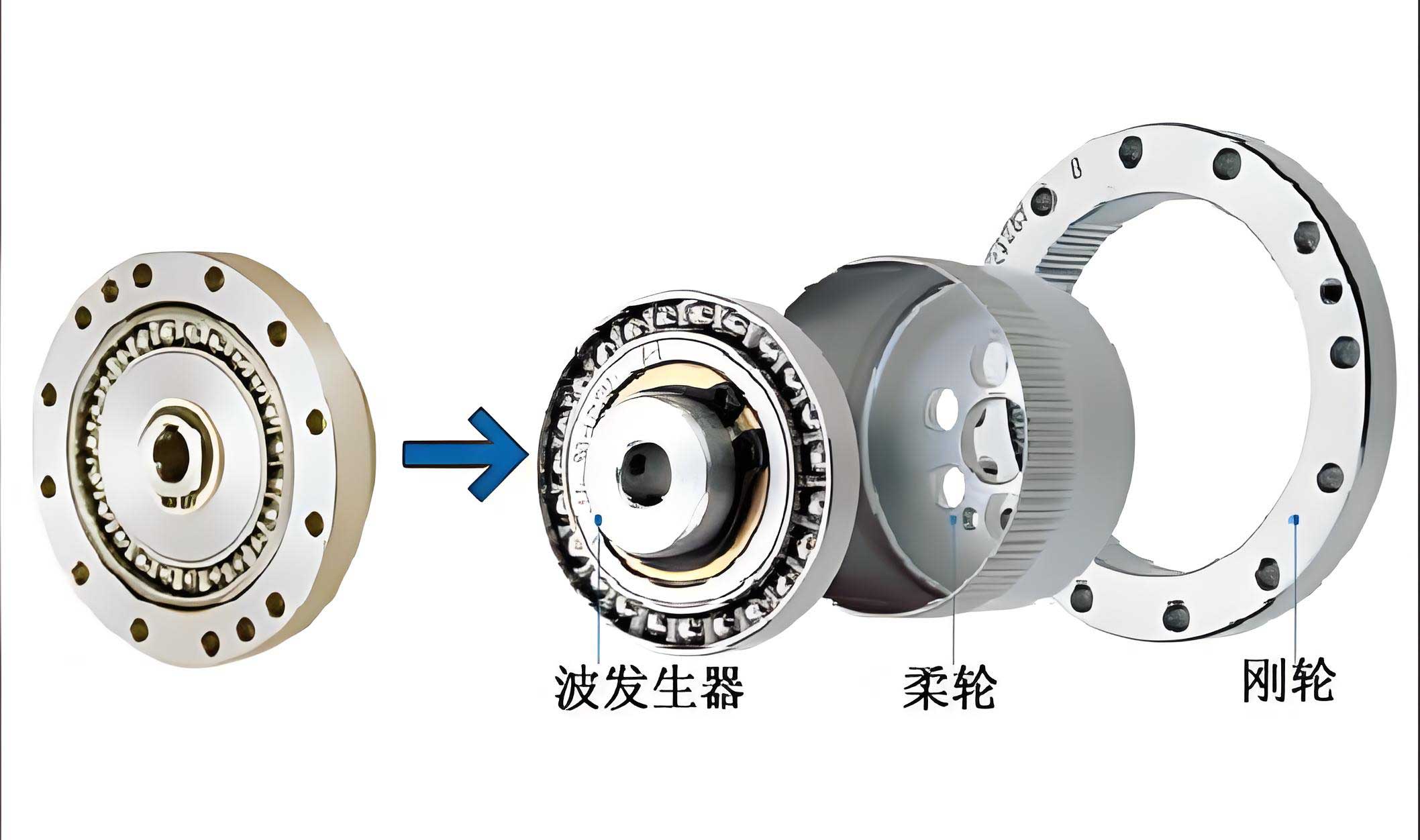
The operational principle of this strain wave gear assembly involves three primary kinematic pairs: two meshing pairs and one sliding pair. The oscillating teeth engage with both the end-face gear at their front end and the wave generator’s end-face cam at their rear end, forming the two meshing pairs. Concurrently, the sides of the oscillating teeth slide within the radial guide grooves of the sheave (or槽轮), constituting the crucial sliding pair. The structural characteristics and force conditions within this oscillating tooth-guide groove sliding pair are paramount, as they fundamentally influence the meshing quality of the gear pairs, the overall transmission efficiency, operational lifespan, and positional precision of the entire strain wave gear drive.
From practical observation and failure analysis of oscillating tooth transmissions, I have noted that the most severe wear occurs precisely on the contacting surfaces of this sliding pair. This wear escalates with increased load and is primarily attributed to a detrimental condition known as double-sided contact and localized stress concentration. In this state, the oscillating tooth is constrained and loaded from both sides of the guide groove, creating high contact pressures and friction that accelerate wear. The pivotal design goal, therefore, is to engineer the system to achieve a state of single-sided contact force transmission. In this ideal state, the resultant force from the two meshing pairs passes through the contact surface of the sliding pair, eliminating the prying action that causes double-sided contact. Achieving this state is the key to unlocking the full durability potential of this advanced strain wave gear design.
The configuration can be categorized based on the number of teeth on each oscillating tooth carrier block. For the sake of foundational analysis, I will concentrate on the single-tooth drive configuration (where each block carries one tooth), as its force analysis is more straightforward and reveals the fundamental principles applicable to more complex multi-tooth designs.
Force Analysis and the Critical Role of Tooth Count Difference
A fundamental parameter influencing the force state is the difference between the number of teeth on the fixed end-face gear, $Z_E$, and the theoretical total number of oscillating teeth, $Z_O$. The sign of this difference ($Z_E > Z_O$ or $Z_E < Z_O$) dictates the side of the oscillating tooth that engages with the end-face gear and, consequently, the relative rotation direction of the sheave when the end-face gear is fixed. This, in turn, critically determines whether the forces from the two meshing pairs act on the same side or opposite sides of the oscillating tooth.
| Condition ($Z_E$ vs. $Z_O$) | Sheave Rotation (End-face gear fixed) | Engaged Side (End-face gear) | Force Application on Oscillating Tooth | Likely Sliding Pair State |
|---|---|---|---|---|
| $Z_E > Z_O$ | Opposite to Wave Generator | Left flank | $F_E$ (left) and $F_W$ (right) on opposite sides | Double-sided contact |
| $Z_E < Z_O$ | Same as Wave Generator | Right flank | $F_E$ (right) and $F_W$ (right) on the same side | Potential for single-sided contact |
As the table summarizes, the condition $Z_E < Z_O$ is necessary for the forces from the end-face gear ($F_E$) and the wave generator cam ($F_W$) to act on the same lateral side of the oscillating tooth. This alignment creates the possibility for their lines of action to intersect within the physical boundaries of the sliding contact surface, a prerequisite for single-sided force transmission in the sliding pair of the strain wave gear. Therefore, the subsequent analysis will focus exclusively on the $Z_E < Z_O$ configuration.
Geometric Determination of the Force Intersection Point
To establish the structural condition for single-sided contact, I must analyze the trajectory of the intersection point (Point B) of the two primary forces, $F_E$ and $F_W$, during the meshing cycle. For analytical clarity, I consider the sheave to be fixed, with the oscillating tooth performing only axial reciprocation within its guide groove. The analysis is confined to the power transmission (mesh-in) phase of engagement, as forces during disengagement are negligible.
The position of Point B, measured as distance $L_D$ from the tooth tip of the end-face gear along the oscillating tooth’s axis, is not static. It varies continuously as the oscillating tooth engages. The geometry evolves through distinct phases defined by the contact condition between the oscillating tooth’s rear flank and the rising surface of the wave generator’s cam.
Let us define the key geometric parameters:
- $H$: Length of the oscillating tooth body.
- $h$: Height of the oscillating tooth.
- $\alpha$: Tooth profile semi-angle of the oscillating tooth.
- $\beta$: Lead angle of the end-face cam on the wave generator.
- $\varphi_1$, $\varphi_2$: Friction angles at the cam-tooth and gear-tooth interfaces, respectively.
- $\theta_w$: Rotation angle of the wave generator’s end-face cam.
- $U$: Number of waves on the generator (typically 2 or 3).
Phase 1: Full Contact at the Cam Interface
This phase spans from initial mesh-in to the critical point where the rear flank of the oscillating tooth begins to lose full contact with the cam’s rising surface. During this phase, the contact area on the rear flank remains constant, so the resultant force $F_W$ can be considered to act at the midpoint of the working flank. The force $F_E$ from the end-face gear acts at the instantaneous point of contact on the tooth’s front flank, which moves down the flank as engagement deepens.
Through geometric analysis of the force lines of action and their intersection, I derive the position $L_D$ as a function of the cam angle $\theta_w$ during this phase:
$$L_D = \frac{(H + A h) \tan(\beta + \varphi_1) – \frac{h \tan \alpha}{2} – \frac{B h U \theta_w}{2\pi}}{C}$$
where the coefficients $A$, $B$, and $C$ are constants for a given design:
$$
\begin{aligned}
A &= 1 + \frac{\tan \alpha \tan \beta}{2} \\
B &= 2\tan(\beta + \varphi_1) + \cot(\alpha + \varphi_2) – \tan \alpha \\
C &= \tan(\beta + \varphi_1) + \cot(\alpha + \varphi_2)
\end{aligned}
$$
At the start of engagement ($\theta_w = 0$), the intersection point $L_{D1}$ is:
$$L_{D1} = \frac{(H + A h) \tan(\beta + \varphi_1) – \frac{h \tan \alpha}{2}}{C}$$
This phase ends at a specific cam rotation $\theta_{wb} = \pi(1 – \tan \alpha \tan \beta)/U$, where the rear flank contact condition changes. At this point, $L_{D2}$ is:
$$L_{D2} = \frac{(H + A h) \tan(\beta + \varphi_1) – \frac{h \tan \alpha}{2} – \frac{B h (1 – \tan \alpha \tan \beta)}{2}}{C}$$
For typical design values of $\alpha$ (between 20° and 30°), the coefficient $B$ is positive, making $L_D$ a linearly decreasing function of $\theta_w$ in this phase. Thus, $L_{D1} > L_{D2}$.
Phase 2: Partial Contact at the Cam Interface
After the critical point, the rear flank contact area diminishes. Both force application points, for $F_W$ and $F_E$, shift. Let $\theta_w’ = \theta_w – \theta_{wb}$ be the cam rotation into this phase. The analysis yields a new expression for $L_D$:
$$L_D = \frac{(H + A h) \tan(\beta + \varphi_1) – \frac{h \tan \alpha}{2} – \frac{[B h U \theta_{wb} + (BU – D) h \theta_w’]}{2\pi}}{C}$$
where $D = \tan(\beta + \varphi_1) + \cot \alpha$.
In this phase, for typical $\alpha$, the term $(BU – D)$ is negative, making $L_D$ a linearly *increasing* function of $\theta_w’$. The intersection point moves back towards the gear side. At full engagement, where $F_E$ acts at the midpoint of the front working flank and $F_W$ acts at the tooth tip of the rear flank, the position $L_{D4}$ is:
$$L_{D4} = \frac{(H + h \tan \alpha \tan \beta) \tan(\beta + \varphi_1) + E h}{C}$$
with $E = [\tan \alpha – \cot(\alpha + \varphi_2)] / 2$.
Since $L_D$ decreases to a minimum at $L_{D2}$ and then increases, the point $L_{D2}$ represents the closest approach of the force intersection point (Point B) to the end-face gear’s tooth tip during the entire meshing cycle of the strain wave gear. This is the most critical position for ensuring single-sided contact.
Structural Condition for Single-Sided Contact Force
The physical requirement for the sliding pair to be in a state of single-sided contact is that the intersection point (Point B) of forces $F_E$ and $F_W$ must always lie within the axial span of the actual contact surface between the oscillating tooth and the guide groove.
Referring to the sheave’s geometry, let:
- $M$: Axial distance from the end-face gear’s tooth tip plane to the near side of the sheave.
- $L_H$: Axial thickness (length) of the sheave’s guide groove.
To prevent the working flank of the oscillating tooth from dipping into the guide groove, a basic constraint is $M \ge h$.
The decisive condition for sustained single-sided contact throughout the power transmission phase is that the most critical intersection point, $L_{D2}$, must fall within the guide groove’s axial domain. This leads to the fundamental double inequality:
$$h \le L_{D2} \le h + L_H$$
Substituting the expression for $L_{D2}$ provides the explicit design equation. Furthermore, from the formula for $L_{D2}$, it is evident that for a given set of parameters ($\alpha, \beta, \varphi_1, \varphi_2, h, U$), the value of $L_{D2}$ is directly proportional to the oscillating tooth body length $H$. Therefore, increasing $H$ is a direct and effective way to shift $L_{D2}$ upward, making it easier to satisfy the condition $L_{D2} \ge h$ and thus promoting the desired single-sided contact state in the strain wave gear’s sliding pair.
| Parameter | Symbol | Role in Sliding Pair Design |
|---|---|---|
| End-face Gear Teeth | $Z_E$ | Must be less than $Z_O$ for potential single-sided contact. |
| Oscillating Tooth Body Length | $H$ | Primary adjustable parameter to raise $L_{D2}$. |
| Tooth Height | $h$ | Defines lower bound for $L_{D2}$ ($L_{D2} \ge h$). |
| Sheave Groove Thickness | $L_H$ | Defines upper bound for $L_{D2}$ ($L_{D2} \le h + L_H$). |
| Tooth Profile Semi-angle | $\alpha$ | Influences coefficients A, B, C, E; typically 20°-30°. |
| Cam Lead Angle | $\beta$ | Determined by kinematics and tooth difference. |
| Critical Intersection Point | $L_{D2}$ | Must satisfy $h \le L_{D2} \le h + L_H$ for single-sided contact. |
Design Implications and Conclusion
The analysis conclusively shows that the prevalent wear in oscillating tooth transmissions stems from the unfavorable double-sided contact stress state in the sliding pair. For the end-face oscillating tooth strain wave gear to realize its potential for high power density and longevity, its design must actively ensure a single-sided contact force condition.
This is achieved by adhering to two principal design rules derived from the force analysis. First, the topological relationship must be set as $Z_E < Z_O$. Second, and more intricately, the geometric parameters—primarily the oscillating tooth body length $H$, but also the tooth height $h$ and sheave thickness $L_H$—must be synthesized to satisfy the condition $h \le L_{D2} \le h + L_H$, where $L_{D2}$ is calculated from the provided analytical formula.
By consciously designing the strain wave gear system to meet these conditions, the detrimental prying action in the guide groove is eliminated. The contact force becomes uniformly distributed across a single side of the sliding interface, drastically reducing contact pressure, minimizing wear, and enhancing the transmission’s efficiency and operational life. This detailed understanding of the sliding pair’s force mechanics provides a critical theoretical foundation for the robust and reliable design of this advanced class of strain wave gear drives, paving the way for their application in more demanding high-torque, precision motion control systems.