
In the field of precision motion control, the harmonic drive gear stands out due to its exceptional combination of high reduction ratios, compact size, lightweight construction, minimal backlash, and excellent positional accuracy. These attributes make it an indispensable component in advanced applications ranging from industrial robotics and aerospace mechanisms to high-end optical instruments and automotive systems. The core of the harmonic drive gear’s operation lies in its unique principle of elastic kinematics, involving the controlled deformation of a flexible spline. At the heart of this deformation mechanism is a critical component: the flexible bearing.
This specialized bearing differs fundamentally from conventional rolling-element bearings. While standard bearings are designed to maintain their shape and provide low-friction rotation, the flexible bearing in a harmonic drive gear is intentionally designed to undergo continuous, elastic deformation. It serves as the primary force transmission element between the wave generator (typically an elliptical cam) and the flexspline (or柔轮). Consequently, the flexible bearing is subjected to severe and cyclically fluctuating stress states, making its failure one of the most prevalent failure modes in harmonic drive gear assemblies. A comprehensive understanding of its mechanical behavior under both assembly and operational loads is therefore paramount. This analysis aims to provide a detailed, first-principles-based examination of the stress and deformation fields within the flexible bearing, considering its interaction with the elliptical cam and the cup-type flexspline. The insights gained are intended to furnish more accurate foundational data for the structural design of the bearing itself, the precise positioning of the flexspline teeth, and the optimization of the overall harmonic drive gear performance.
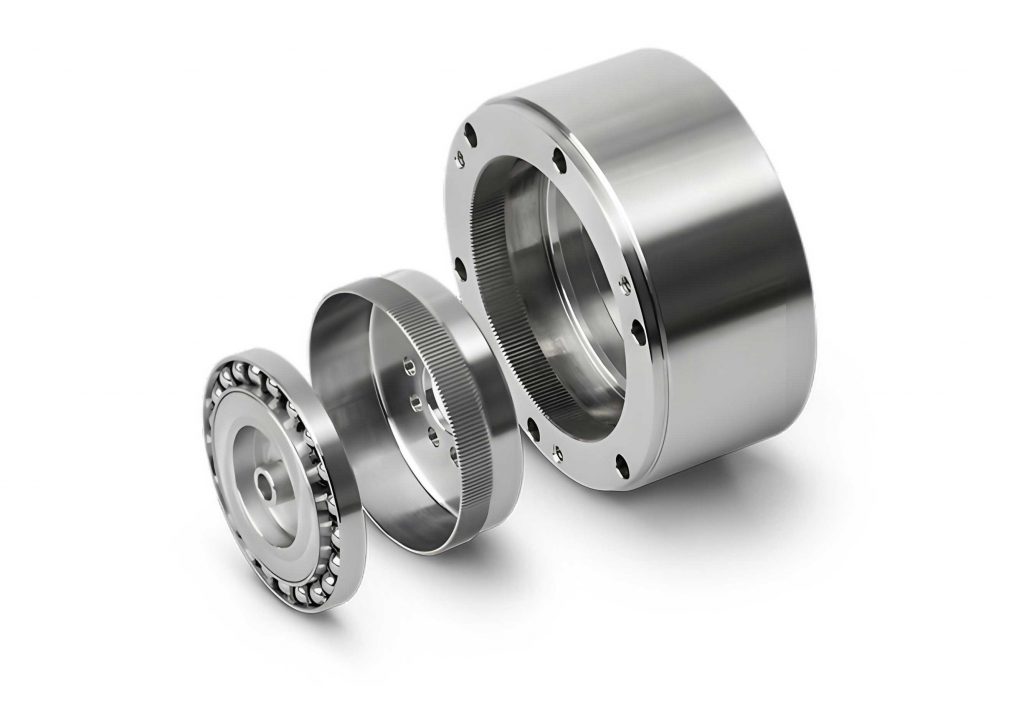
The operational principle of the harmonic drive gear is elegant yet mechanically demanding. The system primarily consists of four elements: a rigid circular spline, a flexible circular spline (flexspline), an elliptical wave generator, and the flexible bearing. The wave generator, often an elliptical cam, is press-fitted into the inner ring of the flexible bearing. This forces the inner ring to conform to the elliptical profile. This deformation is transmitted sequentially: from the inner ring to the rolling elements (balls), which are constrained by a cage, and then from the balls to the thin-walled outer ring. Finally, the deformed outer ring imposes a corresponding elliptical distortion onto the flexspline, causing its external teeth to mesh and unmesh with the internal teeth of the stationary circular spline in two diametrically opposite zones. This process enables high-ratio speed reduction. Throughout this cycle, the flexible bearing’s outer ring endures significant alternating bending stresses, making it the most vulnerable component and the focus of our mechanical analysis.
Methodological Framework and Problem Statement
Prior research has extensively analyzed the deformation of the flexspline and the resulting tooth engagement in harmonic drive gears. However, a detailed, integrated analysis of the flexible bearing’s internal stress state—specifically, the contact mechanics between the balls and the raceways under the imposed elliptical deformation and the subsequent interaction with a conically deformed flexspline—has often been simplified or overlooked. Existing models frequently apply Hertzian contact theory under idealized assumptions, which may not fully capture the effects of complex boundary conditions, friction, pre-stress from assembly, and the coupling between multi-stage contacts.
Our approach addresses these gaps by employing a high-fidelity nonlinear finite element analysis (FEA) methodology. The primary objectives are twofold. First, to model the flexible bearing in its assembled state on the elliptical wave generator (under no-load conditions) and determine the precise load distribution among the balls, the resulting radial and circumferential displacements of the outer raceway, and the contact stress fields at the ball-raceway interfaces. Second, to model the subsequent assembly of this pre-deformed bearing into a cup-type flexspline. This step analyzes the coupled deformation (conical deformation) of the flexspline and the bearing outer ring, the contact pressure distribution at their interface, and how this assembly condition modifies the internal contact stresses within the bearing. This two-stage simulation provides a more holistic view of the loading environment critical for the harmonic drive gear’s reliability.
Model Overview and Finite Element Implementation
We focus on a representative harmonic drive gear model, specifically a 32-80 type, which indicates a gear reduction ratio of 80:1. The key parameters for the flexible bearing and the flexspline are defined as follows.
| Component | Parameter | Value | Unit |
|---|---|---|---|
| Flexible Bearing | Outer Diameter | 74.65 | mm |
| Outer Ring Wall Thickness | 2.096 | mm | |
| Outer Ring Width | 11.81 | mm | |
| Outer Raceway Groove Radius (R) | 4.088 | mm | |
| Ball Diameter | 7.5 | mm | |
| Number of Balls (N) | 24 | – | |
| Elliptical Deformation | Max. Radial Displacement at Major Axis (w₀) | 0.407 – 0.5 | mm |
| Cup-Type Flexspline | Inner Radius (at tooth base) | 37.325 | mm |
| Cylinder Length | 50 | mm | |
| Tooth Ring Thickness | 2 | mm | |
| Cup Wall Thickness | 1 | mm |
The material properties used in the simulation are standard for high-performance bearing steel.
| Component | Elastic Modulus (E) | Poisson’s Ratio (ν) |
|---|---|---|
| Bearing Inner/Outer Rings | 207 GPa | 0.3 |
| Bearing Balls | 217 GPa | 0.3 |
| Flexspline | 207 GPa | 0.3 |
The finite element model is constructed with meticulous attention to contact mechanics, which is a highly nonlinear problem. The bearing’s inner ring, outer ring, and a segment of balls (covering a 180° arc for computational efficiency) are modeled as 3D solid deformable bodies. The flexspline is modeled as a separate 3D solid body. A structured hexahedral mesh is employed throughout, as it provides superior accuracy for stress and contact analysis compared to tetrahedral meshes. The global element size is set to 0.4 mm, with refined mesh sizing of 0.1 mm in all potential contact regions to ensure solution convergence and accuracy.
Contact pairs are defined using surface-to-surface contact elements. For the first stage (bearing on cam), contact is defined between the balls and the outer raceway. For the second stage (bearing inside flexspline), two levels of contact are established: a primary contact between the outer surface of the bearing’s outer ring and the inner wall of the flexspline, and the secondary contact between the balls and the outer raceway (which remains active). Appropriate boundary conditions are applied: symmetry conditions on cut faces, fixed constraints at the base of the flexspline cup, and most critically, prescribed radial displacements derived from kinematic analysis applied to the balls.
Stage 1: Deformation and Stress Under Elliptical Cam Action
The foundation of the analysis lies in determining the kinematic state of the balls after the inner ring is deformed by the elliptical cam. Assuming perfect conformity and neglecting slip, the inner ring’s elliptical profile is transmitted to the balls. However, the balls are held by a cage, maintaining approximately equal angular spacing. Consequently, the locus of the ball centers is not the ellipse itself but its offset curve or parallel curve.
Let the elliptical profile of the inner ring (and thus the cam) be defined in polar coordinates. The radial coordinate \( \rho_i(\phi) \) for the inner surface relative to the bearing’s geometric center O is given by the equation of an ellipse:
$$ \rho_i(\phi) = \frac{a b}{\sqrt{b^2 \cos^2\phi + a^2 \sin^2\phi}} $$
where \( a \) is the semi-major axis, \( b \) is the semi-minor axis, and \( \phi \) is the angular position from the major axis. The major axis radial displacement is \( w_0 = R_{nominal} – b \), where \( R_{nominal} \) is the nominal radius.
The center of a ball in contact with this deformed inner race will lie along the normal to the ellipse at the contact point, offset by the ball radius \( r_b \). For a thin-walled bearing, a highly accurate approximation for the radial position \( \rho_b(\phi) \) of the ball center is given by the ellipse’s equidistant curve:
$$ \rho_b(\phi) \approx \frac{a b}{\sqrt{b^2 \cos^2\phi + a^2 \sin^2\phi}} + r_b – \delta $$
Here, \( \delta \) is a small correction term related to the initial clearance and elastic compression, often neglected for initial kinematic analysis. The radial displacement \( w(\phi) \) of the outer raceway induced by this ball, relative to its nominal circular position \( R_{out} \), is therefore:
$$ w(\phi) = R_{out} – \rho_b(\phi) = w_0 \cdot \frac{b^2 \cos^2\phi + a^2 \sin^2\phi}{a b} – (r_b – \delta) $$
The key insight is that only balls positioned where \( w(\phi) > 0 \) will be in load-bearing contact with the outer raceway, pressing it outward. For a standard elliptical wave generator, this condition is true for balls within approximately ±60° of the major axis. Balls near the minor axis (\( \phi \approx 90° \)) lose contact as the outer raceway moves inward.
We calculate this for six balls at 15° intervals starting from φ=7.5°. The prescribed radial displacements \( U_{r, ball} \) applied in the FEA model are derived from this kinematic analysis.
| Ball # | Angle from Major Axis (φ) | Theoretical Radial Displacement, \( w(\phi) \) (mm) | FEA Applied Displacement (mm) |
|---|---|---|---|
| 1 | 7.5° | 0.4821 | 0.4821 |
| 2 | 22.5° | 0.3471 | 0.3471 |
| 3 | 37.5° | 0.1171 | 0.1171 |
| 4 | 52.5° | -0.1426 | -0.1426 |
| 5 | 67.5° | -0.3626 | -0.3626 |
| 6 | 82.5° | -0.4875 | -0.4875 |
The FEA results confirm the kinematic hypothesis. The contour plot of radial displacement on the outer raceway clearly shows an elliptical deformation pattern. The maximum radial displacement occurs at the major axis and matches the theoretical input value closely (e.g., 0.4896 mm FEA vs. 0.4821 mm theory). More importantly, the analysis reveals the load distribution. Only the first three balls (φ = 7.5°, 22.5°, and 37.5°) exert significant positive contact pressure on the outer raceway. The contact force is highest for the ball closest to the major axis and decreases rapidly with increasing φ. The Hertzian contact stress at these interfaces is substantial, forming the baseline stress state for the harmonic drive gear’s flexible bearing.
Stage 2: Coupled Analysis with the Flexspline – The Conical Deformation Effect
The assembly of the pre-deformed flexible bearing into the flexspline introduces a critical second-order deformation: conical distortion. The flexspline is not a simple cylinder; it is a cup with a diaphragm. When the elliptically deformed bearing outer ring is inserted, it does not press uniformly along the width of the flexspline’s inner wall. The reaction forces from the flexspline’s stiffness, particularly its axial variation due to the cup geometry, cause the bearing outer ring to tilt or assume a conical form. This dramatically alters the contact patterns and stresses.
We model this by assembling the deformed bearing model from Stage 1 inside the cup-type flexspline model. The contact between the bearing’s outer cylindrical surface and the flexspline’s inner wall is activated. The base of the flexspline cup is fully fixed. The previously calculated radial displacements are still applied to the balls, representing the forcing function from the wave generator.
The results are illuminating. The radial displacement of the bearing’s outer ring is no longer uniform across its width. We extract displacement data along three axial paths: Front (near the open end of the cup), Middle, and Rear (near the cup’s diaphragm base).
At the major axis location:
$$ U_{r,rear} < U_{r,front} $$
This indicates that the flexspline wall, being stiffer near the diaphragm, resists outward deformation more strongly at the rear. The outer ring experiences a tilting, causing greater radial displacement at the front edge. Conversely, at the minor axis location:
$$ |U_{r,front}| > |U_{r,rear}| $$
Here, the outer ring is moving inward. The constraint is stronger at the front, leading to a larger inward displacement at the rear. This is the hallmark of conical deformation.
The contact zone between the bearing outer ring and the flexspline inner wall shifts axially with the angular position φ. Near the major axis, the contact pressure is concentrated on the rear portion of the interface. As one moves towards the minor axis, the contact zone migrates progressively towards the front portion. This oscillating, traveling contact pattern is a significant source of complex loading for both components in the harmonic drive gear.
Most critically, this assembly condition modifies the internal ball-raceway contact stresses. While the ball closest to the major axis still experiences the highest contact pressure, its magnitude and distribution are affected by the superimposed bending of the outer ring. The FEA solution for contact pressure \( p_{contact} \) at this critical interface can be examined. The maximum von Mises stress within the outer ring material often occurs sub-surface at these highly stressed ball contact locations, which is crucial for predicting fatigue life in the harmonic drive gear assembly.
| Aspect | Observation | Implication for Harmonic Drive Gear Design |
|---|---|---|
| Ball Load Zone | Only ~90° arc of balls (near major axis) are load-bearing under cam deformation. | Simplifies dynamic load modeling; fatigue cycles concentrate on a subset of balls. |
| Outer Ring Deformation Shape | Elliptical in Stage 1, becoming elliptical with superimposed conical distortion in Stage 2. | Flexspline cup stiffness design directly influences bearing stress state. |
| Flexspline-Bearing Contact | Contact zone shifts axially from rear (major axis) to front (minor axis). | Wear patterns on flexspline inner wall will not be uniform; lubrication paths are complex. |
| Critical Stress Location | Maximum contact stress occurs at the ball-outer raceway interface nearest the major axis. | Material selection, heat treatment, and surface finish of the outer raceway are paramount. |
| Conical Deformation Magnitude | Radial displacement difference between front and rear paths can exceed 10-15% of max radial displacement. | Must be accounted for in accurate tooth positioning and tooth profile modification of the flexspline. |
Analytical Formulas for Design Guidance
While FEA provides detailed solutions, closed-form analytical approximations remain valuable for initial design of the harmonic drive gear’s flexible bearing. Based on the analysis, we can summarize key relations.
1. Approximate Ball Load Distribution: The normal force \( Q(\phi) \) on a ball at angle φ can be approximated by relating the local radial deflection \( w(\phi) \) to the contact stiffness. For a rough estimate, assuming linearized stiffness \( K_{contact} \):
$$ Q(\phi) \approx K_{contact} \cdot w(\phi) \quad \text{for} \quad w(\phi) > 0 $$
$$ Q(\phi) \approx 0 \quad \text{for} \quad w(\phi) \le 0 $$
where \( w(\phi) \) is derived from the equidistant curve equation.
2. Outer Ring Bending Stress: The outer ring can be modeled as a thin circular ring subjected to periodic radial loads \( Q(\phi) \) from the balls. The maximum bending moment \( M_{max} \), which occurs between loading points, contributes to fatigue. An order-of-magnitude formula is:
$$ \sigma_{bending} \approx \frac{C \cdot Q_{max} \cdot R_{out}}{I} $$
where \( C \) is a constant depending on load zone angle, \( Q_{max} \) is the load on the most heavily loaded ball, \( R_{out} \) is the outer ring mean radius, and \( I \) is the area moment of inertia of the ring cross-section per unit width.
3. Conical Deformation Angle: The conical tilt angle \( \theta \) of the outer ring can be related to the differential radial displacement \( \Delta U_r = U_{r,front} – U_{r,rear} \) at a given φ:
$$ \theta(\phi) \approx \arctan\left( \frac{\Delta U_r(\phi)}{L} \right) $$
where \( L \) is the width of the outer ring. This angle influences the effective pressure angle at the flexspline-bearing interface.
Conclusion and Design Implications
The mechanical analysis of the flexible bearing within a harmonic drive gear system reveals a complex, multi-stage stress state that is crucial for predicting performance and longevity. The primary findings are:
First, under the action of an elliptical wave generator, the load distribution on the flexible bearing is highly non-uniform. Only a segment of balls approximately 90° wide around the major axis actively transmits load, with the ball nearest the major axis carrying the highest load. This creates a localized, high-cycle fatigue environment within the bearing.
Second, and critically for accurate system modeling, the assembly of the deformed bearing into a cup-type flexspline induces a significant conical deformation of the bearing’s outer ring. This deformation is not symmetric; the radial displacement varies along the bearing’s width, being influenced by the axial stiffness gradient of the flexspline cup. This results in an axially shifting contact zone between the bearing and the flexspline, which complicates the interface mechanics and wear behavior.
Third, the maximum contact stress, and thus the likely initiation point for failure, resides at the interface between the most heavily loaded ball and the outer raceway of the flexible bearing. This stress is further modulated by the conical bending stress superimposed during operation within the flexspline.
These insights provide actionable guidance for the design and optimization of harmonic drive gears. For flexible bearing design, the focus must be on enhancing the fatigue strength of the outer raceway, particularly in the region corresponding to the major axis load zone. Material upgrades, specialized heat treatments like carburizing, and precise control of surface roughness are essential. For flexspline tooth positioning and profile design, the analysis underscores that the teeth are not mounted on a perfectly elliptical foundation. The conical distortion means the effective radial position of the tooth base varies along the tooth width. Accurate tooth positioning algorithms and intentional profile modifications (tip and root relief) must account for this coupled deformation to ensure smooth, low-wear meshing with the circular spline. Finally, for system integration and lubrication, understanding the traveling contact zone between the bearing and flexspline informs the placement of lubrication channels and the selection of greases capable of maintaining a film under oscillating contact pressures.
In summary, a deep understanding of the flexible bearing’s mechanics, achieved through integrated multi-stage nonlinear FEA as presented here, is fundamental to advancing the reliability, precision, and power density of harmonic drive gear systems. It moves design practices from empirical rules towards physics-based predictions, enabling the next generation of high-performance motion control solutions.