
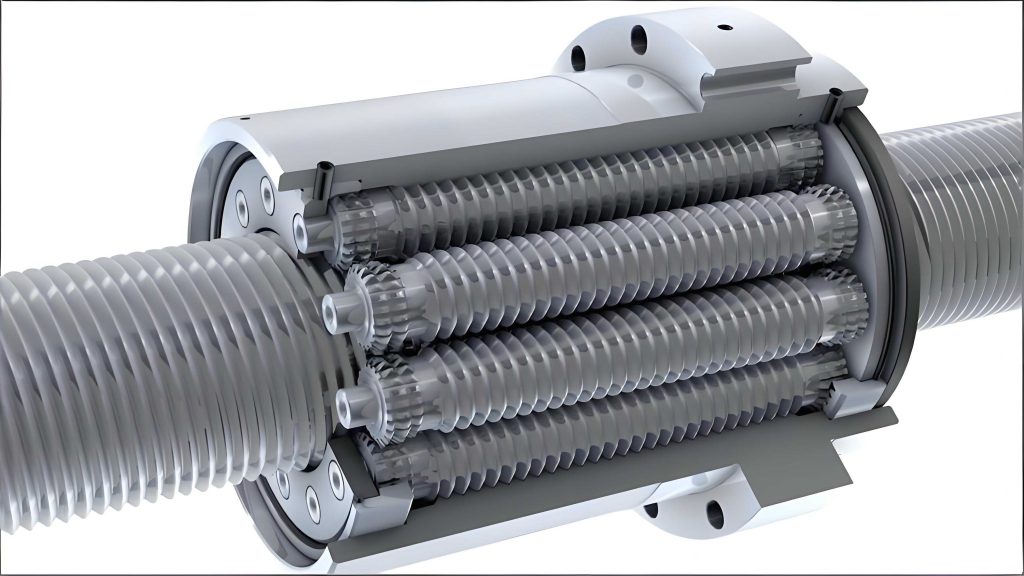
The performance demands on modern mechanical systems, particularly in aerospace, high-precision machine tools, and robotics, continuously push for higher speeds and greater load capacities. The planetary roller screw (PRS) mechanism is a critical component in such systems, renowned for its superior load-bearing capacity, high precision, and efficiency in converting rotary motion to linear motion. However, as operational velocities increase, inertial forces become significant and can drastically alter the internal load distribution among the threads. This altered distribution affects fatigue life, positioning accuracy, and overall reliability. Therefore, accurately predicting the dynamic load distribution under high-speed conditions is paramount for the optimal design and application of the planetary roller screw.
This study aims to establish a comprehensive theoretical model for calculating the dynamic contact forces and load distribution across the thread pairs of a planetary roller screw mechanism under operational speeds. The model builds from fundamental static analysis, incorporating inertial effects to reveal the true load-sharing behavior during high-speed rotation.
1. Theoretical Modeling of Static Contact Forces
The foundation of the dynamic model is a precise calculation of the static contact forces within the planetary roller screw assembly. The analysis is based on the following assumptions: 1) The axial load is uniformly distributed among all planetary rollers; 2) Only elastic deformations are considered; 3) The effects of backlash and impact loads due to meshing clearance are neglected.
1.1 Contact Force between Roller and Screw
Based on the meshing principle of helical surfaces in a planetary roller screw, the contact force between a single roller and the screw is analyzed in a local coordinate system. The contact force vector, \( \mathbf{F^s_{SR}} \), at the static contact point can be derived from the normal vectors of the contacting surfaces:
$$
\mathbf{F^s_{SR}} = \frac{F^s_{SR}}{\sqrt{1 + \tan^2 \lambda_{SR} + \tan^2 \beta_{SR}}} \cdot
\begin{bmatrix}
\cos\phi_{SR} \tan\beta_{SR} – \sin\phi_{SR} \tan\lambda_{SR} \\[0.5em]
-\sin\phi_{SR} \tan\beta_{SR} – \cos\phi_{SR} \tan\lambda_{SR} \\[0.5em]
-1
\end{bmatrix}
$$
where \( F^s_{SR} \) is the magnitude of the static contact force on the screw-roller side, given by:
$$
F^s_{SR} = \frac{F_{NZ}}{n_{\text{roller}}} \cdot \sqrt{1 + \tan^2 \lambda_{SR} + \tan^2 \beta_{SR}}
$$
Here, \( F_{NZ} \) is the total axial load on the nut, \( n_{\text{roller}} \) is the number of planetary rollers, \( \lambda_{SR} \) is the lead angle at the screw-roller contact point, \( \beta_{SR} \) is the thread flank angle at the screw-roller contact point, and \( \phi_{SR} \) is the engagement angle. The geometric parameters \( \lambda_{SR} \) and \( \beta_{SR} \) are defined by the screw and roller thread geometry:
$$
\tan\lambda_{SR} = \frac{L_R}{2\pi r_{SR}}, \quad \tan\beta_{SR} = \frac{r_{SR} – r_R – u_{TR}}{\sqrt{r_{TR}^2 – (r_{SR} – r_R – u_{TR})^2}}
$$
with \( u_{TR} = -r_{TR} \cdot \sin\beta_R \). The parameters \( L_R \), \( r_R \), \( r_{TR} \), and \( \beta_R \) are the roller lead, nominal radius, tooth profile radius, and flank angle, respectively. \( r_{SR} \) is the engagement radius on the roller side against the screw.
1.2 Contact Force between Roller and Nut
Similarly, the static contact force vector between the roller and the nut, \( \mathbf{F^s_{NR}} \), is expressed as:
$$
\mathbf{F^s_{NR}} = \frac{F^s_{NR}}{\sqrt{1 + \tan^2 \lambda_{NR} + \tan^2 \beta_{NR}}} \cdot
\begin{bmatrix}
-\cos\phi_{NR} \tan\beta_{NR} + \sin\phi_{NR} \tan\lambda_{NR} \\[0.5em]
-\sin\phi_{NR} \tan\beta_{NR} – \cos\phi_{NR} \tan\lambda_{NR} \\[0.5em]
1
\end{bmatrix}
$$
For standard design, the lead angle \( \lambda_{NR} \) and flank angle \( \beta_{NR} \) at the nut-roller contact equal those of the roller (\( \lambda_R \), \( \beta_R \)), and the engagement angle \( \phi_{NR} \) is zero. Therefore, the force simplifies to:
$$
\mathbf{F^s_{NR}} = \frac{F^s_{NR}}{\sqrt{1 + \tan^2 \lambda_R + \tan^2 \beta_R}} \cdot
\begin{bmatrix}
-\tan\beta_R \\[0.5em]
-\tan\lambda_R \\[0.5em]
1
\end{bmatrix}
$$
The magnitude of the nut-roller static contact force is:
$$
F^s_{NR} = \frac{F_{NZ}}{n_{\text{roller}}} \cdot \sqrt{1 + \tan^2 \lambda_R + \tan^2 \beta_R}
$$
2. Dynamic Contact Force Model Incorporating Inertial Effects
Under high-speed operation, the planetary rollers revolve around the screw axis, generating a centrifugal (inertial) force. This force must be included in the force equilibrium of the roller to obtain the dynamic contact forces.
2.1 Contact Deformation and Loaded Contact Angle
When an axial load is applied, contact deformations occur at the screw-roller and nut-roller interfaces. The normal contact deformation, \( \delta_{XR} \), is calculated using Hertzian theory:
$$
\delta_{XR} = \delta^* \left[ \frac{3 F_{XR}}{2 \sum \rho} \left( \frac{1-\mu_R^2}{E_R} + \frac{1-\mu_X^2}{E_X} \right) \right]^{2/3} \sum \rho^{1/3}
$$
where \( \delta^* \) is the Hertzian deformation coefficient, \( F_{XR} \) is the static contact force (either \( F^s_{SR} \) or \( F^s_{NR} \)), \( \mu \) and \( E \) are Poisson’s ratio and Young’s modulus (subscript \( R \) for roller, \( X \) for screw or nut), and \( \sum \rho \) is the sum of principal curvatures at the contact.
This deformation shifts the contact points, changing the contact angles from their initial unloaded values \( \alpha^0_{SR} \) and \( \alpha^0_{NR} \) to the loaded values \( \alpha_{SR} \) and \( \alpha_{NR} \). The geometric relationship based on deformation compatibility yields:
$$
\cos\alpha_{SR} = \frac{(r_S + r_N – 2r_R) \cdot \cos\alpha^0_{SR}}{r_S + r_N – 2r_R + 2\delta_{SR}}, \quad \cos\alpha_{NR} = \frac{(r_S + r_N – 2r_R) \cdot \cos\alpha^0_{NR}}{r_S + r_N – 2r_R + 2\delta_{NR}}
$$
2.2 Force Equilibrium with Inertial Force
The centrifugal force acting on a single roller is:
$$
F_c = m \cdot r \cdot \omega_P^2
$$
where \( m \) is the mass of the roller, \( r \) is the effective radius for the roller’s revolution (approximated as the mean of screw and roller pitch radii), and \( \omega_P \) is the roller’s orbital (planetary) angular velocity, which is related to the screw rotational speed \( \omega_S \).
Considering the dynamic contact forces \( F_{SR} \) and \( F_{NR} \) acting at the calculated loaded contact angles, the force equilibrium equations for the roller in the radial and axial directions are:
$$
\begin{aligned}
&F_{SR} \sin\alpha_{SR} + F_{NR} \sin\alpha_{NR} = 0 \\[0.5em]
&F_{SR} \cos\alpha_{SR} + F_{NR} \cos\alpha_{NR} + F_c = 0
\end{aligned}
$$
Solving this system provides the dynamic contact force magnitudes \( F_{SR} \) and \( F_{NR} \) for the entire roller. The inertial force \( F_c \) introduces an asymmetry, typically causing \( F_{NR} \) to increase and \( F_{SR} \) to decrease compared to the static case.
3. Dynamic Load Distribution Across Thread Teeth
The total dynamic contact force on each side of the planetary roller screw is shared among multiple engaged thread teeth. The distribution is governed by the compatibility of deformations in a closed-loop system consisting of three main compliances in series for each load path: 1) the axial stiffness of the screw/nut/roller shaft segments, 2) the bending and shear stiffness of the individual thread teeth, and 3) the Hertzian contact stiffness at the thread contact points.
For the i-th engaged thread pair in the nut-roller loop, the total axial deformation of the nut path must equal that of the roller path:
$$
\sum l_{N_i} = \sum l_{R_i}
$$
This equality translates into a relationship involving the distributed thread loads \( F_{NR_i} \) and \( F_{SR_i} \), and the corresponding stiffness values (\( k_{NB}, k_{NT}, k_{NRC} \) for nut body, nut thread, and nut-roller contact; \( k_{RB}, k_{RT}, k_{SRC} \) for roller body, roller thread, and screw-roller contact):
$$
\sum_{j=1}^{i} \frac{F_{NR_j}}{k_{NB}} + \frac{F_{NR_i} – F_{NR_{i+1}}}{k_{NT}} + \frac{F_{NR_{C_i}}}{k_{NRC}} = \sum_{j=0}^{\lfloor i/2 \rfloor} \frac{(F_{NR_j} – F_{SR_j}) + F_{NR_{(\lfloor i/2 \rfloor+1)}} + \sum_{j=0}^{\lfloor i/2 \rfloor} (F_{NR_j} – F_{SR_j})}{k_{RB}} + \frac{F_{NR_{i+1}} – F_{NR_i}}{k_{RT}} + \frac{F_{NR_{C_{i+1}}}}{k_{NRC}}
$$
A similar but distinct deformation compatibility equation is written for the screw-roller loop. The system is closed by the constraints that the sum of the distributed thread contact forces equals the total dynamic contact force for each interface:
$$
\sum_{i=1}^{n} F_{SR_i} = F_{SR}, \quad \sum_{i=1}^{n} F_{NR_i} = F_{NR}
$$
Solving this coupled system of equations yields the dynamic load \( F_{SR_i} \) and \( F_{NR_i} \) on each individual thread tooth of the planetary roller screw engagement.
4. Model Verification via Finite Element Analysis
To validate the theoretical model for dynamic load distribution in the planetary roller screw, a detailed finite element analysis (FEA) contact model was developed and compared against the theoretical predictions.
4.1 Case Study Parameters
The structural and operational parameters for the validation case are summarized in the tables below.
| Component | Nominal Radius (mm) | Flank Angle, β (°) | Pitch, P (mm) | Number of Starts | Elastic Modulus, E (GPa) | Poisson’s Ratio, μ |
|---|---|---|---|---|---|---|
| Roller | 4.0 | 45 | 2 | 1 | 212 | 0.29 |
| Screw | 12.0 | 45 | 2 | 5 | 212 | 0.29 |
| Nut | 20.0 | 45 | 2 | 1 | 212 | 0.29 |
| Parameter | Value |
|---|---|
| Roller Mass, m (kg) | 0.032 |
| Screw Speed, ω_S (rad/s) | 83 |
| Axial Load on Nut, F_NZ (N) | 5000 |
| Number of Rollers, n_roller | 10 |
| Number of Threads per Roller, z | 20 |
4.2 Theoretical and FEA Results Comparison
First, the static model was verified. For zero speed, the calculated static contact forces were \( F^s_{SR} = 714.46 \, \text{N} \) and \( F^s_{NR} = 708.23 \, \text{N} \), showing the screw-side force is slightly higher under pure static loading, which aligns with established understanding.
For the dynamic case at \( \omega_S = 83 \, \text{rad/s} \), the theoretical model predicts total dynamic contact forces of \( F_{SR} = 705.51 \, \text{N} \) and \( F_{NR} = 758.48 \, \text{N} \). The inertial force has clearly shifted load towards the nut side. The FEA model, incorporating centrifugal body forces, yielded mean dynamic contact forces of \( F_{SR}^{FEA} \approx 683 \, \text{N} \) and \( F_{NR}^{FEA} \approx 734 \, \text{N} \). The relative error between theoretical and FEA results is less than 5%, confirming the accuracy of the proposed dynamic model.
The detailed dynamic load distribution per thread tooth was also compared. Both methods show the same trends: the load on the screw-roller side decreases with increasing thread sequence number, while the load on the nut-roller side increases. Furthermore, the load distribution is more uneven on the screw-roller side than on the nut-roller side. The FEA results showed minor fluctuations due to modeled radial displacements not captured in the simplified theoretical stiffness model, but the overall agreement was excellent.
| Screw Speed (rad/s) | Contact Force (N) | Theoretical Result | FEA Result | Error |
|---|---|---|---|---|
| 0 (Static) | FsSR | 714.46 | — | — |
| FsNR | 708.23 | — | — | |
| 83 (Dynamic) | FSR | 705.51 | ~683 | < 3.5% |
| FNR | 758.48 | ~734 | < 3.3% |
5. Parametric Analysis of Dynamic Load Distribution
Using the verified model, a parametric study was conducted to understand the influence of key operational and design variables on the dynamic load distribution within the planetary roller screw.
5.1 Effect of Screw Rotational Speed
The screw speed was varied from 26 to 133 rad/s (roller orbital speed 10 to 50 rad/s) under a constant 5000 N load. The results indicate that as speed increases, the total dynamic contact force \( F_{SR} \) decreases while \( F_{NR} \) increases. The slope of the load distribution curves becomes steeper for both sides with higher speed, meaning the load becomes more unevenly distributed among the threads. This is a direct consequence of the growing centrifugal force pushing the rollers radially outward against the nut.
5.2 Effect of Axial Load Magnitude
With the screw speed fixed at 83 rad/s, the axial load was varied from 0 to 6000 N. As expected, both \( F_{SR} \) and \( F_{NR} \) increase linearly with the applied load. More importantly, the degree of load unevenness (the variation from the first to the last engaged tooth) increases significantly with higher axial loads. This effect is more pronounced on the screw-roller side, identifying it as the critical interface for fatigue considerations.
3.3 Effect of Thread Pitch
The thread pitch \( P \) directly affects the lead angle and the stiffness characteristics. Analysis for pitches of 2 mm, 4 mm, and 6 mm shows that a larger pitch leads to steeper load distribution curves, i.e., greater load unevenness. While a larger pitch can improve kinematic efficiency, it detrimentally affects the dynamic load-sharing performance of the planetary roller screw. A design trade-off is therefore necessary.
3.4 Effect of Thread Flank Angle
The thread flank angle \( \beta \) was varied between 40°, 45°, and 50°. Results demonstrate that a larger flank angle results in flatter load distribution curves, meaning a more uniform distribution of load across the engaged threads. This is because a larger flank angle improves the alignment of the contact normal force with the axial direction and modifies the bending stiffness of the thread tooth. Thus, increasing the flank angle can be an effective design measure to mitigate uneven dynamic load distribution in high-speed planetary roller screw applications.
6. Conclusion
This study has developed and validated a comprehensive theoretical model for calculating the dynamic load distribution in planetary roller screw mechanisms. The model successfully integrates static contact mechanics based on helical surface geometry, deformation compatibility under load, and the critical influence of inertial forces arising from high-speed operation.
The key findings are:
- The proposed dynamic load distribution model for the planetary roller screw shows excellent agreement with finite element analysis, with errors in total contact force predictions below 5%.
- Inertial forces cause a load shift in the planetary roller screw, reducing the contact force on the screw-roller side and increasing it on the nut-roller side compared to static conditions.
- The unevenness of the dynamic load distribution increases with both higher screw rotational speed and larger axial load. The screw-roller side experiences more severe unevenness.
- Design parameters significantly influence dynamic performance. A larger thread pitch exacerbates load unevenness, while a larger thread flank angle promotes more uniform load sharing across the threads of the planetary roller screw.
This model provides a vital tool for engineers to predict and optimize the dynamic performance and fatigue life of planetary roller screw mechanisms in high-speed, high-load applications, ensuring greater reliability and precision.